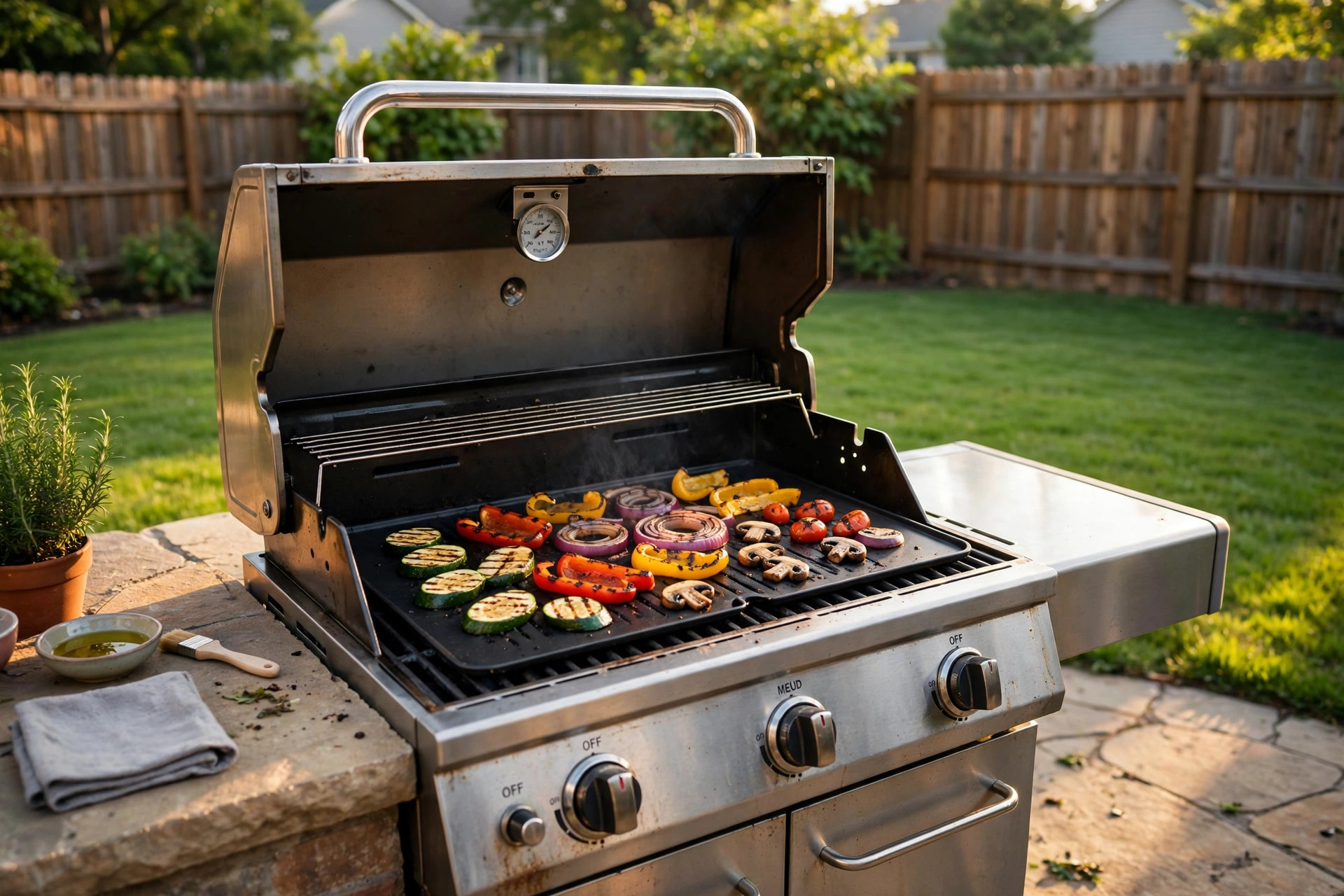

A gas grill is a fine tool, but it has a few small flaws. Small foods fall through the grates. Fish sticks and tears. Sauces drip down and cause flare-ups. The best grill mats for gas grills solve these problems for very little money. A mat is a thin sheet, usually coated fiberglass, that lies on the grate and gives you a smooth cooking surface. Heat passes through. Fat drains away. Food does not stick. This guide explains why grill mats matter, what to look for, what kinds you can buy, what they cost, and how to use them in safety.
Why Grill Mats Matter on a Gas Grill
A gas grill heats with open flame under metal grates. The grates are far apart. Anything small, soft, or thin falls through. Shrimp, sliced peppers, fish fillets, and bacon all suffer. A grill mat closes the gaps. It turns your grate into a flat top, much like a griddle. You can cook small items with no basket and no worry.
A mat also cuts down on flare-ups. Fat drips off food and hits the flame. The flame jumps up and chars the outside of the food while the inside stays raw. A mat catches most of the dripping fat before it reaches the burner. Grease still finds its way around the edges, but the burst of flame is smaller and less frequent. Your food cooks in a more even heat.
Many cooks also find that a mat keeps the grill cleaner. Sauces, cheese, and marinade stay on the mat instead of baking onto the grates. You lift the mat out when you finish, and the grates need only a quick brush. If you own a smaller grill, like those covered in our best grill for condo balcony reviews, a mat makes the small cooking area far more useful.
Another quiet benefit is flavor control. Some cooks like a strong sear from bare grates. Others want gentle, even cooking for delicate foods. A mat lets you do both on the same grill. Leave part of the grate bare for steaks. Cover part of it with a mat for vegetables and fish. You get two cooking zones without buying any new gear.
What to Look for When You Choose a Grill Mat: Best Grill Mats for Gas Grills
Not every mat suits a gas grill. The first thing to check is the heat rating. Gas grills run hot. A burner on high can push the grate past 500 degrees Fahrenheit. The best grill mats for gas grills are rated to 500 or even 600 degrees. A mat with a lower rating will warp, smell, or break down. Check the label before you buy, and read our guide to gas grill flare up causes and fixes to see how heat control ties in.
The second thing is thickness. Most mats are about as thick as a business card. Thin mats pass heat well and give a better sear. Thick mats last longer and stand up to heavy use. A middle thickness of about 0.2 millimeters is a good balance for most cooks. Very thin mats curl at the edges. Very thick mats may not fit under a closed lid.
Size comes next. Mats usually come in sets of two or three, each about 13 by 15 inches or 16 by 13 inches. Measure your cooking grate before you order. A mat that is too small slides around. A mat that is too large hangs off the edge and may catch grease in the wrong place. Many cooks cut their mats with kitchen scissors to fit. Look for mats that say they can be cut to size.
The coating matters most for long-term use. Almost all grill mats use a non-stick coating on a woven fiberglass base. Good mats are PFOA free. They should also say they are safe for food contact. A cheap mat with no clear labeling may use unknown coatings. Spend a little more for a brand that lists its materials plainly. Testers at sources such as Consumer Reports and cooking guides at The Spruce Eats have long stressed the need to know what touches your food.
Finally, look at the edges. Some mats have raised edges or printed guides for portion size. A plain flat mat is fine for most jobs. Textured mats claim better grill marks, but the marks are faint at best. Do not pay extra for features you will not use.
Types of Grill Mats for Gas Grills
There are three common types. The first is the standard flat mat. It is a thin black or copper-colored sheet that lies flat on the grate. It works for nearly every food. Fish, shrimp, vegetables, eggs, and pancakes all cook well on it. Most shoppers end up with this type, and it is the cheapest to replace.
The second type is the mesh mat. It has small holes through the surface. Heat and smoke pass through the holes, so food gets more smoke flavor and a closer feel to open grates. Mesh mats suit smokers and cooks who want some char. A mesh mat does less to stop flare-ups than a solid mat. Cooks who own combo units may read our best grill for smoking and grilling for ideas on how to use both heat styles at once.
The third type is the disposable mat. These are sold in packs and made to be used a few times and thrown away. They suit tailgates, camping trips, and rental houses where you do not want to carry gear home. They cost more per cook than a reusable mat. They are also harder to find in the right size.
Within these types you will see many claims. Some mats say they work on both sides. Some claim to be dishwasher safe. Both claims are usually true for solid mats. Few of these extras change how the food cooks. The heat rating, the size, and the quality of the coating are what count.
Grill brands also sell their own mats. Large makers like Weber, Napoleon, Char-Broil, and Broil King each offer grill accessories sized to their grates. Store brands from home centers can work just as well. The mat does not need to match the grill brand to do its job.
Cost and Price
Grill mats are cheap as grill gear goes. A set of two reusable mats costs between three and fifteen dollars. Most well-reviewed sets sit near the middle of that range. At that price you can afford to replace them each season.
Disposable mats cost more per use. A pack of ten may run eight to twelve dollars. If you grill every week, reusables pay for themselves in a month.
Beware of very cheap sets that come with no heat rating and no list of materials. They may last only a few cooks. A mat that curls or flakes is not a bargain. It is a hazard. Buy from a seller you know. Large home stores carry house brands that list full specs on the box.
Replacement timing is simple. When the coating starts to peel, chip, or flake, throw the mat away. Do not keep using it. A damaged mat will not stay non-stick, and loose coating does not belong in food. Most mats last one to two grilling seasons with regular use and proper care.
Care and Upkeep
Care is easy. Let the mat cool a little after cooking. Wipe it with a damp cloth or a soft sponge and a little dish soap. Do not use metal tools on it. Metal scrapers and wire brushes will cut the coating. Use wood or silicone tools instead.
Most solid mats are safe in the dishwasher. Place them flat on the top rack. Do not fold them. Folding can crease the coating and shorten the life of the mat. Hand washing is gentler and takes only a minute.
Store mats flat or rolled loosely. Do not stack heavy items on them. A sharp fold left in place for months will leave a line where the coating may crack. Some cooks keep the box the mats came in and slide them back inside for storage.
Clean your grill grates as well. A mat does not mean the grates never need care. Grease still runs off the edge of the mat onto the grate and into the drip tray. Brush the grates after each cook. Empty the drip tray before it overflows. A clean grill is a safe grill, and it keeps flare-ups down whether you use a mat or not. Our piece on charcoal grill ash disposal tips covers the same clean-as-you-go habit for another grill type.
Watch for grease buildup on the mat itself. A thick layer of old grease can smoke and catch fire. If a mat is dark and sticky after a normal wash, it is time to replace it.
Safety
Grill mats are safe when used as directed. The main rules are simple. Keep the mat below its rated temperature. Do not place a mat directly over an open burner with the lid closed on high for a long time. Gas grills can get hotter than you think. If you sear steaks at full heat, use bare grates and leave the mat for cooler cooks.
Do not use a mat that is damaged. Peeling, cracking, or flaking means the mat is done. Throw it away and buy a new one. Never cut a mat into small pieces and leave the scraps near the burner.
Keep the mat away from grease fires. If a fire starts, turn off the gas and close the lid. Do not use water on a grease fire. A mat will not stop a fire that is already burning. It only reduces the chance that one starts.
Store unused mats away from heat. Do not leave a spare mat on the warming rack while you cook at high heat. The rack gets hot enough to damage a mat even when food is not on it.
One more note on safety and health. Buy mats labeled PFOA free. The coating industry moved away from PFOA years ago. A clear label is a good sign. If a seller will not say what is in the coating, buy from one that will. Barbecue experts at AmazingRibs and pellet grill makers like Traeger both advise cooks to know their gear and read labels before food touches it.
Frequently Asked Questions
Can I use a grill mat on a gas grill?
Yes. Gas grills are the most common place to use them. Lay the mat flat on the grate after the grill is hot. The heat passes through the mat and cooks the food. Do not let the mat hang over the edge of the grate where it could drip grease onto the burner.
Do grill mats leave grill marks?
A solid mat does not leave strong grill marks. It cooks more like a flat pan. Mesh mats leave faint marks. If grill marks matter to you, sear the food on bare grates first and finish it on the mat.
Are grill mats safe at high heat?
They are safe up to the rating printed on the box. Most good mats are rated to 500 degrees Fahrenheit. Do not exceed that number. For very high heat searing, skip the mat and use the bare grate.
How long does a grill mat last?
Most mats last one to two grilling seasons with normal use. Wash by hand, avoid metal tools, and store the mat flat. Replace it as soon as the coating peels or flakes.
Can I cut a grill mat to fit my grill?
Yes, if the maker says so. Most mats cut easily with kitchen scissors. Measure the grate first. Cut the mat a little small so it does not touch the sides of the grill. Wear gloves if the edge feels sharp.
Do grill mats change the flavor of food?
They change it a little. Less smoke reaches the food, so you get less char flavor. In exchange you get more even cooking and less risk of burning. Many cooks use a mat for half the food and bare grates for the rest. Makers such as Big Green Egg note the same trade-off between even heat and direct flame in their own guides.
A Short Final Word
The best grill mats for gas grills are a small buy with a large payoff. They keep small foods on the grill. They cut flare-ups. They make cleanup fast. Pick a mat rated to at least 500 degrees, sized to your grate, and free of PFOA. Wash it by hand, store it flat, and replace it when it wears out. Do this and your gas grill will cook more kinds of food with less fuss for years to come.
References
AmazingRibs.com. (n.d.). Barbecue and grilling science. https://www.amazingribs.com Big Green Egg. (n.d.). Kamado grills and outdoor cooking. https://www.biggreenegg.com Broil King. (n.d.). Gas and charcoal grills. https://www.broilkingbbq.com Char-Broil. (n.d.). Gas and charcoal grills. https://www.charbroil.com Consumer Reports. (n.d.). Product reviews and ratings. https://www.consumerreports.org Napoleon. (n.d.). Fireplaces, grills, and heating products. https://www.napoleon.com The Spruce Eats. (n.d.). Recipes and cooking guides. https://www.thespruceeats.com Traeger. (n.d.). Wood pellet grills. https://www.traeger.com Weber. (n.d.). Grills and outdoor cooking. https://www.weber.com
Was this guide helpful?

About Michael Thompson
The My Garden US editorial team writes practical, in-depth home and garden guides for American homeowners — tested advice, no fluff.
You May Also Like

How to Smoke Duck on Pellet Grill: A Complete Guide
February 17, 2026 0 views
How to Smoke Beef Ribs on Grill: A Plain Guide to Tender Ribs
February 6, 2026 0 views
The Best BBQ for Thanksgiving Turkey Outdoors: A Complete Guide
March 13, 2026 0 views