The best garden hose reel cart reviews do more than rank products. They save you from buying a cart that leaks, tips over, or rusts after a single season. A hose is one of the hardest-working tools in the yard. It drags across gravel, bakes in the sun, and gets wound and unwound a hundred times a year. A good reel cart takes the punishment so the hose does not have to.
Many gardeners treat the reel cart as an afterthought. They spend good money on a quality hose, then hang it on a cheap hook or leave it in a heap by the spigot. The hose kinks, cracks, and needs replacing within two years. A reel cart costs about as much as a new hose and can double the life of the one you already own.
This guide walks through the best garden hose reel cart reviews so you can shop with confidence. You will learn why these carts matter, what features to compare, which types suit which yards, what prices to expect, and how to care for your cart.
Why a Hose Reel Cart Matters
A hose left on the ground is a hose in danger. Sunlight breaks down rubber and vinyl. Kinks weaken the walls of the hose until they split. Water sitting inside the coils in freezing weather will freeze and burst the hose from within. Even the act of dragging a hose across concrete wears the outer jacket thin. A reel cart solves all of these problems at once.
Wound neatly on a reel, a hose is protected from the sun. The even coils prevent kinks. Draining the hose at the end of the season becomes a simple task instead of a wrestling match. The cart raises the hose off the ground, away from mud, mulch, and mower blades. Garden suppliers such as Gardener’s Supply list hose storage among the simplest ways to extend the life of watering gear.
Mobility is the second advantage. A wall-mounted reel only reaches what the hose can reach from one spot. A cart rolls to the front flower bed, then to the back vegetable patch, then to the driveway when the car needs washing. That is why buyers looking for the best garden hose for large yards so often pair it with a reel cart instead of a fixed mount.
There is also a plain safety argument. A loose hose on a walkway is a trip hazard, and children and older visitors are most at risk. A wound and parked cart sits out of the way and removes a real hazard from paths and patios.
How to Choose the Right Hose Reel Cart: Best Garden Hose Reel Cart Reviews
Capacity
Capacity is the first number to check. It tells you how many feet of hose the reel can hold, and at which hose diameter. A cart rated for 175 feet of 5/8-inch hose may only hold 125 feet of a heavier 3/4-inch hose. Match the cart to your hose, and if you are between sizes, buy up. A reel that is overfilled is hard to wind and strains the frame.
Materials and Build
Most reel carts are made from painted steel, aluminum, or heavy plastic. Painted steel is strong but must be powder-coated or galvanized to resist rust. Check reviews for notes about paint chipping at the joints, because bare steel rusts quickly once exposed. Aluminum carts are light and rust-proof, though they cost more. Heavy-duty plastic resists corrosion well but can crack in cold weather, so look for UV-stabilized resin.
The crank handle deserves attention. It is the part you touch every time you use the cart. Metal handles last longer than plastic ones, a point that tool makers like Corona Tools stress across their garden tool lines. A smooth-winding drum with a geared crank makes rewinding a long hose far less tiring than a direct-drive handle.
Wheels and Mobility
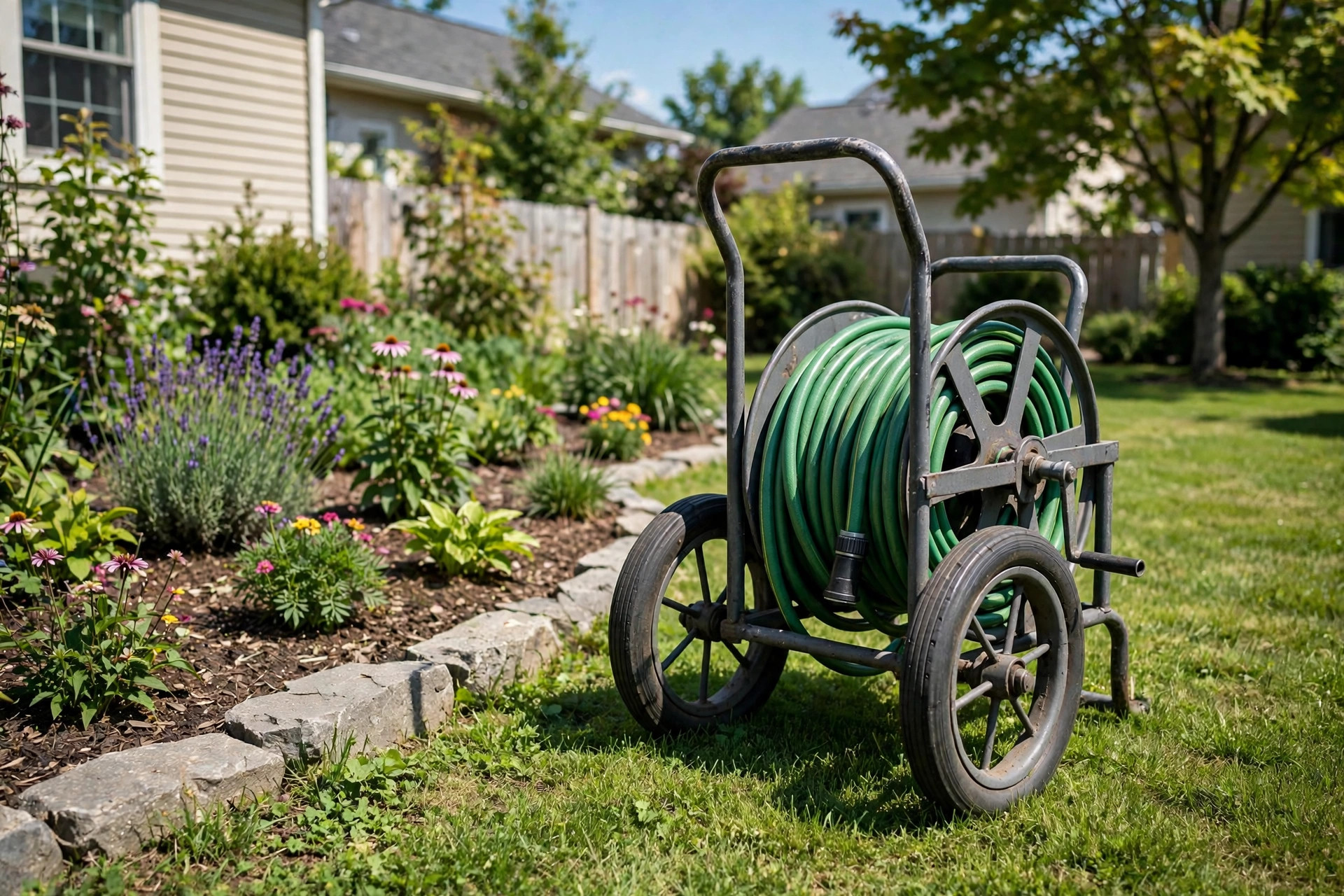
Wheels are what separate a good cart from a frustrating one. Look for large wheels, ideally ten inches or more. Large wheels roll over garden edging, tree roots, and rough ground without tipping. Wide rubber tires grip better than narrow plastic ones, and a low center of gravity helps too.
The connection between the cart and the spigot is another weak point on cheap models. Many carts include a short leader hose that runs from the spigot to the reel. A kink-free leader hose with solid brass fittings will outlast a thin plastic one by years.
Types of Hose Reel Carts
The best garden hose reel cart reviews usually sort products into a few clear types. Knowing the types helps you ignore models that were never meant for your yard.
The two-wheel utility cart is the most common. It looks like a small hand truck with a reel mounted between the handles. These are stable, simple, and affordable. They suit medium to large yards and hold 150 to 200 feet of standard hose.
The four-wheel wagon style has a platform base and steers more like a cart. It is the most stable option on slopes and rough ground, and it is easier for older gardeners to pull since there is no need to tilt it back onto two wheels.
High-wheel carts use oversized wheels, sometimes with pneumatic tires. They are built for large properties and anyone who crosses gravel or uneven ground regularly. They cost more, but reviewers consistently praise how little effort they take to move.
Compact carts are lighter and hold less hose, usually 100 feet or less. They suit small yards, townhomes, and patios, and they are easier to store. If your yard is small, do not buy capacity you will never use. A half-empty reel winds poorly and wobbles.
Finally, there are retractable models that wind the hose back with a spring. They are usually wall-mounted rather than cart-mounted, but a few portable versions exist. They cost more and hold less hose, but they are the easiest option for people who hate hand-cranking.
What the Best Garden Hose Reel Cart Reviews Tell Us
Reading the best garden hose reel cart reviews side by side reveals patterns. The same praises and the same complaints repeat across brands and price levels. Those patterns are more useful than any single five-star rating.
Leakage at the fittings is the most common complaint. The joint where the leader hose meets the reel swivel is under constant water pressure when the spigot is open. Cheap plastic swivels drip, spray, or fail outright. Reviewers consistently rate carts higher when the swivel and fittings are brass, which resists corrosion and holds a seal far longer than plastic.
Assembly quality is the second theme. Many carts ship flat and need assembly at home. The best-reviewed models use clear instructions and standard bolts. The worst use vague diagrams and cheap hardware that strips on first tightening. If several reviews call assembly difficult, believe them.
Durability after a full season matters more than first impressions. A cart can look sturdy in the box and still rust by autumn. The most trusted review sources test products over months. Independent testing organizations such as Consumer Reports are valued precisely because they run long-term tests rather than unboxing impressions. Retailers like Lowe’s and The Home Depot host thousands of owner reviews that reveal how a cart holds up after a winter in the garage.
Winding smoothness is the last big theme. A cart that fights you every time you wind the hose will not get used. Smooth drums, good bearings, and a comfortable crank make the difference between a tool you reach for and one you abandon.
When you compare reviews, weight them sensibly. A single angry review about shipping damage tells you nothing about the product. Ten reviews mentioning the same leaking fitting tell you a great deal. Guides from The Spruce and Bob Vila are useful because their editors combine many owner reports with their own testing.
Cost and Price
Hose reel carts span a wide price range. Compact plastic models start around thirty to forty dollars. Mid-range steel two-wheel carts usually run fifty to ninety dollars. Heavy-duty aluminum or four-wheel wagon carts can reach one hundred twenty to two hundred dollars or more.
Price tracks materials and capacity more than brand name. A fifty-dollar cart and a ninety-dollar cart may look similar in a photo, but the difference usually lies in the fittings, the bearings, and the thickness of the frame. Brass fittings alone can add ten to twenty dollars to the cost, and reviewers say they are worth it.
Think of the purchase in terms of hose replacement. A good hose costs forty to sixty dollars. If a reel cart extends your hose life by even one extra season, the mid-range cart has paid for itself. Buyers on a tight budget should aim for the middle of the range rather than the very bottom.
Watch for hidden costs. Some carts do not include the leader hose. Some require brass quick-connect fittings bought separately. A nozzle is rarely included, so plan to pair your cart with a quality garden hose nozzle with multiple settings for full control over spray patterns.
Care and Upkeep
A hose reel cart asks for little maintenance, but the little it asks for matters. At the end of the watering season, drain the hose fully and store the cart under cover, in a shed, garage, or under a fitted cover. The goal is to keep standing water out of the fittings and winter sun off the tires and plastic parts.
Once a year, check the bolts and tighten anything that has loosened. Moving carts vibrate their hardware loose over time. A drop of oil on the crank bearings and the swivel joint keeps winding smooth. If your cart has pneumatic tires, check the pressure in spring.
Inspect the leader hose each spring. It lives a hard life, bent at sharp angles near the spigot. Replace it at the first sign of cracking or bulging, because a failed leader hose can flood a foundation planting overnight.
If the frame is painted steel, touch up chips promptly. Sand the spot, apply a rust-inhibiting primer, and cover it with exterior paint, a repair covered well in the Family Handyman maintenance guides. A small spot of rust is easy to stop early and costly to ignore.
Safety
Safety advice for a hose reel cart is mostly common sense. Never leave the spigot fully open when the cart is not in use. Constant pressure strains the swivel and the leader hose, and a burst fitting can waste hundreds of gallons while you are away. Open the spigot only when you are watering.
Pull the hose straight off the reel rather than sideways. Sideways pulling tips carts and strains the frame. Teach children not to climb on the cart or swing on the hose, since a loaded cart is heavy enough to hurt a small child if it tips.
Store the cart where it will not roll. Set the wheels against a wall or use a wheel chock on a slope. In regions with hard freezes, drain the hose completely before the first frost. Frozen water expands and can split fittings and hose walls alike.
Frequently Asked Questions
How much hose can a typical reel cart hold? Most two-wheel carts hold 150 to 200 feet of 5/8-inch hose. Compact carts hold 100 feet or less. Always check the rating for your exact hose diameter, because a thicker hose takes up more room on the drum.
Do hose reel carts leak? Cheap ones often do, usually at the swivel where the leader hose meets the reel. Models with brass fittings and a quality swivel seal leak far less. Reading owner reviews for the word “leak” before buying is a fast way to spot trouble.
Can I leave my hose reel cart outside all winter? It is better not to. Drain the hose fully and store the cart under cover. Freezing water can split hoses and fittings, and winter weather wears down tires, plastic parts, and paint.
Are metal or plastic reel carts better? Both work when they are well made. Powder-coated steel and aluminum are strong if the coating stays intact. Heavy UV-stabilized plastic resists rust entirely but can crack in extreme cold. Reviewers tend to favor metal frames with brass fittings for the longest service life.
What size wheels should I look for? Ten-inch wheels or larger roll over lawns and garden paths with the least effort. Small wheels dig into soft ground and catch on edging. For rough or sloped ground, look for wide rubber or pneumatic tires.
Is a reel cart better than a wall-mounted reel? It depends on your yard. A cart wins for large yards, multiple watering zones, and renters who cannot mount hardware. A wall mount wins for small yards where the hose always starts at the same spigot.
A Final Word
The best garden hose reel cart reviews all point to the same conclusion. Buy for the fittings, not the paint. Brass beats plastic. Big wheels beat small ones. Capacity should match your hose with room to spare.
Do not rush the purchase. Read the long-term reviews. Check what Fiskars and other established tool makers say about frame materials, and compare seasonal watering guides from Burpee. The hour you spend reading now is repaid every time you wind the hose without a fight and find it dry, kink-free, and ready for the next dry spell.
References
Bob Vila. (n.d.). Home improvement advice. https://www.bobvila.com Burpee. (n.d.). Seeds, plants, and gardening supplies. https://www.burpee.com Consumer Reports. (n.d.). Product reviews and ratings. https://www.consumerreports.org Corona Tools. (n.d.). Garden and landscape tools. https://www.corona-tools.com Family Handyman. (n.d.). DIY home repair and maintenance. https://www.familyhandyman.com Fiskars. (n.d.). Garden and cutting tools. https://www.fiskars.com Gardener’s Supply Company. (n.d.). Gardening tools and supplies. https://www.gardeners.com Lowe’s. (n.d.). Home improvement products. https://www.lowes.com The Home Depot. (n.d.). Home improvement products. https://www.homedepot.com The Spruce. (n.d.). Home and garden advice. https://www.thespruce.com
Was this guide helpful?

About Michael Thompson
The My Garden US editorial team writes practical, in-depth home and garden guides for American homeowners — tested advice, no fluff.