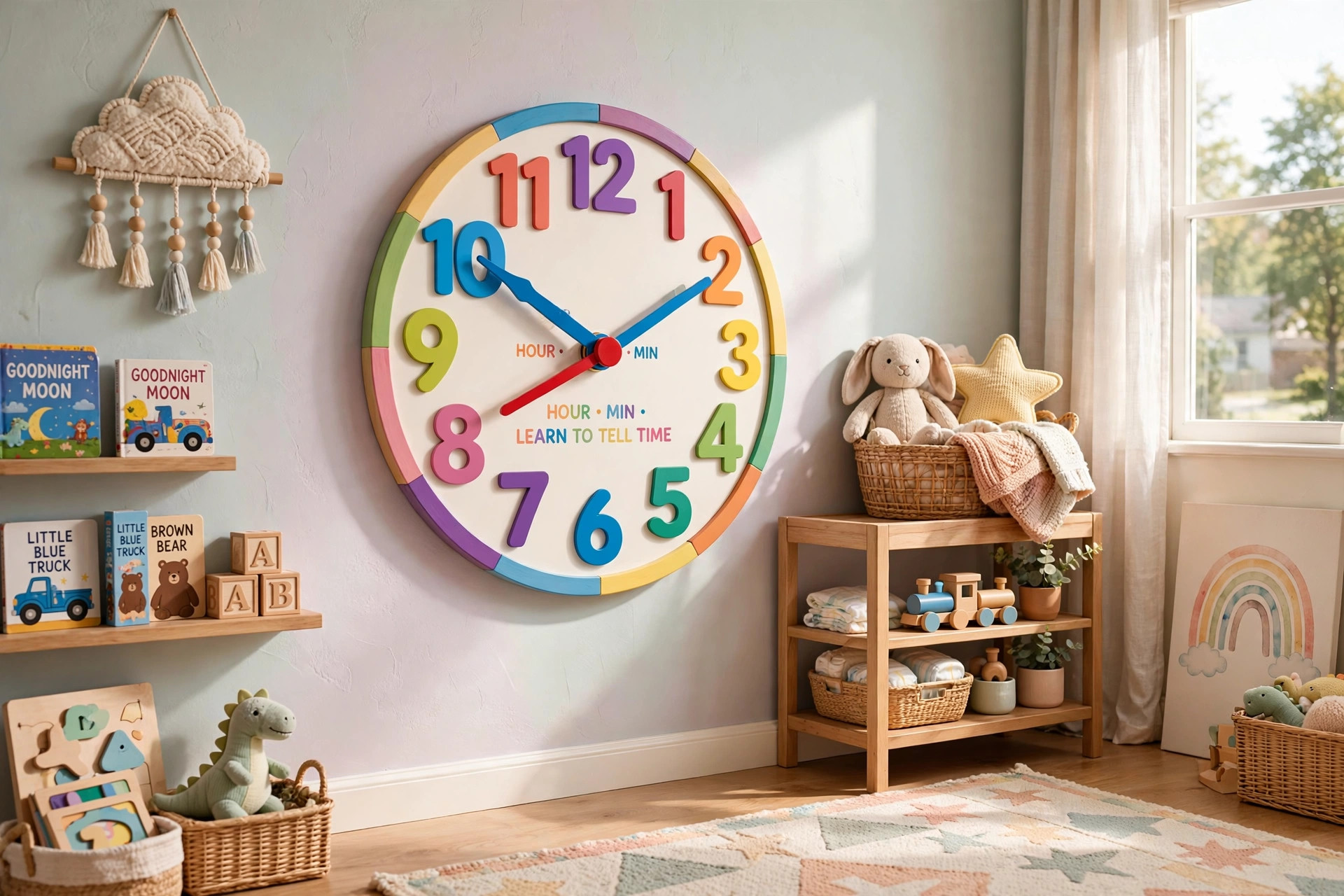

A kids wall clock for learning time decor is one of the simplest tools a parent can buy. It sits on the wall, bright and friendly, and it teaches one of the hardest lessons of early childhood: how to read time. Children who see a teaching clock every day learn the hours faster. They begin to count the minutes. They gain a sense of how long an activity takes. A learning clock is decor, but it is also a teacher that never sleeps.
Most parents wait too long to hang a teaching clock. They assume the child is too young. In truth, a child of three or four can start to learn. At that age the child does not need to read the minutes. The child only needs to watch the big hand and the small hand move. Over the months, the meaning grows. By five or six, many children can read a full analog clock with some help. The clock on the wall makes that growth natural. It is part of the room. The child looks at it a hundred times a day without thinking. Each glance is a small lesson.
Why It Matters
Time is an abstract idea for a young child. It cannot be touched. It cannot be held. A digital clock shows numbers, but the numbers do not show the idea. An analog clock shows the idea itself. The face is a circle. The hands move through space. The child sees that five o’clock sits in one place and that bedtime sits in another. Distance on the clock face becomes distance in time. That picture in the mind lasts for life.
A kids wall clock for learning time decor also brings calm to the home. Children who understand time fight less about routines. When the child can see that the short hand is near the seven, the child knows that supper is close. The parent does not need to repeat warnings. The clock does the warning. Morning routines run smoother. Bedtime runs smoother. The whole day runs on a shared picture.
There is another reason. Schools still teach the analog clock. Standardized tests still include clock faces. Children who learned at home enter school with an advantage. The teacher draws a clock on the board, and the child already knows it. That early confidence in math class carries into other subjects.
How to Choose the Right Learning Clock: Kids Wall Clock for Learning Time Decor
Not every cute clock teaches well. Many children’s clocks look sweet but fail as tools. The numbers are too small. The marks are confusing. The hands are hard to tell apart. A parent must shop with the teaching purpose in mind.
Clear Numbers and Marks
The first rule is clarity. Every number from 1 to 12 should be large and easy to read. The best learning clocks add the minutes too: small numbers like 05, 10, 15, 20, 25, 30, 35, 40, 45, 50, 55, and 60 printed next to each hour mark. This double numbering is the single most useful feature on a teaching clock. The child sees that 5 means both five o’clock and twenty-five minutes. That connection is the heart of time telling.
The face should not be crowded with pictures that cover the numbers. A few friendly images near the center are fine. A busy design that hides the marks is not fine. Simple wins.
Distinct Hands
The hour hand and the minute hand must look different. Good learning clocks use color. The hour hand may be short and blue. The minute hand may be long and red. Some add a third hand for seconds in another color. The child learns fast when the hands are easy to name: the blue one is the hour, the red one is the minute.
The hands should also move in the proper steps. A clock that jumps the minute hand each minute is fine. A silent sweeping movement is fine too, though some children learn better with the gentle jump of a quartz movement. The clock must keep accurate time. Test it against your phone for a few days after you hang it.
The Right Size
Size matters in a nursery or a child’s bedroom. A clock with a diameter of ten to fourteen inches works well for most rooms. It is big enough to read from the bed or the door, but not so big that it overwhelms the wall. Measure the wall space before you buy. A very large clock can look fine on a long empty wall, but on a small wall it crowds the room.
Silent or Quiet Movement
Noise matters. Many cheap wall clocks tick loudly. In a child’s bedroom, a loud tick can disturb sleep. Look for a clock that is advertised as silent or quiet. Quartz movements are usually quiet. If the product page does not mention noise, read the reviews. Parents often mention ticking in reviews, so the information is there.
Hanging Height and Position
Hang the clock at the child’s eye level or a little above it. A clock near the ceiling is decor only; the child cannot use it. Place it where the child spends time: near the bed, above the desk, or by the door. Avoid walls that get direct sun all day, because glare can hide the face.
Matching the Room
The clock should fit the room’s colors. A bright clock can be the accent piece on a soft wall. A pastel clock can blend with a calm nursery. Many parents pair the clock with other wall pieces, such as removable kids bedroom wall decals or a framed nursery wall art set. The teaching clock becomes part of a wall that tells a story.
Types of Learning Clocks
Makers offer several styles of kids wall clock for learning time decor. Each style has its strengths.
Number-and-minute clocks. These show the hours 1 to 12 plus the minute numbers around the rim. They are the classic choice and the easiest for beginners. Most parents start here.
Color-section clocks. These divide the face into colored sections. The hours may sit in blue while the minutes sit in green. The color coding helps the child separate the two jobs of the hands. They suit visual learners.
Theme clocks. These build the lesson around a favorite subject: space, animals, dinosaurs, or fairy tales. The numbers stay clear, but the center art delights the child. A space-themed clock can spark interest in a child who loves stars. Theme clocks work when the numbers remain large and readable.
Chalkboard or dry-erase clocks. Some clocks come with a writable face or a small board beside the clock. The parent or child can write the time next to the hands. These turn practice into a game. They suit older children, ages six to nine, who are learning the fine details.
Wood and natural clocks. A newer style uses light wood, soft colors, and simple shapes. These fit calm, modern nurseries. They teach just as well when the numbers are clear. Retailers such as IKEA and Wayfair carry many styles in this range.
Activity clocks. These pair a clock with a chart of daily routines: wake time, school time, play time, bedtime. The child matches the hands to the pictures. They are excellent for children who resist routines, because the clock explains the schedule without the parent nagging.
Cost and Price
Learning clocks cost little. Most good ones sell for between ten and thirty dollars. Basic plastic models with minute numbers cost around ten to fifteen dollars. Sturdier wood or themed models run twenty to thirty dollars. Premium designs from children’s decor brands can reach forty to fifty dollars, though price does not always mean better teaching.
The budget shopper can find fine options at large retailers like Walmart and Target. Handmade or personalized clocks sell on marketplaces such as Etsy, and craft shops like Michaels carry kits that let families paint their own clock face together.
Do not pay for extra features the child does not need. A built-in thermometer or a radio adds cost and clutter. The money should go to a clear face, strong hands, and quiet movement. One good clock beats three pretty ones.
Care and Upkeep
A wall clock needs little care. Wipe the face with a dry cloth every few weeks. Dust dulls the numbers and makes them harder to read. Change the battery when the hands slow or stop. A standard AA battery lasts a year or more in most quartz clocks.
Check accuracy every few months. Compare the wall clock with your phone. If it runs fast or slow by more than a minute, replace the battery first. If the error remains, replace the clock. A teaching clock that shows the wrong time teaches the wrong lesson.
Inspect the clock once a year. Make sure the hands are tight and the glass or plastic cover is clean and unbroken. A loose hand can slip and confuse the child.
Teaching Your Child to Read the Clock
The clock works best when parents teach in small steps. Start with the hours. Point to the short hand and say, “The short hand tells the hour.” Practice at real moments: “Look, the short hand is near the seven. It is almost supper time.” After a few weeks, add the minutes. Point to the long hand and count by fives around the rim. The minute numbers printed on the face make this easy.
Make it a game. Ask, “Can you find the time for lunch?” Move the hands yourself at first, then let the child move them. Many parents ask the child to set the clock to bedtime each night. The child moves the hands, reads the time, and feels proud. Guides from HealthyChildren note that short, playful practice sessions beat long drills for young learners.
Link the clock to the day’s events. Say, “When the long hand points up, we brush teeth.” The child learns that the clock is not a school subject but a part of life. Advice columns on What to Expect suggest matching lessons to the child’s own routine, since real stakes hold attention better than worksheets.
Be patient. Some children learn in weeks. Others take months. Never scold a wrong answer. Praise the try and show the right reading with a smile.
Safety
A children’s clock must be safe. Choose a light clock that cannot hurt the child if it falls. Hang it with a strong hook or a proper wall anchor, not a weak nail. The clock should sit flat against the wall so little hands cannot rock it loose.
Check that small parts cannot break off. Very young children may pull at the hands or the cover. A sturdy one-piece case is best. Avoid clocks with tiny loose pieces that a toddler could swallow.
The U.S. Consumer Product Safety Commission sets standards for children’s products, and its site at CPSC lists recalls and safety guidance for nursery items. It is wise to check for recalls when buying any product for a child’s room, including a clock.
Keep cords out of reach if the clock needs power. Most learning clocks run on batteries, which is the safest choice. If the clock uses a cord, run it behind furniture where the child cannot reach it.
Frequently Asked Questions
What age is right for a learning clock? Most children are ready between ages three and five. A three-year-old can watch the hands move and learn the idea of morning and night. A five-year-old can start reading hours and half hours. There is no need to rush; the clock on the wall keeps teaching every day.
Should I buy an analog or a digital clock for teaching? Buy analog. A digital clock shows numbers but hides the meaning of time. An analog face shows the circle, the movement, and the spacing of the hours. Children learn the concept faster with analog. You can add a digital clock later, once the child reads analog with ease.
Where should I hang the clock in the nursery? Hang it where the child can see it from the bed or the play area, at or just above the child’s eye level. Avoid hanging it above the crib, where a falling object could land on the baby. A wall by the door or beside the changing area works well.
Can a learning clock fit an older child’s room too? Yes. Simple designs suit teens and tweens. A clean wood clock with minute numbers looks grown up while still teaching. Pair it with other wall pieces, such as a large peel-and-stick nursery wall mural, to keep the room feeling fresh as the child grows.
How do I clean the clock without damage? Use a dry, soft cloth on the face. For the case, a cloth dampened with water is enough. Never spray cleaner directly on the face. Keep water away from the battery compartment and the movement at the back.
My child keeps spinning the hands. Is that a problem? No. Curiosity is good. Let the child explore. Then show how the hands move on their own and how to read them. Many parents find that a clock the child can touch teaches faster than one kept behind glass, as long as the child learns to read it gently.
A Short Final Word
A kids wall clock for learning time decor costs little and gives much. It teaches a life skill. It calms the day. It decorates the wall with purpose. Choose one with clear numbers, colored hands, and quiet movement. Hang it where your child can see it. Then take it slow and make the lessons playful. Reviews and decor ideas on The Spruce and children’s collections at Pottery Barn Kids can help you pick a style that fits your home. The child will look up at that clock a thousand times. Each look is a step toward knowing time, and knowing time is a step toward growing up.
References
American Academy of Pediatrics. (n.d.). HealthyChildren.org. https://www.healthychildren.org Etsy. (n.d.). Handmade and craft marketplace. https://www.etsy.com IKEA. (n.d.). Home furnishings. https://www.ikea.com Michaels. (n.d.). Arts and crafts supplies. https://www.michaels.com Pottery Barn Kids. (n.d.). Kids furniture and decor. https://www.potterybarnkids.com Target. (n.d.). Retail store. https://www.target.com The Spruce. (n.d.). Home and garden advice. https://www.thespruce.com U.S. Consumer Product Safety Commission. (n.d.). Product safety information. https://www.cpsc.gov Walmart. (n.d.). Everyday low prices. https://www.walmart.com Wayfair. (n.d.). Furniture and home goods. https://www.wayfair.com What to Expect. (n.d.). Pregnancy and parenting guidance. https://www.whattoexpect.com
Was this guide helpful?

About Michael Thompson
The My Garden US editorial team writes practical, in-depth home and garden guides for American homeowners — tested advice, no fluff.
You May Also Like
Kids Loft Bed With Slide for Fun Bedroom: A Parent’s Guide
August 3, 2026 0 views
A Toddler Duvet Insert for Small Bed Comfort: What Parents Should Know
June 26, 2026 0 views
Kids Bedroom Wall Decals Removable for Renters
March 20, 2026 0 views