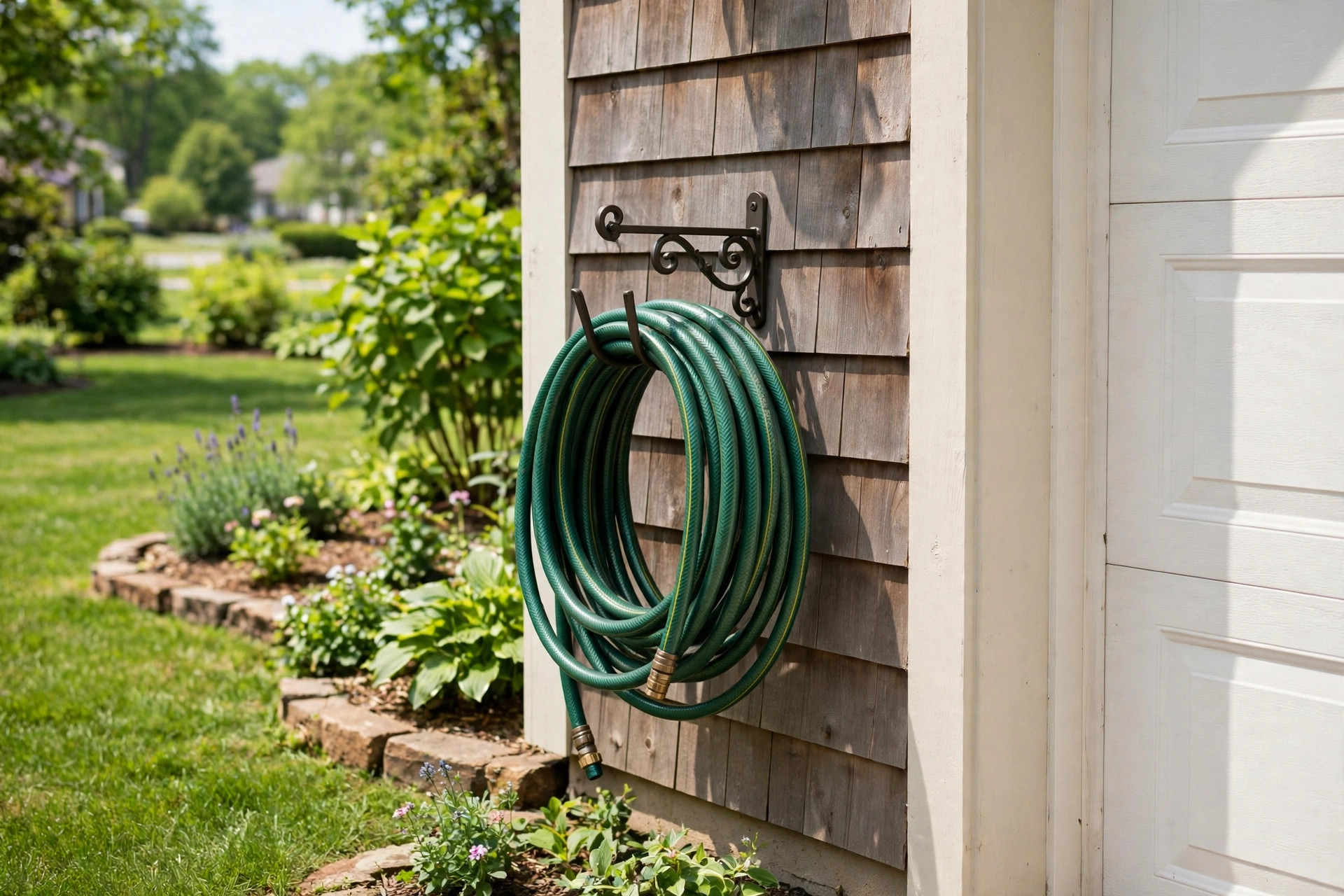
A hose that lies loose on the ground causes trouble. It trips people. It cracks in the sun. It kinks and leaks. The best garden hose hanger for wall use solves all of these problems at once. It lifts the hose off the ground, keeps it in a neat coil, and puts it within easy reach of the spigot. This guide explains what makes a good wall hanger, which types are sold, what they cost, and how to keep them in good shape for many years.
Why It Matters
A garden hose is one of the hardest-working tools in the yard. Yet many owners treat it as an afterthought and drop it in a heap by the faucet. That habit shortens the life of the hose and turns a simple task into a chore.
A coil left on bare soil sits in damp ground, which invites mildew and rot on the hose cover. Sunlight is worse. Long hours of direct sun break down rubber and vinyl. The hose grows stiff, the cover cracks, and small leaks start at the bends. A good hanger ends this cycle. It holds the coil off the ground and against a wall, often in the shade of the house, so air moves around the loops and the hose dries between uses.
There is also the matter of safety. A loose hose across a walkway is a trip hazard, easy to miss in the evening. Wall storage takes the hose out of the path entirely, and the yard looks neater as well.
Good storage also saves time. A hung hose unwinds in a smooth pull. There are no knots to fight and no tangles to pull apart. When the work is done, the hose goes back up in less than a minute. Over a full season, that saved time adds up to hours. Pairing a wall hanger with the right hose makes the job even easier. A guide to the best garden hose for large yards can help you match hose length and weight to your property.
What to Look for When You Choose: Best Garden Hose Hanger for Wall
Strength and Capacity
The first thing to check is how much weight the hanger can hold. A 50-foot rubber hose filled with a little water can weigh 20 pounds or more. A 100-foot hose is heavier still. The hanger must carry that load day after day without bending or pulling out of the wall. Look for a stated weight limit on the package. If no limit is printed, treat that as a warning sign. Cast metal hangers usually hold the most. Thin wire hangers hold the least.
Material
Metal hangers made of cast iron, steel, or bronze last the longest. They stand up to sun and rain without breaking down. Powder-coated steel resists rust. Cast aluminum is lighter and will not rust at all. Plastic and resin hangers are cheaper and will never rust, but they can turn brittle after years in strong sun. Choose the material that fits your climate. In hot, sunny regions, metal holds up better than cheap plastic.
Mounting Hardware
A wall hanger is only as strong as its mounting. The box should include screws or bolts rated for outdoor use. Stainless steel or coated screws resist rust. Wood siding and fence posts need long wood screws that bite deep into solid material. Brick, block, and concrete need masonry anchors. If the kit does not include anchors for your wall type, buy them before you start. A good mounting point, with solid fasteners, is the difference between a hanger that lasts ten years and one that fails in one season. Project sites such as Family Handyman offer clear advice on choosing anchors for masonry walls.
Size of the Coil Space
Check the depth of the hanger from the wall and the width of the support. The coil of hose must fit without squeezing. A hanger made for a 50-foot hose will strain under a 100-foot hose. Measure the loop of your coiled hose before you shop. The hanger should hold the full coil with a little room to spare. A tight fit makes the hose hard to lift off and hard to put back.
Drainage and Shape
Water collects in the bottom loop of a stored hose. A hanger with a rounded or sloped support lets water run off instead of pooling. Sharp edges are another thing to avoid. A hard corner can cut into the hose cover over time. Smooth, rounded supports protect the hose and make it easy to slide the loops on and off.
Types and Options
Simple Loop and Hook Hangers
The simplest design is a single loop or hook that screws into the wall. You coil the hose by hand and drop the loops over the hook. These cost the least and install in minutes. They work well for short, light hoses. For heavy hoses they are less ideal, because all the weight rests on one point and the loops can slide together and tangle.
Cradle and Saddle Hangers
A cradle hanger has two or more arms that form a wide saddle. The hose loops rest across the arms in an even coil. The weight spreads over a larger area, so the hose hangs straighter and lasts longer. Most cradle hangers are cast metal and mount with two or more screws. This is the classic choice, and it suits most homes. Retailers such as The Home Depot and Lowe’s carry a wide range of cradle designs in metal and resin.
Decorative Hangers
Some wall hangers are made to look good as well as work well. You can find them shaped like leaves, scrolls, and garden scenes. They are usually cast iron or cast aluminum with a painted finish and cost more than plain designs. The finish matters. A thick powder coat will hold its color, while cheap paint peels within a year or two of sun and rain.
Hose Reels That Mount on the Wall
A hose reel that mounts on the wall has a drum that turns, often with a crank handle. You wind the hose onto the drum and pull it off as you work. Reels keep the coil even and make long hoses easy to handle. They cost more than simple hangers and have moving parts that can wear, but for a very long hose a reel is often the kindest choice. Reviews at Consumer Reports can help you compare reel designs before you buy.
Cost and Price
Wall hangers for garden hoses span a wide price range. A basic wire or plastic hook costs only a few dollars. A simple resin cradle often sells for under twenty dollars. Cast metal cradle hangers usually run from twenty to fifty dollars, depending on size and finish. Decorative cast designs can reach sixty dollars or more. Wall-mounted reels start around thirty dollars for basic hand-crank models and rise past one hundred for heavy-duty or decorative reels. Storage boxes are the most expensive, often between fifty and one hundred fifty dollars.
Price is not the only cost to weigh. A cheap plastic hanger that cracks after two seasons costs more in the long run than a metal hanger that lasts ten. A good hose is worth protecting, so spending a little more on a strong hanger is cheap insurance. Look for sales at the start and end of the growing season, when stores clear stock at lower prices.
Installation Tips
Start by choosing the spot. Pick a place near the outdoor faucet so the hose reaches without stretching. The wall should be solid and in decent repair. Avoid spots where the coil will block a door, a window, or a walkway. Think about sun as well. A north or east facing wall keeps the hose cooler than a wall that bakes in afternoon sun.
Hold the hanger against the wall and mark the screw holes with a pencil. Check that it is level before you drill, and drill pilot holes to keep the wood from splitting. Use the right anchor for masonry. Drive the screws snug, but do not over-tighten them in soft wood. Give the hanger a firm pull to test it before you hang the hose. It should feel rock solid. Step-by-step mounting guidance from Bob Vila and The Spruce can help if this is your first time.
If you use drip lines or soaker hoses in the beds, our guide on how to use soaker hose effectively shows how to store those lines without kinks.
Care and Upkeep
A wall hanger needs little care, but a small amount of attention each year will keep it working well. In spring, check the mounting screws. Winter freeze and thaw can loosen fasteners. Tighten any screw that has worked loose. If a screw spins without biting, pull it out, fill the hole with a wooden dowel or a larger anchor, and set a new screw.
Wash the hanger once a year with soap and water. Dirt and leaf stains come off easily. While you wash it, look for rust on metal hangers. Small rust spots can be sanded and touched up with outdoor metal paint. Catch rust early, because it spreads under the finish and weakens the metal.
Check plastic and resin hangers for cracks and brittleness. Flex a plastic arm gently. If it feels stiff and shows white stress marks at the bend, it is nearing the end of its life. Replace it before it breaks under the weight of a full hose.
Drain the hose before you hang it for the winter. Water left inside can freeze, expand, and split the hose. In cold climates, many owners store the hose indoors for the winter and leave the empty hanger on the wall. Seasonal checklists from Fiskars are a handy reminder of what garden gear needs attention each season.
The hanger can also be part of a larger storage plan. If your shed holds rakes, pruners, and pots, see our garden tool storage ideas for shed for ways to keep every tool in its place.
Safety
Most safety issues with hose hangers come down to mounting and placement. A hanger that pulls out of the wall can drop a heavy coil of hose on someone below. Mount only into solid material. Do not trust old, rotted siding or crumbling mortar. When in doubt, move the hanger to a stronger spot or add a backing board that spreads the load across several studs.
Place the hanger where no one will walk into the coil. A coil that sticks out from the wall at head height on a narrow path is a hazard. Mount it high enough that the bottom of the coil clears the ground, but low enough that you can lift the hose on and off without straining. For most adults, the center of the coil sits well at chest height.
Keep the area dry. A hose that drips onto a wooden deck can make the boards slippery. If the hose drips constantly, check the washers at the couplings. Fresh rubber washers are cheap and stop most small leaks. Guidance from Gardener’s Supply Company and the growing advice at Burpee remind gardeners to keep paths clear and dry.
Watch for sharp edges on cheap metal hangers. Run a finger along the support arms before you hang the hose. If you find a sharp spot, smooth it with a metal file. This small step protects both the hose and your hands.
FAQ
How high should I mount a garden hose hanger?
Mount it so the center of the coiled hose sits near chest height. You should be able to lift the hose off and set it back on without stretching or bending far.
Can I mount a hose hanger on vinyl siding?
Yes, but take care. Vinyl siding is thin and will not hold screws on its own. Drive the screws through the siding and into the wood sheathing or studs behind it, or use a mounting block made for vinyl siding. Do not hang a heavy hose from siding alone.
Will a wall hanger damage my hose?
A good hanger will not. Damage comes from sharp edges, tight bends, and sun exposure. Choose a hanger with smooth, rounded supports wide enough for your hose, and let the loops fall in their natural curve. A hanger used the right way extends hose life instead of shortening it.
Should the hose be drained before hanging?
It is best to drain most of the water out. A hose full of water is much heavier, and the extra weight strains the hanger and the wall. In winter, full draining is a must in freezing climates, because frozen water expands and can split the hose wall.
What is the best material for a hose hanger?
Cast metal is the best all-around choice for most homes. It holds heavy hoses, stands up to weather, and lasts for many years. Plastic and resin are fine for light hoses and tight budgets, but they wear out faster in strong sun.
How do I stop the hose from kinking on the hanger?
Kinks happen when the coil is twisted or the loops are forced too tight. Lay the hose out straight and walk the twist out before you coil it in wide, even loops. Do not yank the hose off at an angle. Pull each loop straight out.
A Final Word
The best garden hose hanger for wall use is the one that fits your hose, your wall, and your climate. Start with a strong mounting point. Choose a material that will stand up to your weather. Size the hanger so the coil rests easy. A few minutes of care each year is all it takes to keep the hose dry, safe, and ready for work.
References
Bob Vila. (n.d.). Home improvement advice. https://www.bobvila.com Burpee. (n.d.). Seeds, plants, and gardening supplies. https://www.burpee.com Consumer Reports. (n.d.). Product reviews and ratings. https://www.consumerreports.org Family Handyman. (n.d.). DIY home repair and maintenance. https://www.familyhandyman.com Fiskars. (n.d.). Garden and cutting tools. https://www.fiskars.com Gardener’s Supply Company. (n.d.). Gardening tools and supplies. https://www.gardeners.com Lowe’s. (n.d.). Home improvement products. https://www.lowes.com The Home Depot. (n.d.). Home improvement products. https://www.homedepot.com The Spruce. (n.d.). Home and garden advice. https://www.thespruce.com
Was this guide helpful?

About Jennifer Lee
The My Garden US editorial team writes practical, in-depth home and garden guides for American homeowners — tested advice, no fluff.