
Introduction
Parents across the United States want the same simple thing. They want to know their baby is safe. The best baby monitor with camera reviews USA lists can help with that choice. A camera monitor lets you see your child as well as hear them. You can check on naps from the kitchen. You can watch over night sleep from your bed. You can talk to a restless baby without entering the room.
The market is full of choices. Some monitors use your home WiFi. Some use their own closed signal. Some show video on a parent unit. Some show it on your phone. Prices run from under one hundred dollars to over three hundred. Reviews differ from one model to the next.
This guide walks through the main points in plain terms. It covers why a camera monitor matters. It explains what features to look for. It compares the main types. It gives price ranges, care tips, and safety advice. It ends with answers to common questions. By the end, you should know how to read the reviews and pick the right monitor for your home.
Why a Camera Monitor Matters: Best Baby Monitor with Camera Reviews Usa
Sound alone was the old standard. Audio monitors did good work for many years. They let parents hear a cry. But sound has limits. A parent cannot tell from sound alone if a blanket is near a baby’s face. A parent cannot see if a toddler has climbed out of the crib. A parent cannot check breathing movements without walking in.
A camera adds sight to sound. Many new parents say the video feed changed their nights. They glance at the screen instead of opening the nursery door. That keeps the baby asleep. It also lowers the anxiety that keeps many parents awake.
Grandparents and caregivers benefit too. A grandparent watching the baby can see what is happening in real time. A nanny can use two-way talk to soothe a fussy infant. For families with two children, split-screen views let one monitor watch two rooms. That is a real help in larger homes.
Camera monitors also help during nap training. Parents can watch patterns over a week.
Of course, a monitor is a tool. It does not replace care. No device can take the place of a watchful adult. But paired with good habits, a camera monitor is one of the most useful tools in the nursery.
What to Look for in a Baby Monitor Camera
Video Quality
Look for at least 720p high-definition video. Many new models offer 1080p. Higher resolution shows more detail. You can see small hand movements. You can see if eyes are open or closed. At night, the infrared night vision takes over. Check reviews for how clear the night image is. Grainy night video is a common complaint in budget models.
Range and Signal
For non-WiFi models, check the stated range. A range of 800 to 1,000 feet in open air is common. Walls and floors cut that number down. If you live in a large house, look for models with stronger range. For WiFi models, your home network is the limit. You can check the feed from anywhere with internet. But that only works if your internet is reliable.
Battery Life
Parent units with screens drain batteries faster. Look for at least six to eight hours of video use. Many models offer audio-only mode to save power. Some reach twelve hours or more that way. Phone-based monitors use your phone battery instead. Keep a charger near your usual evening spot.
Two-Way Talk
Two-way talk lets you speak through the monitor. Your voice comes out of the camera unit. This is useful for older babies and toddlers. A calm voice can settle a child who woke too soon. It also helps when a caregiver is in the room and you want to say hello. Check reviews for speaker clarity. Thin or harsh sound can startle a baby.
Alerts and Sensors
Many models add extra sensors. Room temperature alerts warn you if the nursery gets too hot or too cold. Sound and motion alerts ping your phone when the baby wakes. Some premium models track breathing movements. Read these claims with care. They are aids, not medical devices. No monitor can guarantee to catch every problem.
Privacy and Security
WiFi monitors connect to the internet. That brings a risk of hacking. Choose brands with strong security records. Use a unique password. Turn on two-factor sign-in if offered. Keep the monitor firmware updated. Non-WiFi monitors use a closed signal. That makes them harder to hack from outside. Many security-conscious parents prefer that route.
Types of Baby Monitors With Cameras
Non-WiFi Video Monitors
These are the classic type. The camera sends video to a parent unit over a private radio signal. Most use digital FHSS technology. The signal does not travel over the internet. Setup is simple. You plug in the camera and turn on the parent unit. That is often all it takes.
The strengths are clear. There is no app to learn. There is no internet outage to fear. The signal is hard for strangers to intercept. Many parents trust these for night use. The weakness is range. You must stay within signal reach. You also cannot check in from work or while traveling.
These monitors suit parents who want simple and secure.
WiFi Smart Monitors
WiFi monitors link the camera to your home network. You watch the feed on a phone or tablet app. You can check in from any place with internet. Many apps offer extra features. They may record clips. They may show sleep charts. They may send push alerts when the baby cries.
The strengths are remote access and smart features. The apps often look modern and clean. Multiple family members can share access. The weakness is dependence on internet. If the network drops, so does the feed. There is also the privacy question noted above.
These monitors suit tech-comfortable parents.
Hybrid Models
Some monitors offer both paths. They send video to a parent unit by closed signal. They also offer an app over WiFi. This gives the best of both worlds. You use the parent unit at home. You use the app when away. These cost more. But they please parents who want options.
When you read reviews, note which type is being reviewed. A five-star WiFi monitor and a five-star non-WiFi monitor serve different needs. Match the type to your life first. Then compare models within that type.
For a related indoor option that many families pair with a nursery monitor, see our guide to pet-friendly indoor cameras. Parents of older children sometimes look at nanny cams for daytime care. And families caring for grandparents may compare elderly monitoring cameras.
Features Worth Paying For
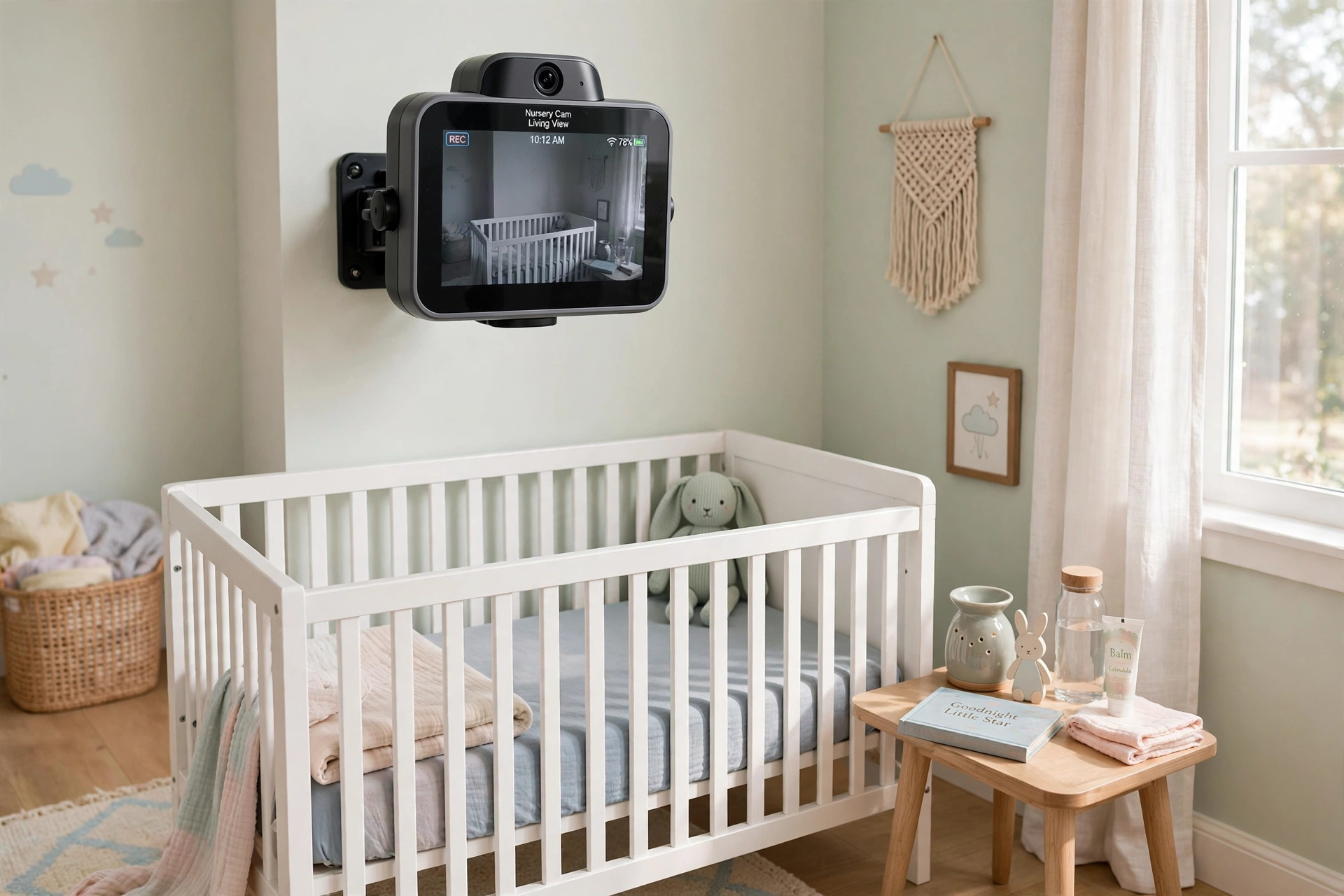
Pan and tilt is worth the money. A camera that moves lets you scan the whole room. Babies roll. Toddlers roam. A fixed camera misses half the action. Remote pan and tilt from the parent unit or app is standard on mid-range models.
Zoom helps too. Digital zoom lets you check breathing without entering the room. A clear zoom image needs good resolution. Cheap zoom looks blurry. Read reviews for real user comments on zoom quality.
Night vision is a must. All camera monitors have it now. But quality differs. Look for automatic switching between day and night. Look for a clear black-and-white night image. Some models add a soft glow light. That can comfort a baby who fears the dark.
Multi-camera support matters for growing families. Some systems let you add a second camera later. You watch both rooms on one screen. This saves buying a whole new system for the second child.
Wall-mount kits deserve a look. A mounted camera sees more of the room. It also stays out of reach of curious hands.
Cost and Price Ranges
Baby monitors with cameras fall into three price bands in the United States.
Budget models run from about 60 to 120 dollars. These are usually non-WiFi units. They offer basic video, night vision, and two-way talk. Screens are smaller. Range is modest. Reviews are mixed. Many work fine for small apartments.
Mid-range models run from about 120 to 220 dollars. This is the sweet spot for most families. You get 1080p video, good night vision, pan and tilt, and temperature alerts. Both WiFi and non-WiFi options live here. Reviews in this band are strong. Reliability is better.
Premium models run from about 220 to 350 dollars and up. These add smart features. They may track sleep patterns. They may offer breathing movement alerts. Apps are polished. Build quality is high. Some require a monthly subscription for full features. That adds to the true cost. Read the fine print before you buy.
Watch for holiday sales. Baby gear goes on sale often. Major shopping events in November and spring bring real discounts. Buying a prior-year model can save money too. The camera technology changes slowly. Last year’s top model is still excellent.
Also check what is in the box. A second camera, a wall mount, or a travel case adds value. Compare the full package, not just the base price.
Setup, Care, and Upkeep
Setup is usually quick. Place the camera at least three feet from the crib. This keeps cords out of reach. Aim the camera at the mattress, not at a wall.
Keep the camera lens clean. A soft dry cloth once a week is enough. Dust on the lens blurs the image. Check the power cord for wear each month.
Update firmware when the app asks. Updates fix bugs and close security holes. This matters most for WiFi models. Turn on automatic updates if the option exists.
Charge habits affect battery life. Do not leave the parent unit on the charger all day every day. Lithium batteries last longer with normal charge cycles. If the battery swells or drains in an hour, replace the unit or the battery.
Most brands offer a one-year warranty. Some offer two. Keep your receipt. Register the product online if the brand asks. That speeds up warranty claims.
Safety Notes Every Parent Should Know
Cord safety comes first. Keep all cords, including the camera power cord, at least three feet from the crib. The U.S. Consumer Product Safety Commission warns that cords near cribs are a strangulation risk. Never run a cord across or inside the crib. Use cord covers if the camera must sit near the nursery.
Mount the camera high and out of reach. A toddler who can grab the camera can pull it down. Wall mounts or high shelves work well. Make sure the mount is tight. A falling camera can injure a child.
For WiFi models, lock down your network. Change the default password on the monitor. Use a strong unique password for your home WiFi. Enable two-factor sign-in on the monitor app. Do not share the login with people you do not trust. Disable remote access if you never use it.
Remember what a monitor cannot do. It cannot prevent sudden infant death. Breathing and movement alerts are not medical alarms. Always follow safe sleep guidance. Place the baby on the back to sleep. Keep the crib free of blankets, pillows, and toys.
Check the monitor each night before bed. Make sure the camera shows a live image. Make sure alerts are on. A quick thirty-second check avoids a long night of worry.
Frequently Asked Questions
Are WiFi baby monitors safe from hackers?
They can be safe if you set them up well. Use a strong unique password. Turn on two-factor sign-in. Keep firmware updated. Buy from known brands with good security reviews. Sites like CNET and PCMag test monitor security in their reviews. If you want the lowest risk, choose a non-WiFi model with a closed signal.
Do I need a subscription for a WiFi baby monitor?
Some brands require one for full features. Basic live video is often free. Cloud storage and sleep reports may need a monthly plan. Plans often run five to fifteen dollars a month.
What is the best range for a non-WiFi monitor?
Look for 800 feet or more in open air. Real range indoors is lower. Thick walls and metal cut the signal. If your home is large, read user reviews about range in real houses. Test the monitor in your farthest room on day one. Return it if the signal drops.
Can I use one monitor for two children?
Yes, if the system supports extra cameras. Many mid-range and premium systems allow two or even four cameras. You view them in split screen or cycle between them. Buying the add-on camera later is cheaper than a second system. Check that the add-on camera matches your base model.
How long do baby monitors usually last?
Most last two to four years with daily use. Batteries are the weak point. Parent unit batteries often fade after a year or two. Some brands sell replacement batteries. Others do not. Consumer Reports tracks reliability in its member surveys. Keep your receipt for warranty claims.
Should I buy a monitor with breathing movement alerts?
These features can add peace of mind. But they are not medical devices. They can give false alarms. False alarms cause stress, not rest. For most healthy babies, good video, clear audio, and safe sleep habits are enough.
A Final Word
The best baby monitor with camera for your family is the one that fits your home and your habits. A small apartment may need only a simple non-WiFi unit. A large house may need long range or WiFi access. A traveling parent may want smart alerts on a phone. There is no single winner for every family.
Read reviews with a clear eye. Look for patterns across many reviews, not one loud complaint. Check the type, the features, and the true cost with any subscription. Buy from a store with a fair return policy.
Technology outlets such as The Verge cover new monitor launches each year. Security system makers like SimpliSafe and ADT also publish home safety guides worth reading. Take your time. A good monitor will serve your family for years. The right choice is the one that lets you rest easy while your baby sleeps.
References
ADT. (n.d.). Home security and automation. https://www.adt.com CNET. (n.d.). Technology news and reviews. https://www.cnet.com Consumer Reports. (n.d.). Product reviews and ratings. https://www.consumerreports.org Google Store. (n.d.). Smart home devices. https://store.google.com PCMag. (n.d.). Technology product reviews. https://www.pcmag.com SimpliSafe. (n.d.). Home security systems. https://www.simplisafe.com The Verge. (n.d.). Technology news and reviews. https://www.theverge.com U.S. Consumer Product Safety Commission. (n.d.). Product safety information. https://www.cpsc.gov
Was this guide helpful?

About Jennifer Lee
The My Garden US editorial team writes practical, in-depth home and garden guides for American homeowners — tested advice, no fluff.
You May Also Like
Hidden Wall Safe Installation Cost USA: A Complete Guide to Price and Planning
May 13, 2026 0 views
Smart Pool Pump with App Control Reviews USA: What to Buy and Why
February 28, 2026 0 views
Philips Hue vs LIFX Comparison 2026 USA: Which Smart Bulb Is Right for Your Home
January 2, 2026 0 views