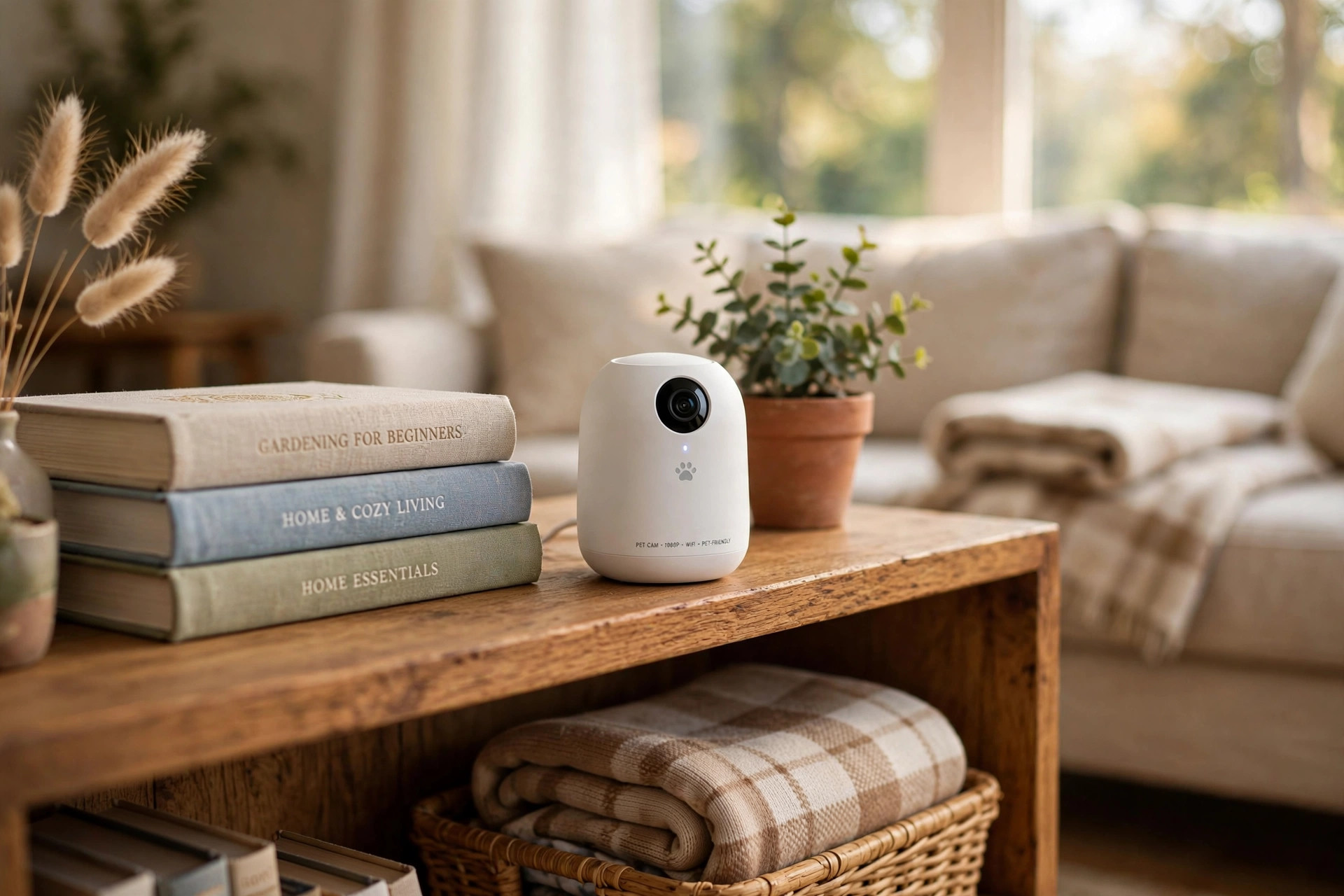

Pet friendly indoor camera reviews 2026 USA shoppers can trust are hard to find. Every maker claims its camera is the best. Every box promises peace of mind. But pet owners need more than a box of promises. They need a camera that tells the difference between a sleeping dog and a dog in trouble. They need clear night vision, two-way talk, and alerts that do not cry wolf. This guide walks through what matters in 2026. It covers the features worth paying for, the types on the shelf today, and the prices you can expect across the country.
Why a Pet Camera Is Worth the Money
Most dog and cat owners leave home for eight to ten hours each day. Work takes them away. Errands take them away. In that time, a pet can get sick, tear up a door, or knock over a lamp. A camera lets an owner see all of this in real time. It does not replace a good sitter. But it fills the gap between morning and evening with real knowledge.
Veterinarians have said for years that early notice saves lives. A dog that bloats, a cat in pain, a puppy that chews a cord: each case turns out better when the owner finds out fast. A camera with motion alerts sends a phone notice the moment something moves. Two-way audio lets the owner speak a calm word and check if the animal answers with movement. Some models even toss treats on a schedule, which keeps a lonely dog busy.
There is also the money side. A single vet visit for a swallowed sock can cost hundreds of dollars. Boarding a dog for a week can cost more than a year of cloud storage. When owners weigh the cost against the risk, the camera usually wins. That is why these reviews matter. A good pick pays for itself the first time it catches trouble early.
What to Look for Before You Buy: Pet Friendly Indoor Camera Reviews 2026 Usa
A pet friendly camera is not the same as a general security camera. Security cameras watch for strangers. Pet cameras watch for animals, and animals are smaller, faster, and quieter than people. The checklist below covers the points that matter most.
Picture and Sound Quality
Start with resolution. In 2026, most good indoor cameras offer 1080p as the base. Many offer 2K. A sharp picture lets you read a dog’s body language. Is the tail tucked? Is the cat limping? Grainy video hides those signs. Look for a wide field of view, at least 120 degrees, so one camera can cover a whole living room.
Night vision matters too. Pets are most active at dawn and dusk, and many owners check in after dark. Infrared night vision gives a clear black-and-white picture in a dark room. The better models use invisible infrared LEDs. Visible red LEDs can spook a nervous cat or a rescue dog.
Two-way audio is the third leg. A speaker and microphone let you hear whines, barks, and meows. You can answer with your own voice. The best units keep the delay under two seconds. Testers at PCMag note that audio lag ruins the value of a pet camera, since a late reply only confuses the animal.
Pet-Specific Features
Person detection was built for people. Pet detection is built for animals. The better cameras in 2026 can tell a dog from a shadow on the wall. This cuts false alerts. Some units send a special alert when they detect barking or meowing. That feature alone is worth its weight for owners of anxious dogs.
Pan and tilt add real value. A fixed camera watches one corner. A camera that pans 360 degrees can follow a cat from the couch to the kitchen. Auto-tracking goes further: the camera turns on its own to keep a moving pet in frame. If your dog roams the whole house, this feature is not a luxury. It is the point.
Treat dispensers divide buyers. Some love them. A camera that tosses a treat keeps a dog engaged and lets the owner reward calm behavior from the office. Others worry about overfeeding. If you choose a model with a dispenser, fill it with small low-calorie treats and cap the daily count in the app.
Privacy Controls
A camera inside your home watches everything, not just the pet. Privacy shutters have become common in 2026. A physical shutter slides over the lens when you are home. Reviews of the best indoor security camera with privacy shutter show that buyers now treat a shutter as a must-have, not a bonus.
Local storage is another privacy win. Many cameras now take a microSD card. Video stays in your house instead of on a server. Cloud plans add features like longer history and smart alerts, but they cost a monthly fee. Check the app’s data policy before you buy. Trusted reviewers at Consumer Reports publish data-privacy ratings for major camera brands, and those ratings are worth a look.
Types of Pet-Friendly Indoor Cameras
The 2026 market breaks into four broad types. Each suits a different home and a different budget.
Fixed plug-in cameras. These are small, simple, and cheap. You set one on a shelf, plug it in, and aim it at the room. They record in 1080p or 2K and send motion alerts. They suit owners who want to watch one room, such as the kitchen where the dog stays. Prices start low, and setup takes minutes. The downside is the fixed view. If the pet leaves the frame, you see an empty room.
Pan-tilt cameras. These sit on a motorized base and turn to follow movement. Many cover 360 degrees side to side and tilt up and down. They suit open floor plans and multi-pet homes. The auto-tracking on the better models works well with cats, which move fast and low. Expect to pay more than for a fixed camera. The Ring indoor line includes pan-tilt options that pair with its wider home security system, which some owners like for one-app control.
Treat-dispensing cameras. These add a hopper for dry treats and a toss mechanism. The owner taps a button in the app, and the camera flings a treat across the room. Some models schedule tosses through the day. They suit dogs with separation anxiety. The hopper needs refilling every few days, and the treats must fit or the mechanism jams. These are the priciest type on this list.
Multi-camera kits and hubs. Some makers sell two or three cameras with one hub. This suits large homes or owners who want eyes on the living room, the crate area, and the back door at once. A hub with local storage can serve all cameras and cut cloud fees. SimpliSafe and ADT sell cameras as part of broader home systems, which appeals to buyers who want security and pet watching in one place.
Cost and Price in 2026
Prices have settled into clear bands. A basic fixed indoor camera costs between 30 and 60 dollars. Mid-range pan-tilt models run 60 to 130 dollars. Treat-dispensing cameras run 150 to 300 dollars, with the top names at the high end. Multi-camera kits start near 150 dollars and climb past 400 for three cameras with a hub.
Cloud storage is the hidden cost. Most brands offer a free tier with live view and a few days of event clips. Full plans run 3 to 10 dollars per month per camera, or 10 to 20 dollars for unlimited cameras on one account. Local microSD storage skips the fee. A 128 GB card holds weeks of event clips and costs about 15 dollars. Many owners mix the two: local storage for daily use and a cheap cloud plan for backup.
Watch for subscription traps. Some cameras lose person and pet detection without a paid plan. The detection runs on the maker’s servers. Before you buy, read the fine print on what works for free. Comparison sites like CNET track which features sit behind paywalls, and their charts save buyers from surprises. Retailers such as the Google Store list plan prices next to the camera, which makes the true cost clear.
Care and Upkeep
A pet camera needs little care, but small habits keep it working for years. Wipe the lens once a month with a dry microfiber cloth. Pet hair and dust settle on everything in a house with animals. A dirty lens turns night vision into a gray fog.
Check the power cord. Puppies chew cords. Cats bat at them. Run the cord behind furniture or through a cord cover. If the camera uses a battery, charge it on a schedule. A dead camera helps no one.
Update the firmware. Makers push updates that fix bugs and close security holes. Turn on auto-update in the app if the option exists. Also update the app itself. Old apps lose features over time.
For treat dispensers, clean the hopper every two weeks. Crumbs and oils build up and can jam the toss wheel. Use treats made for dispensers: small, hard, and uniform. Soft treats break apart and clog the works.
Finally, review your storage. If you use a microSD card, format it every few months. Cards wear out with constant writing. Replace the card once a year. If you use cloud storage, check that clips are actually saving. A plan that lapsed silently is the same as no plan at all.
Safety for You and Your Pets
Safety has two sides: the pet’s body and the family’s privacy.
Place the camera out of reach. Dogs jump. Cats climb. A camera knocked off a shelf can break, and small parts can choke a curious puppy. Mount it high on a wall or set it on a tall shelf. Use the included mount or a sturdy third-party bracket.
Secure the cord as noted above. The U.S. Consumer Product Safety Commission has long warned about cord hazards around children, and the same care applies to pets. A chewed cord can shock an animal or start a fire.
On the privacy side, use a strong unique password for the camera account. Turn on two-factor authentication. Cameras have been hacked through weak passwords, and an indoor camera is the last device you want exposed. Keep the firmware current, as noted above. A privacy shutter gives a final layer: close it when you are home and open it when you leave.
If the camera watches a room where guests stay, tell them. House rules and rental laws in some states require notice of indoor recording. A simple note or a mention at the door covers it. Buyers comparing options for family rooms may also want to read the best baby monitor with camera reviews usa, since baby monitors and pet cameras share many features and some models do both jobs. For hidden-camera concerns in shared spaces, the best nanny cam hidden camera reviews usa guide covers the legal lines in plain terms.
Frequently Asked Questions
Do pet cameras work without Wi-Fi? Most need Wi-Fi for live view and alerts. A few record to a local card without it, but you lose remote access. For pet watching while you are at work, steady Wi-Fi is a must. Place the camera within good range of your router. A weak signal causes lag and dropped clips.
Can one camera watch two pets? Yes, if the camera pans or has a wide view. A 360-degree pan-tilt camera in a central spot can follow two animals in one room. For two rooms, buy two cameras. Multi-pet homes do best with a kit rather than one fixed unit.
Are treat-dispensing cameras safe for cats? They can be, with care. Use cat-sized treats and small portions. Some cats startle at the toss sound, so test it while you are home first. Never leave a cat alone with a dispenser until you have watched several tosses go well.
How much cloud storage does a pet owner need? Event-based clips use little space. A week of motion clips often fits in a few gigabytes. Continuous recording uses far more. Most owners do fine with event recording plus a 128 GB local card. Cloud plans matter most for owners who want clip history longer than a month.
Will a pet camera scare my dog? Some dogs notice the camera at first. The pan motor hum and the treat toss click can startle a nervous dog. Introduce it slowly. Let the dog sniff the camera while it is off. Turn on features one at a time. Most dogs ignore the camera within a week.
Do I need a subscription? Not always. Basic live view, motion alerts, and local recording usually work free. Smart features like pet detection, bark alerts, and long cloud history often need a plan. Decide which features you truly need, then pick the plan, not the other way around. Tech reviewers at The Verge regularly note that the free tier is enough for many casual pet watchers.
A Short Final Word
A pet friendly indoor camera is a small purchase that buys real peace of mind. Start with your needs: one room or the whole house, basic watch or treat tossing, local storage or cloud. Compare two or three models side by side. Read the plan fine print. Then set the camera high, secure the cord, and let it do its quiet work. Your dog or cat will never know you are watching. You will know they are safe. That is the whole point.
References
ADT. (n.d.). Home security and automation. https://www.adt.com CNET. (n.d.). Technology news and reviews. https://www.cnet.com Consumer Reports. (n.d.). Product reviews and ratings. https://www.consumerreports.org Google Store. (n.d.). Smart home devices. https://store.google.com PCMag. (n.d.). Technology product reviews. https://www.pcmag.com Ring. (n.d.). Smart home security devices. https://www.ring.com SimpliSafe. (n.d.). Home security systems. https://www.simplisafe.com The Verge. (n.d.). Technology news and reviews. https://www.theverge.com U.S. Consumer Product Safety Commission. (n.d.). Product safety information. https://www.cpsc.gov
Was this guide helpful?

About Michael Thompson
The My Garden US editorial team writes practical, in-depth home and garden guides for American homeowners — tested advice, no fluff.
You May Also Like
Video Doorbell for Apartments With No Wiring: A Complete Guide for USA Renters
May 27, 2026 0 views
Best Professionally Monitored Security System USA: A Complete Homeowner Guide
July 10, 2026 0 views
Best Video Doorbell Without Subscription USA: A Practical Guide
August 3, 2026 0 views