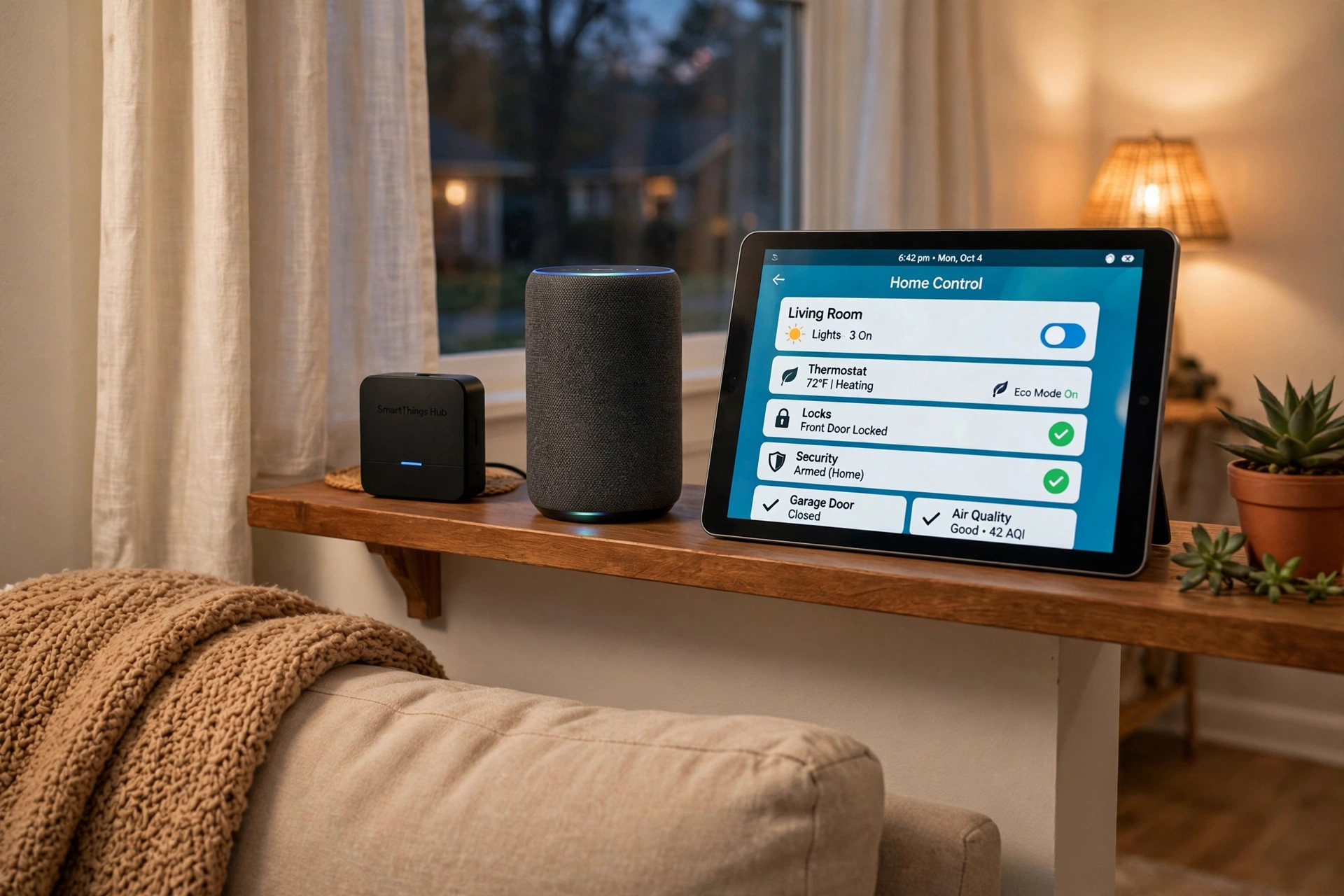
This home assistant vs smartthings comparison usa guide looks at two of the most popular smart home platforms in the United States. Home Assistant is free open-source software that runs on your own hardware. SmartThings is a Samsung product that runs through a hub and a phone app. Both can control lights, locks, thermostats, cameras, and sensors. Both work with thousands of devices. Yet they take very different paths to get there.
American buyers often ask which one fits a normal household better. The answer depends on how much control you want, how much time you will spend on setup, and how you feel about cloud services. This article walks through each platform in plain terms. It compares cost, setup, ease of use, device support, privacy, and security. By the end, you should know which one matches your home and your habits.
Why This Comparison Matters
Smart home spending in the United States keeps growing. Homes now hold far more connected devices than they did five years ago. A single household may have smart bulbs, a video doorbell, a robot vacuum, a smart thermostat, and two or three voice assistants. Without one central platform, these devices live in separate apps. Lights go in one app. The camera goes in another. The thermostat goes in a third.
A platform solves that problem. It brings all devices under one roof. You can set routines that cross brands and check everything from one dashboard.
Choosing the wrong platform costs time and money. Some devices work better on one platform than the other. Moving from one platform to another later means setting everything up again. That is why a careful home assistant vs smartthings comparison usa review matters before you buy hardware.
What To Look For In A Smart Home Platform: Home Assistant vs Smartthings Comparison Usa
A good platform shares five traits. First, it supports the devices you already own. Second, it is stable day after day. Third, it is easy enough for everyone in the home to use. Fourth, it protects your data. Fifth, it does not lock you into one brand.
Device Support
Check which brands and protocols the platform handles. The main wireless standards are Wi-Fi, Zigbee, Z-Wave, and Matter. A platform that supports all four gives you the widest choice of devices. Both Home Assistant and SmartThings handle these standards, but they do it differently.
Reliability
Your lights must turn on when you press the button. Routines must run even when the internet drops. Local control matters here. A platform that runs in your home keeps working during an internet outage. A cloud-based platform stops working until the connection returns.
Ease Of Use
Most families want a system that a guest or a child can operate. If the app is confusing, people stop using it. Simple controls matter more than advanced features for daily life.
Privacy
Smart home devices collect data about your habits. They know when you wake up, when you leave, and when you sleep. A platform that keeps this data inside your home gives you more control over it.
Cost Over Time
Look past the price tag of the hub. Some platforms need monthly fees for full features. Others are free but need hardware you buy yourself. Add up five years of cost, not one.
Home Assistant: The Power User Choice
Home Assistant is free, open-source software made by a large community of volunteers and a small company called Nabu Casa. You install it on your own hardware. Many people run it on a Raspberry Pi or a small mini PC. The popular Home Assistant Green hub costs about 99 dollars and arrives ready to plug in.
Once running, Home Assistant finds devices on your network by itself. It supports more than 3,000 integrations. That is far more than any other platform. If a device has any smart features at all, Home Assistant probably supports it.
The strongest point of Home Assistant is local control. Automations run inside your home. They do not travel to a cloud server. This makes them fast and private. It also means they keep working when your internet goes down.
The dashboard is fully yours to design. You can build pages for each room. You can add graphs, camera feeds, and weather cards. Every detail of the interface can change. This freedom is also the weakness. New users often feel lost. Setting up some devices needs patience and a little reading. The learning curve is real.
Home Assistant fits owners who like to tinker. It fits homes with many brands of devices. It fits people who care deeply about privacy. It is not the best pick for someone who wants everything to work in ten minutes.
SmartThings: The Simple Choice
SmartThings is a Samsung product. It started as a small startup and grew into one of the largest smart home platforms in America. You control it through the SmartThings app on your phone. A SmartThings hub, such as the Aeotec Smart Home Hub, connects Zigbee, Z-Wave, and Matter devices. Many Samsung appliances and televisions have SmartThings built in.
The main strength of SmartThings is ease of use. Setup takes minutes. The app walks you through adding devices step by step. Routines use simple rules. If motion is detected after dark, turn on the porch light. Most people can build these rules without any help.
SmartThings also benefits from the Samsung name. It sits inside millions of phones, televisions, and appliances already in American homes. If you own a Samsung washer or a Galaxy phone, SmartThings feels natural from the first day.
The weakness is the cloud. Most SmartThings routines run on Samsung servers, not in your home. If your internet drops, many automations stop. Samsung has moved some processing to local hubs in recent years, but the cloud still plays a large role. Privacy-minded users may dislike how much data flows through Samsung servers.
SmartThings fits most American households. It fits renters who cannot change wiring. It fits beginners who want a system that just works. It fits Samsung owners who already live inside the Samsung world.
Side-By-Side Comparison
The table below sums up the main points of this home assistant vs smartthings comparison usa review.
| Feature | Home Assistant | SmartThings | |—|—|—| | Price of software | Free | Free | | Typical hub cost | 99 to 150 dollars | 100 to 130 dollars | | Monthly fee | None, optional 6.50 for remote access | None | | Local control | Yes, nearly everything | Partial, growing | | Device integrations | 3,000 plus | Hundreds | | Setup difficulty | Medium to hard | Easy | | Phone app quality | Good, needs setup | Excellent | | Voice assistants | Alexa, Google, Siri via HomeKit | Alexa, Google, Bixby | | Privacy | Very high, local by default | Moderate, cloud-based | | Best for | Tinkerers and privacy fans | Beginners and families |
Cost And Price
Both platforms are free to download. The real cost is the hardware. A Home Assistant Green costs about 99 dollars. A used mini PC for Home Assistant costs 100 to 150 dollars. A SmartThings hub costs about 100 to 130 dollars. Some Samsung televisions and appliances include the hub function at no extra charge.
Neither platform charges a monthly fee for basic use. Home Assistant offers an optional cloud subscription at 6.50 dollars per month for easy remote access and voice assistant links. You can skip it and set up remote access yourself for free. SmartThings has no paid tier at all.
Over five years, the cost is close. Home Assistant may cost slightly more if you buy better hardware. SmartThings may cost more if you replace devices that lack support. Neither one will surprise you with hidden fees.
Setup And Daily Use
Setting up Home Assistant takes about one hour on a ready-made hub. You plug it in, open a web page, and follow the steps. Adding devices is mostly automatic. Building complex automations takes longer. Expect to spend a few evenings learning the system in the first month.
Setting up SmartThings takes about twenty minutes. You download the app, sign in with a Samsung account, and add the hub. Most homes finish the basic setup on the first day.
Daily use favors SmartThings for simple tasks. The app is clean and fast. Guests can use it with no training. Home Assistant rewards the effort you put in. Once your dashboards and automations are built, daily use is smooth.
Privacy And Security
Privacy is the biggest gap between the two platforms. Home Assistant keeps your data in your home. Device states, camera feeds, and automation history stay on your hardware. Nothing leaves unless you allow it.
SmartThings sends much of its data to Samsung cloud servers. Samsung states that it protects this data and lets users manage settings. Still, the data leaves your home by design. During a cloud outage, routines may fail. The U.S. Consumer Product Safety Commission publishes general guidance on connected product safety that every buyer should read.
Both platforms support two-factor sign-in. Both get regular software updates. SmartThings benefits from Samsung’s large security team. Home Assistant benefits from open code that anyone can inspect. For a broader look at tested smart home gear, reviews at PCMag and CNET cover hubs, cameras, and sensors in depth.
Device And Brand Support
Home Assistant supports the widest range of devices in the industry. It talks to nearly every brand sold in America. Old devices that lost official support often gain new life through community integrations. If you own a mix of brands bought over many years, Home Assistant is the safer bet.
SmartThings supports the most popular brands well. Philips Hue, Ring, Ecobee, Yale, and Schlage all work smoothly. Before you buy, check the official compatibility list.
Both platforms now support Matter, the new common standard. Matter should make future devices work on both platforms with less trouble. This is good news for American buyers, because it lowers the risk of picking the wrong side.
Voice control works on both. Home Assistant connects to Alexa and Google Assistant through its optional cloud service or manual setup. SmartThings connects to Alexa, Google, and Samsung Bixby out of the box. Owners of Google Nest devices can browse options at the Google Store and link them to either platform.
If you plan to build a security-focused setup, pairing your platform choice with the right camera matters. Our guide on the best outdoor security camera without wifi subscription covers options that pair well with local-first platforms. For lighting routines, see our review of smart outdoor lighting timer reviews usa.
Automations And Routines
Home Assistant offers the deepest automation engine of any consumer platform. You can build rules with many conditions. You can use presence, weather, time, and sensor data together. The automation editor is visual, so most rules need no code.
SmartThings routines are simpler. They follow a basic if-this-then-that pattern. For most homes, simple routines are enough. Lights at sunset, locks at bedtime, and alerts when a door opens cover daily needs.
Which One Should You Choose
Choose Home Assistant if you want full control, strong privacy, and support for every device you own. Choose SmartThings if you want the simplest setup and a polished phone app that everyone in the home can use.
There is no wrong answer. Both platforms are mature and well supported in the United States. Tech coverage at The Verge tracks both platforms closely if you want to follow new features. Independent test results from Consumer Reports can also help when you compare specific hubs and devices.
If you are comparing robot vacuums to add to either platform, read our rachio vs orbit bhyve comparison 2026 usa guide for another head-to-head breakdown in the smart home space. For whole-home protection beyond the platform itself, monitored options from providers like SimpliSafe and ADT can layer professional monitoring on top of your setup.
Frequently Asked Questions
Is Home Assistant really free?
Yes. The software costs nothing. You only pay for the hardware it runs on, such as a 99-dollar hub. An optional 6.50-dollar monthly cloud plan adds easy remote access, but it is not required.
Does SmartThings work without the internet?
Only partly. Some routines now run on the local hub, but many still need the Samsung cloud. During an internet outage, basic device control from the app may fail. Home Assistant keeps working fully without internet.
Can I switch from SmartThings to Home Assistant later?
Yes. Many users start with SmartThings and move to Home Assistant. You will need to remove devices from SmartThings and add them to Home Assistant. Zigbee and Z-Wave devices can move over. Wi-Fi devices just need new sign-in steps.
Which platform is better for renters?
SmartThings is usually better for renters. Setup is fast, nothing needs wiring changes, and the hub moves easily to a new apartment. Home Assistant works for renters too, but the setup effort is higher.
Do both work with Alexa and Google Assistant?
Yes. Both platforms link to Amazon Alexa and Google Assistant. SmartThings also works with Samsung Bixby. Home Assistant links to Siri through HomeKit bridging as well.
Is one safer for families with kids?
Both are safe when set up well. SmartThings is easier for children to use. Home Assistant gives parents more control over data. Either way, use strong passwords and two-factor sign-in on every smart home account.
Final Word
This home assistant vs smartthings comparison usa review comes down to a simple trade. Home Assistant gives you power, privacy, and freedom at the cost of setup time. SmartThings gives you speed, simplicity, and polish at the cost of cloud dependence. Most American families will be happy with SmartThings. Owners who want total control will love Home Assistant. Pick the one that matches how you live, and build from there.
References
ADT. (n.d.). Home security and automation. https://www.adt.com CNET. (n.d.). Technology news and reviews. https://www.cnet.com Consumer Reports. (n.d.). Product reviews and ratings. https://www.consumerreports.org Google Store. (n.d.). Smart home devices. https://store.google.com PCMag. (n.d.). Technology product reviews. https://www.pcmag.com Raspberry Pi. (n.d.). Raspberry Pi computers and accessories. https://www.raspberrypi.com SimpliSafe. (n.d.). Home security systems. https://www.simplisafe.com The Verge. (n.d.). Technology news and reviews. https://www.theverge.com U.S. Consumer Product Safety Commission. (n.d.). Product safety information. https://www.cpsc.gov
Was this guide helpful?

About Sarah Mitchell
The My Garden US editorial team writes practical, in-depth home and garden guides for American homeowners — tested advice, no fluff.