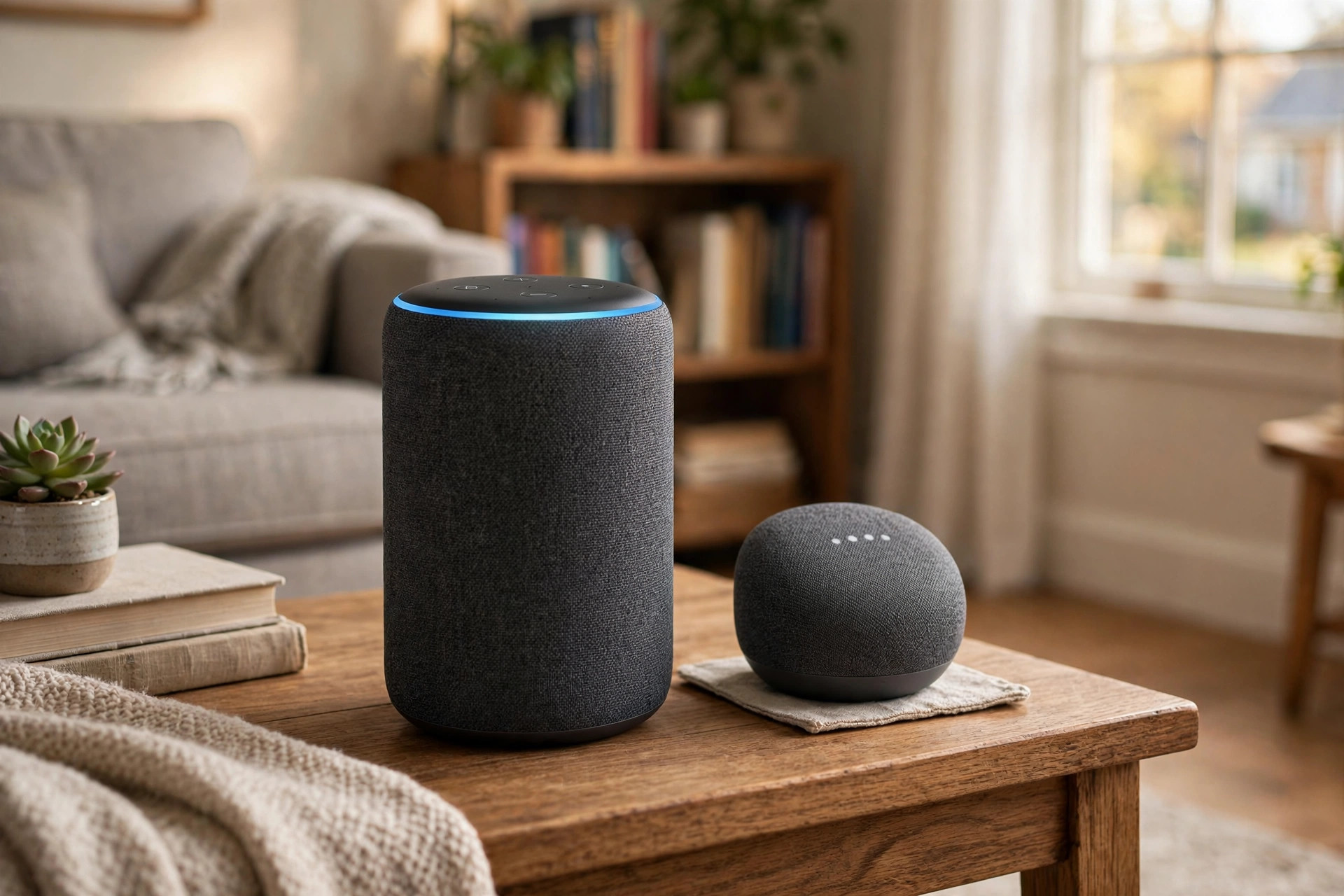

The alexa vs google home 2026 comparison usa is one of the most common questions among American shoppers this year. Both systems promise hands-free control of lights, locks, thermostats, and music. Both sit on your shelf and answer questions all day. Yet they are not the same. Amazon Alexa and Google Home take different paths with sound quality, smart home support, and privacy. This guide walks through each one in plain terms so you can choose with care.
Why This Choice Matters in 2026
A voice assistant becomes the front door to your smart home. Once you buy into one system, most of your later purchases will match it. Speakers, doorbells, cameras, plugs, and bulbs all work best inside one family. Switching later costs money and time. That is why the decision deserves thought.
The market in the United States is split mainly between these two brands. Amazon built Alexa around its Echo speakers and a vast catalog of compatible products. Google built its assistant around search strength and its Nest devices. In 2026 both add new features each year, and both keep prices low to win new homes. Expert reviews at CNET track these changes, and ratings at Consumer Reports test how the devices hold up over time.
Your choice also shapes your daily habits. You will speak to this device many times a day. You will ask for weather, set timers, play music, and turn off lights. Small differences in how each assistant hears you and answers you will add up fast.
How to Choose Between Alexa and Google Home: Alexa vs Google Home 2026 Comparison Usa
Start with what you own now. If your home already has Ring doorbells or many Amazon devices, Alexa fits better. If you use Google services such as Gmail, Google Calendar, and YouTube, Google Home fits better. Neither choice locks out the other entirely, but life is easier when your assistant talks to your other tools.
Think about your rooms. A kitchen speaker should hear well over noise and answer cooking questions. Our guide to the best smart speaker for your kitchen can help you pick the right model for that busy space. A bedroom speaker should play music softly and wake you on time. A living room speaker should fill the space with clear sound for movies and parties.
Consider who will use it. Large families like voice profiles that tell members apart. Parents like strong filters for children. Older adults like simple commands and clear replies. Both assistants offer these tools, but their settings menus look different, and one may feel easier to you.
Sound Quality and Music
Music is the top job for most smart speakers. Amazon and Google both sell models at three levels: small, midsize, and large. The small models cost little and sound fine for talk and background music. The midsize models add richer bass and fill a normal room. The large models aim at serious listeners.
In 2026 the midsize Echo and the midsize Nest Audio remain the best value picks for most buyers. Both play from the major music services. Both can pair two speakers in stereo. Both support multi-room groups, so music can follow you from kitchen to living room with one command.
Alexa has a slight edge in music service choice. It works with Amazon Music, Spotify, Apple Music, and several others. Google Home works with YouTube Music and Spotify, but it dropped some rivals in past years. If your family pays for one music service, check that it works with the assistant you pick before you buy.
For display models, sound also matters. The Echo Show and Nest Hub comparison shows how the two screen speakers differ in audio and video. If you plan to watch recipes or make video calls in the kitchen, read that guide before you decide.
Smart Home Control
This is where the two assistants differ most. Alexa supports the largest number of smart home devices. Amazon opened its system early to makers of bulbs, plugs, locks, and cameras. As a result, you can find Alexa-compatible versions of almost anything in stores like Best Buy and on Amazon. If you enjoy trying new gadgets, Alexa gives you the widest shelf.
Google Home supports fewer devices, but it handles the common ones well. Lights, thermostats, locks, cameras, and doorbells from the big brands all work. Its strength is smooth control of what you own. The Google Home app shows your rooms in a clear layout, and voice commands feel natural. Say “dim the living room lights” and it works without extra setup.
Both assistants now support the Matter standard. Matter is a shared language that lets smart devices work across brands. This is good news for shoppers in 2026. A Matter bulb bought today should answer to either assistant. Over time, this standard may shrink the gap between the two systems.
Routines make both assistants shine. A routine runs many actions from one command. Say “good night” and the assistant can lock the doors, turn off the lights, and set the alarm. Alexa offers deep routine options with many triggers, including motion and time. Google offers routines too, with strong ties to your calendar and commute. Both are easy to set up in their apps.
Fans and climate devices deserve special care. If you plan to control ceiling fans by voice, look for models built for your system. Many shoppers pair Alexa with smart ceiling fans that work with Alexa for hands-free comfort in summer.
Privacy and Data Controls
Both companies record your voice commands to improve their service. This makes some buyers uneasy, and that is fair. The good news is that both now give you real controls.
Alexa lets you review and delete voice recordings in the Alexa app. You can set recordings to delete on their own after three months or eighteen months. You can also mute the microphone with a button on each speaker. When muted, the ring turns red and the device stops listening.
Google offers similar tools. You can review activity in your Google account, delete recordings by voice, and set auto-delete on a schedule. The Nest speakers have a physical microphone switch on the back. Google says it does not sell your personal data to advertisers, and it publishes details about how voice data is used.
Neither system is fully private. Voice assistants need the cloud to understand speech. If privacy is your top concern, use the mute button often, review your history each month, and keep sensitive talks away from the speaker. These habits matter more than the brand you pick.
Cost and Price in the USA
Prices stay friendly in 2026. Small speakers from both brands often sell for under fifty dollars, and holiday sales push them lower. Midsize speakers sit near one hundred dollars. Display models with screens cost more, from about ninety to two hundred and thirty dollars depending on screen size.
Watch for bundles. Stores often pair a speaker with a smart bulb or plug at a discount. These bundles are a cheap way to start a smart home. Check prices at more than one store, since Best Buy and Amazon often run different sales in the same week.
Ongoing costs are small. Neither assistant charges a monthly fee for basic use. Music services cost extra if you want them, and some camera features need a subscription. But the voice assistant itself stays free after you buy the device.
Care and Upkeep
Smart speakers need little care, but a few habits keep them working well.
Keep the software current. Both brands send updates on their own, but the speaker must stay plugged in and connected to Wi-Fi. If a device acts odd, check the app for a pending update and restart the speaker.
Place the speaker with care. Keep it away from sinks, stoves, and open windows. Steam and dust can harm the microphones over time. Give it a few inches of space on each side so sound can spread.
Clean it gently. Wipe the fabric or plastic with a dry, soft cloth. Do not spray cleaners directly on the device. For screens, use a cloth made for glass.
Check your device list twice a year. Old phones, moved houses, and sold gadgets can leave stale entries in your app. Removing them keeps voice commands fast and avoids mix-ups.
Safety Tips for Households
Smart speakers are safe when used with care. The U.S. Consumer Product Safety Commission offers guidance on home product safety, and its recall notices are worth checking before you buy any connected device.
Use a strong Wi-Fi password and keep your router software updated. Your speakers share your home network, so network health protects them too.
Set up voice purchasing with a PIN or turn it off. Children and guests can order items by accident if this feature stays open.
Place cameras with care if you add them later. Brands like Ring make popular doorbells that work with Alexa, and many work with Google too. Point indoor cameras away from private spaces, and tell guests when one is recording.
If you connect your assistant to a full security system, choose a trusted provider. Companies such as SimpliSafe and ADT offer professional monitoring that pairs with voice assistants. News and reviews at The Verge often cover how these integrations work in real homes.
Keep cords out of walkways and away from small children and pets. Wall-mount small speakers where you can. These simple steps prevent most home accidents with electronics.
Frequently Asked Questions
Which is better for beginners, Alexa or Google Home? Both are friendly to beginners. Google Home feels simpler if you already use Google apps. Alexa feels simpler if you shop on Amazon and own Echo devices. Pick the one that matches the accounts you use most.
Can I use both Alexa and Google Home in one house? Yes. Many homes run both. You might keep an Echo in the kitchen and a Nest speaker in the bedroom. Just give each device a clear name and room so commands do not clash.
Do these speakers work during a power or internet outage? No. Smart speakers need power and Wi-Fi to work. During an outage they cannot answer questions or control devices. Keep a battery radio and manual light switches as backup.
Which assistant understands accents and speech differences better? Both have improved greatly. Google has a small edge with natural questions because of its search background. Alexa has strong voice profiles that learn each family member. Try both in a store if you can, and speak as you would at home.
Are there monthly fees for Alexa or Google Home? No. The assistants are free to use after you buy the speaker. Extra costs come only from optional services like music plans or camera cloud storage.
Can these devices help older adults live alone? Yes, with limits. They can set medication reminders, call family hands-free, and turn on lights at night. They are helpers, not medical devices. For health emergencies, a dedicated alert system from a provider like ADT is a safer choice.
A Short Final Word
The alexa vs google home 2026 comparison usa has no single winner. Alexa wins on device choice and shopping ties. Google Home wins on search smarts and clean app design. Matter support is closing the gap each year. Choose the one that fits your accounts, your rooms, and your habits. Buy one speaker first, live with it for a month, and then grow your system with care. That slow start saves money and leads to a home that truly listens.
References
ADT. (n.d.). Home security and automation. https://www.adt.com Amazon. (n.d.). Online shopping. https://www.amazon.com Best Buy. (n.d.). Consumer electronics retailer. https://www.bestbuy.com CNET. (n.d.). Technology news and reviews. https://www.cnet.com Consumer Reports. (n.d.). Product reviews and ratings. https://www.consumerreports.org Ring. (n.d.). Smart home security devices. https://www.ring.com SimpliSafe. (n.d.). Home security systems. https://www.simplisafe.com The Verge. (n.d.). Technology news and reviews. https://www.theverge.com U.S. Consumer Product Safety Commission. (n.d.). Product safety information. https://www.cpsc.gov
Was this guide helpful?

About Michael Thompson
The My Garden US editorial team writes practical, in-depth home and garden guides for American homeowners — tested advice, no fluff.
You May Also Like

Do Security Yard Signs Really Work? A Plain Guide for American Homeowners
January 2, 2026 0 views
Robot Vacuum for Hardwood Floors Reviews USA: An Honest Buyer’s Guide for 2026
July 21, 2026 0 views
Cellular Security Camera No WiFi Reviews USA: A Plain Guide for Homes and Cabins
March 26, 2026 0 views