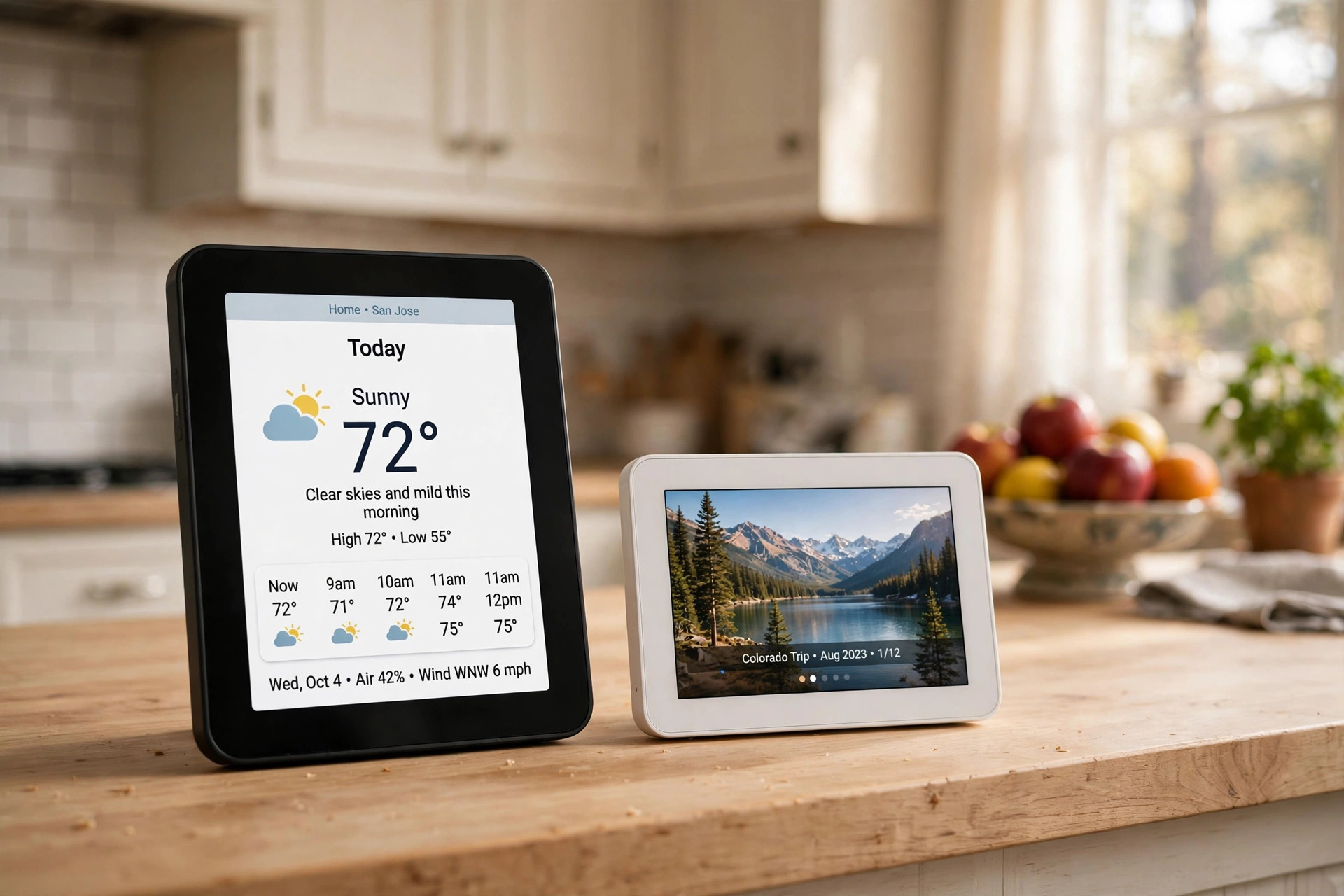
A smart display is a speaker with a screen. It plays music. It shows the weather. It runs timers. It can run your lights, locks, and cameras. The two biggest names in this market are the Amazon Echo Show and the Google Nest Hub. This echo show vs nest hub comparison 2026 walks through the key differences in plain terms so you can pick the one that fits your home.
Both lines have grown over the years. Amazon sells several Echo Show sizes, from the small Show 5 up to the large Show 21. Google keeps the Nest Hub line simpler, with the Nest Hub and the Nest Hub Max. Prices, screens, and features shift from year to year, so this guide focuses on the traits that tend to stay true: the voice helper inside, the screen, the sound, the camera, and how each one handles your smart home.
Why the Choice Matters
A smart display often becomes the heart of a room. It sits on the kitchen counter or the nightstand. The family uses it many times a day. If it runs the voice helper you already like, life is easy. If it fights with the devices you own, it becomes a daily annoyance. So the choice is less about which box is “better” in a lab test and more about which one fits your home and your habits.
The echo show vs nest hub comparison 2026 comes down to two ecosystems. The Echo Show runs Alexa. The Nest Hub runs Google Assistant, now backed by Google’s newer AI tools. If your phone is an Android phone and your email and photos live in Google’s world, the Nest Hub feels natural. If you shop with Amazon, use Prime, and talk to Alexa through other Echo speakers, the Echo Show feels natural. Many homes mix both. That is fine, but one of them will have to be the main hub on the counter.
What to Look for in a Smart Display: Echo Show vs Nest Hub Comparison 2026
Before you compare the two brands, it helps to know what traits matter most.
Screen Size and Quality
A small screen, around five to eight inches, is fine for a nightstand or a desk. A larger screen, ten inches and up, works better in the kitchen. Recipes are easier to read from across the room, and photos look better.
Sound Quality
A smart display is also a speaker. It plays music while you cook. It reads the news. It rings for video calls. Small models sound thin. Larger models have room for better drivers and can fill a room. If music matters to you, look at the bigger models or plan to pair the display with a separate Bluetooth speaker.
The Voice Helper
Alexa and Google Assistant are both strong at the basics: timers, alarms, weather, simple questions, and music. Google has long had an edge at answering odd questions. Alexa has long had an edge at smart home skills, with support for a very wide range of third-party devices. In 2026 both helpers have grown smarter, but the old strengths still show.
The Camera and Privacy
Some smart displays have a camera for video calls. Others do not. The Nest Hub, in its standard size, famously ships without a camera. Google made that choice on purpose for bedrooms, and it won over many buyers. The Nest Hub Max does have a camera. Most Echo Show models have a camera, including the small ones.
Both brands give you a mic-off button and a way to cover or shut off the camera.
Smart Home Control
Both displays act as a control screen for your home. You can see your cameras, lock the door, dim the lights, and change the thermostat. Both work with the big standards of the day, including Matter, which lets devices from different brands talk to each other. That said, some device brands still work a little better with one helper than the other. Check that your key devices — the doorbell, the lock, the thermostat — list support for the helper you plan to use.
Security devices deserve special care. A ring vs nest doorbell comparison 2026 usa can help if you are choosing a doorbell at the same time, since the doorbell brand you pick often pairs best with the display from the same family.
The Echo Show Line: Options and Traits
Amazon sells the Echo Show in several sizes. The Show 5 is small and cheap, built for the nightstand. The Show 8 is the middle choice, with a better screen and better sound. The Show 10 has a screen that turns to face you as you move around the room. The Show 15 and Show 21 are large screens meant for the wall or the kitchen, closer to a small TV.
Across the line, Alexa is the star. She runs routines, answers questions, and controls a huge range of smart home devices. Amazon’s store ties in closely: you can order items by voice, track packages on screen, and watch Prime Video. Most models include a camera, which makes video calls easy through Alexa’s calling feature.
The big wall models, the Show 15 and Show 21, double as photo frames and family boards, with widgets for calendars, sticky notes, and shopping lists.
The Nest Hub Line: Options and Traits
Google keeps things simpler. The Nest Hub is a seven-inch display with no camera, aimed at the bedroom and the desk. The Nest Hub Max is a ten-inch display with a camera, aimed at the kitchen and the living room. That is the whole line, and many buyers like that there are only two choices to weigh.
Google Assistant is the star here. It answers questions well, handles follow-up questions in a natural way, and ties into Google services: Gmail, Google Calendar, Google Photos, and YouTube. The photo frame mode is a favorite feature. It shows your Google Photos in a slow slide show, and it looks so good that many owners buy the Hub just for that.
Smart home control on the Nest Hub is clean and simple. The home view shows your rooms and devices at a glance. It works with Nest cameras and doorbells best of all, which makes sense since they are one family. If you own Nest Protect smoke alarms, the Hub can show their status too, and a nest protect vs first alert comparison usa is worth a read if you are still choosing alarms.
Side-by-Side Comparison
Voice Helper
Google Assistant answers general questions better and holds a conversation more smoothly. Alexa controls a wider range of smart home gear and handles routines with great depth. For most buyers, the helper they already use wins.
Tech reviewers at CNET and PCMag have long tested both helpers head to head, and their write-ups are a good second opinion.
Screen and Design
The Echo Show line offers more sizes, from five inches to twenty-one. The Nest Hub line offers two. Echo Show screens tend to be a little brighter. Nest Hub screens look softer and calmer, and the photo frame mode is the best in the business.
Sound
On small models, both sound thin. Move up a size and the Echo Show 8 and Show 10 pull ahead of the standard Nest Hub for music. The Nest Hub Max closes the gap and sounds warm and full.
Camera and Video Calls
Most Echo Show models have cameras, and Alexa calling is simple to set up. The Nest Hub Max has a camera with auto-framing that keeps you in view as you move. The standard Nest Hub has no camera at all, which many bedroom buyers prefer.
Smart Home Control
Both handle lights, plugs, locks, and thermostats well. Both support the Matter standard. Alexa still lists the longer roll of supported devices, which helps in a mixed-brand home. Google’s home view is simpler and cleaner on screen.
Streaming and Services
The Echo Show plays Prime Video, and larger models feel like small TVs. The Nest Hub plays YouTube and YouTube TV, but it does not play Netflix. If you want to watch shows while you cook, check which services each screen supports before you buy.
Price
Prices move with sales, and both brands discount often. As a rule, the small models from both brands cost about the same. Amazon’s middle models often sell for less than the Nest Hub Max. Watch for holiday sales; smart displays are some of the most discounted tech products of the year.
Independent testers at Consumer Reports track prices and rate smart speakers and displays on sound and ease of use, which can help you time a purchase.
Cost and Price Ranges
Expect to pay the least for the small models: the Echo Show 5 and the standard Nest Hub often sit in the same low range, especially on sale. The middle tier — the Echo Show 8 and the Nest Hub Max — costs more.
Do not forget the hidden costs. Neither display needs a paid plan for basic use. But if you want cloud video history from a doorbell or camera you view on the screen, that may need a subscription. Our guide to floodlight camera reviews without subscription usa is useful if you want cameras with no monthly fee.
Care and Upkeep
A smart display needs little care. Wipe the screen with a soft dry cloth. Keep it out of steam if it sits near the stove. Restart it once in a while if it feels slow, just like a phone. Install software updates when they arrive; they bring new features and security fixes.
Place the display where it can hear you but not where it gets splashed. The kitchen counter a few feet from the stove is ideal. In the bedroom, keep it at arm’s length from the bed so the mic hears you and the screen does not glare in your eyes.
Safety Notes
A smart display is an always-on mic in your home. Both brands let you mute the mic with a physical button, and the screen shows when it is muted. Use the mute button when you want true quiet, such as during a private talk.
For camera models, use the built-in shutter or the software off switch when you do not want the camera active. Teach kids not to share personal details with the voice helper. Set up voice profiles so the helper knows who is talking, and turn on purchase PINs so no one can order by voice by accident.
Safety agencies such as the U.S. Consumer Product Safety Commission publish guidance on connected home products, and it is worth a look if you are setting up cameras or alarms around children.
Which One Should You Buy?
Choose the Echo Show if you already use Alexa, if you want the widest choice of screen sizes, if you watch Prime Video in the kitchen, or if your home has many different smart device brands. The Show 8 is the sweet spot for most buyers: good screen, good sound, fair price.
Choose the Nest Hub if you live in Google’s world, if you want the best photo frame, if the display is for a bedroom and you want no camera, or if you value calm design over a busy home screen. The standard Nest Hub is the bedroom pick; the Nest Hub Max is the kitchen pick.
News and review sites like The Verge cover each new model as it ships, so a quick check there before you buy can catch a brand-new release that changes the math.
FAQ
Can the Echo Show and Nest Hub work in the same house?
Yes. They can sit in different rooms and each do its job. The only cost is mental: you have to remember which helper to talk to in which room.
Which is better for a bedroom?
The standard Nest Hub. It has no camera, its screen dims very low, and its sunrise alarm is gentle.
Which is better for video calls?
Either of the camera models. Pick the one that matches the helper you already use.
Do I need a subscription for either one?
No. Basic use — voice help, timers, music, smart home control — needs no paid plan. Subscriptions are only for extras like cloud camera recordings or premium music plans.
Which one is better for music?
The larger models on both sides. The Echo Show 8 and Show 10 sound fuller than the small models, and the Nest Hub Max sounds warm and room-filling.
Will these work with my existing smart devices?
In most cases, yes. Both support the Matter standard and the big device brands. Before you buy, check that your must-have devices — doorbell, lock, thermostat — list support for Alexa or Google Assistant. Same-family pairs, like a Ring doorbell with an Echo Show (Ring) or Nest gear with a Nest Hub (Google Store), set up the smoothest.
A Short Final Word
There is no single winner in this echo show vs nest hub comparison 2026. The right pick is the one that matches your helper, your rooms, and your habits. Alexa buyers get more sizes and deeper smart home support with the Echo Show. Google buyers get calmer design, better questions answered, and the best photo frame with the Nest Hub. Pick your ecosystem first, pick your screen size second, and you will end up with a display that earns its place on the counter.
Home security brands such as SimpliSafe and ADT also tie their systems into these displays, so if a full alarm system is in your plans, check which display your chosen provider supports best.
References
ADT. (n.d.). Home security and automation. https://www.adt.com CNET. (n.d.). Technology news and reviews. https://www.cnet.com Consumer Reports. (n.d.). Product reviews and ratings. https://www.consumerreports.org Google Store. (n.d.). Smart home devices. https://store.google.com PCMag. (n.d.). Technology product reviews. https://www.pcmag.com Ring. (n.d.). Smart home security devices. https://www.ring.com SimpliSafe. (n.d.). Home security systems. https://www.simplisafe.com The Verge. (n.d.). Technology news and reviews. https://www.theverge.com U.S. Consumer Product Safety Commission. (n.d.). Product safety information. https://www.cpsc.gov
Was this guide helpful?

About Michael Thompson
The My Garden US editorial team writes practical, in-depth home and garden guides for American homeowners — tested advice, no fluff.