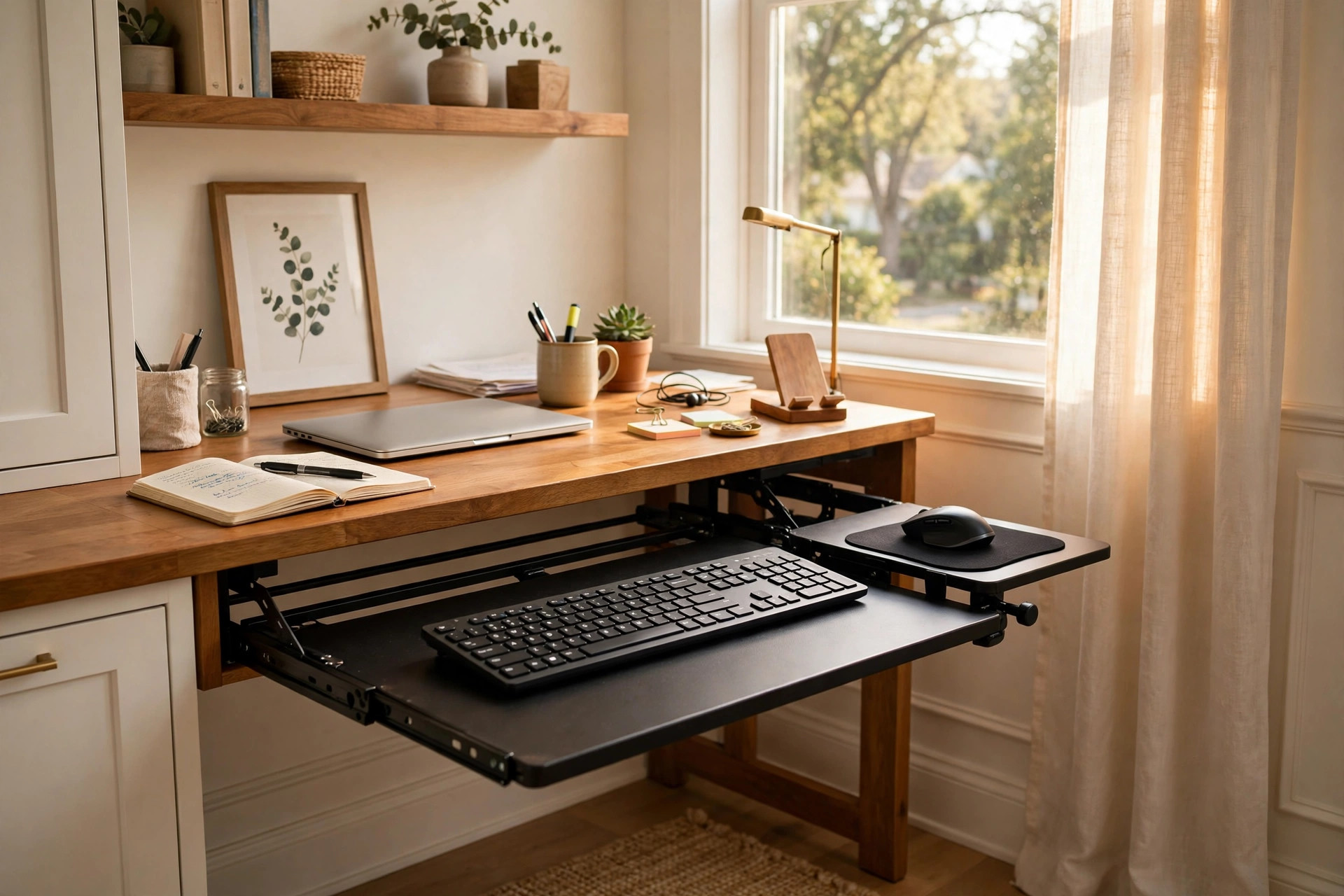

An adjustable under desk keyboard tray ergonomic setup is one of the simplest upgrades a home worker can make. It moves the keyboard and mouse off the desktop and onto a low platform under the desk. This small change can ease wrist strain, reduce shoulder pain, and improve sitting posture. This guide explains what these trays are, how to choose one, and how to use it well.
Why an Adjustable Keyboard Tray Matters
Most desks are built at one fixed height. That height works for writing with a pen, but it is often too high for typing. When the keyboard sits on the desktop, the typist must lift the shoulders and bend the wrists back. After a few hours, this causes fatigue. After a few years, it can lead to real injury.
An adjustable under desk keyboard tray solves this problem. It places the keyboard a few inches below the desktop. The forearms rest in a near-level position. The wrists stay straight. The shoulders drop and relax. The difference feels small, but the effect over a full workday is large.
Doctors who study office work have long agreed that the keyboard should sit at or just below elbow height. Few fixed desks meet that rule for short or average-height users. A tray with height adjustment brings the keyboard down to the right level. It is a practical fix that costs far less than a new desk.
What to Look for When You Choose a Tray: Adjustable under Desk Keyboard Tray Ergonomic
Not all keyboard trays are equal. A good tray has several key features. The first is height adjustment. The tray should move up and down at least a few inches. This lets each user set it to the right level for their body and chair.
The second feature is tilt. The front edge of the tray should drop slightly below the back edge. This keeps the wrists in a neutral line with the forearms. Some trays tilt in one direction only. Better trays tilt both ways and swivel slightly. These small angles matter for comfort.
The third feature is a mouse platform. Many trays come with a small side board for the mouse. Some are fixed on the right side. Others can be moved to the left for left-handed users. A tray without a mouse platform leaves the mouse up on the desktop, which defeats the purpose.
The fourth feature is width and strength. The tray must hold the keyboard and mouse with room to spare. A width of 24 to 28 inches suits most users. The arm that holds the tray should feel firm when typing hard. A wobbly tray is worse than no tray at all.
The fifth feature is easy mounting. Most trays clamp or screw to the underside of the desk. Clamp models install in minutes and leave no marks. Screw-mounted models are stronger but need tools and drill holes. Check that your desk has a solid wood or metal underside before you buy.
Readers who are setting up a full workstation may also want to pair the tray with an ergonomic drafting stool with foot ring or a best laptop stand for standing desk posture for a complete posture-friendly office.
Key Measurements to Take Before You Buy
Measure the thickness of your desktop first. Many clamps fit tops from one to two inches thick. Next, measure the clear space under the desk. The tray and its arm need room to swing and retract. Check that the drawer or modesty panel will not block the motion.
Also measure your sitting elbow height. Sit in your office chair with your feet flat on the floor. Let your arms hang loose at your sides. Bend the elbows to a right angle. The distance from the floor to the underside of your forearm is your ideal keyboard height. Write this number down and compare it with the tray’s adjustment range.
Types of Adjustable Under Desk Keyboard Trays
Tray designs fall into a few broad groups. Knowing them makes the choice easier.
Basic Slide-Out Trays
The simplest tray is a flat board on two rails. It pulls out for use and pushes back when you need the desk space. It has no height or tilt adjustment. It is cheap and easy to install. It suits users who already sit at the right desk height and only want more room on the desktop.
Height-Adjustable Arm Trays
This is the most common type of adjustable under desk keyboard tray ergonomic model. A metal arm clamps to the desk. The platform hangs from the arm and can be raised, lowered, and tilted. A handle under the platform lets you change the height in seconds. This type suits shared desks and users of different heights.
Gel or Foam Edge Trays
Some trays have a soft gel pad along the front edge. The pad supports the wrists during pauses. It does not replace good posture, but it makes resting the hands more comfortable. These trays cost a little more. Users with sensitive wrists often prefer them.
Compact Trays for Small Desks
Compact trays are narrow, often 20 inches wide. They hold a ten-keyless keyboard and a mouse on a small side pad. They fit under narrow desks and in tight home offices. Heavy typists should check the weight rating before choosing a compact model.
Sit-Stand Compatible Trays
These trays mount to standing desks or desk risers. They keep the keyboard at the right height as the desk moves up and down. If you already use a best pen cup holder for office desk organization and other desktop tools, a sit-stand tray keeps your typing zone separate from your storage zone.
You can browse ergonomic office seating and accessories from established makers such as Herman Miller and Steelcase, whose long history in workplace design informs many tray and chair standards used today.
Setting Up Your Tray for Best Results
Buying the tray is only the first step. Setting it correctly is what brings the benefit.
Start with your chair. Sit with your back against the backrest and your feet flat on the floor. If your feet dangle, use a footrest. Raise or lower the chair until your thighs are roughly level and your elbows form a right angle or a slightly open angle.
Now adjust the tray. Pull it out and set the height so the keyboard surface is at or just below your elbow level. Your upper arms should hang close to your body. Tilt the front edge down by about 10 to 15 degrees. The wrists should form a straight line with the forearms, not bent up or down.
Place the mouse on the side platform at the same height as the keyboard. Keep it close to the keyboard so your arm does not stretch sideways. Many users place the mouse too far out. This causes shoulder strain over time.
Finally, adjust your monitor. The top of the screen should sit at or just below eye level. If lowering the keyboard made the monitor feel too high, raise the monitor on a stand or stack of books. The goal is a relaxed neck with the eyes looking slightly down.
Office furniture retailers like IKEA and Wayfair carry a wide range of monitor stands and desk parts that pair well with a new tray. Specialty standing-desk makers such as UPLIFT Desk also publish setup guides for matching tray height to desk height.
Cost and Price Ranges
Prices for an adjustable under desk keyboard tray ergonomic model vary with features and build quality.
Basic slide-out trays cost the least. Most sell for 25 to 60 dollars. They have no height adjustment and simple rails. They are fine for users who only need extra desktop space.
Mid-range adjustable trays cost 80 to 180 dollars. These have height and tilt adjustment, a mouse platform, and a strong arm. This is the sweet spot for most home offices. The build quality is solid enough for daily use over many years.
Premium trays cost 200 to 350 dollars or more. They add features like full swivel, one-handed adjustment, gel wrist pads, and heavier load ratings. They suit users with wrist or shoulder problems who need precise positioning.
Installation costs are low. Most users mount the tray themselves in 20 to 40 minutes. No professional help is needed. If the desk has a metal frame or a very thick top, check the clamp limits before ordering.
To compare prices and read buyer reviews, large home improvement and office supply sites are useful starting points. Product roundups from The Spruce often test tray comfort and build quality in real home offices.
Care and Upkeep
A keyboard tray needs little care, but a few habits will keep it working well for years.
Wipe the platform with a damp cloth once a month. Dust builds up under desks faster than on desktops. If the tray has a gel wrist pad, clean it with mild soap and water. Let it dry fully before typing again.
Check the mounting screws or clamp every few months. Typing creates small vibrations that can loosen fasteners over time. A quick turn of the screws keeps the arm firm. If the tray develops a wobble, tighten the joints on the arm before assuming the tray is worn out.
Oil the sliding rails and arm joints once a year with a light machine oil. Wipe away extra oil so it does not drip on the floor. Do not use heavy grease, which attracts dust.
If the height lever becomes stiff, check for dirt in the mechanism first. A blast of compressed air often fixes it. Do not force a stuck lever. Forcing it can bend the internal parts and void the warranty.
Safety Notes
A keyboard tray is safe when installed and used properly. Still, a few safety points deserve mention.
First, mind the weight limit. Most trays hold 10 to 25 pounds. A heavy keyboard and a mouse are well under that. Do not rest your full body weight on the tray or let children hang from it. The arm can bend or pull loose from the desk.
Second, watch for pinch points. The arm and the tilt joints can pinch fingers when the tray moves. Keep hands clear of the joints when adjusting. Teach children to keep their fingers away.
Third, install the tray squarely under the desk. A tray mounted too far forward can catch on chair arms. A tray mounted too far back is hard to reach and forces the user to lean forward. Test the full range of motion before you tighten the final screws.
Fourth, do not overload the tray with extra gear. Some users stack phones, tablets, and coffee cups on the tray. This crowds the keyboard and raises the risk of spills. Keep drinks on the desktop or on a side table instead.
Independent testing labs review the durability and weight limits of office accessories. Buyers can consult buying guides from PCMag and Wirecutter for model-by-model test results and safety notes.
Frequently Asked Questions
Will a keyboard tray fit under any desk?
Most trays fit desks with a solid flat underside. They need a clear area at least 20 inches wide and a desktop between one and two inches thick. Glass desks, desks with a thin veneer top, and desks with drawers that fill the knee space may not work. Always measure before you buy.
Does a keyboard tray help with carpal tunnel symptoms?
A tray can reduce wrist strain by keeping the wrists straight and the shoulders relaxed. Many users report less pain after switching. But a tray is not a medical treatment. Anyone with lasting numbness, tingling, or pain should see a doctor. Ergonomics supports treatment but does not replace it.
Should the tray hold the mouse too?
Yes. The mouse should sit on the tray at the same height as the keyboard. If the mouse stays on the desktop, the shoulder must lift and reach every time you move it. A tray with a side mouse platform keeps both hands in the same comfortable zone.
How far should the tray extend from the desk?
Pull the tray out far enough that the space bar and the home keys are easy to reach with a slight bend in the elbows. For most people, the front edge of the keyboard sits about 6 to 10 inches from the body. You should not need to lean forward or stretch your arms straight.
Can I use a keyboard tray with a standing desk?
Yes, and many users do. Choose a tray designed for sit-stand use or one with a wide height range. The keyboard must stay at elbow height in both sitting and standing positions. Some standing-desk makers sell matching trays that move with the desk surface.
Is it better to clamp or screw the tray to the desk?
Clamp models install faster and leave no marks, which suits renters and temporary setups. Screw-mounted models are more rigid and better for heavy daily typing. If you choose screws, make sure the desktop is solid wood or thick MDF so the screws hold firmly.
A Short Final Word
An adjustable under desk keyboard tray ergonomic setup is a small investment with a large daily payoff. It brings the keyboard to the right height, keeps the wrists straight, and frees space on the desktop. Choose a model with true height and tilt adjustment, mount it firmly, and take ten minutes to set it to your body. Your wrists and shoulders will feel the difference within the first week.
References
Herman Miller. (n.d.). Office furniture and ergonomic seating. https://www.hermanmiller.com IKEA. (n.d.). Home furnishings. https://www.ikea.com PCMag. (n.d.). Technology product reviews. https://www.pcmag.com Steelcase. (n.d.). Office furniture and workplace research. https://www.steelcase.com The Spruce. (n.d.). Home and garden advice. https://www.thespruce.com UPLIFT Desk. (n.d.). Standing desks and ergonomic office furniture. https://www.uplift-desk.com Wayfair. (n.d.). Furniture and home goods. https://www.wayfair.com Wirecutter. (n.d.). Product reviews from The New York Times. https://www.nytimes.com/wirecutter
Was this guide helpful?

About Michael Thompson
The My Garden US editorial team writes practical, in-depth home and garden guides for American homeowners — tested advice, no fluff.
You May Also Like
Adjustable Height Desk Legs Only for DIY Standing Desks
September 21, 2026 0 views
Compact Treadmill Desk for Walking While Working: A Plain Guide
March 30, 2026 0 views
Home Office Monitor Stand With USB Hub: What to Know Before You Buy
March 28, 2026 0 views