
A Small Tool That Changes How Your Legs Feel at Work
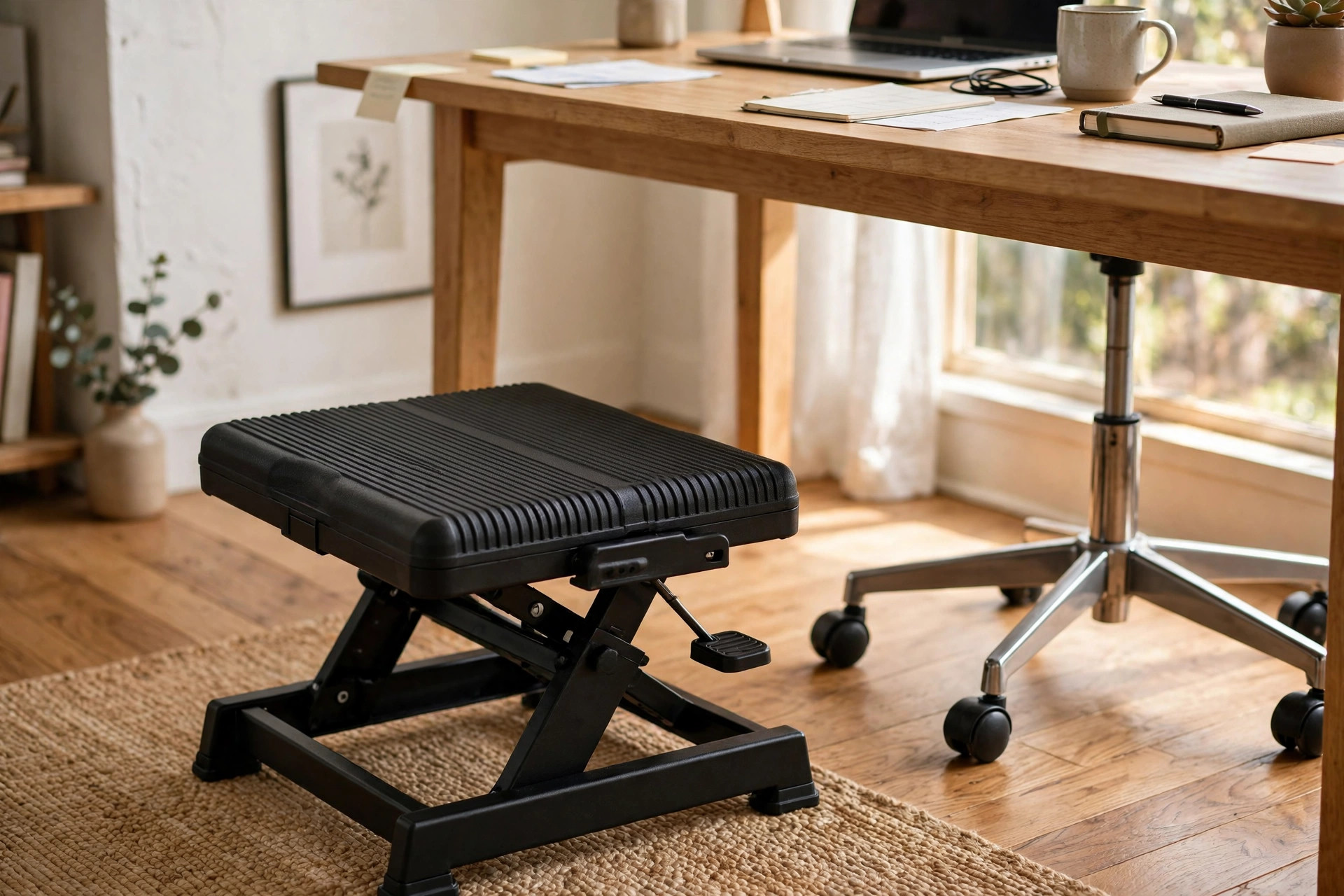
Most people think about the chair when they set up a home office. They think about the desk. They think about the screen. Few people think about where their feet rest. Yet an adjustable footstool for under desk leg support can make a long workday feel much easier on the body.
When you sit for hours, your feet often hang in the air or press flat on a hard floor. The angle of your knees may be wrong. Blood flow to the lower legs slows down. The result is tired legs, sore feet, and a stiff lower back by the end of the day. A footstool that raises and tilts solves this problem in a simple way. It lifts your feet to the right height. It keeps your knees at a comfortable angle. It lets your leg muscles relax.
This article explains why this small item matters so much. It covers what to look for when you buy one. It describes the main types on the market. It gives price ranges, care tips, and safety notes. It also answers common questions. By the end, you will know how to choose a footstool that fits your body and your desk.
Why Leg Support Matters at a Desk: Adjustable Footstool for under Desk Leg Support
The human body was not built for sitting still for eight hours. When you sit, the weight of your upper body presses down through your hips. Your thighs take much of this load. If your feet cannot rest at the right height, your posture suffers.
A good sitting posture follows a simple rule. Your feet should rest flat. Your knees should bend at about ninety degrees. Your thighs should be level with the floor or tilted slightly down. When the chair is too high, your feet dangle. When the floor is too low for your legs, your knees point upward. Both positions strain the body.
An adjustable footstool for under desk leg support fills the gap between your feet and the floor. It raises the feet so the knees sit at the correct angle. The change is small, only a few inches. But the effect on comfort is large.
Shorter workers benefit the most. Many standard desks and chairs are made for people of average height. A footstool corrects this mismatch. Good circulation is another benefit. When feet rest flat on a raised platform, the muscles in the calves stay loose, and blood moves more freely through the lower legs. Swelling in the ankles becomes less likely.
Posture improves as well. When the feet are well supported, the pelvis sits in a more neutral position. The lower back keeps more of its natural curve. Slouching becomes less likely. Over weeks and months, better posture can mean fewer aches. Ergonomic office furniture makers like Herman Miller have long taught that the whole body works as a system, and the feet are part of that system.
What to Look for When You Buy
Shopping for an adjustable footstool for under desk leg support is easier when you know the key features. The market holds many models. Some are simple and cheap. Some have extra features. The list below covers what matters most.
Height Range
The stool must adjust to fit your body and your chair. Look for a model that moves through a range of at least three to five inches. A wider range gives more room to find the right setting. Check the lowest and highest settings before you buy. Sit in your chair, place your feet where they feel right, and measure the gap. Then match that gap to the stool’s range.
Tilt Angle
A flat platform works, but a tilting platform works better. A slight tilt lets you rock the feet gently. This small motion keeps the calf muscles active. Some models lock at several angles. Others tilt freely. Either design is fine. The key point is that your ankles should not feel forced into one rigid position.
Surface Size
The top of the stool should fit both feet side by side with room to spare. A surface about sixteen to eighteen inches wide suits most adults. A surface that is too narrow forces the feet together. A very wide surface may not fit under a small desk. Measure the space under your desk before you order.
Grip and Texture
Your feet may be bare, in socks, or in shoes. The surface should keep them from sliding. Many models have a ribbed or textured top. Some have a fabric cover. A massage-style surface with small bumps is common. These bumps can feel good under bare feet, though some people find them too rough. Choose based on how you will use it.
Weight Capacity
Most footstools hold two hundred to three hundred pounds. This is more than enough for resting feet. Still, check the rating. A higher rating usually means a sturdier frame. If the stool will sit on carpet, a wider base adds stability.
Frame and Build Quality
Look at the legs and the joints. Metal frames last longer than thin plastic ones. The height adjustment should lock firmly with no wobble. Read reviews of office gear at PCMag or buying guides from Consumer Reports to learn which models hold up over time.
Under-Desk Fit
Measure the clear space under your desk. Note the height from the floor to the underside of the desk, and the width between the legs or side panels. The footstool must slide in and out freely. It should not hit the modesty panel or the desk legs when you adjust it.
Types of Adjustable Footstools
Not all footstools work the same way. The main types differ in how they adjust and what they are made of. Knowing the types helps you pick the right one.
Bar-Adjustment Footstools
These are the most common type. A bar or lever under the platform changes the height in steps. The design is simple and reliable, and prices are modest. This type suits most home offices.
Free-Tilt Rocking Footstools
These models tilt forward and back as you move your feet. The rocking motion keeps the calf muscles gently active. This suits people who feel restless during long desk days.
Cushioned Top Footstools
These have a padded top covered in fabric or vinyl. The cushion feels soft under bare feet. Check the quality of the foam, since cheap padding wears down in a few years.
Wedge and Slant Boards
These are simple angled boards, some with adjustable angles. They take up little space and work well for people who mainly want a tilt rather than a height change.
Footstools With Massage Rollers
Some footstools add rollers or textured bars to the surface. Rolling the feet over them during the day can ease tension. This is a comfort extra, not a medical treatment.
Home stores like Lowe’s and The Home Depot carry several of these types, and major retailers such as Amazon offer a wide range with buyer reviews.
Cost and Price Ranges
An adjustable footstool for under desk leg support does not have to cost much. Prices vary with build quality and features. The ranges below are typical for the American market.
Budget models, fifteen to thirty dollars. These are usually plastic with a simple height adjustment. They do the basic job. The surface may be smaller, and the frame may flex under pressure. For light use, they are fine.
Mid-range models, thirty to sixty dollars. This is the sweet spot for most buyers. You get a metal frame, several height settings, and a textured non-slip surface.
Premium models, sixty to one hundred dollars and up. These offer cushioned tops, massage features, or heavier-duty frames. Office furniture specialists like Steelcase and standing-desk maker UPLIFT Desk sell ergonomic accessories in this tier.
When you compare prices, look at the cost per year of use. A forty-dollar stool that lasts five years costs eight dollars a year. Budget-friendly options from IKEA and furniture sites like Wayfair can be good value, but check the reviews first.
Remember that a footstool is one part of the home office. You may also need a rolling cart for home office printer stand to keep the printer within reach, and a home office storage box for tax records usa to keep papers in order. Plan the whole space so each item fits together.
How to Set Up Your Footstool
Buying the right model is only half the job. Setting it correctly matters just as much. Follow these steps for the best result.
1. Sit in your office chair at your normal working height. 2. If your feet do not reach the floor comfortably, adjust the footstool upward until your feet rest flat on it. 3. Set the tilt so your ankles feel relaxed. A slight forward tilt often feels natural. 4. Slide the stool so it sits under your knees, not too far forward and not too far back. 5. Work for an hour and notice how your legs feel. Move the height one notch if needed, and give your body a day or two to adapt.
When you stand, push it aside. Keep the floor space clear so you can move freely.
Care and Upkeep
A footstool is a simple item, and it needs little care. A few basic habits will keep it working well for years.
Clean the surface regularly. Dust and dirt collect on the top. Wipe a plastic or metal surface with a damp cloth. For fabric covers, vacuum the surface or spot-clean with mild soap and water. Let it dry fully before use.
Check the adjustment lock. Every few months, test the height lock. Press the bar and move the platform through its range. It should lock firmly at each setting with no slipping. If it slips, stop using it and contact the maker or replace it. A stool that drops suddenly can startle you and strain your legs.
Inspect the feet and base. The stool should sit flat on the floor without rocking. If it has rubber feet, check that they are still in place. Missing rubber feet let the stool slide on hard floors. Replacement feet are cheap and easy to fit.
Keep it dry. Do not leave the stool in a damp area. Moisture can rust metal frames and harm fabric covers. If you spill a drink on it, dry it right away.
Store it with care. If you need to put the stool away, set it to its lowest height. This protects the adjustment parts. Do not stack heavy boxes on it. The frame is built for foot pressure, not for heavy loads.
Safety Notes
Footstools are safe when used as intended. Still, a few safety points deserve mention.
Use it only for feet. Do not stand on the footstool. It is not a step stool. Standing on it can tip it over and cause a fall. If you need to reach a high shelf, use a proper step stool instead.
Keep cords away. Desk areas often have power cords and cables under the desk. Keep them clear of the footstool so they do not snag when you slide it. Tangled cords are a trip hazard.
Watch the edges. Some metal models have firm edges. If you have small children or pets who play under the desk, choose a model with rounded edges or a soft cover.
Mind your posture. A footstool supports good posture, but it cannot fix a bad chair or a desk at the wrong height. If you still feel pain after setting up the footstool, look at the rest of your workstation. Your screen, keyboard, and chair all play a part.
Take breaks. Even with perfect leg support, sitting all day is hard on the body. Stand up, stretch, and walk for a few minutes every hour. No accessory replaces movement.
Frequently Asked Questions
Do I really need an adjustable footstool, or is a fixed one enough?
A fixed footstool works if its height happens to match your body. The problem is that most people cannot know the right height until they try. An adjustable model lets you test settings and change them later. If you switch chairs or desks, you can adjust the stool to match. For these reasons, adjustable models are the safer buy.
What height should I set my footstool to?
There is no single correct height. The right setting is the one that lets your feet rest flat with your knees at about ninety degrees. Start in the middle of the range and move up or down one step at a time. Your legs should feel relaxed, not lifted or pressed.
Can a footstool help with back pain?
It can help when the pain comes from poor sitting posture. Raising the feet lets the pelvis sit more evenly, which eases strain on the lower back. If pain lasts more than a few weeks, see a doctor or a physical therapist.
Will a footstool work on carpet?
Yes, but choose carefully. On thick carpet, a stool with small feet may sink or wobble. Look for a model with a wide base that spreads the weight. Some users place a flat board or a chair mat under the stool on deep carpet to keep it stable.
How do I keep the footstool from sliding on a hard floor?
Choose a model with rubber or non-slip feet. If the stool still slides, place it on a small rug or a non-slip mat that lies flat.
Can I use a footstool with a standing desk?
Yes. Use the footstool during the hours you sit, and slide it out of the way when you stand.
A Short Final Word
A home office is made of small choices. The chair, the desk, the screen height, and the lighting all matter. The support under your feet matters too. An adjustable footstool for under desk leg support is one of the cheapest upgrades you can make, and it pays off every single day in comfort.
Take the time to measure your space and your sitting height. Pick a sturdy model with a good range of adjustment. Set it with care, and give your body a few days to adapt. Your legs will feel lighter. Your posture will improve. And the long hours at the desk will feel a little easier.
If you are finishing out the room, small touches help as well. A home office wall art for professional background can make video calls look better, and the right accessories from trusted sellers can round out a space that works as good as it looks.
References
Amazon. (n.d.). Online shopping. https://www.amazon.com Consumer Reports. (n.d.). Product reviews and ratings. https://www.consumerreports.org Herman Miller. (n.d.). Office furniture and ergonomic seating. https://www.hermanmiller.com IKEA. (n.d.). Home furnishings. https://www.ikea.com Lowe’s. (n.d.). Home improvement products. https://www.lowes.com PCMag. (n.d.). Technology product reviews. https://www.pcmag.com Steelcase. (n.d.). Office furniture and workplace research. https://www.steelcase.com The Home Depot. (n.d.). Home improvement products. https://www.homedepot.com UPLIFT Desk. (n.d.). Standing desks and ergonomic office furniture. https://www.uplift-desk.com Wayfair. (n.d.). Furniture and home goods. https://www.wayfair.com
Was this guide helpful?

About Jennifer Lee
The My Garden US editorial team writes practical, in-depth home and garden guides for American homeowners — tested advice, no fluff.
You May Also Like
Small Corner Standing Desk for Apartment Living
January 27, 2026 0 views
Adjustable Laptop Desk for Bed and Couch Use
January 5, 2026 0 views
Ergonomic Laptop Riser for Standing Desk Height: What to Know Before You Buy
July 23, 2026 0 views