
When you buy landscape lighting transformers online in Colorado, a little planning goes a long way. The right transformer powers your whole yard lighting system. The wrong one leaves some lights dim and others burned out. This guide walks you through the whole process in plain terms. You will learn what a transformer does, how to pick the right size, what prices to expect, and how to order with confidence from your home in Denver, Boulder, or anywhere else in the state.
Why It Matters
Landscape lights do not run on house current. Most outdoor fixtures use low voltage, usually 12 volts. A transformer takes the 120-volt power from your outlet and steps it down to a safe level. Without it, your path lights and spot lights cannot work at all.
A good transformer also protects your investment. Quality landscape lighting fixtures cost real money. Voltage spikes and overloads shorten their life. The transformer stands between your house wiring and your lights. It keeps the current steady and safe. That means fewer burned out bulbs and fewer repair calls.
In Colorado, yard lighting takes on added importance. Winter nights come early and last long. A well lit walkway makes the front steps safer in snow and ice. Light also adds curb appeal. Real estate agents say that first impressions start at the street. Soft lighting on a walkway or a stone wall makes a home look cared for all year round.
Buying online makes sense for Colorado homeowners. Local stores carry a limited stock. They may not carry the exact wattage you need. Online stores show the full line. You can compare models side by side. Reviews from other buyers tell you how a unit held up in real weather. Shipping to Colorado usually takes only a few days.
What to Look For When You Buy: Buy Landscape Lighting Transformers Online in Colorado
Not all transformers are the same. Here are the points that matter most.
Get the Wattage Right
Wattage is the main number. Each light fixture draws a certain number of watts. Add up the watts of every light on the circuit. Then buy a transformer rated above that total.
The rule of thumb is simple. Add 25 percent to your total. If your lights draw 200 watts, buy a 300-watt transformer. The extra room keeps the unit from running hot. It also leaves space to add more lights later. Many homeowners add fixtures a year or two after the first install. A larger transformer saves you from buying twice.
Common sizes are 100, 200, 300, and 600 watts. Most single-family homes in Colorado land in the 200 to 300 range. Count your fixtures before you shop. Write the wattage of each one on paper. Then do the math. This one step avoids most problems.
Choose the Timer and Controls
Transformers come with different control options. The simplest units have a manual switch. Better units have a built-in timer. The timer turns lights on at dusk and off at a set time. That saves energy and means you never forget.
Photocell sensors are another good option. A photocell detects darkness. It turns the lights on at sunset and off at sunrise. This is very useful in Colorado winters when sunset times shift week to week. Some models add a countdown timer as well. You can set the lights to turn off at midnight instead of burning all night.
Smart models connect to a phone app. They let you change schedules from your couch. They cost more. For most yards, a simple timer and photocell do the job well.
Check the Enclosure Rating
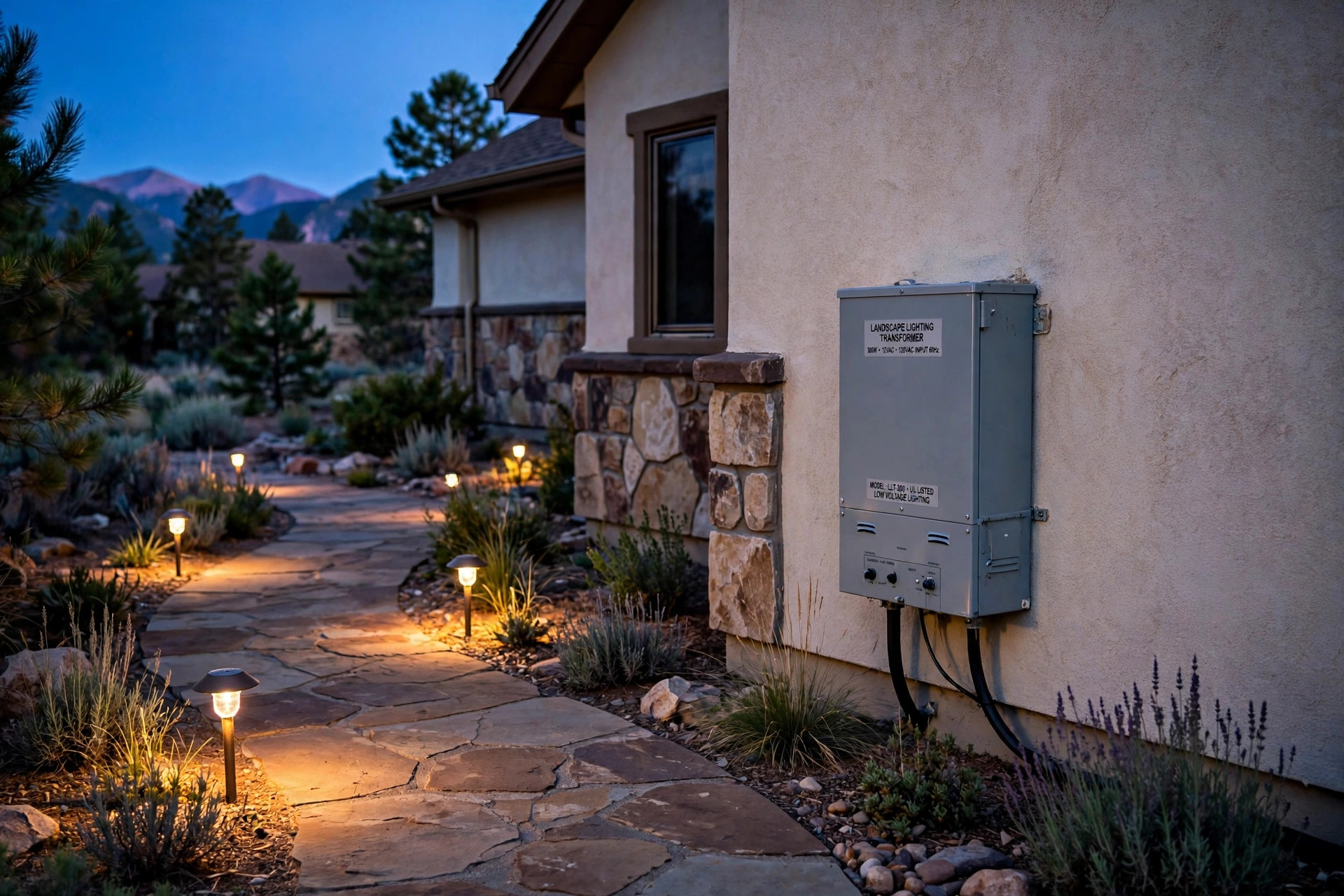
Colorado weather is tough on outdoor gear. Summer brings hail and strong sun. Winter brings snow and deep cold. Look for a weatherproof enclosure. A NEMA 3R rating means the case keeps rain out. Stainless steel cases resist rust and last longer than painted steel.
Mount the transformer where it stays dry. Under an eave is ideal. Keep it at least a foot above the ground. Snow drifts can bury a low unit. Also keep it close to an outdoor GFCI outlet. Long runs of high voltage cable add cost.
Look for Multiple Taps
Good transformers have multiple voltage taps. These are terminals marked 12, 13, 14, and 15 volts. They let you compensate for voltage drop along long wire runs. Lights far from the transformer can run dim. Moving them to a higher tap fixes the problem. This feature matters on large Colorado lots. If your yard is an acre or more, multiple taps are a must.
Types and Options
Transformers fall into a few main types. Knowing the differences helps you spend wisely.
Magnetic transformers are the old standard. They use a heavy coil of wire. They hum a little. They are very durable. Many units from the 1980s still run today. They weigh more and cost more to ship. For a permanent install, they are hard to beat.
Electronic transformers are lighter and smaller. They run silent. They work well with LED fixtures. They can be sensitive to heat. In a hot garage or a sun-baked wall, a magnetic unit may last longer.
Plug-in transformers mount right at the outlet. They suit small systems of six to ten lights. Installation takes minutes. Larger systems need hardwired units with circuit breakers on each zone.
Multi-zone transformers have two or three separate outputs. Each zone has its own breaker. You can run path lights on one zone and tree lights on another. If one zone trips, the others stay lit. This is the best choice for a full yard plan.
LED fixtures have changed the market. LEDs draw far less power than old halogen bulbs. A system that once needed 600 watts may now need 200. If you plan to use LEDs, you can buy a smaller and cheaper transformer. Check fixture wattage before you decide. Online listings show this clearly.
Cost and Price
Prices vary with size and features. Here is a fair picture of the market.
A small 100-watt plug-in unit costs about 40 to 80 dollars. These suit small beds and short paths. A 200 to 300-watt unit with a timer runs 120 to 250 dollars. This is the sweet spot for most homes. A 600-watt multi-zone unit costs 300 to 500 dollars. Professional grade units run higher.
Shipping to Colorado is usually free from major online stores. Some charge a small fee for heavy units. Factor that into the price. Also budget for wire and connectors. A 500-foot spool of 12-gauge landscape wire costs about 100 dollars. Waterproof wire nuts and connectors add another 30 to 50 dollars.
Watch for sales in spring and fall. Stores clear inventory before new models arrive. Buying off season can save 15 to 20 percent. If your project can wait a month, the savings are worth it.
Be careful with prices that seem too low. Very cheap transformers often lack good surge protection. Colorado storms bring lightning. A cheap unit may fail after one strike. Spending a bit more on a known brand pays for itself in years of service.
Care and Upkeep
A transformer asks for little. A few simple habits keep it running for decades.
Check the unit each spring. Open the case and look for nests. Mice and wasps like warm boxes. Clear away any debris. Tighten the terminal screws. Wires loosen over time. Loose wires get hot and can melt insulation.
Test the timer after daylight saving time changes. Clocks drift. A timer set in March may be off by October. Walk the yard at night once a season. Look for dim or dead fixtures. One dead bulb can signal a wire problem. Catch it early.
Keep the vents clear. Transformers shed heat through vents in the case. Leaves and grass clippings block them. Brush the case clean in fall. Do not pile mulch against it. Leave a foot of open space all around.
If you add new lights, redo the wattage math. Stay under 80 percent of the rated capacity. Overloading shortens the life of the unit. It can also trip the breaker on cold nights when resistance rises.
Safety
Low voltage is safer than house current. It still demands respect. Follow these rules.
Always plug the transformer into a GFCI outlet. A GFCI cuts power if it senses a fault. Most Colorado homes built after 1990 have GFCI outlets outside. Older homes may not. An electrician can add one for a fair price.
Turn off power before you touch any wire. Even 12 volts can spark. Sparks near dry grass are a fire risk in Colorado summers. Keep wire connections in waterproof boxes. Bury cable at least six inches deep. Use a trenching shovel to cut a clean slot.
Do not run low-voltage wire in the same conduit as house wiring. Keep them separate. Do not overload the circuit. If the breaker trips more than once, find the cause. A repeated trip means a short or an overload. Do not just reset it and walk away.
When you buy landscape lighting transformers online in Colorado, check that the unit is UL listed or ETL listed. These marks mean an independent lab tested it for safety. Units without the marks may not meet code. Your home insurance may also care. A listed unit protects you in every sense.
Frequently Asked Questions
What size transformer do I need for my yard?
Add up the wattage of all your planned fixtures. Then add 25 percent. Buy a transformer rated at or above that number. For most Colorado homes with 15 to 25 LED fixtures, a 200 to 300-watt unit is right. Count before you shop.
Can I install a landscape lighting transformer myself?
Yes, in most cases. Plug-in units need no wiring skills. You mount the box, run the low-voltage cable, and connect the fixtures. The work is simple and safe. Hardwired units and new GFCI outlets are best left to a licensed electrician. Check local code in your city. Denver and Boulder have their own rules.
How long do landscape lighting transformers last?
A quality magnetic transformer lasts 15 to 25 years. Electronic units last 8 to 12 years. Weather, overload, and lightning strikes shorten life. Mounting the unit in a sheltered spot and keeping it clean adds years.
Do transformers work with LED landscape lights?
Yes. Most modern transformers work fine with LEDs. Electronic transformers pair especially well with LED fixtures. Check that the total LED wattage is not too low for the unit. Some older magnetic transformers need a minimum load to regulate well. The product specs will state the minimum.
Where should I mount the transformer?
Mount it on a wall near a GFCI outlet. Keep it at least one foot off the ground. Place it out of direct sprinkler spray. Under an eave or on a garage wall works well. Keep it within easy reach for timer changes. Do not hide it behind shrubs where you cannot service it.
Should I buy one big transformer or two small ones?
One big unit costs less per watt. Two small units give you backup. If one fails, half your yard stays lit. On large properties, two units also shorten wire runs. That cuts voltage drop. For most homes, one right-sized unit is fine. For lots over half an acre, consider two.
Pairing With Other Exterior Projects
A transformer is one part of a larger yard plan. Many homeowners tackle lighting along with other exterior work. New professional grade exterior lighting fixtures can refresh the look of entry doors and patios while the low-voltage system handles the garden. A clean facade matters too, and top rated house power washing services can wash away a season of dust before you aim the new spot lights. Some yards also gain a shaded seating area, and comparing pergola installation kits is a natural next step once the wiring is done.
Lighting choices also connect to safety guidance from public agencies. The Consumer Product Safety Commission publishes advice on outdoor electrical safety that every homeowner should read before starting a project. Energy guidance from the U.S. Department of Energy covers efficient outdoor lighting and can help you pick low-wattage options that cut the electric bill.
Retailers make comparison shopping easy. Lowe’s stocks a wide range of transformers with buyer reviews from all over the country. Project guides from This Old House walk through real installs step by step. The how-to library at Family Handyman answers common wiring questions with clear photos.
For efficiency, the ENERGY STAR program rates outdoor lighting products and explains what the labels mean. Home idea sites like The Spruce show how lighting fits into full yard designs. Builders and remodelers trust siding makers such as James Hardie and CertainTeed for exterior products that pair well with a finished landscape.
A Short Final Word
Buying a landscape lighting transformer online in Colorado is a simple project with a big payoff. Count your fixtures. Size the unit with room to grow. Choose a timer or photocell that fits your habits. Buy from a trusted store and check the safety marks. Install it with care and keep it clean. Your yard will glow on the darkest winter night, and you will know every light is powered right.
References
CertainTeed. (n.d.). Building materials and exterior products. https://www.certainteed.com ENERGY STAR. (n.d.). Energy efficient products. https://www.energystar.gov Family Handyman. (n.d.). DIY home repair and maintenance. https://www.familyhandyman.com James Hardie. (n.d.). Fiber cement siding and exterior products. https://www.jameshardie.com Lowe’s. (n.d.). Home improvement products. https://www.lowes.com The Spruce. (n.d.). Home and garden advice. https://www.thespruce.com This Old House. (n.d.). Home renovation guidance. https://www.thisoldhouse.com U.S. Consumer Product Safety Commission. (n.d.). Product safety information. https://www.cpsc.gov U.S. Department of Energy. (n.d.). Energy efficiency and renewable energy. https://www.energy.gov
Was this guide helpful?

About Jennifer Lee
The My Garden US editorial team writes practical, in-depth home and garden guides for American homeowners — tested advice, no fluff.
You May Also Like

Reliable Storm Door Installation in Florida: What Homeowners Need to Know
August 25, 2026 0 views
Low Maintenance Siding Color Visualizer Tools Buying Guide
January 27, 2026 0 views
Budget Friendly Metal Siding for Homes: A Complete Buying Guide
July 11, 2026 0 views