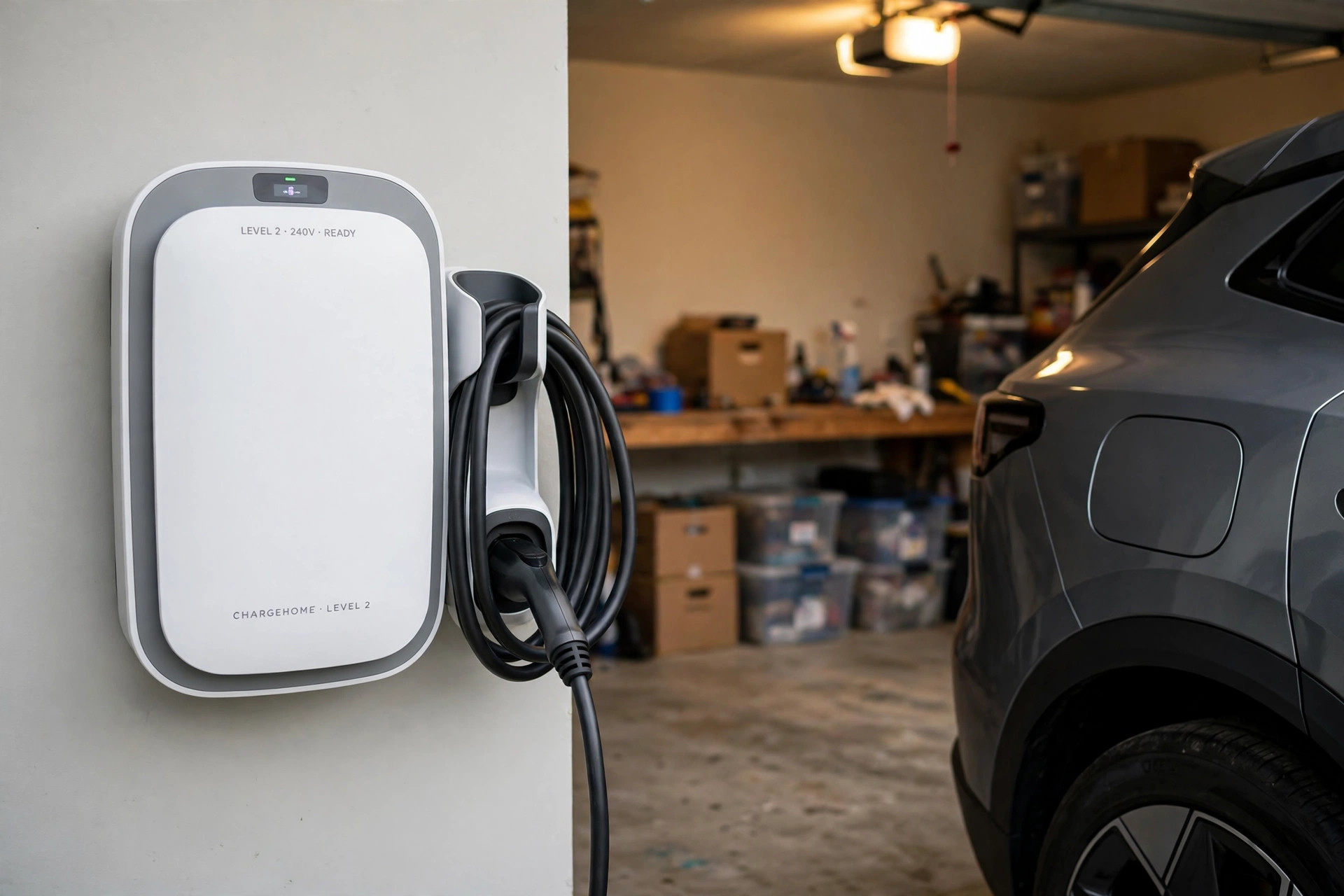

An electric car changes how you think about fuel. You no longer stop at a gas station. You fill up at home. The small charging cord that came with the car works, but it is slow. On a normal wall outlet it can add only two to five miles of range per hour. A full charge can take a day or more. A level 2 charger fixes that problem. It uses a 240-volt circuit, like the one that runs a clothes dryer. It can add 25 to 60 miles of range per hour. Most cars charge overnight while you sleep.
That is why interest in the best level 2 charger for garage reviews usa keeps growing. American drivers read reviews to learn which chargers are safe, fast, and easy to use. They want to know what each model costs and what the install will take. This guide pulls those review themes together in plain words. It covers power, cables, smart features, types, cost, care, and safety. It ends with answers to common questions. No jargon. No sales talk. Just what a homeowner needs to know.
Why a Level 2 Charger Matters
Speed is the first reason. A level 1 cord draws power at 120 volts. That is fine for a short daily drive. It falls behind when the battery is large or the commute is long. A level 2 unit draws power at 240 volts. It can refill a 250-mile battery in about six to eight hours. You plug in at night and wake up full.
Cost is the second reason. Many power companies charge less for electricity at night. A smart charger can be set to charge only during those cheap hours.
Control is the third reason. Most level 2 chargers connect to a phone app. The app shows how much power went into the car. It shows the cost of each session. It can remind you to plug in. Some models let you share one circuit between two cars. For a busy family, that kind of control removes guesswork.
There is also a home value angle. A garage with a real charger attracts buyers, much like a new smart smoke and CO combo or a modern doorbell.
What to Look for When You Choose: Best Level 2 Charger for Garage Reviews Usa
Reviews point to the same short list of features again and again. Work through them before you buy.
Charging Power
Power is measured in amps. Common ratings are 32, 40, and 48 amps. A 32-amp unit adds about 25 miles of range per hour. A 48-amp unit adds about 37 miles per hour. More is faster, but faster is not always better for you.
Your home must be able to feed the charger. A 48-amp charger needs a 60-amp circuit. A 32-amp charger needs a 40-amp circuit. An electrician must check your panel first. Many older homes have 100-amp panels that are already full. The charger may need a panel upgrade, or you may choose a lower-amp model. Reviews warn buyers about this often. Decide on power only after the electrician sees your panel.
Adjustable chargers are worth a look. They let you dial the amps up or down in the app. That helps if your panel is tight on space. You can set the charger to fit what your home can give.
Cable Length and Plug Type
Cable length matters more than most buyers expect. Standard cables run 18 to 25 feet. Think about where the car parks. Think about where the panel sits. A short cable that cannot reach is a daily annoyance. Measure the path the cable will take along the wall and across the floor. Then buy with room to spare.
Plug type is the next question. Most non-Tesla cars in the United States use the J1772 plug. Tesla cars use the NACS plug, which Tesla opened to other makers. Many new chargers now ship with a NACS plug or include an adapter. Some wall units have a built-in adapter dock that holds both types. If your family has two cars with different plugs, look for that kind of setup.
Smart Features
Wi-Fi is now standard on most reviewed models. The app lets you schedule charging for cheap-rate hours. It tracks energy use by day, week, and month. It can send an alert when charging stops. Some apps connect to your power company to earn rebates for off-peak charging.
Voice control is less common but growing. A few apps work with popular voice assistants sold through stores like the Google Store. You can ask for the charge status without opening the app. This is a nice extra, not a must-have.
Look for load sharing if you own two electric cars. Two chargers can share one circuit and split the power. The apps manage the split on their own. That can save hundreds of dollars on electrical work.
Build Quality and Weather Rating
Many garages are not sealed against weather. Dust, heat, and cold all reach the charger. Reviewers praise metal housings over thin plastic. They also check the outdoor rating. A NEMA 4 rating means the unit can stand up to rain and hose spray. A NEMA 3R rating is a step down but still fine for a covered spot.
The cable itself should feel thick and flexible in cold weather. Cheap cables stiffen in winter and fight you every night.
Types and Popular Options
Chargers fall into two main types: plug-in and hardwired.
A plug-in charger uses a large outlet, most often a NEMA 14-50. You mount the unit on the wall and plug it in. The outlet must be wired for the full load. The big plus is that you can unplug the charger and take it with you if you move. The minus is that outlets add a weak point. Heavy plugs and heat can wear them over time. Reviewers say to buy an industrial-grade outlet, not the cheapest one at the store.
A hardwired charger connects straight to the wires in the wall. There is no plug and no outlet. This is the safer setup for high power. Units above 40 amps are often hardwired only. The minus is that moving the charger takes an electrician. Many owners accept that trade for the cleaner, stronger install.
A third option is the portable travel charger. It is small and rides in the trunk. It can plug into different outlets with adapters. It is slower than a wall unit. Think of it as a backup, not a daily solution.
Names that come up often in consumer testing and tech press include the ChargePoint Home Flex, the Tesla Universal Wall Connector, the Emporia EV Charger, and the Grizzl-E. Read several reviews before you pick. Sites like CNET, PCMag, and The Verge all publish detailed charger tests each year.
Cost and Price
The charger itself usually costs between 300 and 700 dollars. Basic 32-amp models sit at the low end. Smart 48-amp models with long cables sit at the high end. Price gaps of 100 dollars often come down to the app, the cable length, or the brand name.
Install cost varies more. A simple install near the panel can run 500 to 800 dollars. A long wire run across the garage can push it past 1,200 dollars. A panel upgrade can add 1,500 to 3,000 dollars. Get two or three quotes from licensed electricians. Ask each one to list the wire length, the breaker size, and the permit fee.
There is good news on taxes and rebates. A federal tax credit for home charger installs has been in place for years. It can cover a large share of the cost. Rules change, so check the current law with a tax adviser before you count on it. Many power companies also offer rebates of 200 to 500 dollars for smart chargers. Some sell the charger itself at a discount. Call your utility before you buy. That one call can save real money.
When you compare reviews, do not look at the unit price alone. Add the install and subtract the rebates. That total is the true cost.
Care and Upkeep
A wall charger needs little care, but a little care goes a long way.
Keep the plug clean. Wipe the pins with a dry cloth once a month. Dust and road grit build up on the handle. A clean plug seats better and runs cooler.
Check the cable twice a year. Look for cuts, flat spots, or cracks in the jacket. Do not run the cable under the car tire. Do not let the car door pinch it. Hang the cable on its holster after each use. A cable left on the floor wears out fast.
Keep the unit dry inside. If your charger sits outside the garage, check the seals after storms. Make sure the door or cover closes fully. Water and high voltage do not mix.
Watch for heat. The plug and the cable end get warm during charging. That is normal. They should never be hot enough to hurt your hand. If you smell burning plastic or see marks on the pins, stop using the charger and call an electrician.
Safety
Electricity at this level demands respect. A level 2 charger draws as much power as an electric stove. Safe install and safe habits matter more than any feature.
Hire a licensed electrician. This is not a do-it-yourself job for most homeowners. The work needs the right wire gauge, the right breaker, and a permit in most towns. The inspector checks the work before you use it. That inspection is your safety net.
Do not use extension cords. Standard cords cannot carry this much current. They overheat and melt. If the charger cannot reach the car, move the charger or buy a longer-cable model.
Keep the area clear. Do not stack boxes against the charger. Air must flow around the unit so it can shed heat. Keep flammable liquids like gas cans far from the charging area.
Check for recalls. The federal safety agency tracks product recalls, and its site is worth a visit before any big purchase. You can search its database at CPSC for past charger recalls. Register your charger with the maker so you get recall notices by email.
Teach the household the basics: how to stop a charge, never to force a plug that does not fit, and that the cable is not a toy.
Home safety works best as a system. A charger is one part. Cameras, alarms, and detectors are others. Many owners who research chargers also compare floodlight cameras without subscriptions or read a Ring vs Nest doorbell comparison while they plan their garage setup. Firms like Ring, ADT, and SimpliSafe all sell gear that pairs well with a modern garage.
Frequently Asked Questions
Do I need a level 2 charger, or is the cord that came with the car enough? It depends on your driving. If you drive under 30 miles a day, the stock cord may keep up. If you drive more, or if you want a full battery each morning, a level 2 charger is worth it. Most reviewers say the upgrade is the single best purchase after the car itself.
Can I install a level 2 charger myself? In most cases, no. The install needs a 240-volt circuit, a permit, and an inspection. A licensed electrician does this work in a few hours. Some plug-in models are simpler, but the outlet still needs proper wiring. Poor wiring is a fire risk.
How long does it take to charge with a level 2 charger? Most cars gain 25 to 40 miles of range per hour. A car with a 250-mile battery charges from empty in about six to nine hours. In daily life you rarely charge from empty. A few hours each night is enough for most drivers.
Will a level 2 charger work with any electric car? Almost. J1772 plugs fit nearly all non-Tesla cars. NACS plugs fit Teslas and newer cars from other makers. Adapters cover the rest. Check your car manual for the plug type and the fastest charge rate the car can take. A car that tops out at 32 amps gains nothing from a 48-amp charger.
Does charging at home raise my electric bill a lot? It raises it, but less than gas costs. Driving 1,000 miles a month on home power often costs 30 to 60 dollars, depending on local rates. Night-rate plans cut that further. The charger app shows the exact cost per session, so there are no surprises.
Is it safe to charge in the rain? Yes, if the charger is rated for it. Plugs and car ports are sealed against water. Chargers with a NEMA 4 rating are built for wet spots. Still, keep connections off the ground and out of puddles. If anything looks damaged, do not charge until it is checked.
A Short Final Word
The best level 2 charger for garage reviews usa agree on the basics. Buy the right power for your panel. Get a cable long enough to reach with ease. Pick a maker with a good app and a real warranty. Hire a licensed electrician for the install. Do those four things and the charger will serve you well for years. Every morning starts with a full battery. That is the quiet payoff that reviewers keep coming back to.
References
ADT. (n.d.). Home security and automation. https://www.adt.com CNET. (n.d.). Technology news and reviews. https://www.cnet.com Consumer Reports. (n.d.). Product reviews and ratings. https://www.consumerreports.org Google Store. (n.d.). Smart home devices. https://store.google.com PCMag. (n.d.). Technology product reviews. https://www.pcmag.com Ring. (n.d.). Smart home security devices. https://www.ring.com SimpliSafe. (n.d.). Home security systems. https://www.simplisafe.com The Verge. (n.d.). Technology news and reviews. https://www.theverge.com U.S. Consumer Product Safety Commission. (n.d.). Product safety information. https://www.cpsc.gov
Was this guide helpful?

About Robert Taylor
The My Garden US editorial team writes practical, in-depth home and garden guides for American homeowners — tested advice, no fluff.
You May Also Like
Best WiFi Sprinkler Timer Reviews 2026 USA: A Plain Guide for Homeowners
January 10, 2026 0 views
Window Security Film Installation Cost USA: A Plain Guide
February 12, 2026 0 views
Solar Lease vs Buy Comparison USA 2026: A Plain Guide for Homeowners
April 10, 2026 0 views