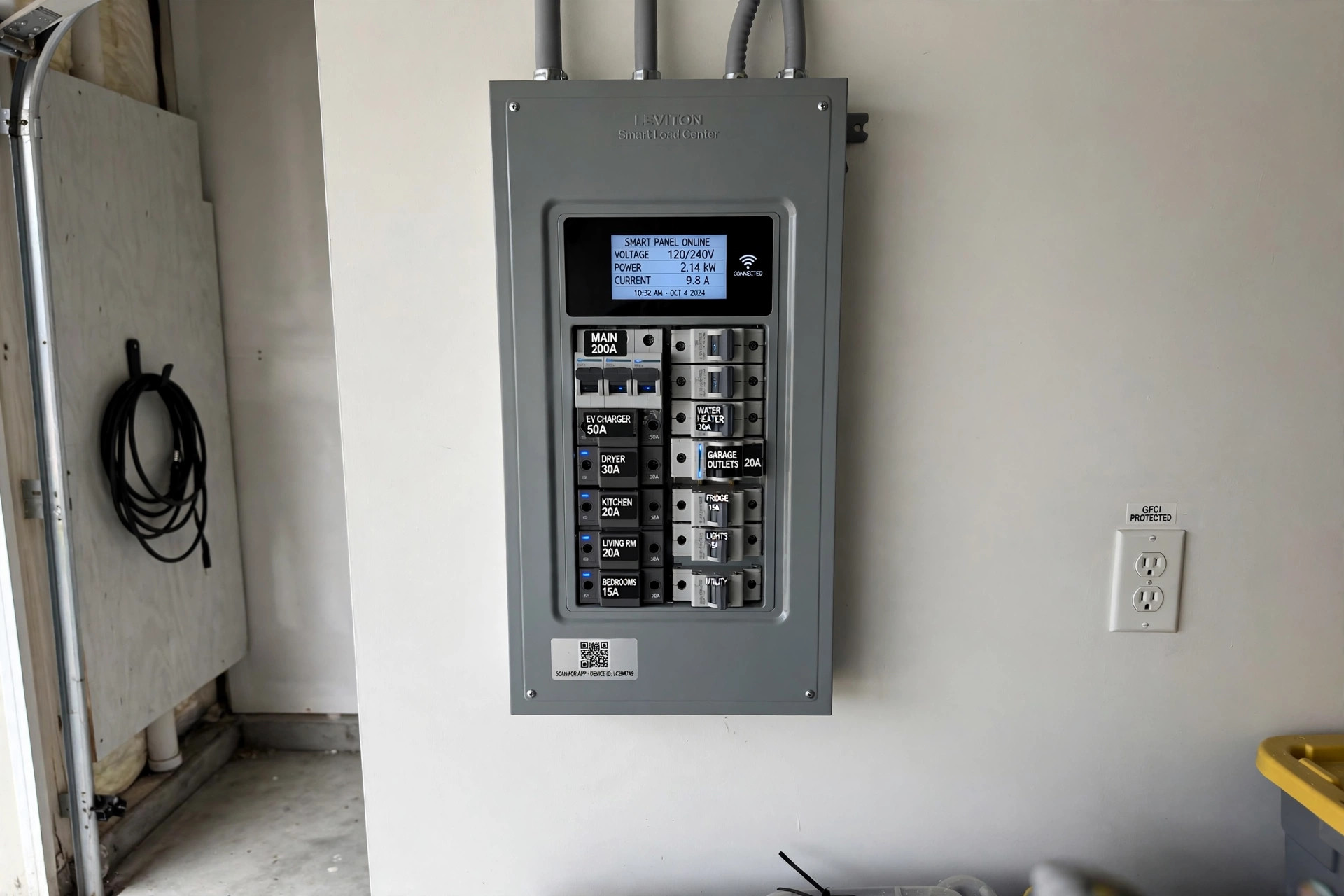

If you are reading smart circuit breaker panel reviews 2026 USA to plan an upgrade, this guide will help you. A smart breaker panel does the same basic job as an old electrical panel. It protects your home from overloads and short circuits. But it also adds new tools. You can see the power use of each circuit on your phone. You can turn circuits on and off from far away. You can get an alert when a breaker trips while you are not at home. For many home owners, that mix of safety and data is worth the price.
Why a Smart Panel Matters
An old breaker panel is silent. It sits in the garage or the basement. You only think about it when a breaker trips. Then you walk to the panel and flip the switch back. That is all it does.
A smart panel changes that. It gives each circuit its own sensor. The panel sends data to an app on your phone. You can see how much power the air conditioner used last night. You can see that the garage freezer is drawing more power than last year. You can turn off the guest room outlets while you are on vacation.
That data helps in three ways. First, it can cut your electric bill. When you see which circuits waste power, you can change your habits. Second, it helps you find problems early. A circuit that draws more power than normal can point to a worn motor or a bad connection. Third, it gives you control. If a space heater is left on in the spare room, you can shut off that circuit from your desk at work.
Smart panels also help with new loads. Many homes now charge an electric car. Many homes have solar panels or a home battery. A smart panel can manage these loads. It can slow the car charger when the air conditioner is running hard. It can keep the total load below the limit of your service. That kind of load management is one reason smart panels are getting more popular each year, as seen in recent coverage of smart home technology.
A smart panel also fits into a wider smart home. Many home owners pair it with smart home security devices or a monitored home security system. Others use a DIY home security system. The panel adds an energy layer to that setup. When the security system arms at night, the panel can cut power to nonessential circuits on its own.
What to Look For When You Choose a Smart Panel: Smart Circuit Breaker Panel Reviews 2026 Usa
Not all smart panels are the same. The right one for you depends on your home, your goals, and your budget. Check independent test reports along with the points below. Here are the key points to compare.
Circuit-Level Monitoring
The core feature of a smart panel is per-circuit monitoring. Each breaker reports its own power use. Look for panels that track both watts and kilowatt hours. Watt readings show real time use. Kilowatt hour totals show use over the month. That data should be stored in the app for at least a year so you can compare seasons.
Some systems monitor only the main lines and guess the rest. Full circuit monitoring costs more, but it is more useful. If you want to know exactly what the pool pump costs you each month, you need a sensor on that circuit.
Remote On and Off Control
Monitoring is useful. Control is the next step. With remote control, you can turn a circuit off or on from the app. This is handy for outdoor circuits, guest rooms, and holiday lights. It is also a safety tool. If you smell something odd near the kitchen, you can cut power to the range circuit before you get home.
Check how the control works. Some panels let you control every circuit. Others limit control to certain breakers. Also check what happens if the internet goes down. The breakers must still protect your home when the Wi-Fi is off. Safety should never depend on a cloud server.
App Quality and Alerts
A smart panel is only as good as its app. Look for an app that is easy to read. The main screen should show total home use and the biggest loads. You should be able to rename each circuit in plain words, like “Kitchen Outlets” instead of “Circuit 12.”
Alerts matter too. A good app can send a push alert when a breaker trips, when use spikes, or when a circuit stays on too long. If your home already runs on smart home hubs, check that the panel app can share alerts with your hub. Test the app reviews before you buy. A panel with weak software will frustrate you even if the hardware is fine.
Solar, Battery, and EV Compatibility
If you have solar panels, a home battery, or an electric car, check compatibility first. Some smart panels are built to work with these systems. They can show solar output next to home use. They can keep the battery charged during storms. They can schedule car charging for cheap night rates.
If you plan to add solar later, pick a panel that supports it. Replacing a panel twice is expensive. A short talk with your solar installer can save you trouble.
Load Shedding and Smart Breakers
Some smart panels can drop nonessential loads on their own. This is called load shedding. For example, the panel can pause the water heater when the car charger starts. That keeps the total load under the service limit. It can let you avoid a costly service upgrade to a larger amperage.
This feature is worth real money. A service upgrade from 100 amps to 200 amps can cost several thousand dollars. A smart panel that manages loads can delay or remove that need.
Professional Installation
Smart panels are not a weekend project. The panel connects to the main service lines, which carry lethal voltage. In most states, a licensed electrician must do the work. You will also need a permit and an inspection in most cities. Plan for the install to take most of a day. Power to the home will be off during part of the work.
Ask your electrician if they have installed your brand before. Smart panels have extra wiring for data and control. An electrician who knows the product will finish faster and set up the app with you.
Data Privacy
A smart panel knows a lot about your life. It can tell when you cook, when you sleep, and when you leave town. Check the maker privacy policy before you buy. Look for clear statements about what data is collected and how long it is kept. Avoid products that share detailed energy data with third parties without clear consent.
Types and Options
Smart electrical products come in several forms. You do not always need a full panel replacement. Here are the main options.
Full Smart Panels
A full smart panel replaces your old panel with a new one that has smart breakers built in. Every circuit gets monitoring and control. These are the most complete option. They are also the most expensive. Full smart panels are the best choice when your old panel is worn out or too small.
Smart Breaker Retrofits
Some makers sell smart breakers that fit in standard panels. You replace a few old breakers with smart ones. You get monitoring and control on the circuits you care about most. This costs far less than a full panel. It is a good path if your panel is in good shape and has open slots.
Energy Monitor Add-Ons
Clamp style monitors attach to the main wires inside the panel. They show total home use and try to detect big loads by their signatures. They do not control circuits. They cost much less than smart panels. They are a good first step if you only want data.
Service Upgrades With Smart Features
Some homes need a bigger service, such as a move from 100 amps to 200 amps. This is a natural time to go smart. The electrician is already replacing the panel. Adding smart breakers or a smart panel at the same time saves labor cost.
Cost and Price
Prices vary by brand, region, and the state of your wiring. Use these ranges as a guide.
A full smart panel with breakers often costs between 2,500 and 6,500 dollars for the hardware. Professional installation often adds 1,500 to 4,000 dollars. The total often lands between 4,000 and 10,000 dollars. Homes that need new wiring or a service upgrade can pay more.
Smart breaker retrofits cost less. A single smart breaker often costs 150 to 400 dollars. Many home owners retrofit six to ten key circuits. That brings the retrofit cost to about 1,000 to 3,000 dollars plus labor.
Clamp style monitors are the cheapest option. Many cost 200 to 500 dollars. Some need a professional install, which adds a few hundred dollars.
Get at least two quotes from licensed electricians. Ask for a line item price for hardware, labor, permit, and inspection. Quotes that seem too low may skip the permit or the inspection. Both are important for safety and for insurance.
A smart panel will not pay for itself through energy savings alone. The savings are real, often 5 to 15 percent on the electric bill, but the payback takes years. The home energy guidance from the Department of Energy can help you estimate savings. Buy a smart panel for control, safety, and load management. Treat the energy savings as a bonus.
Care and Upkeep
A smart panel needs little care, but a few habits will keep it working well.
Keep the panel area clean and dry. Do not store boxes against the panel door. The code requires clear space in front of the panel. Keep at least three feet of space so the door opens fully.
Keep the breakers labeled. Good labels help you and your electrician. When you rename circuits in the app, match the physical labels on the panel.
Update the firmware. Makers release updates that fix bugs and add features. Most apps update on their own. Check the settings to make sure auto updates are on.
Review the app once a month. Look for circuits with odd patterns. A slow rise in use on a circuit can point to a motor that is wearing out. A circuit that drops to zero may have a tripped breaker you missed. Pair this habit with energy-efficient products around the home for the best results.
Test each breaker once a year. Flip it off and on. Make sure the handle moves freely and the app sees the change. If a breaker feels loose or hot, call an electrician.
Keep your login safe. Use a strong password and two factor sign in if the app offers it. Do not share the main login with guests. Use guest modes or limited profiles when you want to share access.
Safety
Electricity is dangerous. A breaker panel is one of the most dangerous places in the home. Follow these rules.
Never open the panel cover yourself. The inside of a panel has live parts even when breakers are off. Only a licensed electrician or the utility crew should remove the cover.
Never bypass a breaker. If a breaker keeps tripping, there is a reason. It may be an overload, a short, or a bad breaker. Call an electrician. Replacing a breaker with a larger one without checking the wire size is a fire risk.
Get permits and inspections. Your city wants to check the work. The inspection protects you. It also protects your insurance coverage. If an unpermitted panel causes a fire, the insurer may refuse the claim.
Watch for recalls. Check the U.S. Consumer Product Safety Commission site for electrical safety recalls. If your panel or breaker brand has a recall, follow the maker instructions right away.
If you smell burning near the panel, hear buzzing, or see scorch marks, turn off what you can safely reach and call an electrician. Do not touch hot or damaged parts. If there are flames, leave the home and call the fire department.
Frequently Asked Questions
What exactly is a smart circuit breaker panel?
It is an electrical panel with smart breakers. Each breaker can report its power use to an app. Many can also be turned on and off from the app. The safety job is the same as a normal breaker. The smart features add data and control.
I already use smart plugs. Do I still need a smart panel?
Smart plugs and smart panels solve different problems. Smart plugs are great for single devices, and our guide to best smart plug with energy monitoring usa can help you pick one. A smart panel covers the whole home, including hard wired loads like the air conditioner, water heater, and range. Those loads use far more power than anything on a smart plug. Many home owners use both.
Can a smart panel replace a whole house surge protector?
No. They do different jobs. A smart panel manages circuits and data. A surge protector guards against voltage spikes from lightning or grid events. Many home owners install both. If you want pricing, read about whole house surge protector installation cost and compare it with the best surge protector for home theater usa for point of use protection.
Does a smart panel work with solar panels and home batteries?
Many do, but check before you buy. Look for models that list solar and battery support. The panel should show solar output and home use on one screen. Some can keep the battery charged before a storm. Talk to your solar installer about which panels they support.
How long does installation take?
Most installs take four to eight hours. The power will be off for part of that time. Plan around it. Charge your phone, and keep the fridge closed. The electrician will also need time to set up the app and name each circuit with you.
Will a smart panel work if my internet goes down?
Yes, for safety. The breakers still trip on overloads without internet. You will lose remote control and data during the outage. Some panels store data locally and upload it when the connection returns. Check this detail before you buy.
A Short Final Word
A smart circuit breaker panel is one of the most useful upgrades a home owner can make. It turns a silent gray box into a window on your home energy use. It adds remote control, better alerts, and smarter load management for cars, solar, and batteries. The cost is real, and the install is a job for a licensed electrician. But for homes with rising electric bills, new loads, or a worn out panel, it is worth a close look. Read independent technology reviews and hands-on product tests before you decide. Compare a few brands, get two install quotes, and pick the panel that fits your home and your plans.
References
ADT. (n.d.). Home security and automation. https://www.adt.com CNET. (n.d.). Technology news and reviews. https://www.cnet.com Consumer Reports. (n.d.). Product reviews and ratings. https://www.consumerreports.org ENERGY STAR. (n.d.). Energy efficient products. https://www.energystar.gov Google Store. (n.d.). Smart home devices. https://store.google.com PCMag. (n.d.). Technology product reviews. https://www.pcmag.com Ring. (n.d.). Smart home security devices. https://www.ring.com SimpliSafe. (n.d.). Home security systems. https://www.simplisafe.com The Verge. (n.d.). Technology news and reviews. https://www.theverge.com U.S. Consumer Product Safety Commission. (n.d.). Product safety information. https://www.cpsc.gov U.S. Department of Energy. (n.d.). Energy efficiency and renewable energy. https://www.energy.gov
Was this guide helpful?

About James Carter
The My Garden US editorial team writes practical, in-depth home and garden guides for American homeowners — tested advice, no fluff.
You May Also Like
Best Baby Monitor With Camera Reviews USA
August 31, 2026 0 views
Home Assistant vs SmartThings Comparison USA: Which Smart Home Platform Wins
April 30, 2026 0 views
Best Solar Path Lights Reviews 2026 USA: A Plain Guide to Bright, Safe Walkways
September 19, 2026 0 views