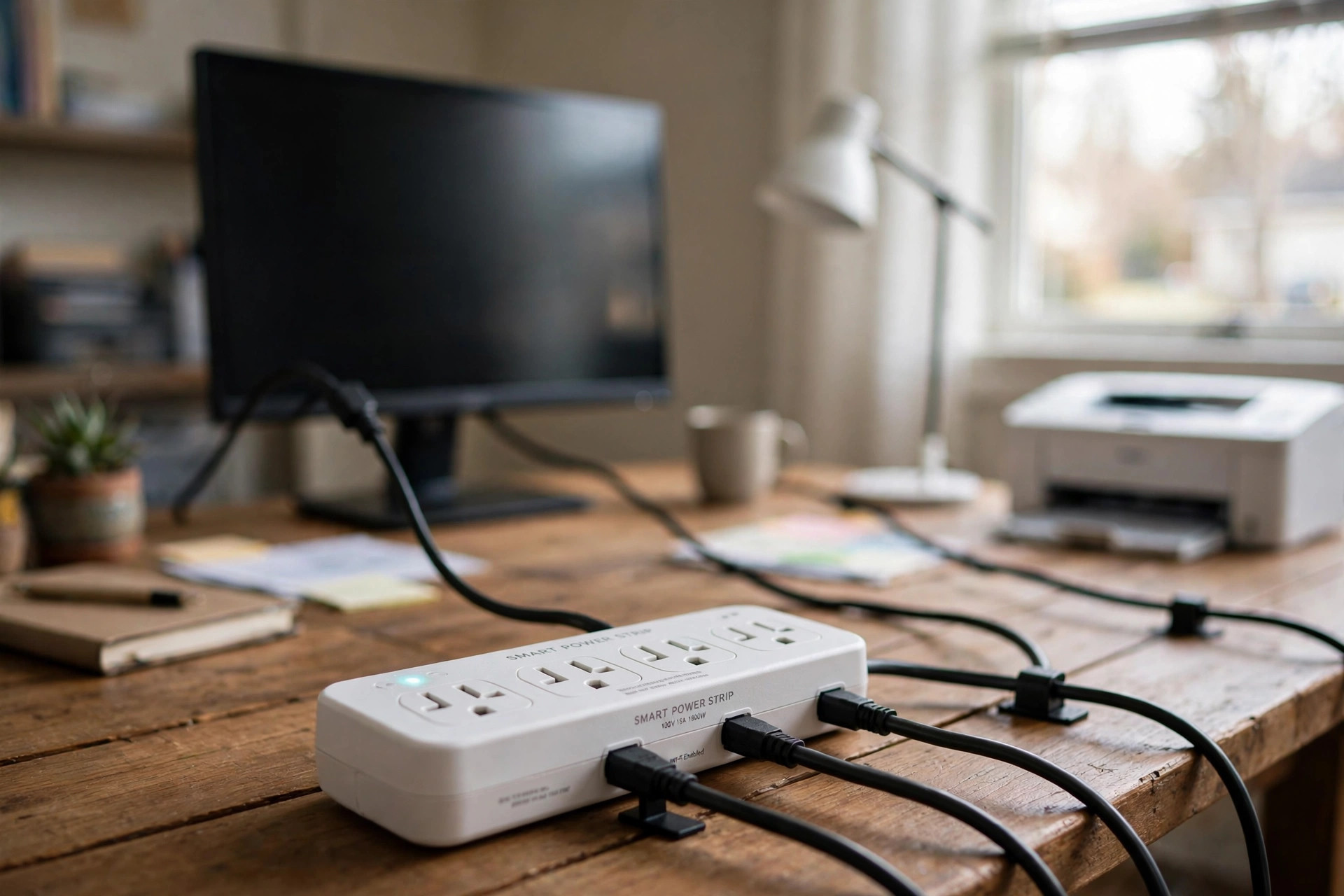

A home office today holds more plugs than a living room did in 1985. A computer, two monitors, a printer, a desk lamp, a phone charger, a speaker, and a modem all fight for the same few wall outlets. That is why smart power strip for home office reviews usa have become a staple of American tech shopping guides. A smart power strip looks like a normal strip with four to six outlets. But each outlet, or a group of outlets, can be switched on and off from a phone app, by voice, or on a set schedule. Many models also watch how much power each device draws. The reviews in the United States judge these strips on safety, ease of setup, the quality of the app, and how much money they can save on the electric bill.
Why a Smart Power Strip Matters in a Home Office
A home office is one of the easiest places in the house to waste power. The desk lamp burns all night. The printer sits in standby for weeks. The monitor glows in an empty room. The United States Environmental Protection Agency has long warned that standby power, the small draw of idle electronics, adds up across millions of homes. Reviewers at Consumer Reports and CNET keep coming back to one fact. A smart strip can cut that idle draw with one tap, because it kills power to whole groups of outlets when you leave the desk.
A smart strip also brings order. Behind most home desks sits a tangle of cords. A strip with labeled outlets in its app lets you name each plug: left monitor, right monitor, printer, lamp. When the workday ends, one command shuts the whole desk down. When you sit down in the morning, another command wakes it up. Tech sites such as The Verge and PCMag praise this routine most of all. The device pays for itself in saved power, but the daily habit of one-tap control is what reviewers say keeps owners happy for years.
There is a third reason, and it matters most to people who run a small business from home. A smart strip with energy monitoring shows exactly how many kilowatt-hours the office uses. That number helps at tax time, and it helps when you want to argue that the new computer is not the reason the bill went up. The ENERGY STAR program offers guides on measuring and cutting plug loads, and smart strips are one of the simplest tools it points to.
How to Choose: What the Reviews Measure: Smart Power Strip for Home Office Reviews Usa
American review sites do not test smart strips the way they test televisions. The field is simpler, and the same few points decide nearly every ranking.
Outlets, USB Ports, and Spacing
Count your devices before you shop. A basic home desk needs four to six grounded outlets. Reviews punish strips whose outlets sit too close together, because a bulky wall adapter for a monitor or a laptop brick will block its neighbor. The better models space at least two outlets wide enough for large plugs. Many strips now add two to four USB-A or USB-C ports for phones and headsets. Reviewers count these as a plus, but they warn that USB ports share one power budget. Two fast-charging phones at once may charge slowly on a cheap strip.
Energy Monitoring
This is the feature that separates a twenty-dollar strip from a sixty-dollar one. With monitoring, the app shows watts per outlet and a running total of energy used. Shoppers who want the best smart plug with energy monitoring for a single device will find the same idea here, applied to a whole desk. Reviews test the accuracy of these readings. The better strips stay within a few percent of a lab meter. The weak ones drift, and reviewers call that out.
The App, Voice Control, and Standards
Every strip needs a phone app to set schedules and timers. Reviews judge apps on one thing above all: whether setup works on the first try. The common standard in the United States is 2.4 GHz Wi-Fi, and strips that demand it often trip up buyers whose phones sit on a 5 GHz network. The better apps guide you through that step. Voice control through Amazon Alexa or Google Assistant is now normal, and a strip page on Amazon or Best Buy will list which assistants work. Newer models also support Matter, the open smart-home standard. A plain guide to Matter smart home devices can help if the term is new to you.
Types of Smart Power Strips on the Market
Reviews in the United States tend to sort strips into three groups.
The first group is the basic Wi-Fi strip. It has four to six outlets, one switch in the app turns everything on or off, and a timer sets on and off hours. It costs the least. It suits a renter or a student who wants one-tap control of a desk and a lamp.
The second group is the per-outlet strip. Each outlet gets its own name, its own schedule, and its own power reading. This is the group most reviews recommend for a real home office. You can leave the modem and the router on all day while the monitors and the printer shut off at six in the evening. If you have ever wired a smart light switch with no neutral wire in an older American house, you will recognize the same idea here: control where you need it, without rewiring the room.
The third group is the surge-protecting smart strip. It adds real surge protection, measured in joules, on top of smart control. Reviews treat the joule rating as the honest measure of protection. A rating under one thousand joules is light duty. Two thousand or more suits a desk full of costly gear. This group costs the most, but reviewers say it is the right pick for anyone whose office holds a work computer they cannot afford to lose.
Some strips also add a master-control outlet, an old idea made smart. One outlet senses when the computer sleeps and cuts power to the rest. A few models carry a small battery backup for the modem outlet, so a short outage does not drop a video call. These extras win praise in long-term reviews, where owners report back after a year of daily use.
Cost and Price: What You Can Expect to Pay
Prices in the United States fall into clear bands, and reviews return to them year after year.
A basic four-outlet Wi-Fi strip with a single master switch sells for about fifteen to thirty dollars. At this price you get scheduling and voice control, but no per-outlet switching and no energy readings.
A mid-range strip with per-outlet control and energy monitoring sells for about thirty-five to sixty dollars. This is the band most review winners live in. You get six outlets, a few USB ports, solid apps, and readings close enough to trust.
A premium surge-protecting smart strip sells for about sixty to one hundred dollars, and a few pro models reach one hundred twenty. You pay for the high joule rating, better build, and sometimes a longer warranty on connected equipment.
Reviews make one cost point again and again. Do not buy on price alone. A fifteen-dollar strip from an unknown brand with no safety listing can cost far more than it saves. The strip should carry a mark from a recognized testing lab, such as UL or ETL. That mark is printed on the box and on the strip itself.
As for payback, the math is simple. If a strip costs forty dollars and kills thirty watts of standby draw for sixteen hours a day, the yearly saving at average American rates lands near twenty-five to thirty-five dollars. Most reviewers call that a payback of about one to two years, with convenience thrown in free.
Care and Upkeep
A smart strip asks little, but it is not a fit-and-forget device. Dust it every few months. Dust on warm electronics is a fire risk, and the back of a desk collects it fast. Keep the strip where air can move around it. Never bury it under papers, a rug, or a blanket.
Check the app once in a while. Makers push firmware updates that fix bugs and close security holes. A strip that has not updated in a year deserves a look. If an outlet feels hot to the touch, stop using it and move that device to another outlet. Heat is the warning sign every safety guide agrees on.
Replace the strip if the case cracks, if a plug fits loosely, or if the strip is more than five to seven years old. Surge protection wears out with each hit it absorbs, even the small ones you never notice. A strip that has guarded your office through several storm seasons has earned retirement.
Safety: What the Reviews and Regulators Warn About
This section matters more than any feature list. The United States Consumer Product Safety Commission, at CPSC, keeps a public record of recalled power strips and surge protectors. Before you buy, a quick check of that record costs two minutes and can steer you away from a model with a history of melting or smoking.
Reviews repeat four safety rules so often they read like a creed. First, never plug one power strip into another. The practice even has a name, daisy-chaining, and it overloads the first strip. Second, never plug a space heater, a window air conditioner, or any device that draws heavy heat into a smart strip. Those belong straight in a wall outlet. Third, keep liquids away from the strip, which sounds plain until you remember the coffee mug on every home desk. Fourth, respect the amp limit printed on the strip, usually fifteen amps for American models. Add up the draw of what you plug in. The app on a monitoring strip can do this math for you.
Home security brands such as Ring, SimpliSafe, and ADT now sell whole-home safety systems, and some reviewers test smart strips as part of that wider net. The point they make is a good one. A smart strip is part of the home’s electrical safety, not just a gadget. Treat it that way.
Frequently Asked Questions
Do smart power strips really lower the electric bill? Yes, but by a modest amount. They kill standby draw from idle gear, which is the waste they are built to stop. A busy home office might save twenty to forty dollars a year. The bigger win is control and habit, not a dramatic cut in the bill.
Will a smart strip work if my Wi-Fi goes down? The outlets keep their last state, so your gear stays powered. But app control, voice commands, and schedules stop working until the network returns. A few strips store schedules on the device itself, and reviews mark that as a strong plus.
Can I use a smart power strip with a space heater? No. Reviewers and safety agencies agree on this. Heaters draw too much current for a strip. Plug heaters directly into a wall outlet, and never leave them running unattended.
Is a surge-protecting smart strip worth the extra money? For a home office with a work computer, yes. The joule rating is the honest measure. Two thousand joules or more gives real cover against spikes from storms and grid faults. For a simple lamp-and-charger desk, a basic strip is enough.
Do I need a hub for a smart power strip? Most American models connect straight to Wi-Fi and need no hub. A few that use Zigbee or Z-Wave do need one. The product page will say so. If you already run a smart home hub, check that the strip speaks the same protocol before you buy.
How long does a smart power strip last? About five to seven years in normal use. Surge protection fades with each surge it absorbs. If the strip has guarded your desk through years of storms, replace it on schedule rather than waiting for a failure.
A Short Final Word
A smart power strip is a small purchase that changes a daily routine. The reviews in the United States agree on the shape of the right choice. Buy enough well-spaced outlets, insist on a safety listing, and pay a little more for per-outlet control and energy readings if your desk holds real work gear. Set the evening schedule once. Then let the strip do what it does best, which is to turn the office off when you walk away and have it ready when you sit down.
References
ADT. (n.d.). Home security and automation. https://www.adt.com Amazon. (n.d.). Online shopping. https://www.amazon.com Best Buy. (n.d.). Consumer electronics retailer. https://www.bestbuy.com CNET. (n.d.). Technology news and reviews. https://www.cnet.com Consumer Reports. (n.d.). Product reviews and ratings. https://www.consumerreports.org ENERGY STAR. (n.d.). Energy efficient products. https://www.energystar.gov PCMag. (n.d.). Technology product reviews. https://www.pcmag.com Ring. (n.d.). Smart home security devices. https://www.ring.com SimpliSafe. (n.d.). Home security systems. https://www.simplisafe.com The Verge. (n.d.). Technology news and reviews. https://www.theverge.com U.S. Consumer Product Safety Commission. (n.d.). Product safety information. https://www.cpsc.gov
Was this guide helpful?

About Sarah Mitchell
The My Garden US editorial team writes practical, in-depth home and garden guides for American homeowners — tested advice, no fluff.
You May Also Like

Smart Home Insurance Discounts Explained USA
January 12, 2026 0 views
Best Smart Oil Tank Gauge Reviews USA: A Homeowner Guide
January 12, 2026 0 views
Security Camera With Local Storage Reviews USA: A Plain Buyer Guide
August 18, 2026 0 views