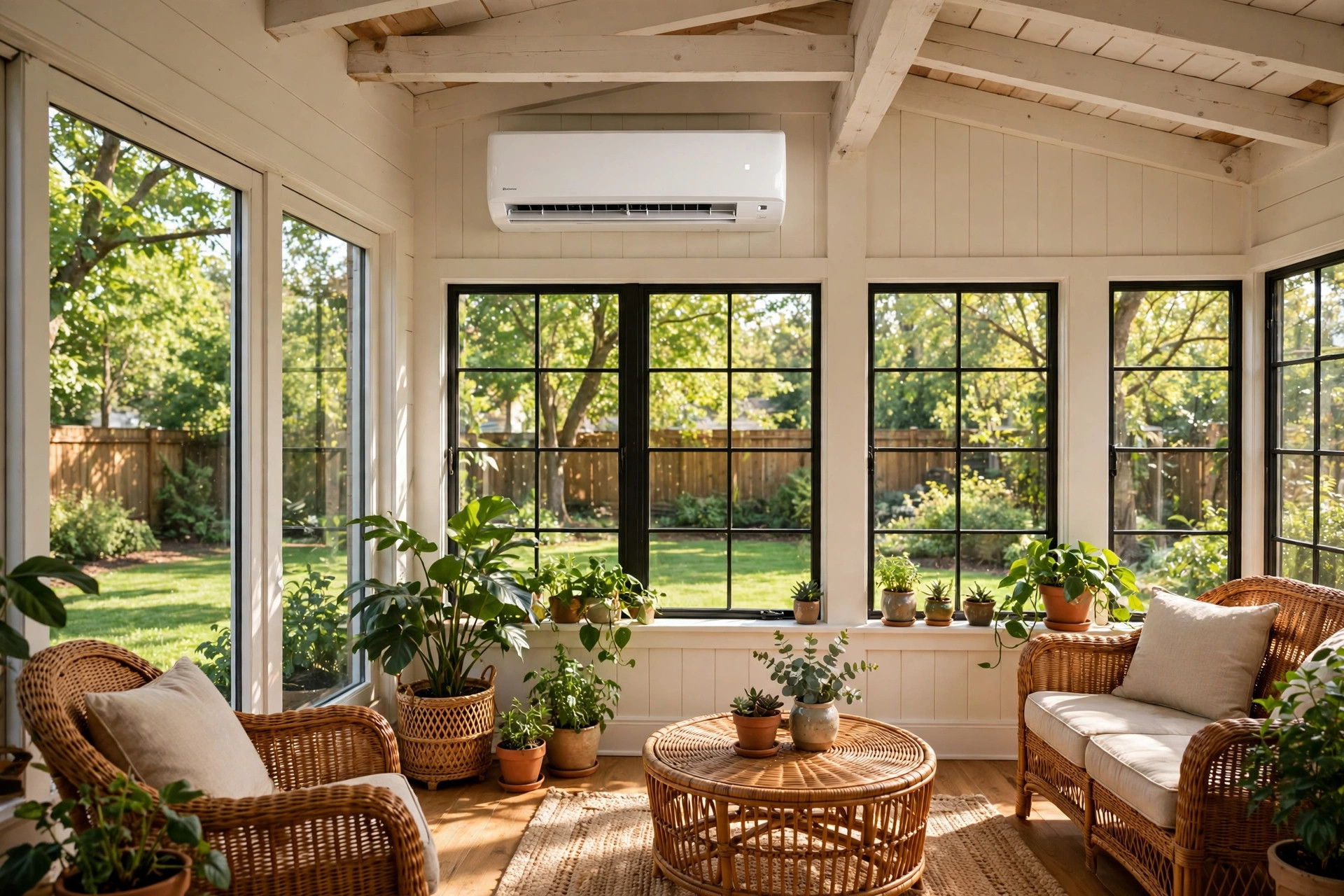

A sunroom is a hard room to heat and cool. The walls are glass. The sun beats in all afternoon. At night the heat runs out the same glass. The best mini split for sunroom reviews USA buyers read all point to one answer: a ductless mini split heat pump sized right for the room. It gives cooling in July and heat in January with no new ductwork.
Why a Mini Split Makes Sense for a Sunroom
Sunrooms are rarely tied into the main heating and cooling system. Most homes were built with ducts that end at the back door. Extending those ducts to a glass room is costly. It is also poor design. The room gains and loses heat far faster than the rest of the house. A system that serves the whole house will always fight itself when one room behaves so differently.
A mini split gives the sunroom its own zone. The indoor head mounts on a wall or ceiling. A thin line set runs to a small outdoor condenser. That is all the equipment the room needs. Consumer Reports tests show that ductless systems beat window units and portable units on both noise and efficiency. They are a strong fit for rooms that need extra help, and sunrooms are first on that list.
Sunrooms also have big heat swings. Morning shade can turn into full sun by noon. A single-stage window unit blasts on and off and leaves cold spots. Most modern mini splits use inverter-driven compressors. The system speeds up and slows down as the load changes. The room holds a steady temperature instead of swinging hot and cold. Owners of garage mini split setups report the same benefit in other hard-to-condition spaces.
What to Look For When You Choose One: Best Mini Split for Sunroom Reviews Usa
Sizing It Right
Sizing matters more in a sunroom than in almost any other room. Too small and the unit runs nonstop on hot days. Too large and it short cycles in mild weather. Short cycling leaves humidity behind. A clammy sunroom feels cool but never comfortable.
Start with the square footage. A common rule of thumb is 20 to 25 BTUs per square foot for a standard room. A sunroom is not a standard room. Glass walls and a glass roof add load. Many installers use 30 to 35 BTUs per square foot for rooms with heavy glass. A 250-square-foot sunroom may need 9,000 BTUs or more. The U.S. Department of Energy has sizing guidance for heat pumps at Energy.gov, and a manual load calculation from a local contractor beats any rule of thumb.
Heating Power in Cold Weather
Most mini splits sold today are heat pumps. They cool in summer and heat in winter. For a sunroom that gets used year round, a heat pump model is the right call. A cooling-only model saves money up front but leaves the room cold in winter.
Cold-climate performance matters in the northern half of the country. Standard heat pumps lose output as the temperature drops. Cold-climate models keep working down to five degrees below zero or lower. If your sunroom will be heated through a real winter, look for a low ambient rating. Shoppers comparing cold-climate mini split reviews should give this spec extra weight.
Efficiency Ratings
Two ratings matter: SEER2 for cooling and HSPF2 for heating. These are the newer versions of the SEER and HSPF scales. Higher numbers mean lower bills. ENERGY STAR certified models sit at the top of the market. ENERGY STAR publishes lists of qualified ductless systems each year. For a sunroom that runs many hours a day, the payback on a high-efficiency unit is fast.
Types and Options
Single-Zone and Multi-Zone
A single-zone system pairs one outdoor unit with one indoor head. It is the simplest choice for a lone sunroom. A multi-zone system connects two to five indoor heads to one outdoor unit. If you also want to condition a porch, a home office, or a bedroom, one multi-zone condenser can serve them all. The equipment costs more, but you save on a second outdoor unit.
Wall Mount, Ceiling Cassette, and Floor Mount
The classic wall-mounted head hangs high on an interior wall. It is the cheapest and easiest to install. A ceiling cassette sits in a drop ceiling and blows air in four directions. It hides the hardware well in a finished sunroom. A floor-mounted unit sits low on the wall and works well where wall space is scarce, such as under a bank of windows. Each style has tradeoffs in cost and airflow that are worth weighing before you buy.
Heat Pump or Cooling Only
As noted above, a heat pump heats and cools. A cooling-only mini split is cheaper but heats nothing. Sunrooms in warm climates can get by with cooling only. In any state with a real winter, the heat pump is the better long-term buy.
Smart Features Worth Having
Wi-Fi control is worth the small premium. A sunroom heats up fast when the sun hits it. Being able to cool the room from your phone before you sit down in it is a real comfort win. Scheduling is useful too. Set the unit to ease off at night and warm the room before breakfast.
Many heads now carry occupancy sensors. The unit detects an empty room and drops to a low-energy mode. It resumes normal work when someone walks in. For a sunroom that is used a few hours a day, this saves real money. Built-in air filtration is another plus. Sunrooms collect dust and pollen through their doors and windows. A good filter keeps the air cleaner while it conditions the room.
How Much It Costs
A single-zone sunroom mini split usually runs between two thousand and five thousand dollars installed. The number moves with capacity, brand, efficiency, and local labor rates. Multi-zone systems run higher. Electrical work can add to the bill if the panel needs a new circuit.
The DIY market has grown fast. Brands like MrCool and Pioneer sell pre-charged systems that skilled homeowners install themselves. Family Handyman covers what a DIY install takes. This can cut the total cost nearly in half. A DIY mini split review will tell you if your skill level fits the job. Keep in mind that permits and local code still apply, and mistakes in the line set can ruin the equipment.
Running costs are modest. A high-efficiency heat pump can deliver three to four units of heat for each unit of electricity it uses. This Old House notes that zoned heating keeps bills down because you stop paying to condition rooms you are not using. In a sunroom that used to need a space heater and a window unit, the savings add up.
Installation Notes
Place the indoor head on a wall that lets air sweep the room. In a sunroom, that often means the wall opposite the glass. Mount it high, with clear space above and below. The outdoor unit needs a solid pad and airflow on all sides. Keep it out of direct sun if you can, and give it room for the service panel to open.
The line set connects the two. It should be as short as the plan allows, with no sharp bends. Most lines come with insulation already fitted. Condensate needs a drain path. Sunrooms often sit on slabs, so a small condensate pump may be needed if gravity drainage is not possible.
Electrical work is simple but must be done right. The outdoor unit needs a dedicated circuit and a disconnect box. A licensed electrician should do this part even in a DIY install.
Sunrooms built on slabs sit low. Watch for water pooling near the outdoor pad. Raise the unit on a stand if the yard drains toward the house. A few inches of height keep the coil dry in heavy rain. Also check where the line set enters the house. A sunroom wall is often thin. Seal the entry hole with caulk so insects and drafts stay out.
Rebates can cut the cost. Many utilities and state programs pay cash back for high-efficiency heat pumps. ENERGY STAR and the Department of Energy both list current incentive programs. Check what your utility offers before you sign a quote. A rebate of a few hundred dollars is common, and some programs pay much more.
Care and Upkeep
A mini split asks little of its owner. Wash or vacuum the indoor filters once a month during heavy use. Dirty filters cut airflow and raise bills. Wipe the indoor coil with a soft cloth each season. Keep the outdoor coil free of leaves, grass, and snow.
Once a year, have a technician check refrigerant pressures, clean the coils deeply, and test the drain. A well-kept mini split lasts fifteen to twenty years. Carrier and Trane both stress filter care in their owner guides, and the advice holds for every brand. Lennox publishes similar maintenance schedules that apply to ductless systems as well.
Safety
Electrical safety comes first. Turn off the breaker before opening any cover. Refrigerant lines stay pressurized and should be handled only by trained hands. Mount the outdoor unit where children and pets cannot reach the fan or the coil. Keep the disconnect box locked or labeled.
In winter, keep snow and ice clear of the outdoor unit. A buried condenser cannot breathe. Never pour water on the unit to melt ice; let it defrost on its own cycle. If the indoor head leaks water onto the floor, shut the unit off and check the drain line before restarting.
FAQ
What size mini split do I need for a 300-square-foot sunroom? Plan on roughly 30 to 35 BTUs per square foot because of the glass. That points to a 9,000 to 12,000 BTU system for 300 square feet. A load calculation from a contractor will confirm the number.
Can a mini split heat a sunroom in winter? Yes, if you buy a heat pump model rated for your climate. Cold-climate models heat well below freezing. Cooling-only models cannot heat at all.
Are mini splits loud? No. Indoor heads run near 20 to 30 decibels, about the level of a quiet room. The compressor sits outside the room, which is why they are so much quieter than window units.
How long does installation take? A single-zone system takes most installers half a day to a full day. DIY installs take a weekend for a first-timer with the right tools.
Do mini splits need ductwork? No. That is the point of a ductless system. A small line set and a wire bundle connect the indoor and outdoor parts.
Will a mini split raise my electric bill a lot? It depends on what it replaces. Compared with electric space heaters, a heat pump costs far less to run. Compared with nothing, it adds a modest line to the bill while making the room usable year round.
A Final Word
The best mini split for sunroom reviews USA shoppers can trust comes down to three things: right size, heat pump model, and solid efficiency ratings. Glass rooms punish undersized equipment and reward steady inverter heat. Get the load calculation, buy from a brand with a real warranty, and keep the filters clean. Do those things and the sunroom becomes the favorite room in the house, in every season.
References
Carrier. (n.d.). Heating and cooling systems. https://www.carrier.com Consumer Reports. (n.d.). Product reviews and ratings. https://www.consumerreports.org ENERGY STAR. (n.d.). Energy efficient products. https://www.energystar.gov Family Handyman. (n.d.). DIY home repair and maintenance. https://www.familyhandyman.com Goodman. (n.d.). Heating and cooling equipment. https://www.goodmanmfg.com Lennox. (n.d.). Heating and cooling systems. https://www.lennox.com Rheem. (n.d.). Heating, cooling, and water heating. https://www.rheem.com This Old House. (n.d.). Home renovation guidance. https://www.thisoldhouse.com Trane. (n.d.). Heating and air conditioning. https://www.trane.com U.S. Department of Energy. (n.d.). Energy efficiency and renewable energy. https://www.energy.gov
Was this guide helpful?

About James Carter
The My Garden US editorial team writes practical, in-depth home and garden guides for American homeowners — tested advice, no fluff.
You May Also Like

Attic Stairs Insulation Cover Reviews USA: A Plain Guide
August 1, 2026 0 views
Best Outdoor Fireplace Kits for Sale USA: A Buyer’s Guide
July 26, 2026 0 views
Smokeless Fire Pit Reviews 2026 USA: What the Reviews Say and How to Choose
April 28, 2026 0 views