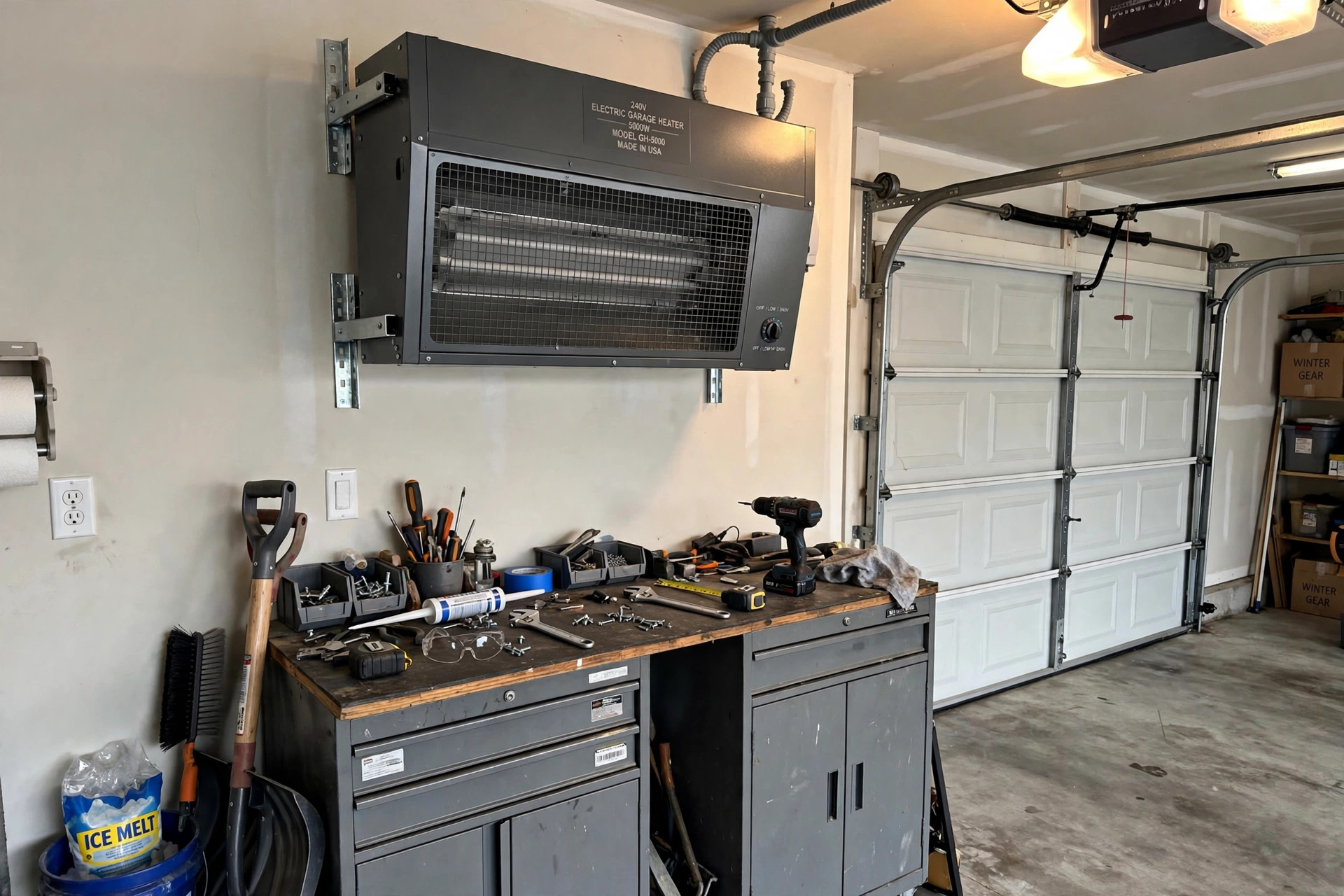

If you search for electric garage heater 240v reviews usa, you will find hundreds of opinions, star ratings, and product claims. It is easy to feel lost. This guide cuts through the noise. It explains what these heaters do, what the reviews really tell you, and how to choose one that fits your garage, your wiring, and your budget. Everything here is written in plain language so you can buy with confidence.
Why a 240-Volt Heater Matters in a Cold Garage
A garage is often the coldest part of an American home. The walls may have thin insulation. The big door leaks air around the seals. The floor is bare concrete, and concrete pulls heat out of the room. When winter arrives, tools can rust, paint cans can freeze, and working out there becomes miserable.
A 240-volt electric heater brings far more power than a small plug-in model. A standard wall outlet gives you about 1,500 watts. That is fine for a bedroom. It is weak for a two-car garage. A 240-volt unit can deliver 3,000 to 10,000 watts. It warms the space faster and holds a steady temperature on bitter days.
Many owners report that a 240-volt heater turns a garage into a year-round workshop. If you want a broader look at options beyond electric models, our guide to the best garage heater for winter reviews usa covers gas, infrared, and other types side by side.
What to Look for When You Read Reviews: Electric Garage Heater 240v Reviews Usa
Reviews are useful only if you know what to read between the lines. Star ratings alone do not tell the whole story. A five-star review from a man in Florida means little to a buyer in Minnesota. Focus on the details below, and judge each review against your own garage.
Heating Capacity and BTUs
Reviewers often mention how fast a heater warms their space. That speed depends on BTUs, a measure of heat output. As a rough guide, you need about 30 to 45 BTUs per square foot for a garage, depending on insulation. A well-insulated 400-square-foot garage needs roughly 12,000 to 18,000 BTUs. A drafty one needs more.
A watt equals 3.41 BTUs. A 5,000-watt heater gives about 17,000 BTUs. A 7,500-watt heater gives about 25,600 BTUs. When you read reviews, look for buyers whose garage size and insulation match yours. Their results will predict yours.
Power and Wiring Requirements
A 240-volt heater needs a dedicated circuit wired by an electrician in most cases. Reviews sometimes gloss over this cost. The unit itself may cost a few hundred dollars, but the wiring can cost as much or more if your breaker panel is far from the garage.
Check the amp draw before you buy. A 5,000-watt heater at 240 volts draws about 21 amps. It needs a 30-amp breaker and 10-gauge wire. A 7,500-watt model draws about 31 amps and needs a 40-amp breaker. Never run a heater on an undersized circuit. The breaker will trip, or worse, the wire will overheat.
Fan and Thermostat Features
Good reviews often praise quiet fans and accurate thermostats. A cheap thermostat can swing the temperature ten degrees before the heater kicks on. A good one holds within two or three degrees. Look for reviewers who comment on how often the unit cycles. Frequent short cycling wastes energy and wears out parts.
Many top-rated units include a built-in thermostat with an external sensor option. Some offer remote controls. Home improvement guides at This Old House show how proper thermostat placement improves comfort in workshop spaces.
Types of 240-Volt Electric Garage Heaters
Not every 240-volt heater works the same way. The three common types each suit different garages.
Fan-Forced Unit Heaters
These are the most popular type in reviews. A heating element warms up, and a fan pushes the hot air out into the room. They heat fast and spread warmth evenly. Most mount on the wall or ceiling, which saves floor space.
Brands like Modine are famous here, though most Modine units run on gas. For electric fan-forced models, buyers often compare specs the same way they compare gas units in our modine hot dawg heater reviews for garage roundup. Expect strong airflow, a delay timer, and an adjustable thermostat on the better models.
Infrared Radiant Heaters
Infrared heaters do not warm the air. They warm objects and people directly, the way the sun warms your skin. They are quiet because many have no fan. They work well in drafty garages because the warmth does not blow away when the door opens.
The trade-off is reach. Radiant heat feels great nearby but fades with distance. Reviewers like them for a single workbench or a small bay. For a full two-car garage, most buyers still choose fan-forced units.
Convection and Cabinet Heaters
Cabinet heaters sit low on the wall. Cool air enters at the bottom, rises past a heating element, and exits warm at the top. They are silent and simple, with no fan to wear out. But they heat slowly and struggle in very cold, poorly insulated spaces. They suit small attached garages that already stay above freezing.
Cost and Price: The Unit, the Wiring, and the Bills
Electric garage heater reviews in the USA often quote the unit price and forget the rest. Here is the full picture.
The unit. A 3,000 to 5,000-watt fan-forced heater costs about 150 to 350 dollars. A 7,500 to 10,000-watt model costs about 300 to 600 dollars. Infrared quartz heaters in the same range run similar prices. Cabinet models are often cheaper, at 100 to 250 dollars.
The wiring. A dedicated 240-volt circuit costs roughly 300 to 800 dollars in most areas. The price depends on the distance from the panel and whether the panel has spare breaker slots. If your panel is full, an upgrade can push the total past 2,000 dollars. Always get a licensed electrician. Reviews that mention “easy install” usually mean the buyer already had the right circuit in place.
The running cost. Electricity costs more per BTU than gas in most states. At 15 cents per kilowatt-hour, a 5,000-watt heater costs about 75 cents per hour to run. A 7,500-watt model costs about 1.13 dollars per hour. A good thermostat cuts those costs by cycling the heater off once the set point is reached. For a comparison of fuel costs, see our article on gas garage heater installation cost usa, which breaks down gas versus electric spending over a full winter.
Insulation saves money. The cheapest heat is the heat you do not lose. Sealing the garage door, adding weather stripping, and insulating the walls can cut heating costs by a third or more. Efficiency programs listed on ENERGY STAR show how better insulation lowers bills across the whole home, garage included.
Installation Basics
Most 240-volt electric garage heaters mount on a wall or ceiling bracket. Choose a spot with clear space around the unit. The manual will list minimum distances from walls, ceilings, and anything flammable. Follow those numbers exactly.
Hardwiring is the norm for units above 3,000 watts. The wire runs from a dedicated breaker to the heater. A disconnect switch near the unit is required by code in many areas so power can be cut during service. DIY project advice from Family Handyman stresses pulling a permit where required and never skipping the disconnect.
Mount the thermostat where it senses room temperature, not directly in the heater’s airflow. Some units let you wire a remote wall thermostat. That small detail improves comfort and gets praised in the best reviews.
Check local codes before you start. Some towns require a permit for new 240-volt circuits. The U.S. Department of Energy publishes plain-language guidance on safe electric heating, worth a read before any wiring work begins.
Care and Upkeep
Electric heaters need little care, but a yearly check keeps them safe and efficient.
– Vacuum dust from the front grille and the element housing each fall. Dust burns off with a smell and can be a fire risk. – Tighten mounting bolts once a year. Vibration loosens them over time. – Check wire connections at the heater and the breaker for heat discoloration. Darkened insulation means a loose connection that needs an electrician at once. – Test the thermostat each season. Set it, wait, and confirm the room holds the set temperature. – Keep the area around the heater clear. Store paint, solvents, and gasoline far away.
A heater that clicks loudly on startup or smells hot after the first hour of the season deserves a look. Equipment makers like Carrier, Trane, Lennox, Rheem, and Goodman all publish maintenance tips that apply to electric heating equipment as well as their larger HVAC systems.
Safety in the Garage
Garages hold cars, gas cans, lawn equipment, and chemicals. That mix demands care around any heater.
Keep a clear zone of at least three feet around the unit. Never stack boxes or hang clothes near it. Mount the heater high enough that a car cannot bump it. Wall-mounted units usually sit six to eight feet up, out of harm’s way.
Never use an electric garage heater to dry rags soaked in solvents. Never spray paint near a running heater. Install a smoke alarm and a carbon monoxide alarm in the garage, even though electric heaters do not produce fumes. Cars do, and the heater keeps you in the garage longer.
Buy units listed by a recognized testing lab such as UL or ETL. The listing mark means the design passed independent safety tests. Many of the best-reviewed heaters carry this mark, and reviewers often mention it as a sign of trust.
Frequently Asked Questions
How many watts do I need for a two-car garage?
A typical two-car garage is 400 to 500 square feet. With average insulation, a 5,000 to 7,500-watt heater does the job. Drafty or uninsulated garages need 7,500 to 10,000 watts. Measure your space and check your insulation before choosing.
Can I plug a 240-volt heater into a dryer outlet?
A dryer outlet is 240 volts, but it may not match the heater’s amp rating. A 30-amp dryer circuit cannot safely feed a 7,500-watt heater that needs 40 amps. Do not use adapters or extension cords. Have an electrician install the correct dedicated circuit.
Do electric garage heaters cost a lot to run?
They cost more per hour than a gas heater in most regions. But electric units need no venting, no gas line, and little maintenance. For a workshop used a few evenings a week, the total winter cost stays reasonable. A programmable thermostat trims it further.
Are electric garage heaters safe to leave on overnight?
A properly wired, wall-mounted unit with a working thermostat can run safely. Still, most safety experts suggest turning the heat down when no one is there. Keep the area clear, keep alarms working, and have the wiring inspected if the heater is old.
Fan-forced or infrared: which is better?
Fan-forced suits whole-garage heating and gets the most praise in reviews. Infrared suits spot heating near a workbench and runs silently. Many buyers with large garages choose fan-forced; many with small, drafty shops prefer infrared.
Final Word
The best electric garage heater 240v reviews usa buyers write share a pattern: the buyer sized the unit to the space, wired it right, and set a realistic thermostat setting. Do those three things and almost any well-reviewed unit will serve you well for years. Read the reviews for wiring and reliability notes, not just stars. Then enjoy a garage that stays warm all winter.
References
Carrier. (n.d.). Heating and cooling systems. https://www.carrier.com ENERGY STAR. (n.d.). Energy efficient products. https://www.energystar.gov Family Handyman. (n.d.). DIY home repair and maintenance. https://www.familyhandyman.com Goodman. (n.d.). Heating and cooling equipment. https://www.goodmanmfg.com Lennox. (n.d.). Heating and cooling systems. https://www.lennox.com Rheem. (n.d.). Heating, cooling, and water heating. https://www.rheem.com This Old House. (n.d.). Home renovation guidance. https://www.thisoldhouse.com Trane. (n.d.). Heating and air conditioning. https://www.trane.com U.S. Department of Energy. (n.d.). Energy efficiency and renewable energy. https://www.energy.gov
Was this guide helpful?

About Jennifer Lee
The My Garden US editorial team writes practical, in-depth home and garden guides for American homeowners — tested advice, no fluff.
You May Also Like

Solo Stove vs Breeo Comparison Reviews USA
June 15, 2026 0 views
How Much Does an Outdoor Wood Boiler Cost Installed in the USA?
October 5, 2026 1 views
Best Central Air Conditioner Brands 2026 USA
August 9, 2026 0 views