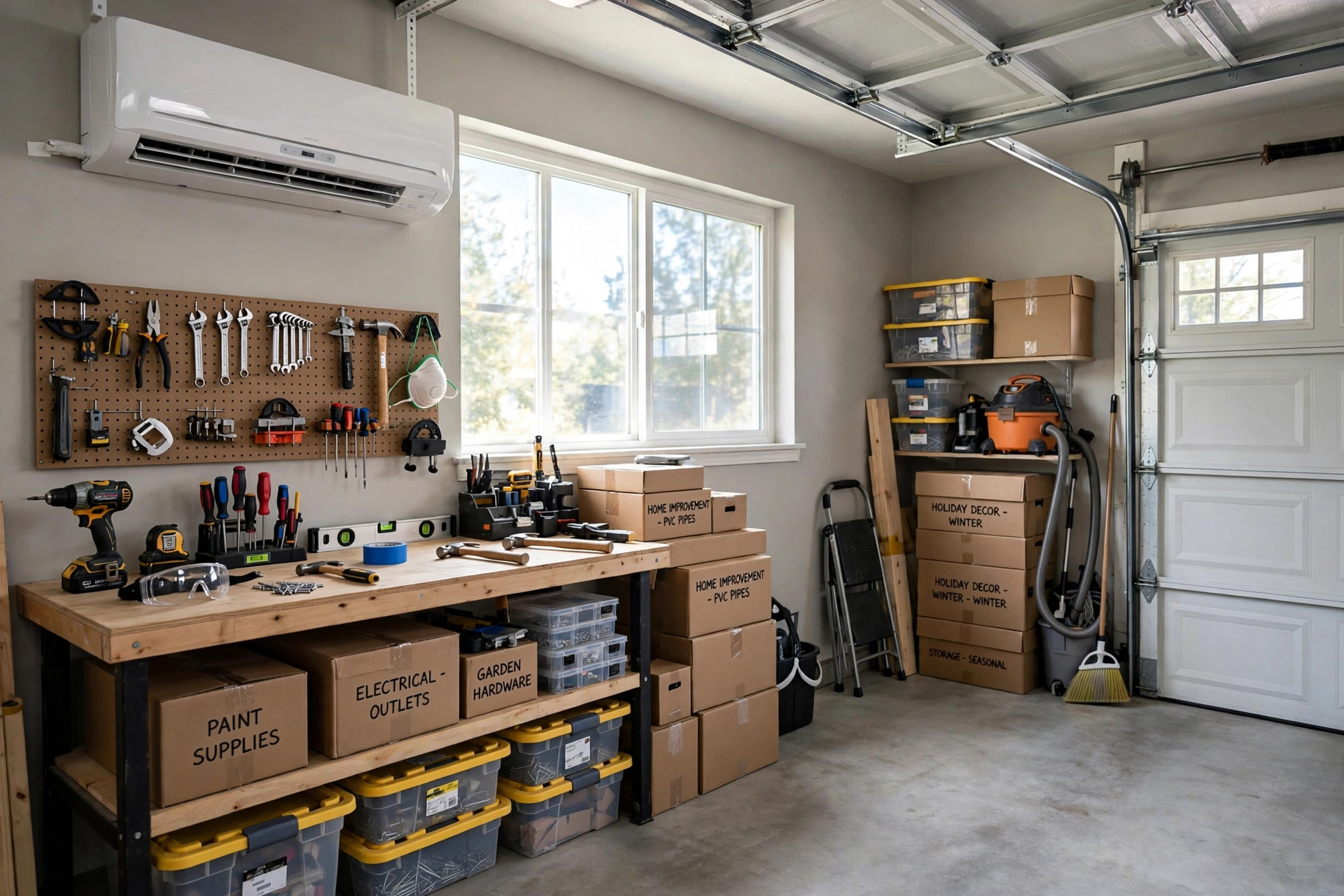

Most garages are built for cars, not for people. In January the concrete floor is cold enough to sting your knees. In July the air sits heavy and still, and paint or glue sets too fast to work with. For years the only fix was a portable heater in winter and a window fan in summer. A mini split for garage heating and cooling changes that picture. It is a small ductless system that warms the space in winter and cools it in summer, all through one wall unit and one outdoor box.
Garages have become more than parking space. They are workshops, home gyms, laundry rooms, and project corners. Heating and cooling such a space used to mean running ducts from the house system or settling for drafty plug-in units. A ductless mini split offers a middle path: it is sized for the garage alone, it costs less to run than most portable units, and it can be installed without tearing open walls.
Why a Garage Needs Its Own Climate Control
A garage is usually cut off from the main heating system. Builders rarely extend ducts there, and for good reason. Running furnace ducts into a garage can draw car exhaust and chemical fumes into the rest of the house. That separation keeps the home safer, but it leaves the garage at the mercy of the weather.
In cold months, tools rust, paint thickens, and concrete sweats as warm air from an open door meets the cold floor. In hot months, heat builds under the roof and has nowhere to go. A steady temperature protects what you store. It also makes the space usable. If you work on cars, wood, or crafts, comfort is not a luxury. It is the difference between an hour of good work and an afternoon cut short.
A mini split system handles both seasons with one machine. It is a heat pump, so it moves heat instead of making it from scratch. In summer it pulls heat out of the garage and dumps it outside. In winter it reverses and pulls warmth from the outdoor air into the garage. Modern units work well even when the outdoor temperature falls below freezing.
How a Ductless Mini Split Works: Mini Split for Garage Heating and Cooling
The system has two parts. An indoor air handler mounts high on the wall. It blows warm or cool air into the room and pulls a small amount of air back through a filter. An outdoor condenser sits on a pad or hangs on brackets outside the garage. The two connect through a small hole in the wall, usually three inches wide, carrying refrigerant lines, a drain hose, and power cable.
There are no ducts, so nothing runs through the attic or behind drywall. Installation is simple compared with adding ductwork. The indoor unit runs on a remote control or a wall thermostat, and many newer models connect to a phone app.
One point deserves clear words. A mini split does not bring in fresh air. It recirculates the air already in the room. If you spray paint or run a car engine in the garage, you still need to open a door or use an exhaust fan. The unit controls temperature, not ventilation.
What to Look for When You Choose a System
Size the Unit to the Garage
Size is the most common mistake. A unit too small will run all day and never catch up. A unit too large will short-cycle, wear out faster, and leave the air clammy.
Garages are often measured by square footage alone, but that is only a start. A one-car garage of 250 square feet usually needs about 6,000 to 9,000 BTU. A two-car garage of 400 to 500 square feet often needs 12,000 to 18,000 BTU. A three-car garage can need 18,000 to 24,000 BTU.
Then adjust for real life. Poor insulation calls for the larger end of the range. A south-facing garage door in a hot climate adds load. High ceilings add volume. Count these factors before you buy, not after. Start with a free heat-load estimate from an installer or a sizing calculator on a manufacturer site such as Carrier.
Check the Heating Rating for Cold Weather
Not all heat pumps are equal in winter. Look at the HSPF rating for heating efficiency and check the lowest outdoor temperature the maker lists. Some units keep heating well below zero degrees, while basic models lose strength around freezing. If your winters are long and hard, spend more on a cold-climate model. Energy Star lists certified cold-climate heat pumps with verified low-temperature performance.
Look at Noise, Efficiency, and Extras
The indoor unit should be quiet. Most good wall units run at 20 to 30 decibels, about the sound of a whisper. Check the SEER rating for cooling efficiency. A rating of 18 or higher is solid for a garage unit.
Useful extras include a remote control with a sleep mode, a washable filter, and a follow-me sensor that reads the temperature at the remote instead of at the wall. Some units also dehumidify, which matters if your garage tools fight rust.
Types and Options for Garage Mini Splits
Single-zone systems are the usual choice. One indoor unit serves the whole garage. If the garage is divided into a work bay and a finished room, a dual-zone system can serve both with separate controls. That costs more but gives better comfort in a split space.
Ceiling cassette units sit flush in a finished ceiling and spread air in four directions. They suit garages with finished interiors and no free wall space. Floor-mounted units sit low on the wall and work well under a window or where the upper walls are crowded with shelves.
Voltage matters. Small units run on a standard 115-volt circuit. Larger units often need 208 or 230 volts on a dedicated circuit. Before buying, check your electrical panel. An electrician may need to add a breaker, and that cost belongs in your budget.
Some homeowners wonder about geothermal heat pump cost per ton as an alternative for whole-house and garage comfort. Geothermal is efficient but costs far more to install. For a single garage, a ductless mini split is usually the simpler and cheaper answer.
Cost and Price: What to Expect
Prices vary by size, brand, and region. A small 9,000 BTU single-zone system often costs between $1,500 and $2,500 for the equipment. A mid-size 12,000 to 18,000 BTU unit runs $2,000 to $3,500. Larger or dual-zone systems can reach $4,000 to $6,000.
Professional installation usually adds $1,000 to $2,500. The work includes mounting both units, running the line set, pulling a vacuum on the refrigerant lines, and wiring the power. In many places the law requires a licensed technician to handle refrigerant. Do-it-yourself kits exist, and guides from This Old House explain what the job involves, but a poor refrigerant charge will ruin efficiency and shorten the life of the unit.
Running costs are lower than most people expect. Because a heat pump moves heat instead of making it, it uses far less electricity than baseboard heaters or portable space heaters. A well-insulated two-car garage might cost $20 to $50 a month to heat in winter, depending on local power rates and how warm you keep it. Energy.gov has plain guides on heat pump running costs by climate.
Do not forget the tax angle. Some federal and state credits cover ductless heat pumps. Energy Star and the EPA publish current lists of qualifying equipment. Check before you buy, since the paperwork must be filed in the right year.
Installation Basics
A good install starts with placement. The indoor unit goes high on an inside wall, away from the garage door, so it can throw air across the room. Keep it clear of shelves and stored items. The outdoor unit needs open air on all sides and should sit above expected snow lines in cold regions.
The line set runs through a three-inch hole sealed with caulk and a wall cap. Water must not follow the lines into the wall, so the hole should slope slightly downward toward the outside. The drain hose carries condensate away from the foundation.
Electrical work is the part most owners hand to a pro. A dedicated circuit protects the unit and meets code. Permits vary by town. Some towns ask for a simple electrical permit, while others want a full mechanical permit. A short call to the local building office settles the question.
If you are comparing brands, homeowner reviews help. Reading Lennox versus Rheem air conditioner reviews gives a feel for how the big names are rated, and Consumer Reports tests ductless systems for noise and efficiency. Retailers such as Home Depot list common sizes with buyer reviews attached.
Care and Upkeep
A mini split asks for little but rewards regular care. Wash or vacuum the indoor filter every month during heavy use. A dirty filter chokes airflow and forces the unit to work harder.
Wipe the indoor coil with a soft cloth once a year. Outside, keep leaves, grass clippings, and snow away from the condenser. A clear two-foot zone on all sides lets the fan breathe. Rinse the outdoor coil gently with a hose in spring.
Have a technician check the refrigerant and the electrical connections every two or three years. Family Handyman publishes seasonal checklists that walk through each step. With steady care, a quality unit lasts 12 to 20 years.
Watch for warning signs. Ice on the indoor coil, water dripping inside, or a unit that runs but never reaches the set temperature all call for service. Strange grinding or clicking sounds are also worth a service call. Small problems are cheap to fix early.
Safety Notes for Garage Installations
Safety comes first in a garage. Never run a car engine with the garage door closed, even with the mini split running. The unit does not remove carbon monoxide. Keep a working carbon monoxide detector in the garage at all times.
Keep flammable items away from the indoor unit. Gasoline, solvents, and paint thinners belong in sealed metal cabinets, stored low and away from any heat source. Do not spray paint near the indoor unit, since overspray can clog the filter and coat the coil.
Make sure the electrical circuit is grounded and protected by the right breaker. Water and electricity do not mix. If the drain hose clogs and water backs up, fix it before it reaches wiring. In storm country, a surge protector on the disconnect adds cheap insurance.
If you heat with fuel as well, know the trade-offs. A wood stove versus pellet stove cost comparison shows that combustion heat can be cheap to run, but open flame and stored fuel bring risks a heat pump avoids. For most garages, electric heat from a mini split is the safer path.
Frequently Asked Questions
Will a mini split heat a garage in very cold weather?
Cold-climate models keep heating down to minus 10 or even minus 20 degrees. Standard models lose capacity near freezing. Match the unit to your climate. If you see long stretches below zero, choose a cold-climate rated system and consider keeping the garage at a moderate 50 degrees rather than room temperature.
How much does it cost to run a mini split in a garage?
Most two-car garages cost between $20 and $60 a month in heating season, depending on insulation, climate, and power rates. Cooling costs less. Adding insulation to the garage door and walls cuts the bill more than any other single step.
Can I install a mini split in my garage myself?
Pre-charged do-it-yourself kits are sold, and a handy owner can mount the units and run the lines. But refrigerant rules in many states require a licensed technician for the final connections and vacuum. A poor install can void the warranty. When in doubt, hire a pro for at least the refrigerant work.
What size mini split do I need for a two-car garage?
A typical two-car garage of 400 to 500 square feet needs 12,000 to 18,000 BTU. Insulated garages land at the low end. Garages with tall ceilings, big west-facing doors, or no insulation need the high end. A free load calculation from an installer beats guessing.
Does a mini split need a drain in the garage?
Yes. The indoor unit produces water as it cools, and even in heating mode the outdoor unit defrosts. Run the drain hose to a floor drain, a utility sink, or outside away from the foundation. Keep the hose sloped so water flows out on its own.
Will a mini split raise my electric bill a lot?
It adds to the bill, but it replaces less efficient heat. Compared with portable electric heaters, a mini split uses roughly a third of the power for the same warmth. Many owners find the total bill barely moves once the space heaters are retired.
A Short Final Word
A mini split for garage heating and cooling turns a harsh, drafty space into a room you can use all year. It heats and cools with one machine, sips electricity, and installs without ducts. Size it right, place it well, and give it simple care, and it will serve the garage for well over a decade.
Start with a load estimate, check the cold-weather rating for your climate, and get quotes from two or three installers. Brands such as Trane, Rheem, and Goodman all make ductless lines worth a look. With the right unit on the wall, the garage stops being a seasonal room and becomes part of the home you actually live in.
References
Carrier. (n.d.). Heating and cooling systems. https://www.carrier.com Consumer Reports. (n.d.). Product reviews and ratings. https://www.consumerreports.org ENERGY STAR. (n.d.). Energy efficient products. https://www.energystar.gov Family Handyman. (n.d.). DIY home repair and maintenance. https://www.familyhandyman.com Goodman. (n.d.). Heating and cooling equipment. https://www.goodmanmfg.com Rheem. (n.d.). Heating, cooling, and water heating. https://www.rheem.com The Home Depot. (n.d.). Home improvement products. https://www.homedepot.com This Old House. (n.d.). Home renovation guidance. https://www.thisoldhouse.com Trane. (n.d.). Heating and air conditioning. https://www.trane.com U.S. Department of Energy. (n.d.). Energy efficiency and renewable energy. https://www.energy.gov U.S. Environmental Protection Agency. (n.d.). Protecting human health and the environment. https://www.epa.gov
Was this guide helpful?

About David Wilson
The My Garden US editorial team writes practical, in-depth home and garden guides for American homeowners — tested advice, no fluff.
You May Also Like
Best Electric Wall Heater Reviews 2026 USA
May 5, 2026 0 views
The Best Pellet Stove for Basement Heating: Reviews USA
May 3, 2026 0 views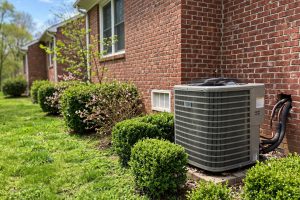
What Is the AC Tune Up Cost Near Me for Spring 2026?
April 19, 2026 0 views