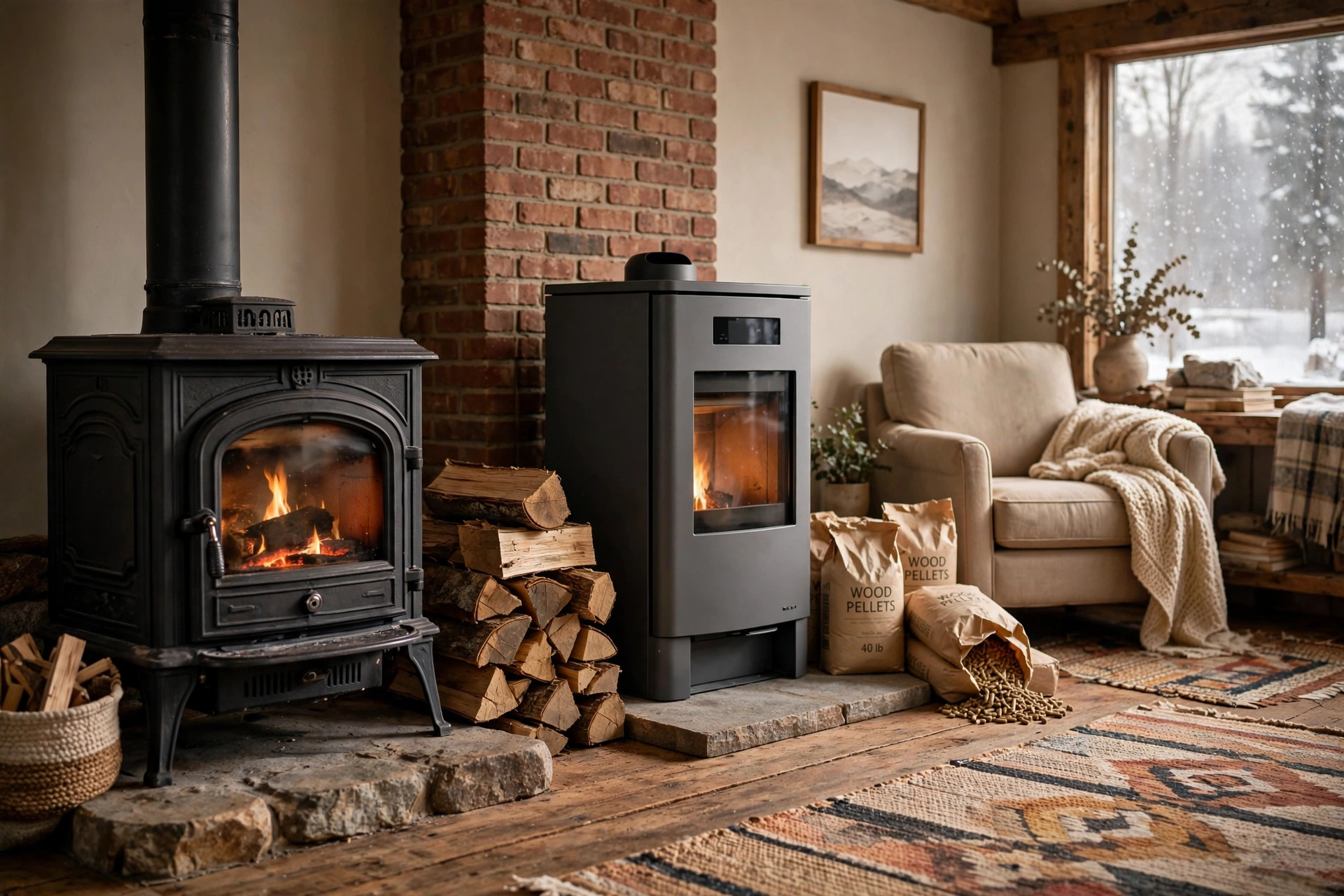
Many American homes burn wood or wood pellets for heat. Both choices can cut a fuel bill. Both can warm a room in a way a furnace never can. Yet the true price of each is not always clear. A wood stove vs pellet stove cost comparison must look past the price tag in the store. It must count the chimney, the fuel, the upkeep, and the daily labor. This guide walks through each cost in plain terms, so a homeowner can choose with eyes open.
Why This Comparison Matters
Fuel prices rise and fall. In cold states, a long winter can make a heating bill painful. Wood stoves and pellet stoves give a family some control. Both burn a renewable fuel. Both can heat one room or a whole small house. Both can serve as backup heat when the power fails, though only one works without any electricity at all.
Still, the two machines are very different. One is simple and old in design. The other uses motors, fans, and a computer control board. That difference shapes every cost that follows. A wood stove vs pellet stove cost comparison that skips this point can mislead. The buyer who wants the cheapest heat may pick the wrong stove.
How Each Stove Works: Wood Stove vs Pellet Stove Cost Comparison
Wood Stoves
A wood stove is a steel or cast-iron box. You open the door, place split logs inside, and light them. Air vents control the burn rate. Heat comes from the hot metal and, in many models, from a blower fan. Smoke leaves through a chimney flue. Newer models are EPA certified, which means they burn cleaner than the old smoke dragons of the past.
A wood stove needs no electric power to run. The fire burns by natural draft. A blower is a nice extra, but the stove will heat without it. This makes a wood stove a true backup heat source during a winter storm.
Pellet Stoves
A pellet stove burns small compressed pellets made from sawdust and wood waste. A hopper holds a bag or more of pellets. An auger feeds them into the burn pot. A fan pushes hot air into the room. A thermostat sets the room temperature, and the stove adjusts the feed rate on its own.
Pellet stoves are easy to run. You load the hopper and set the dial. They are clean and steady. But they need electricity to run the auger and fans. In a power outage, most pellet stoves stop working unless you add a battery backup.
What to Look For When You Choose
Before any wood stove vs pellet stove cost comparison makes sense, know what you need.
Heating size. Stoves are rated by the square feet they can heat. A small stove heats 1,000 square feet. A large one heats 2,500 or more. Match the stove to your space. An oversized stove forces you to burn it low, which wastes fuel and builds creosote.
Your fuel supply. Do you have free or cheap firewood on your land? Then a wood stove has a big edge. Do you live near a store that sells pellets by the ton? Then a pellet stove may win. Check local fuel prices before you buy.
Your daily time. A wood stove needs splitting, stacking, hauling, and daily fire tending. A pellet stove needs a weekly cleaning and a bag of pellets every day or two. Be honest about the labor you will give.
Your chimney. A wood stove needs a tall masonry or class-A metal chimney. A pellet stove can vent through a simple small pipe through the wall. If your house has no chimney, this fact changes the math.
If you plan to burn wood, also read our guide to wood stove installation costs near me to see what a safe chimney adds to the budget.
Cost and Price: The Heart of the Matter
This is the core of the wood stove vs pellet stove cost comparison. Costs vary by region and by model, so the ranges below are broad. Use them as a starting point, then get local quotes.
Upfront Purchase Cost
A basic non-catalytic wood stove costs about 1,000 to 2,000 dollars. A large high-efficiency model with a catalytic combustor can run 2,500 to 4,500 dollars. Cast iron costs more than plate steel.
Pellet stoves start near 1,500 dollars for a simple free-standing unit. Mid-range models run 2,000 to 3,500 dollars. Fancy models with large hoppers, quiet fans, and smart controls can reach 4,000 to 5,000 dollars.
On purchase price alone, the two are close. Neither has a clear win.
Installation Cost
Here the gap opens. A wood stove often needs a new chimney or a chimney liner. A class-A metal chimney through the roof can add 1,500 to 4,000 dollars. If your home has no chimney at all, the full install can reach 5,000 to 8,000 dollars.
A pellet stove is easier to install. Its vent pipe is only three or four inches wide. A simple through-wall install can cost 500 to 1,500 dollars. Floor protection and clearances still apply, but the job is smaller.
Many buyers are surprised by this step. Before you commit, check our overview of pellet stove installation costs near me and compare with the wood stove figures above.
Fuel Cost Over a Heating Season
Fuel is where the two part ways for good.
Firewood. A cord of seasoned hardwood costs 200 to 400 dollars in most areas. A home that heats mainly with wood burns three to five cords per winter. That is 600 to 2,000 dollars per season. If you cut your own wood, the cash cost falls to almost nothing, though your labor does not.
Wood pellets. Pellets sell for 250 to 350 dollars per ton. A stove that heats a home burns two to four tons per winter. That is 500 to 1,400 dollars per season. Pellet prices are steadier than firewood prices, but they spike when winters are harsh.
So the fuel cost is roughly even for most buyers. The winner is the buyer with the cheaper local fuel.
Upkeep and Repair Cost
A wood stove is a simple machine. Yearly costs are low. A chimney sweep costs 150 to 300 dollars per year. Gaskets and firebrick need replacement every few years for 50 to 150 dollars. That is all.
A pellet stove has moving parts. Motors, fans, and the auger wear out. A yearly deep cleaning runs 200 to 350 dollars if you hire it out. Over ten years, you may replace an igniter, a fan motor, or the control board. Budget 100 to 300 dollars per year for parts and service on average. Igniter rods and gaskets are common early fixes; you can read about them at Carrier and Trane, where heating equipment guides cover many of the same service themes.
A Five-Year Cost Example
Take a home with a 2,000-square-foot living space in a cold climate.
Wood stove path. A 3,000-dollar stove plus 3,500 dollars for a chimney comes to 6,500 dollars installed. Four cords of wood per year at 300 dollars each is 1,200 dollars per year, or 6,000 dollars over five years. Chimney sweeping adds about 1,000 dollars. Five-year total: about 13,500 dollars.
Pellet stove path. A 2,500-dollar stove plus 1,000 dollars for venting comes to 3,500 dollars installed. Three tons of pellets per year at 300 dollars each is 900 dollars per year, or 4,500 dollars over five years. Service and parts add about 1,250 dollars. Five-year total: about 9,250 dollars.
In this example, the pellet stove wins by a wide margin, because the wood stove needed a new chimney. But flip the facts. If the home already has a sound chimney, the wood stove install drops to about 3,500 dollars, and the five-year totals come close. If the owner cuts free firewood, wood wins outright.
This is why a real wood stove vs pellet stove cost comparison must use your own numbers, not national averages. The U.S. Department of Energy offers heating cost tools at Energy.gov, and ENERGY STAR publishes efficiency guidance that helps you size either stove correctly.
Care and Upkeep
Both stoves reward steady care.
For a wood stove, burn only dry, seasoned hardwood. Wet wood wastes heat and coats the flue with creosote. Empty the ash pan before it fills. Have the chimney swept once a year, or more often if you burn daily. Check the door gasket each fall. A worn gasket lets air leak in and makes the fire run too hot.
For a pellet stove, clean the burn pot weekly during the heating season. Vacuum the ash traps and the heat exchanger tubes. Empty the ash pan. Use quality pellets with low ash content. Cheap pellets clog the burn pot and raise your cleaning load. Once a year, give the vent pipe and the internal passages a full cleaning. Guides from Lennox and Rheem explain seasonal tune-up habits that apply to any home heating equipment.
Whichever stove you choose, a working carbon monoxide detector is a must. Put one on each floor of the house.
If you want pellet heat in a lower level, our article on the best pellet stove for basement heating covers what to check before you place one there.
Safety
Wood stoves and pellet stoves are safe when installed right and run with care. Most house fires from heating start with bad installation or neglected chimneys.
Clearances. Every stove lists minimum distances to walls, floors, and furniture. Follow them exactly. Use approved heat shields and floor pads where needed.
Chimney and vent. A blocked or cracked chimney can send smoke and carbon monoxide into the house. Have a certified sweep inspect the chimney or vent each year.
Burn rules. Never burn trash, painted wood, or treated lumber in a wood stove. They release toxic fumes and damage the stove. Never burn anything but wood pellets in a pellet stove.
Ash safety. Hot ashes can start a fire days later. Store ashes in a metal can with a tight lid, placed on concrete away from the house.
The EPA sets emission standards for new wood stoves, which you can review at EPA.gov. Napoleon makes both wood and pellet models and publishes clearance specs for each.
For wider advice on home safety systems, This Old House and Family Handyman both run detailed how-to libraries.
FAQ
Which is cheaper to run: a wood stove or a pellet stove? It depends on your fuel price. With purchased firewood and purchased pellets, costs are close, often within a few hundred dollars per season. With free firewood from your own land, the wood stove is far cheaper. With cheap bulk pellets, the pellet stove can win.
Do pellet stoves work during a power outage? Most do not. The auger and fans need electricity. Some owners add a battery backup or a small generator. A wood stove works with no power at all, which is a real advantage in storm country.
Which stove is easier to use day to day? The pellet stove is easier. You fill the hopper and set the thermostat. The stove feeds itself. A wood stove needs you to build and tend fires, haul wood, and manage ash by hand.
How long do these stoves last? A good wood stove lasts 20 to 30 years or more with basic care. A pellet stove lasts 15 to 20 years, but its motors and electronics will need replacement parts along the way.
Which is better for the environment? EPA-certified wood stoves burn far cleaner than old models. Pellet stoves burn very cleanly and use waste sawdust as fuel. Both are renewable heat. Check local rules, since some towns limit wood burning on bad air days.
Can either stove heat my whole house? Yes, if the stove is sized right and the floor plan is open. Many owners use a stove as the main heat source and keep a furnace as backup. In tight or multi-level homes, heat may not reach far rooms.
Final Word
A fair wood stove vs pellet stove cost comparison ends where it began: with your home and your habits. The wood stove costs more to install when a chimney is needed, but it is simple, rugged, and needs no power. The pellet stove costs less to install, runs itself, and burns cleaner, but it needs electricity and more maintenance.
Price the chimney. Price the fuel. Count your time. Then choose the stove that fits your life, not just your wallet. Either way, a well-chosen stove can warm your home for decades.
References
Carrier. (n.d.). Heating and cooling systems. https://www.carrier.com ENERGY STAR. (n.d.). Energy efficient products. https://www.energystar.gov Family Handyman. (n.d.). DIY home repair and maintenance. https://www.familyhandyman.com Lennox. (n.d.). Heating and cooling systems. https://www.lennox.com Napoleon. (n.d.). Fireplaces, grills, and heating products. https://www.napoleon.com Rheem. (n.d.). Heating, cooling, and water heating. https://www.rheem.com This Old House. (n.d.). Home renovation guidance. https://www.thisoldhouse.com Trane. (n.d.). Heating and air conditioning. https://www.trane.com U.S. Department of Energy. (n.d.). Energy efficiency and renewable energy. https://www.energy.gov U.S. Environmental Protection Agency. (n.d.). Protecting human health and the environment. https://www.epa.gov
Was this guide helpful?

About Lisa Anderson
The My Garden US editorial team writes practical, in-depth home and garden guides for American homeowners — tested advice, no fluff.