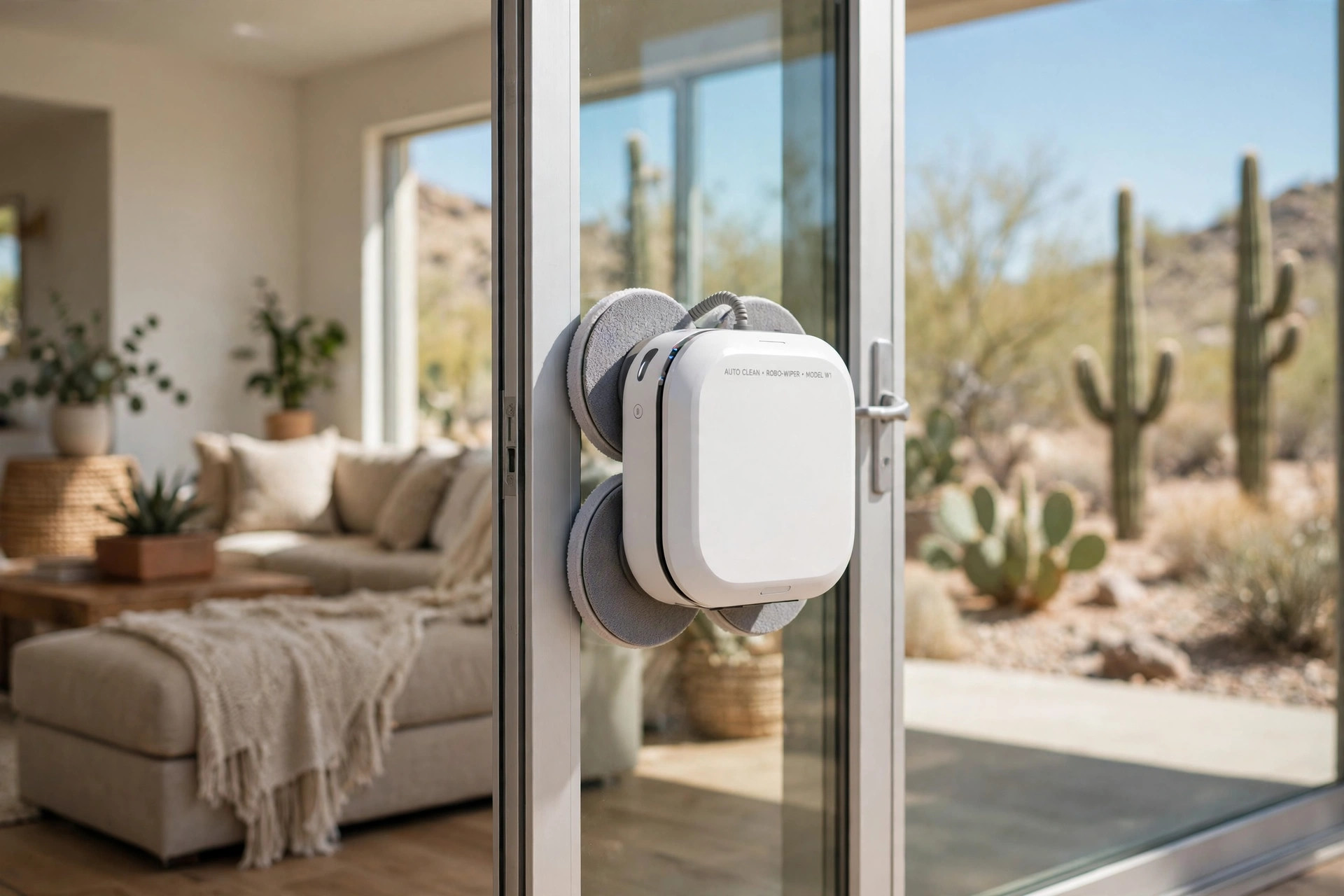

Arizona homes take in a great deal of sun. Tall glass doors, picture windows, and sliding patio walls are common in Phoenix, Tucson, and Scottsdale. They also collect dust fast. Dry air and desert dust coat glass in a matter of weeks. Many homeowners now ask where to buy window cleaning robots in arizona, because a small robot that climbs the glass and wipes it clean can save hours on a ladder.
A window cleaning robot is a compact machine that sticks to glass with suction or magnets. It moves across the pane in a set pattern and cleans with cloth pads. Some models work on only one side of the glass. Others clean both sides at once with two magnetic units. Prices range from under one hundred dollars to more than four hundred. This guide covers the stores that carry them, the types you will find, the costs, and how to keep the machine in good shape.
Why Arizona Homeowners Look for Window Cleaning Robots
Desert Dust and Hard Water
Arizona air carries fine dust for much of the year. Monsoon season adds mud and grit to window frames. Sprinkler water often leaves hard mineral spots on lower panes. These spots grow harder to remove the longer they sit. A robot that cleans on a set schedule can keep dust and minerals from baking onto the glass in the summer heat.
Tall Glass and Second Stories
Many Arizona homes have two-story entries, clerestory windows, and glass walls around pools. Cleaning these by hand takes a ladder and a steady arm. Falls from ladders send thousands of people to emergency rooms each year, according to the Consumer Product Safety Commission. A window cleaning robot stays on the glass by itself. The owner never has to climb. For that reason alone, many buyers in Arizona find the machine worth the cost.
Who Buys These Machines
Most buyers are homeowners with large windows or tall entry glass. Others are condo owners whose rules forbid hanging out of windows. Some buyers run small cleaning businesses and want the robot to speed up jobs. Rental owners with many sliding doors also buy them, since clean glass makes a listing show better.
What to Look for When You Shop: Where to Buy Window Cleaning Robots in Arizona
Suction Strength
The robot must hold its own weight against the glass. Look for the suction power in the product listing. A good home unit lists suction above two thousand Pascals. Weak suction is the main cause of falls. Buy from a seller with a clear return policy so you can test the hold on your own glass.
Cleaning Path
Robots move in patterns. The better units clean in a neat grid, first up and down, then side to side. Cheaper models move at random and miss spots. Reviews on Consumer Reports often note which models track in straight lines and which wander.
Frameless Glass and Edge Detection
Some robots work only on framed windows. Others handle frameless glass and shower doors. If your home has frameless shower glass, check the listing for edge detection. Without it, the robot may drive off the edge of the pane.
Safety Rope
Most window cleaning robots ship with a safety rope. You tie one end to the robot and the other to a fixed indoor anchor. If suction fails, the rope catches the unit. The U.S. Environmental Protection Agency notes that dropping objects from height is a real hazard; a tether costs little and should never be skipped. Always tie the rope, even on ground-floor windows.
Battery Backup
Good robots carry a small battery that keeps the suction motor running for twenty to thirty minutes if the power cord pulls loose. This gives you time to grab the unit. Short battery backup is a common weakness in budget models. Check the rated backup time before you buy.
Noise and Speed
A window cleaning robot takes several minutes per pane. Expect a steady hum, about as loud as a hair dryer on low. Faster models finish a standard patio door in four or five minutes. Slower ones take ten. If you plan to clean many windows in one day, speed matters.
Types of Window Cleaning Robots
Single-Side Suction Robots
These are the most common type. One unit sticks to the outside or inside of the glass. It works on both framed and frameless panes. It cannot clean both sides at once, so you must move it to the other side yourself. Most cost between one hundred and two hundred fifty dollars. They suit ground-floor homes and easy windows.
Magnetic Double-Side Robots
These use two units, one inside and one outside, held together by strong magnets. As the inside unit moves, the outside unit follows and cleans the outer pane at the same time. They cost more, often two hundred fifty to four hundred dollars. They only work on thin glass, since the magnets must hold through the pane. Most Arizona home glass is thin enough, but triple-pane windows may be too thick.
Spray and Wipe Systems
Some robots spray a fine mist of cleaning fluid as they move. Others ask you to wet the pad by hand first. Spray models cost more and need refill tanks. Manual-wet models are simpler and cheaper. For dusty Arizona glass, a light spray helps loosen grit before the pad wipes it away.
Corded and Cordless Models
Most window cleaning robots plug into a wall outlet with a long cord. A few run on battery alone. Corded models run as long as you need. Battery models free you from the cord but last forty minutes to an hour per charge. For a full day of window cleaning, corded is the safer pick.
Where to Buy Window Cleaning Robots in Arizona
Big Home Improvement Stores
The first place many Arizona shoppers check is a large home improvement store. Branches of The Home Depot and Lowe’s across Phoenix, Mesa, Tucson, and Glendale carry small appliances and cleaning machines. Stock of window cleaning robots varies by store. Call ahead or check the store website for local pickup. Buying in person lets you see the box size, check the pad type, and ask staff about the return policy.
Online Marketplaces
Many models are sold only online. Large online stores ship to Arizona in a few days and often show hundreds of buyer reviews. Read the reviews with care. Look for reviews from buyers in hot, dry states, since their glass and dust match yours. Also check the seller rating. A low price from an unknown seller can mean no warranty and no spare pads.
Specialty Cleaning Supply Stores
Some Arizona cities have cleaning supply shops that serve both homes and businesses. These stores often carry pro-grade machines and replacement pads. Prices run higher than online, but the staff usually know the products well. The Family Handyman site has a helpful overview of cleaning machine basics worth reading before you visit a specialty shop.
Robot and Vacuum Dealers
Stores that sell robot vacuums sometimes stock window cleaning robots as well. Dealers may offer demos, which let you watch the machine move across glass before you pay. Ask if they sell spare pads and nozzles. Pads wear out, and a machine you cannot get pads for is a poor buy.
Buying Tips for Arizona Shoppers
Buy from a seller that offers at least a thirty-day return window. Test the robot on a low, easy window first. Keep the box and receipt until you are sure the machine works on your glass. Check the warranty length. One year is standard. Two years is better. Register the warranty on the maker’s site the day the machine arrives.
Cost and Price Guide
Typical Prices
– Budget single-side robots: $80 to $150. Basic suction, random path, short battery backup. – Mid-range robots: $150 to $250. Better suction, grid cleaning path, longer backup, edge detection. – Premium models: $250 to $450. Strong suction, smart mapping, spray system, quiet motor.
Spare Pads and Parts
Replacement pads cost ten to twenty dollars for a pack. Most pads last twenty to forty cleanings before they lose their grip. Power cords and spray nozzles are also sold as spares. Buy one extra pack of pads with the robot so you are not stuck waiting on shipping later.
Long-Term Cost Compared with Hiring Help
A pro window cleaner in Arizona may charge two to four hundred dollars for a full house with tall glass. If you pay for two cleanings a year, a two-hundred-dollar robot can pay for itself in one season. The trade-off is your own time. The robot still needs you to place it, watch it, and move it from pane to pane.
If you are weighing the cost of a one-time deep clean before you buy a machine, the window cleaning service cost guide on this site can help you compare numbers.
Care and Upkeep
Cleaning the Pads
Remove the pads after each use. Rinse them in warm water with a drop of mild soap. Let them dry fully before the next use. Dirty pads scratch glass and leave streaks. Replace pads when they feel thin or lose their spring.
Storing the Robot
Store the machine in its box or a soft bag, out of direct sun. Arizona garages get very hot in summer. Heat can weaken the suction seals and the battery. A closet inside the house is a better spot.
Seasonal Cleaning Schedule
In Arizona, plan a full window pass four to six times a year. Spring and fall are the best times, since dust is lighter and the heat is low. After monsoon storms, wipe the worst mud spots by hand before running the robot. The machine handles dust well but struggles with dried mud.
Common Problems
– The robot slips: the pads are dirty or worn. Replace them. – The robot stalls in corners: the glass frame is too thick for the edge sensors. Try a frameless setting if the model has one. – Streaks remain: too much cleaning fluid, or the pad is dirty. Use less fluid and a fresh pad. – The rope tangles: keep the cord and rope apart as the robot moves. Short guide clips help.
Safety
Use the Tether Every Time
Tie the safety rope to a solid indoor anchor before the robot leaves your hands. Test the knot. This is the single most important safety step. A falling robot can hurt a person below or break through a lower pane.
Keep People and Pets Clear
Do not run the robot on windows above a walkway where people pass. Keep pets and small children away from the glass while it works. The suction motor can pinch fingers if a hand gets under the unit.
Electrical Safety
Most robots use a wall cord. Keep cords away from water and wet glass edges. Do not run the cord through a window that may slam shut. For upper windows, plan the cord path before you start. Advice from This Old House on ladder-free home care also stresses planning the cord path in advance.
Cleaning Solutions
Use only the fluid the maker suggests, or plain water with a small amount of vinegar. Harsh chemicals can damage the pads and the suction seals. They can also leave film on the glass that attracts more dust. Good Housekeeping publishes tested cleaning solution guidance that lines up well with most robot makers’ advice.
Frequently Asked Questions
Do window cleaning robots work on Arizona’s dusty windows?
Yes, but wipe the heaviest dust first. A layer of dry desert dust can clog the pads fast. A quick rinse or a pass with a dry microfiber cloth lets the robot do the fine work. For routine upkeep between full cleanings, the robot alone is enough.
Can I use one on my second-story windows?
Yes, if you anchor the safety rope indoors first. Many Arizona buyers choose a robot for exactly this reason. Never hang out of the window to place the unit. Place it from inside on glass you can reach, or use a pole tool made for the job.
Will a robot scratch my glass?
A clean pad on clean glass will not scratch. Scratches happen when grit gets trapped in a dirty pad. Rinse pads often and keep them free of sand. Replace worn pads right away. The Spruce has a clear primer on window cleaning basics that covers pad care well.
How long does one window take?
A standard sliding patio door takes four to ten minutes, based on the model. Small bathroom windows take two to three minutes. Plan on one to two hours for a full average-size Arizona home.
Are they hard to set up?
Most units need no setup beyond plugging in and wetting the pads. A remote control or phone app starts the cleaning path. Bob Vila’s buying advice notes that setup takes under ten minutes on nearly every model sold today.
Where can I buy replacement pads locally in Arizona?
Check the same store where you bought the robot. Large home stores sometimes stock pads near the cleaning aisle. If not, order from the maker’s site. Pads are light and ship fast. Buying two packs at once saves on shipping.
Final Word
A window cleaning robot suits Arizona homes well. Tall glass, desert dust, and bright sun are exactly what the machine was made for. Shop at a big home store for an easy return, or order online for a wider choice. Check suction strength, edge detection, and battery backup before you pay. Tie the safety rope every time. Keep spare pads on hand. With simple care, the robot will keep your glass clear for years, and you will stay off the ladder.
If you are comparing robot helpers for other jobs around the house, you may also like our guides to upholstery cleaning machines and whole house water filters, which follow the same plain buying format.
References
Bob Vila. (n.d.). Home improvement advice. https://www.bobvila.com Consumer Reports. (n.d.). Product reviews and ratings. https://www.consumerreports.org Family Handyman. (n.d.). DIY home repair and maintenance. https://www.familyhandyman.com Good Housekeeping. (n.d.). Product reviews and home advice. https://www.goodhousekeeping.com Lowe’s. (n.d.). Home improvement products. https://www.lowes.com The Home Depot. (n.d.). Home improvement products. https://www.homedepot.com The Spruce. (n.d.). Home and garden advice. https://www.thespruce.com This Old House. (n.d.). Home renovation guidance. https://www.thisoldhouse.com U.S. Consumer Product Safety Commission. (n.d.). Product safety information. https://www.cpsc.gov U.S. Environmental Protection Agency. (n.d.). Protecting human health and the environment. https://www.epa.gov
Was this guide helpful?

About Lisa Anderson
The My Garden US editorial team writes practical, in-depth home and garden guides for American homeowners — tested advice, no fluff.
You May Also Like

Buy Microfiber Cleaning Cloth Sets Online in Colorado
September 23, 2026 0 views
Best Air Purifiers for Allergies for Humid Climates
February 8, 2026 0 views
How to Find the Best Window Cleaning Service Companies Near Me
January 7, 2026 0 views