
Many people ask where they can find good solar path lights in the United States. The answer is simple. Solar path lights are sold in almost every home improvement store, lighting shop, and large online store in the country. The hard part is not finding them. The hard part is choosing the right ones at a fair price. This guide answers the question of solar path lights where to buy usa in full. It names the best kinds of stores. It explains what to check before you pay. And it shows how to keep your lights working for years.
Why Solar Path Lights Are Worth the Money
A dark walkway can be a problem. People can trip. Guests can feel uneasy. A house can look cold and plain after sunset. Solar path lights solve these problems at a low cost. They need no wiring. They use no power from the grid. The sun charges them by day, and they glow by night.
The federal energy office notes that lighting makes up a real share of home energy use, so any light that runs on sunshine instead of wall power saves money over time. That is the simple math behind solar path lights. You buy the fixture once. The sun does the rest.
They also fit almost any yard. You can place them along a front walk, beside a driveway, around a flower bed, or near a back deck. If you move, you pull them out of the ground and take them with you. No electrician is needed. No permits are needed in most towns.
Where to Buy Solar Path Lights in the USA: Solar Path Lights Where to Buy Usa
Big Home Improvement Stores
The first place to look is a large home improvement store. Chains such as Home Depot and Lowe’s carry wide ranges of solar path lights. You can find sets of four, six, or ten lights. Prices run from a few dollars per light to twenty dollars or more per light for heavy models.
The main benefit is that you can see the lights in person. You can lift a fixture and feel its weight. You can read the box for the lumen rating. Store staff can answer basic questions. Many stores also keep a few display models lit on a shelf so you can judge the color of the light.
These stores often run spring and summer sales. Prices drop when the gardening season starts. Buying in sets is cheaper than buying single lights. If you need ten lights for a long path, a ten-pack from a home center is usually the best deal in town.
Lighting Specialty Shops
If you want more style and better quality, visit a lighting specialty shop or its website. Stores such as Lamps Plus and Lumens stock solar path lights with stronger metal frames, warmer light, and better solar panels. Their catalogs include designs that look like old gas lamps, modern posts, and small bollards.
Specialty shops cost more than big-box stores. But the fixtures tend to last longer. Many come with longer warranties. If you are lighting the front walk of a home you plan to keep for many years, the extra cost can pay off.
Online Marketplaces and Brand Sites
Online stores offer the widest choice. You can compare dozens of models in an hour. You can read hundreds of user reviews. Major brands like Philips also sell direct from their own sites, which can be useful when you want a full set from one brand line.
When you shop online, check three things: the return policy, the shipping time, and the warranty terms. Solar lights sometimes arrive with weak batteries. A good seller lets you return a bad set without a fight.
Warehouse Clubs and Discount Stores
Warehouse clubs sell solar path lights in big packs at low per-light prices. The designs are basic. The quality is fair for the money. These packs suit renters, new homeowners on a budget, or anyone who needs many lights fast.
A full solar path lights buying guide can help you compare models before you decide where to shop. It is worth reading before a big purchase.
What to Look for Before You Buy
Price is not the only thing that matters. A cheap light that dies in one year costs more than a good light that lasts five. Here is what to check.
Brightness and Color of Light
Brightness is measured in lumens. Most solar path lights give between 5 and 50 lumens. For a walkway, 10 to 20 lumens per light is enough in most yards. Brighter is not always better. Very bright spots can blind people and ruin the soft mood of a garden.
Color is measured in kelvin. Warm white light, around 2700 to 3000 kelvin, looks soft and inviting. Cool white light, around 5000 kelvin and up, looks harsh and clinical. For home paths, warm white is the common choice. Home guides like The Spruce often advise matching outdoor light color to the mood you want in the yard.
Battery and Solar Panel Quality
The heart of a solar path light is its battery and panel. Most use small rechargeable batteries. Better lights use larger batteries that hold a charge through a cloudy day. Look for the battery type on the box. Lithium batteries tend to hold up better than old nickel cells.
The solar panel should face the sun for most of the day. Monocrystalline panels charge better than thin-film panels in low light. If your path sits under trees, choose lights with strong panels and large batteries. The Energy Star program publishes general advice on efficient lighting choices, and its principles apply to solar fixtures too.
Material and Build
Cheap plastic lights crack in the sun and break in cold winters. Metal frames, thick glass lenses, and sealed housings last longer. Stainless steel and powder-coated aluminum are good choices for wet climates. Check the stake at the bottom. A thick stake holds firm in soil. A thin stake bends and snaps.
Water resistance matters. Look for an IP rating on the box. IP44 or higher means the light can handle rain and sprinklers. This is not a luxury. A path light lives outside in all weather.
Spacing and Number of Lights
Most makers suggest placing path lights six to eight feet apart. Measure your walk before you shop. A forty-foot walk needs five to seven lights. Buying the right number at once saves a second trip. It also keeps the style matched, since makers change designs from year to year.
If you want stronger light for security at a door or gate, consider pairing path lights with landscape spot lights. Spots can aim at trees or walls while path lights mark the ground.
Types of Solar Path Lights
Not all solar path lights look the same. The common types are:
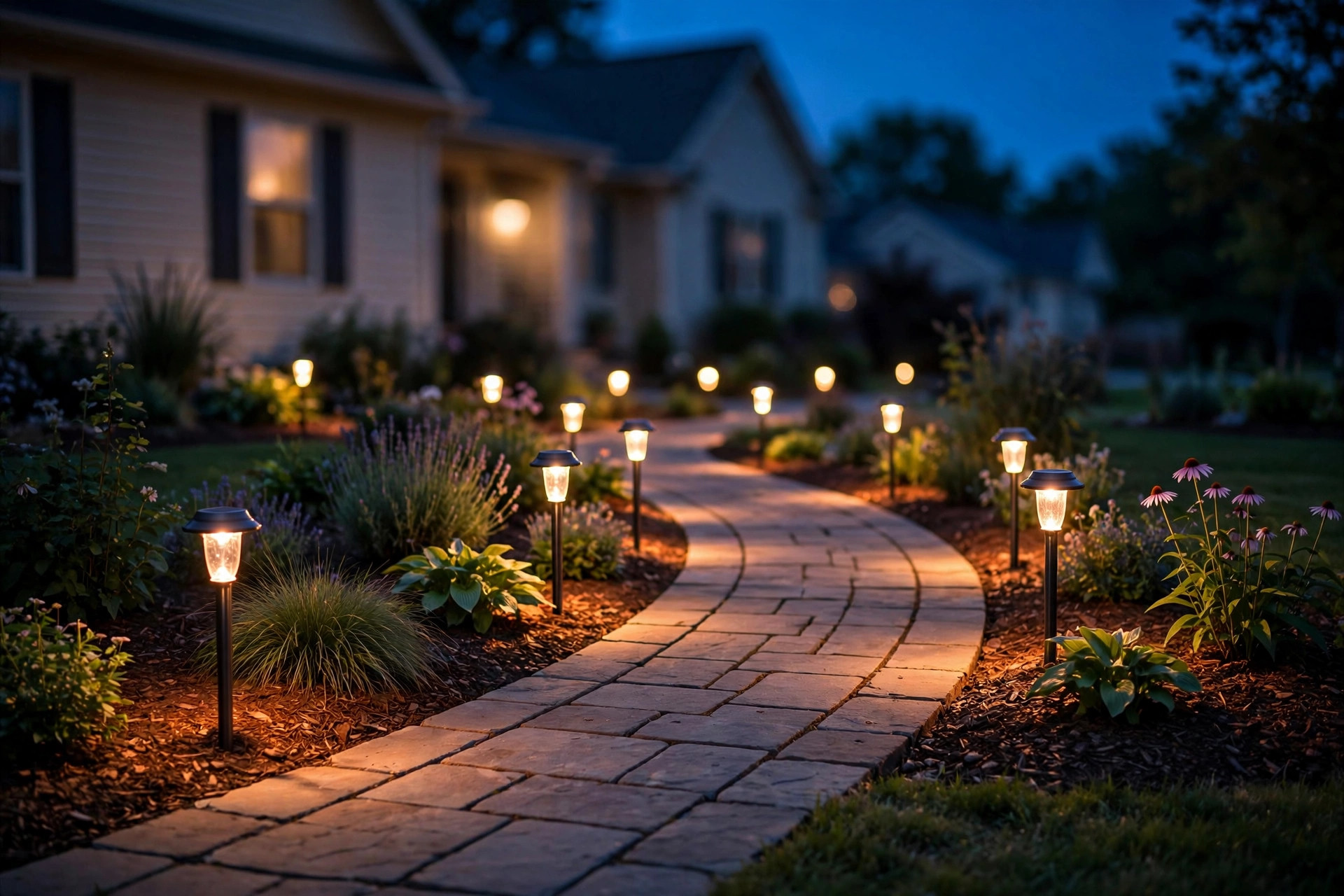
– Stake lights. The classic style. A short post pushes into the soil. Cheap and easy to move. – Bollard lights. Taller posts with a modern look. They cost more but give an even glow. – Cap lights. Low fixtures that sit on fence posts or deck posts. – Disk lights. Flat round lights that lie flush with the ground. They mark path edges without sticking up. – Lantern lights. Decorative tops that look like old oil lamps. They suit classic homes and gardens.
Some sets mix solar path lights with string lights for patios. A set of warm patio string lights overhead plus path lights below makes a backyard feel like a finished room.
Cost and Price Ranges
Solar path lights come in three price bands.
Budget sets cost two to five dollars per light. They are plastic, dim, and may last one or two seasons. They are fine for a short-term fix or a rental home.
Mid-range lights cost eight to fifteen dollars per light. They use metal frames, warmer light, and better batteries. This is the sweet spot for most homeowners.
Premium lights cost twenty to fifty dollars per light. They look like fine fixtures. They often carry two- or three-year warranties. They suit front walks and entry paths where looks matter most.
Remember that the total cost includes your time. Installing solar lights takes minutes. There is no trench to dig and no wire to bury. That alone can save hundreds of dollars compared with wired landscape lighting.
Care and Upkeep
Solar path lights need little care, but they do need some. Dust and pollen coat the panels. A dirty panel charges poorly. Wipe each panel with a damp cloth once a month during the bright season. It takes only a few minutes.
Batteries wear out. Most rechargeable cells last two to three years. When a light grows dim even after sunny days, change the battery. Many lights use standard sizes you can buy at any drugstore or hardware shop.
In winter, snow can cover the panels. Brush snow off after a storm. In very cold states, some owners store their lights indoors for the coldest months. This is not required, but it can extend the life of the batteries.
Move lights around as plants grow. A light that sat in full sun in spring may sit in deep shade by late summer once shrubs leaf out. Shade kills performance. Check the sun on each light twice a year.
Safety Tips
Solar path lights are safe by design. They run on low voltage. There is no shock risk. Still, a few rules help.
Keep light heads below eye level along walks. Bright glare in the eyes can blind a person for a moment. That is the opposite of safe.
Do not rely on path lights alone for security. They mark paths. They do not scare off intruders. For security, use motion lights or a proper porch light.
Check local rules if you live in a community with a homeowners association. Some associations limit the style or brightness of outdoor lights. A quick check saves a dispute.
Frequently Asked Questions
How long do solar path lights stay on at night?
Most give six to ten hours of light after a full day of sun. Premium models can run past midnight. On cloudy days, expect less. If a light dies early every night, the panel is shaded or the battery is old.
Do solar path lights work in winter?
Yes, but with less power. Short days and low sun angles cut charging time. Snow on the panel stops charging entirely. Lights still work on clear winter days, just for fewer hours. Wiping snow off the panels helps a lot.
Can I leave solar path lights out in the rain?
Yes. Good lights are built for rain. Look for an IP44 rating or higher. The weak point is usually the battery door. Keep the seals clean and the cover tight.
How many solar path lights do I need for a walkway?
Measure the walk in feet and divide by seven. A 35-foot walk needs about five lights. For a soft glow, space them a little wider. For a bright guide line, space them a little closer.
Are expensive solar path lights worth it?
For front entries and main walks, yes. They last longer, look better, and give steadier light. For side yards and temporary use, budget sets are fine. Match the price to the job.
Can I replace the batteries in solar path lights?
In most models, yes. The battery sits under the top cap or inside the post. It is often a standard rechargeable size. A fresh battery can give an old light two more years of life.
A Final Word
The question of solar path lights where to buy usa has many good answers. Home improvement stores offer the best mix of price and convenience. Specialty lighting shops offer better design and longer life. Online stores offer the widest choice. Start with a clear plan: measure your path, pick a style, and set a budget per light. Buy warm white light. Check the battery and panel quality. Then place your lights where the sun shines longest. A few simple steps turn a dark walk into a safe and pleasant path, and the sun pays the power bill.
References
ENERGY STAR. (n.d.). Energy efficient products. https://www.energystar.gov Lamps Plus. (n.d.). Lighting and home decor. https://www.lampsplus.com Lowe’s. (n.d.). Home improvement products. https://www.lowes.com Lumens. (n.d.). Lighting and ceiling fans. https://www.lumens.com Philips. (n.d.). Lighting products. https://www.philips.com The Home Depot. (n.d.). Home improvement products. https://www.homedepot.com The Spruce. (n.d.). Home and garden advice. https://www.thespruce.com U.S. Department of Energy. (n.d.). Energy efficiency and renewable energy. https://www.energy.gov
Was this guide helpful?

About Michael Thompson
The My Garden US editorial team writes practical, in-depth home and garden guides for American homeowners — tested advice, no fluff.
You May Also Like
Landscape Spot Lights American Homes Guide: How to Light Your Yard the Right Way
October 1, 2026 1 views
Deck Cap Lights American Homes Guide: What to Know Before You Buy
August 19, 2026 0 views
Where to Find Landscape Spot Lights for Sale in the USA
August 22, 2026 0 views