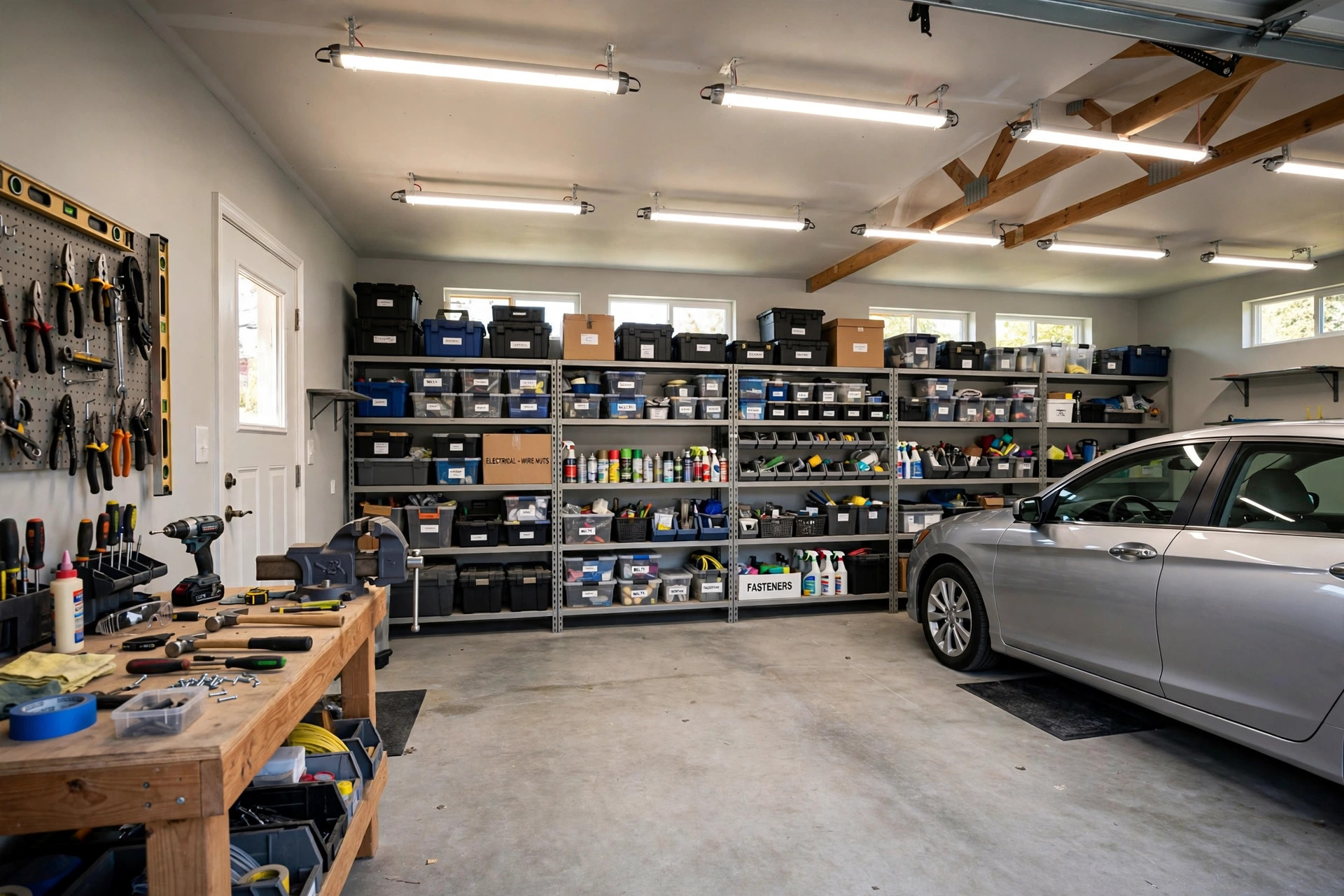

A garage without good light is hard to work in. Tools hide in shadows. Labels are hard to read. The search for garage shop lights usa online deals starts with this simple wish: a bright, safe place to work. The good news is that new LED fixtures are cheaper and brighter than the old tube lights of the past. Online stores in the United States now carry a wide range of garage and shop lights at fair prices.
This guide will help you shop with care. You will learn why good garage light matters, what to look for, and how prices compare. You will also learn how to care for your lights and how to stay safe when you install them.
Why It Matters
A garage is more than a place to park a car. Many people use it as a workshop, a tool room, or a place to fix things. Good light protects your eyes. It also protects your hands. When you can see clearly, you make fewer mistakes with sharp tools and heavy parts.
Old fluorescent tubes are common in garages. They flicker in the cold. They hum. They burn out fast. New LED shop lights solve these problems. They turn on at once, even on winter mornings. They stay bright for years. They use far less power, which keeps the electric bill low.
The savings add up. A garage often has four or more fixtures. If each old tube uses 64 watts and each new LED uses 40 watts, the difference is real over a year. The federal ENERGY STAR program notes that LED lights use at least 75 percent less energy than old bulbs in many uses. A site like ENERGY STAR offers plain facts about saving power at home.
How to Choose: Garage Shop Lights Usa Online Deals
Shopping online gives you many choices. That is good, but it can be confusing. Keep these points in mind before you buy.
Brightness
Light is measured in lumens. A two-car garage needs about 5,000 to 10,000 lumens per fixture zone, or a total near 20,000 to 40,000 lumens for the whole room. Look for the lumen number on the box or the web page. Do not judge by watts. A 40-watt LED can outshine a 64-watt tube.
Color of Light
Color is measured in kelvin. For a garage, choose 4,000 to 5,000 kelvin. This range gives clean white light that shows true colors. It helps you read paint codes and see rust. Lower kelvin numbers give warm yellow light, which is fine for a living room but poor for shop work.
Fixture Shape
Most garage lights are long bars that hang from the ceiling. Four-foot models fit most garages. Some are linkable, which means you can join two or more in a row with one plug. That saves outlet space. Flush-mount panels are another choice if your ceiling is low.
Ballast and Wiring
Old fluorescent fixtures have a ballast. LED tube replacements come in two kinds. One kind works with the old ballast. The other kind, called ballast bypass, wires straight to the line and needs the ballast removed. If you are not sure, pick full new fixtures instead of tube swaps. New fixtures are simple. You hang them and plug them in.
Damp Rating
Garages can get damp. Pick fixtures rated for damp or wet places. The label will say so. This small step keeps you safe and helps the light last longer.
For general ideas on planning home lights, a guide like the one at The Spruce can help you think through room by room needs. If your garage work connects to the rest of the house, you may also want to read a guide on LED recessed lights installation for indoor rooms.
Types of Garage Shop Lights
LED Bar Fixtures
These are the most common choice. They look like long bars with many small LED chips inside. They hang by chains or mount flat to the ceiling. Many models give 4,000 to 5,000 lumens each. Big makers like Philips sell shop lights that last for years with no bulb changes.
High Bay Lights
High bays hang from tall ceilings. If your garage has a ten-foot ceiling or more, a high bay puts strong light down where you work. They are round or square and give very high lumens. They cost more, but one can replace two bar fixtures.
Linkable Shop Lights
These are slim bars that plug into each other in a line. You buy a pack of four or six and connect them. One switch or pull chain controls the whole row. They are easy to set up and often show up in online deal packs.
Motion Sensor Models
Some shop lights turn on when they sense movement. This is handy when your hands are full of tools or groceries. It also saves power because the light never stays on by mistake. A good place to compare smart options is a roundup of smart bulbs and lighting for the rest of the house.
Portable Work Lights
These stand on a tripod or sit on a bench. They are not for the ceiling. They are for the one dark corner behind the engine. Every garage should have one portable light for close work.
Cost and Price
Online deals on garage shop lights in the United States change with the season. Still, some patterns hold year after year.
A single four-foot LED shop bar usually costs between 25 and 60 dollars. Packs of four or six often cost 90 to 200 dollars, which brings the price per light down. High bay lights cost more, often 60 to 150 dollars each. Portable tripod lights run 40 to 100 dollars.
Watch for sales events. Big retailers lower prices around spring cleaning season and the winter holidays. Warehouse clubs and home stores like The Home Depot and Lowe’s run online deals on multi-packs. Marketplaces such as Amazon and Walmart also list many brands side by side, which makes it easy to compare prices and read buyer notes.
Be careful with very cheap lights. A bar that costs 12 dollars may give low lumens or fail in a year. Read the lumen rating and the warranty. A five-year warranty is a good sign. A one-year warranty on a light that claims to last 50,000 hours is not.
Also check shipping cost. A good deal can turn bad when shipping adds 20 dollars. Many large stores ship free over a set amount. Some small sellers do not. Compare the full cost, not just the tag price.
If you are still comparing sellers, browse current garage shop lights for sale listings to get a feel for normal price ranges before you buy.
Care and Upkeep
LED shop lights need little care. That is one of their best traits. Still, a few small steps keep them bright.
Dust settles on the lens and cuts light. Wipe the lens with a dry cloth once or twice a year. Do this with the power off. Check the hanging chains or mounts too. A garage vibrates when the door opens and closes. Screws can loosen over time. Tighten them so nothing sways or falls.
Look at the cords once a year. If a cord is cracked or pinched, replace the light. Do not tape over damaged cords. If a fixture flickers or goes dim, check if it is still under warranty before you throw it away.
Insects like bright lights. A lens full of dead moths blocks light. A quick wipe fixes it. If your garage is very dusty from woodwork, mount lights with a simple cover or clean them more often.
The Department of Energy publishes plain guidance on home energy use. Its notes on lighting remind readers that clean fixtures and the right bulb for the task keep both bills and waste down.
Safety
Electricity is safe when you treat it with respect. Read these points before you install anything.
First, turn off power at the breaker before you touch wires. Test that the power is off with a simple tester. Do not trust the wall switch alone. Someone may flip it while you work.
Second, do not overload outlets. A power strip full of chargers, a freezer, and four shop lights may trip a breaker or heat up. Spread heavy loads across different circuits when you can.
Third, use a steady ladder. Most falls in home projects come from ladders, not from wires. Keep three points of contact. Do not stretch past your reach.
Fourth, keep lights away from flammable items. Paint cans, gas cans, and rags should not sit right under a hot fixture. LEDs run cooler than old tubes, but care is still wise.
Fifth, if wiring scares you, hire an electrician. Adding a new circuit or moving a switch is a job for a licensed worker. Plug-in fixtures are fine for most people. Hard-wired jobs are not.
The federal Consumer Product Safety Commission is worth checking if you ever hear of a recall on a light fixture. Register your new lights with the maker when you can so you get recall news by mail.
For help picking fixtures from a lighting specialist, Lumens and Lamps Plus both carry wide selections with clear spec sheets. Their pages list lumens, kelvin, and damp ratings so you can compare without guesswork.
FAQ
How many shop lights does a two-car garage need?
Most two-car garages do well with four to six four-foot LED bars. That gives even light with few shadows. Start with four and add more if corners stay dark. Linkable packs make it easy to grow later.
Are LED shop lights better than fluorescent tubes?
Yes, for most garages. LEDs turn on at once in the cold, use less power, and last longer. They do not hum or flicker. The price gap has closed, so LED is now the smart buy in nearly every case.
What does 5000K mean on a shop light?
It means the light color is a clean daylight white. This is the most popular choice for garages and shops. It shows true colors and helps you see small details. Avoid warm 2700K lights for work areas.
Can I install shop lights myself?
Plug-in models are easy. You hang the fixture and plug it in. Hard-wired models need basic wiring skill. If you must open a junction box or add a circuit, call an electrician. Safety comes first.
Do online deals include warranties?
Most do, but check the terms. Big stores honor maker warranties without trouble. Some small online sellers do not. Buy from sellers that list a clear warranty and a return address in the United States.
How long do LED shop lights last?
A good fixture is rated for 30,000 to 50,000 hours. At three hours a day, that is more than 25 years. Cheap models may fail sooner. The rated life is only a promise from the maker, so buy brands with a record of standing behind it.
A Final Word
Finding the best garage shop lights USA online deals is not about chasing the lowest price. It is about matching the right light to your garage. Check the lumens. Pick 4,000 to 5,000 kelvin. Choose a damp rating. Buy a known brand with a real warranty. Then clean and check the lights once a year.
A bright garage is a gift to your future self. Every bolt will be easier to find. Every label will be easier to read. And every project will go a little faster, because you can finally see what you are doing.
References
Amazon. (n.d.). Online shopping. https://www.amazon.com ENERGY STAR. (n.d.). Energy efficient products. https://www.energystar.gov Lamps Plus. (n.d.). Lighting and home decor. https://www.lampsplus.com Lowe’s. (n.d.). Home improvement products. https://www.lowes.com Lumens. (n.d.). Lighting and ceiling fans. https://www.lumens.com Philips. (n.d.). Lighting products. https://www.philips.com The Home Depot. (n.d.). Home improvement products. https://www.homedepot.com The Spruce. (n.d.). Home and garden advice. https://www.thespruce.com U.S. Consumer Product Safety Commission. (n.d.). Product safety information. https://www.cpsc.gov U.S. Department of Energy. (n.d.). Energy efficiency and renewable energy. https://www.energy.gov Walmart. (n.d.). Everyday low prices. https://www.walmart.com
Was this guide helpful?

About David Wilson
The My Garden US editorial team writes practical, in-depth home and garden guides for American homeowners — tested advice, no fluff.
You May Also Like
Sensor Porch Lights: Where to Buy in the USA
February 20, 2026 0 views
Motion Flood Lights for Sale USA: How to Choose the Right One
July 31, 2026 0 views
Sensor Porch Lights Reviews Buying Guide USA
April 22, 2026 0 views