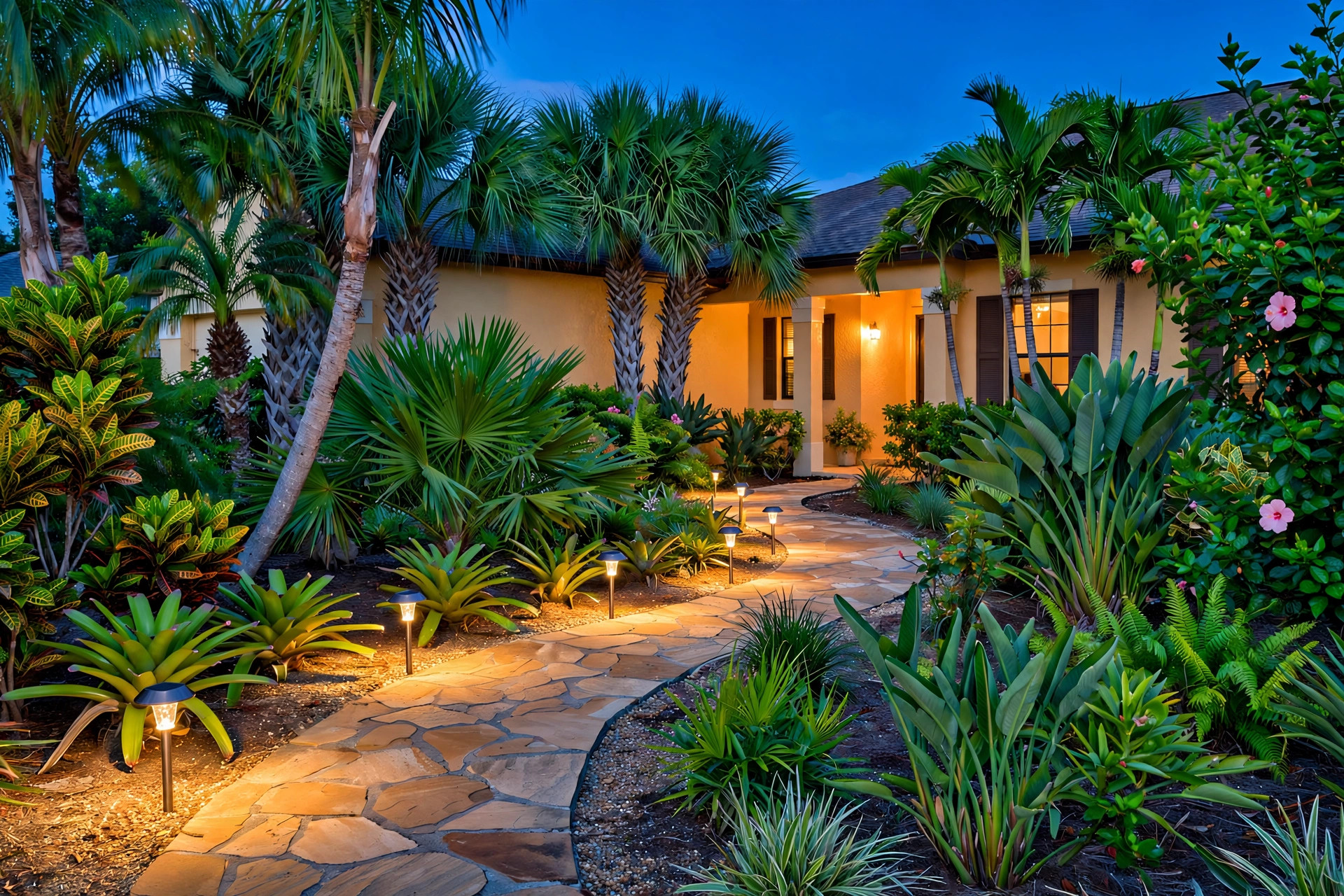

When the sun goes down in Florida, a dark yard can be a problem. Walkways disappear. Steps become hard to see. Guests trip. A good set of solar path lights florida homes usa owners trust can solve this without digging a trench or hiring an electrician. These small lights drink in the strong Florida sun all day and give back a soft glow all night.
Florida is one of the best states in the country for solar lights. The sunshine is long and strong for most of the year. That means the small panels on top of each light can gather plenty of energy, even on cloudy days. But Florida also has heat, heavy rain, salt air near the coast, and hurricanes. Not every solar light can stand up to that. This guide walks through what matters, what to buy, what it costs, and how to keep the lights working for years.
Why Solar Path Lights Matter in Florida Homes
A path light has one job: to show the way. In Florida, that job matters more than many people think. Summer days are long, but when night falls it falls fast. A walkway from the driveway to the front door can turn pitch black in minutes. Good lighting keeps family and guests safe on their feet.
There is also the question of curb appeal. Real estate agents in Florida often say that a lit walkway makes a home look warm and cared for. A row of soft lights along a path or around a garden bed adds a quiet charm that costs very little to run. Solar lights need no wiring and no electric bill. Once they are in the ground, the sun does the rest.
Security plays a part too. A well-lit yard is less inviting to intruders. While a reading floor lamp lights the inside of a home, path lights take care of the outside. Together they make a home feel lived in and watched over, even when the family is away.
For homes near the beach, path lights help mark the way across sand and shell paths that shift underfoot. For inland homes, they outline pool decks and garden borders. In every case, the idea is the same: light where you walk, without fuss and without wires.
How Solar Path Lights Work: Solar Path Lights Florida Homes Usa
A solar path light is a simple machine. On top sits a small solar panel. Inside is a rechargeable battery and an LED bulb. During the day, the panel turns sunlight into power and stores it in the battery. At dusk, a small sensor detects the falling light and switches the LED on. At dawn, it switches off again.
Most models run eight to ten hours on a full charge. In Florida, a full charge is easy to get. Even in winter, the state gets enough sun to fill the small batteries most days. The LED bulbs in these lights sip power, so a little charge goes a long way.
The weak point is the battery. Most solar path lights use nickel-metal hydride or lithium batteries. Heat wears batteries down faster, and Florida has heat. A battery that lasts three years in a mild state may last two in Florida. The good news is that many brands sell replacement batteries, and swapping one takes about a minute.
The solar panel itself can last far longer. Panels do not wear out the way batteries do. What hurts them is grime. Dust, pollen, and salt spray coat the panel and block the sun. A quick wipe every month or two keeps the charge strong.
What to Look for When Choosing Solar Path Lights
Florida’s climate narrows the field. Here are the traits that matter most.
Brightness. Brightness is measured in lumens. For a path light, 10 to 30 lumens per light is the sweet spot. Below 10 lumens the glow is too dim to mark a path. Above 30 the lights start to glare and waste power. Look for the lumen rating on the box before you buy.
Battery type and capacity. Lithium batteries handle heat better than older nickel types and hold a charge longer. Check the milliamp-hour rating, written as mAh. A higher number means more stored power and a longer run on short winter days.
Water resistance. Florida rain is not gentle. Look for a rating of IP44 or higher. The IP code tells you how well the light keeps out dust and water. IP65 is excellent for a path light and will stand up to driving rain.
Materials. Cheap plastic lights fade and crack in the Florida sun within a year. Stainless steel, aluminum, and heavy-duty resin hold up far better. Glass lenses beat plastic lenses because they do not cloud over time. If you live near the coast, salt air eats bare metal, so choose powder-coated or marine-grade finishes.
Stake quality. Many solar lights fail at the stake, not the light. Thin plastic stakes snap in hard Florida soil or in a storm. Look for thick, ribbed stakes. Some owners set the lights in small pots of gravel instead of driving stakes into rocky ground.
Warm versus cool light. Light color is measured in Kelvin. Warm white, around 2700 to 3000 Kelvin, feels soft and welcoming. Cool white, above 5000 Kelvin, looks harsh and blue. For a home walkway, warm white is the better choice. It flatters the house and the garden alike.
Shoppers comparing options can learn a lot from lighting guides at The Spruce, which reviews outdoor fixtures in plain language, and from Consumer Reports, which tests solar lights for brightness and battery life.
Types of Solar Path Lights
Not all path lights look the same. The main styles each suit a different yard.
Stake lights. These are the classic kind. A small head on a ground stake. They are cheap, easy to place, and easy to move. Most Florida homeowners start here. They work well along straight walkways and garden edges.
Lantern-style lights. These look like small old-fashioned lanterns. They give a wider pool of light and suit homes with a traditional or coastal style. They cost more but they dress up a yard.
Bollard lights. Short posts, usually a foot or two tall, with the light at the top. They mark driveways and wide paths with a modern look. They are sturdier than stake lights and harder to knock over.
In-ground disk lights. Flat round lights that sit flush with the ground. They mark path edges without sticking up and are easy to mow around. Their glow is softer because they lie flat and catch less sun.
Motion-sensor path lights. These stay dim until someone walks by, then brighten. They save power and startle no one. They are a smart pick for side yards and dark corners where constant light is not needed.
A homeowner who also wants to light up trees or walls may look at landscape spot lights, which are brighter and aimed upward. Path lights stay low and gentle by design.
Cost and Price in the USA
Solar path lights are one of the cheapest upgrades a homeowner can make. Prices in the USA break down roughly like this.
A basic set of six to eight stake lights costs between twenty and forty dollars. These are fine for a short walkway but may not last more than a season or two in Florida heat.
Mid-range sets of eight to twelve lights run forty to ninety dollars. This is where most Florida buyers should shop. The materials are better, the batteries are bigger, and the water sealing is stronger. Many sets in this range carry two-year warranties.
Premium single lights or small sets cost fifteen to thirty dollars per light. Brands sold through lighting specialists like Lumens and Lamps Plus sit in this tier. The build quality is high, replacement parts are available, and the light output is honest.
Beyond the lights themselves, the running cost is near zero. There is no electrician bill and no added cost on the power bill. The only repeat cost is replacement batteries every two to three years, usually a few dollars per light. Retailers such as Home Depot and Lowe’s stock both the lights and the replacement batteries, so upkeep is simple. For a typical Florida front walk of twenty feet, eight mid-range lights at about sixty dollars total is a fair budget.
Installing Solar Path Lights the Right Way
Installation takes minutes, but placement takes thought. A little planning goes a long way.
First, walk the path at night with a flashlight. Note where the dark spots are. Steps, turns, and uneven ground need light the most. Mark these spots in daylight.
Second, check the sun. Each light needs six to eight hours of direct sun on its panel. Watch the path through a day and note where shade falls. Do not place a solar light under a dense tree or on the north side of a fence. If a spot is shady, choose a different spot or trim the branch.
Third, space the lights six to eight feet apart. Closer spacing wastes lights. Wider spacing leaves dark gaps. Stagger them on alternate sides of the path for a natural look rather than lining them up like soldiers.
Fourth, push the stakes into soft ground after rain or watering. Florida soil can be hard and sandy. If the ground resists, dig a small pilot hole with a screwdriver first. Never hammer a solar light. The head will crack.
Fifth, let the lights charge for two full sunny days before judging them. New batteries need a few cycles to reach full strength. Many owners think their lights are weak on night one. By night three they glow as they should.
Big-box guides at Philips lighting pages and the ENERGY STAR program both stress the same point: solar lights are only as good as the sun they receive. Placement is everything.
Care and Upkeep in the Florida Climate
Florida asks more of outdoor lights than most states. A small routine keeps them shining.
Clean the panels monthly. Wipe each panel with a damp cloth. Pollen season coats panels in yellow dust. Near the coast, salt film builds up. A dirty panel can cut charging in half.
Check after storms. Summer brings daily downpours and the odd hurricane. After a big storm, walk the path. Straighten leaning lights. Reseat any that blew over. Pull out any that filled with water and let them dry.
Trim plants. Fast-growing Florida plants swallow path lights by midsummer. Keep grass and shrubs cut back so the panels see the sky and the light reaches the path.
Replace batteries every two to three years. When lights dim early in the night, the battery is usually the cause, not the panel. Open the battery compartment, note the size, and buy the same type. The U.S. Department of Energy notes that heat shortens battery life, so Florida owners should expect the shorter end of the range.
Bring them in for hurricanes. When a hurricane warning comes, pull the lights and store them in the garage. Flying stakes become projectiles in high wind. Put them back out after the storm passes.
Watch for ants. Fire ants love the warm dry housing of a solar light. If a light stops working, check for ant nests inside before assuming it is dead.
Safety Notes
Solar path lights are low voltage and safe to handle. There are still a few cautions worth noting.
Do not place lights where lawn mowers or string trimmers will hit them. Set them a foot back from the path edge. A mower blade will shatter a light and throw the pieces.
Keep lights clear of dry mulch in fire season. The lights themselves run cool, but any electrical device near dry tinder deserves respect. A gravel ring around each light looks tidy and adds safety.
Make sure the lights do not blind drivers. A path near the street should use low, shielded lights aimed down. Bright cool-white lights aimed at the road annoy neighbors and can distract drivers.
If you use indoor grow lights inside the house, remember they are a different animal. Those plug into the wall and run hot. Solar path lights are strictly outdoor, low-power devices. Do not bring them inside expecting them to charge under a lamp. They need real sun.
Frequently Asked Questions
Do solar path lights work on cloudy days? Yes, but not as long. Panels still gather light through clouds, just less of it. In Florida, true all-day gloom is rare, so most nights the lights still run for hours. After two or three dark storm days in a row, expect a shorter glow.
How long do solar path lights last in Florida? The light heads and panels often last five years or more. Batteries need replacement every two to three years in the heat. Cheap plastic models may crack within a year. Spending a little more up front usually buys several extra years.
Will they survive a Florida summer? Good ones will. Look for high water-resistance ratings and heat-tolerant lithium batteries. The main summer enemies are standing water and extreme heat on the battery. Lights on high ground with good drainage fare best.
Can I leave them out during a hurricane? It is better to bring them inside. Stakes can snap and heads can crack in high wind. Store them in a garage or shed until the storm passes, then set them back out. The panels recharge quickly.
Are solar path lights bright enough to read by? No, and they are not meant to be. They mark the path, not light a book. If you need real brightness for a patio or grill area, look at wired fixtures or brighter solar flood lights instead.
A Final Word
Solar path lights are a small purchase with an outsized payoff, and Florida is the perfect place for them. The sun is free and plentiful. The installation takes an afternoon. The upkeep takes minutes a month. Choose lights built for heat and rain, place them where the sun can reach them, and keep the panels clean. Do that, and your walkway will glow softly every night for years, with no wire, no electrician, and no power bill.
References
Consumer Reports. (n.d.). Product reviews and ratings. https://www.consumerreports.org ENERGY STAR. (n.d.). Energy efficient products. https://www.energystar.gov Lamps Plus. (n.d.). Lighting and home decor. https://www.lampsplus.com Lowe’s. (n.d.). Home improvement products. https://www.lowes.com Lumens. (n.d.). Lighting and ceiling fans. https://www.lumens.com Philips. (n.d.). Lighting products. https://www.philips.com The Home Depot. (n.d.). Home improvement products. https://www.homedepot.com The Spruce. (n.d.). Home and garden advice. https://www.thespruce.com U.S. Department of Energy. (n.d.). Energy efficiency and renewable energy. https://www.energy.gov
Was this guide helpful?

About David Wilson
The My Garden US editorial team writes practical, in-depth home and garden guides for American homeowners — tested advice, no fluff.
You May Also Like
Solar Path Lights American Homes Guide
April 24, 2026 0 views
Indoor Wall Sconces: An American Homes Guide
January 1, 2026 0 views
Reading Floor Lamps USA Online Deals: A Simple Guide to Bright Corners
April 18, 2026 0 views