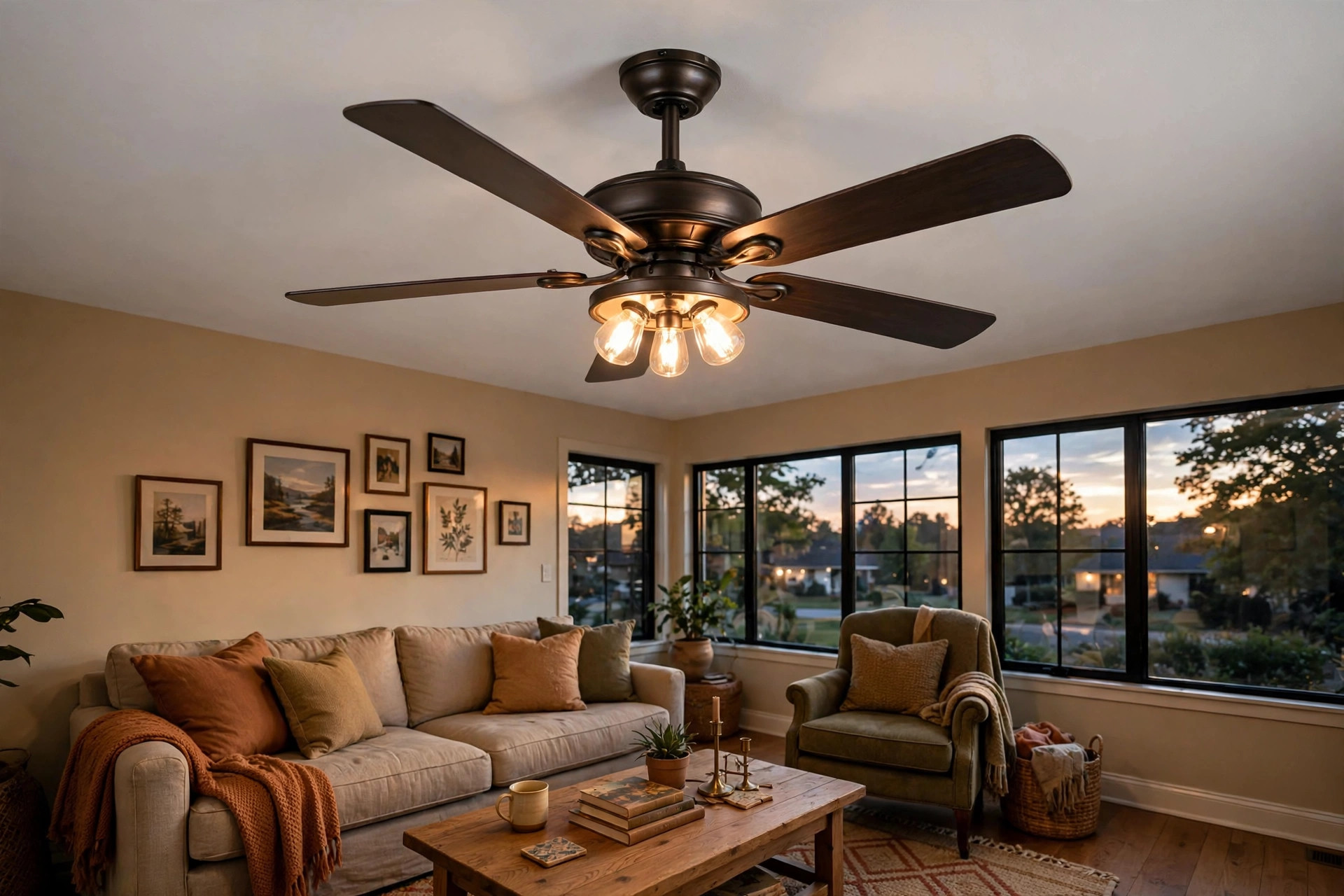

A ceiling fan with lights is one of the most useful fixtures in American homes. It cools the room in summer. It spreads warm air in winter. It lights the room at night. One fixture does the work of two. This ceiling fans lights american homes guide walks through each choice in plain words. It covers size, style, cost, and care. By the end, any homeowner will know which fan fits which room.
Why It Matters
Americans spend a large part of the year indoors. Comfort depends on air movement and good light. A ceiling fan with lights serves both needs at once. It saves space on the ceiling. It saves the cost of a second fixture. It keeps the room tidy.
Air movement changes how warm a room feels. A fan does not lower the temperature. It moves air across the skin. Moving air carries heat away from the body. The room feels four or five degrees cooler. This allows the thermostat to sit a little higher. The air conditioner runs less. Energy bills fall.
In winter, the fan can reverse. Warm air rises to the ceiling. Most people never feel it there. A fan turning slowly in the other direction pushes that warm air down. The room feels warmer at floor level. The heater runs less. Few homeowners use this feature. It is free to them already.
Light matters as much as air. Rooms need light in the right place. A ceiling light sits at the center of the room. It throws light in all directions. It keeps corners bright. Combined with a fan, it removes the need for a separate ceiling fixture. That matters in rooms with low ceilings. One opening in the ceiling does two jobs. A ceiling fans lights buying guide can help compare models side by side before a purchase.
What to Look For When You Choose: Ceiling Fans Lights American Homes Guide
Buying a fan with lights is simple when the basics are clear. Three things decide the result. Room size, light quality, and the way the fan is controlled.
Room Size and Fan Size
Fans are measured by blade span. This is the width from one blade tip to the opposite tip. Small fans run about 29 to 36 inches. Medium fans run 42 to 48 inches. Large fans run 52 inches or more. The room decides the span.
Small rooms up to 75 square feet suit a 29 to 36 inch fan. Bathrooms and small offices fall here. Rooms from 76 to 144 square feet suit a 42 to 44 inch fan. Most bedrooms fall here. Rooms from 144 to 225 square feet suit a 50 to 54 inch fan. Living rooms fall here. Rooms above 225 square feet may need a fan of 56 inches or more. Very large rooms may need two fans.
The fan must sit at the right height. Blades should hang at least seven feet above the floor. They should sit eight to nine feet above the floor for best air flow. A room with an eight foot ceiling needs a flush mount fan. A room with a high ceiling needs a downrod. The downrod drops the fan to the right height.
Light Output and Color
The light kit is the second half of the purchase. Light output is measured in lumens. A bedroom needs about 800 to 1,000 lumens. That equals an old 60 watt bulb. A living room needs 1,200 to 2,000 lumens. Kitchens need more. Choose the lumen level to match the room.
Color temperature matters too. It is measured in Kelvin. Warm light sits near 2700 Kelvin. It looks like old bulbs. It suits bedrooms and living rooms. Neutral light sits near 3500 Kelvin. It suits kitchens and offices. Cool light sits near 5000 Kelvin. It suits work areas and garages. Many new fans let the owner change the color with a switch. This is a fine feature. It avoids a wrong guess.
Check whether the bulbs are built in. Many modern fans use LED panels that are part of the fixture. They last for years. When they fail, the whole panel must be replaced. Fans with screw-in bulbs are easier to fix. Any standard bulb fits. Each style has a trade. The guidance from Energy Star on efficient lighting explains how LED choices cut power use over time.
Controls
Older fans use pull chains. Newer fans use remotes or wall controls. A remote controls the fan speed and the light from the bed or the couch. Smart fans connect to phone apps and voice assistants. They can join a home schedule. The light can dim on a timer. Remotes add cost. They also add comfort. A fan on a high ceiling almost needs a remote. No one wants to climb for a pull chain.
Types and Options
Ceiling fans with lights come in several forms. The room and the ceiling decide the type. Style decides the look.
Mounting Styles
Flush mount fans hug the ceiling. They suit ceilings of eight feet or less. The blades sit close to the ceiling. Air flow is slightly weaker. The fan is safe for low rooms. Downrod fans hang below the ceiling on a pipe. They suit ceilings of nine feet or more. The rod can be short or long. Angled ceilings need a special mount. It lets the fan hang level on a slope.
Motor Types
Two motor types fill the market. AC motors are the old standard. They are strong and proven. They cost less. They use more power. DC motors are the newer style. They use far less power. They run quieter. They allow more speeds. Six speeds are common. DC fans cost more at the start. They pay back in lower bills. A quiet fan matters in a bedroom. A noisy fan ruins sleep.
Blades and Finishes
Most fans have three to five blades. More blades do not always mean more air. Blade pitch matters more. Pitch is the angle of the blade. A pitch of 12 to 15 degrees moves good air. Blade material matters for the setting. Wood blades suit dry rooms. Plastic blades suit damp rooms. Damp rated fans suit covered porches. Wet rated fans suit open areas where rain can fall on them.
Finishes should match the room. Brushed nickel suits modern rooms. Oil rubbed bronze suits warm rooms. White suits low ceilings because it fades into the ceiling. Wood tones suit classic rooms. The light kit finish should match the fan. Mixed metals look wrong on one fixture.
If the home already has dining room chandeliers, a fan with a chandelier style light kit can match the tone of the house. Some fans carry small crystal shades. They bridge the gap between a fan and a chandelier.
Cost and Price
Prices vary widely. A basic fan with lights costs 60 to 120 dollars. It has an AC motor. It has pull chains. It works fine in a spare room. A mid range fan costs 120 to 300 dollars. It has a remote. It has a quieter motor. It suits bedrooms and living rooms. A premium fan costs 300 to 600 dollars or more. It has a DC motor. It has smart controls. It has fine finishes. Designer models can pass 1,000 dollars.
Installation costs add to the price. A simple swap of an old fan costs 100 to 200 dollars for an electrician. A new install with new wiring costs 200 to 400 dollars. A new ceiling box rated for fans is required. A standard light box is not strong enough. It can break under the weight. The box must say it is rated for fan support.
Running costs are small. A fan uses 15 to 75 watts depending on speed and motor. The light adds 10 to 20 watts with LEDs. Running a fan for eight hours a day costs only a few dollars a month. The savings on air conditioning are far larger. Shoppers comparing prices can check large home improvement stores such as Home Depot and Lowe’s for current ranges.
Care and Upkeep
A ceiling fan with lights needs little care. A small routine keeps it safe and quiet.
Dust the blades twice a year. Dust builds on the top edge of each blade. It throws the fan off balance. A pillowcase slid over each blade collects the dust. Wipe with a damp cloth for a deeper clean. Turn the fan off first. Let the blades stop.
Tighten screws once a year. Fans vibrate. Screws loosen over time. Check the screws on the blades and the mount. A loose screw causes wobble and noise. Tighten with care. Do not strip the threads.
Clean the light glass. Glass shades collect dust and dead insects. Remove the shade. Wash it in warm soapy water. Dry it fully before replacing it. Check the bulbs or the LED panel at the same time. Replace weak bulbs. Note the max wattage printed on the socket. Never use a bulb above that rating.
Balance the fan if it wobbles. A balancing kit comes with many fans. It holds small weights that clip to the blades. Clip a weight to one blade. Run the fan. Move the weight until the wobble stops. Then stick it in place. A wobbling fan is noisy. It wears the motor mount faster.
Safety
Ceiling fans are safe when installed right. A few rules protect the home.
Blades must hang at least seven feet above the floor. Lower blades can strike a tall person. Keep them eight to nine feet up when the ceiling allows. The fan must hang from a box rated for fan support. The box carries the weight and the motion. A light only box is not enough. It can pull out of the ceiling.
Turn off power at the breaker before service. The wall switch is not enough. Someone can flip it by mistake. Test that the fan is dead before touching wires. Water and fans do not mix. Only damp rated or wet rated fans belong outdoors or in wet rooms. Indoor fans in damp places can rust and fail. The safety standards discussed by the U.S. Consumer Product Safety Commission cover fixtures and cords in the home.
Keep children from hanging on blades. A blade can break under weight. The fan can pull loose. Teach children to use the remote or the wall control. Never let them swing from the fan. Keep the fan speed low in rooms where children play with balloons or toys that fly. A blade strike can break a toy and startle a child.
Frequently Asked Questions
What size fan does a bedroom need?
Most bedrooms measure 100 to 150 square feet. A 42 to 48 inch fan suits this size. Measure the room first. Multiply length by width. Match the result to the size ranges above. A fan too small will not move enough air. A fan too large will feel harsh on low speed.
Can one wall switch run both the fan and the light?
Yes, in most cases. One switch can power both. The remote or the pull chains then split the control. The switch turns all power on and off. The remote sets fan speed and light level. A dual wall control can run fan and light on separate switches. This needs extra wiring in the wall.
Do ceiling fans help in winter?
Yes. Most fans have a reverse switch. It changes the blade direction. In winter, run the fan slowly in reverse. It pushes warm air down from the ceiling. The room feels warmer at the level where people sit. This cuts heating costs. The Department of Energy’s fan guidance explains the reverse setting in detail.
What is a damp rated fan?
A damp rated fan resists moisture in the air. It suits covered porches and bathrooms. Its parts resist rust. Its wiring resists humidity. An indoor only fan will corrode in these places. A wet rated fan goes one step further. It can take direct rain. Match the rating to the spot.
How long do LED light kits last?
A built in LED panel often lasts 25,000 to 50,000 hours. That is many years of normal use. Heat shortens LED life. Keep the glass clean so heat escapes. Screw in LED bulbs last about 15,000 to 25,000 hours. They are easy to replace when they fade.
Are smart ceiling fans worth the extra cost?
They are worth it for some homes. A smart fan joins a phone app or a voice system. It can run on a schedule. It can turn off when no one is home. It can dim the light at night. The extra cost runs 50 to 150 dollars over a plain remote fan. Homes with garage shop lights and other smart fixtures gain the most, since one app can run the whole house.
A Short Final Word
A ceiling fan with lights is a quiet workhorse. It cools, it warms, and it lights. Choose the size for the room. Choose the light for the mood. Mount it safe and high. Keep it clean. It will serve the home for twenty years. Few fixtures give so much for so little. For deeper reading, lighting specialists such as Lamps Plus and Philips publish detailed fixture guides for every room.
References
ENERGY STAR. (n.d.). Energy efficient products. https://www.energystar.gov Lamps Plus. (n.d.). Lighting and home decor. https://www.lampsplus.com Lowe’s. (n.d.). Home improvement products. https://www.lowes.com Lumens. (n.d.). Lighting and ceiling fans. https://www.lumens.com Philips. (n.d.). Lighting products. https://www.philips.com The Home Depot. (n.d.). Home improvement products. https://www.homedepot.com U.S. Consumer Product Safety Commission. (n.d.). Product safety information. https://www.cpsc.gov U.S. Department of Energy. (n.d.). Energy efficiency and renewable energy. https://www.energy.gov
Was this guide helpful?

About Sarah Mitchell
The My Garden US editorial team writes practical, in-depth home and garden guides for American homeowners — tested advice, no fluff.
You May Also Like

Sensor Porch Lights Texas Homes USA: A Practical Guide to Motion and Dusk-to-Dawn Porch Lighting
June 1, 2026 0 views
Under Cabinet Strips: A Guide for American Homes
February 27, 2026 0 views
WiFi Smart Bulbs: Reviews and Buying Guide for USA Homes
January 21, 2026 0 views