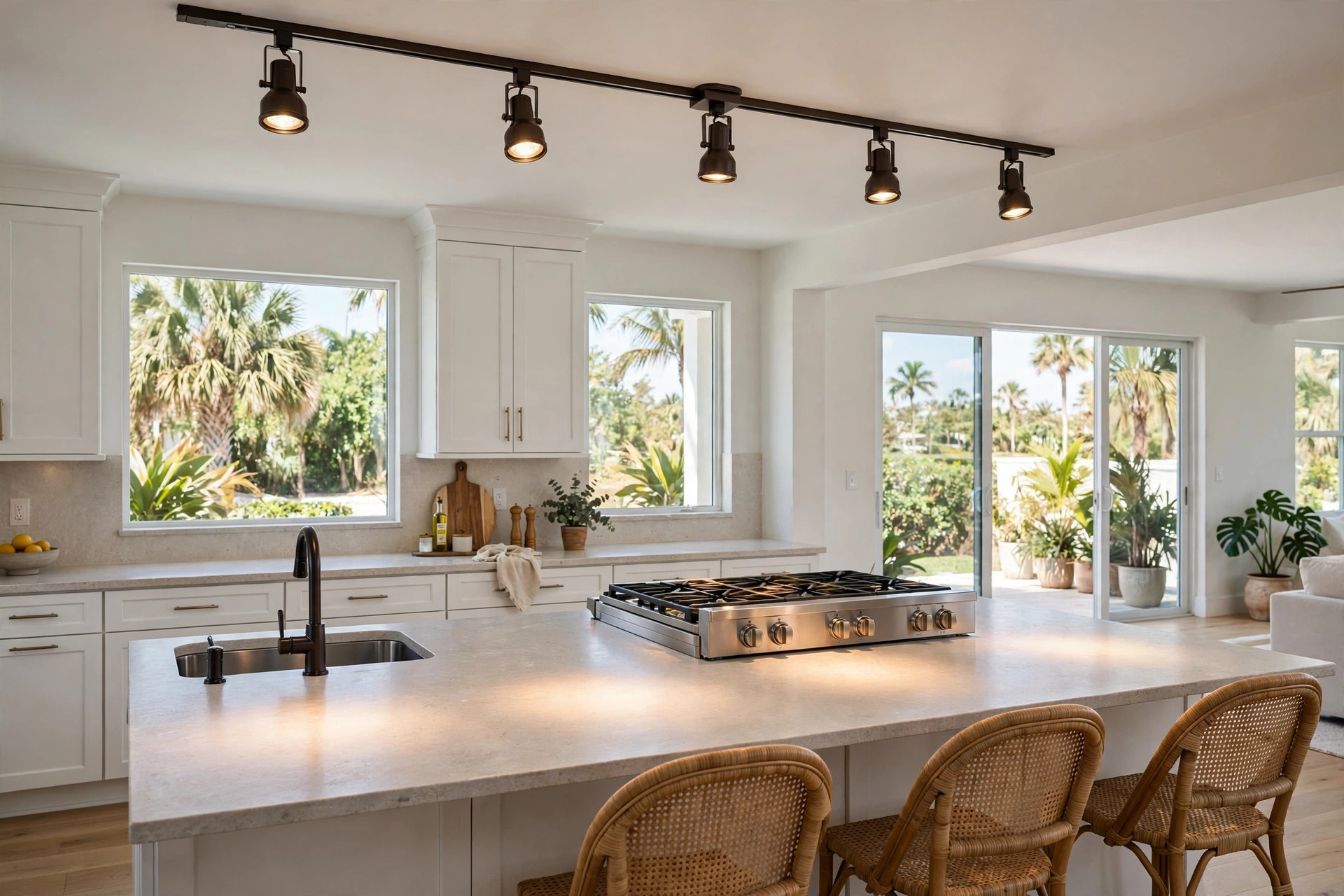
A kitchen needs good light. In Florida, many kitchens are wide and open. Windows bring in strong sun by day. At night, a single ceiling bulb often leaves dark corners. That is why so many home owners look at kitchen track lighting florida homes usa options. Track lighting is a rail fixed to the ceiling. Small light heads hang from the rail. Each head can turn and point in a new direction. This lets one fixture light the stove, the sink, and the counters all at once.
Florida homes have their own needs. Heat and humidity are high. Afternoon storms can darken the sky in minutes. A good track system answers these problems with flexible light and low heat. This guide explains the main types, what to look for, what it costs, how to keep it clean, and how to stay safe.
Why Track Lighting Suits Florida Kitchens
Florida kitchens often serve as the center of the home. Families cook, eat, and talk in one open space. A single fixed fixture cannot cover all these tasks. Track heads can be aimed at work zones. One head lights the cutting board. Another lights the pantry door. A third throws soft light over the breakfast nook. When you move furniture or add an island, you can aim the heads again instead of buying a new fixture.
The Florida climate also matters. Rooms get hot in summer. Old halogen heads gave off strong heat and made this worse. Modern LED track heads run cool and use little power. The ENERGY STAR program rates many efficient fixtures, and its lists can help buyers compare. The U.S. Department of Energy also publishes plain guidance on home energy use.
Humidity is another factor. Kitchens in Tampa, Miami, and Orlando carry moisture from cooking and from the air itself. Metal tracks with good finishes resist rust and stains. Sealed heads keep grease out of the wiring. For rooms near the coast, salt in the air can corrode cheap metal fast. A finish rated for damp places lasts longer.
Many Florida homes also have high ceilings or open plans shared with the living room. Recessed cans can be hard to add after the home is built. A track mounts to the ceiling surface, so it often needs no new holes through the roof. This makes it a favorite in remodels.
How to Choose the Right Track System: Kitchen Track Lighting Florida Homes Usa
Measure the Kitchen First
Draw a simple plan of the kitchen. Mark the sink, stove, counters, and island. Note the dark spots at night. A rail of four to eight feet covers most kitchens. Larger kitchens may need two rails or an L-shaped layout. Keep the track away from cabinet doors that swing up, and keep heads at least a foot from the wall so heat and glare do not hit painted surfaces.
Pick the Track Standard
Three main track types exist. H-type is the most common in the USA. J-type and L-type are older but still sold. Heads and tracks must match. If you already own heads, check their type before you buy a rail. Most new kits sold today use H-type, which gives the widest choice of heads and accessories.
Choose the Light Color
Bulbs list a color temperature in Kelvin. Warm white is about 2700K and feels like old incandescent bulbs. Bright white is about 3500K. Daylight is 5000K and looks crisp. Most Florida kitchens look best between 3000K and 4000K. Food looks fresh, and white counters do not turn blue. Buy all heads in the same temperature so the light looks even.
Decide on Fixed or Adjustable Heads
Some heads are simple spots that tilt. Others rotate a full circle and tilt too. For task work, choose heads with wide movement. For simple fill light, fixed heads cost less. A mix often works well: two adjustable spots over the island and two fixed spots along the counter.
Many owners pair track lights with under-cabinet lighting strips for a layered effect. The track handles the room, while the strips remove shadows under the cabinets.
Main Types of Track Lighting
Line-Voltage Track
Line-voltage track runs straight from house power. It is simple and strong. Heads come in many styles and wattages. Because it uses full voltage, it can carry long runs and many heads. The drawback is size. Heads and rails are bulkier than low-voltage parts.
Low-Voltage Track
Low-voltage track uses a transformer to step power down. The heads and rails are slim and neat. This suits small kitchens and low ceilings. The transformer adds cost and can hum if it is cheap. Also, long runs may dim at the far end if the wire is thin.
Monorail and Cable Systems
Monorail is a flexible rail that bends into curves. Cable systems use two thin wires stretched across the room. Both look modern and light. They are often low voltage. They suit islands and peninsulas where a straight rail would look stiff. They cost more and need careful planning.
LED Integrated Track
Many new tracks come with built-in LED modules instead of replaceable bulbs. The light is bright and efficient. The catch is that when the module fails, the whole head must be replaced. Heads with standard sockets accept smart bulbs, which let owners change color and dimming from a phone.
Bulb makers like Philips sell LED bulbs in many track head sizes. Large home improvement stores such as The Home Depot and Lowe’s stock rails, heads, and bulbs in one aisle, which makes it easy to compare finishes side by side. Lighting specialists like Lamps Plus and Lumens carry wider ranges online.
Cost and Price in the USA
Prices vary by type and finish. A basic four-head line-voltage kit costs about 60 to 120 dollars. Mid-range kits with brushed nickel or bronze finishes run 150 to 300 dollars. Designer monorail systems can pass 500 dollars before bulbs.
Bulbs add to the cost. LED bulbs for track heads run 8 to 20 dollars each. Integrated LED heads cost more up front but need no bulbs. Electrician labor, if needed, often runs 150 to 300 dollars per visit in Florida cities. A homeowner who can work with a simple junction box may install a surface track in an afternoon.
Running costs are low with LED. A four-head LED track may use 40 watts total. At Florida power rates, that is only a few dollars a month with normal use. Halogen heads used five times that power and added heat to the room. Replacing halogen heads with LED is one of the cheapest upgrades a kitchen can get.
Shop sales carefully. Holiday weekends often bring discounts at major retailers. Home advice sites like The Spruce publish seasonal buying guides that can help time a purchase. For outdoor areas, some owners also add motion-sensor porch lights to cut night-time power use further.
Care and Upkeep
Track lighting needs little care, but regular cleaning keeps it bright. Dust heads and rails every month with a dry cloth. In Florida kitchens, grease from frying settles on heads. Wipe them with a damp cloth and mild soap, then dry them fully. Never spray cleaner directly on a head. Turn the power off at the switch before you touch any part.
Check the aim of the heads twice a year. Vibration from doors and storms can shift them. A head pointed at the wrong spot wastes light and can glare in the eyes. Tighten the small screws or clips that hold each head in place.
Replace failing bulbs promptly. A dead head in a four-head track cuts light by a quarter. With LED bulbs, look for flicker or dimming as signs of age. Keep one spare bulb in a drawer so a failure does not wait for a store trip.
Inspect the track ends and connectors once a year. Look for loose caps, discolored plastic, or a burnt smell. These are signs of a bad connection. Cut power at the breaker and call an electrician if you see them. Do not try to fix scorched wiring yourself.
In coastal homes, wipe metal finishes every few months to fight salt film. A thin coat of car wax on the rail, applied with a soft cloth, can slow corrosion. Keep this wax away from bulb lenses.
Safety
Safety starts with correct installation. Track must be fixed to a ceiling box rated for its weight. Long rails need extra support straps. If the old fixture box is loose or cracked, replace it. Florida building codes require permits for new wiring in many cases, so check local rules before you cut into the ceiling.
Keep insulation away from hot heads. Halogen heads can burn skin and scorch paper. Even LED heads need some air space. Do not aim a head straight at curtains or wooden shelves from a short distance.
Water and power do not mix. Keep tracks away from spots where roof leaks drip. Florida storms can push water through old flashing. If a leak stains the ceiling near the track, cut power until a roofer and an electrician have checked the area.
Dimmer switches must match the bulbs. An old dimmer made for incandescent bulbs can make LED heads flicker or buzz. Buy a dimmer rated for LED loads. If flicker appears after a bulb change, the dimmer is the first thing to check.
Homes with small children need extra care. Keep pull cords and low heads out of reach. Choose heads with cool-to-touch housings in family kitchens.
Frequently Asked Questions
Is track lighting enough for a whole kitchen? It can be, if the rail is long enough and the heads are aimed well. A four-head track covers a small to medium kitchen. Large open kitchens often need a second rail or extra help from under-cabinet lights and pendants.
Can I install track lighting myself? Many owners do. A surface-mount track that uses an existing ceiling box is a common do-it-yourself job. Turn off the breaker, follow the kit manual, and test with a voltage checker. Call an electrician for new wiring, heavy rails, or anything you are unsure about.
Do LED track heads work in Florida heat? Yes. LED heads run far cooler than halogen. They still need air flow, so do not box them in. In garages or lanais that bake in summer sun, choose heads rated for higher ambient temperatures.
How long do LED track bulbs last? Most are rated for 15,000 to 25,000 hours. In a kitchen used three hours a day, that is more than ten years. Heat and cheap drivers shorten life, so buy bulbs from known brands.
Can track lighting dim? Yes, if the heads and the dimmer are both rated for dimming. Use an LED-rated dimmer. Test one head with the dimmer before you buy a full set.
What finish suits a Florida coastal home? Brushed nickel, stainless steel, and bronze resist salt air better than plain chrome or painted white. Wipe the finish a few times a year to stop film buildup.
A Final Word
Kitchen track lighting gives Florida homeowners control over their light. It adapts to open plans, stands up to heat and humidity, and sips power when fitted with LED heads. Measure the room, match the track type to your heads, pick a sensible color temperature, and keep the system clean. With those simple steps, one rail can serve the sink, the stove, and the table for many years.
References
ENERGY STAR. (n.d.). Energy efficient products. https://www.energystar.gov Lamps Plus. (n.d.). Lighting and home decor. https://www.lampsplus.com Lowe’s. (n.d.). Home improvement products. https://www.lowes.com Lumens. (n.d.). Lighting and ceiling fans. https://www.lumens.com Philips. (n.d.). Lighting products. https://www.philips.com The Home Depot. (n.d.). Home improvement products. https://www.homedepot.com The Spruce. (n.d.). Home and garden advice. https://www.thespruce.com U.S. Department of Energy. (n.d.). Energy efficiency and renewable energy. https://www.energy.gov
Was this guide helpful?

About Jennifer Lee
The My Garden US editorial team writes practical, in-depth home and garden guides for American homeowners — tested advice, no fluff.