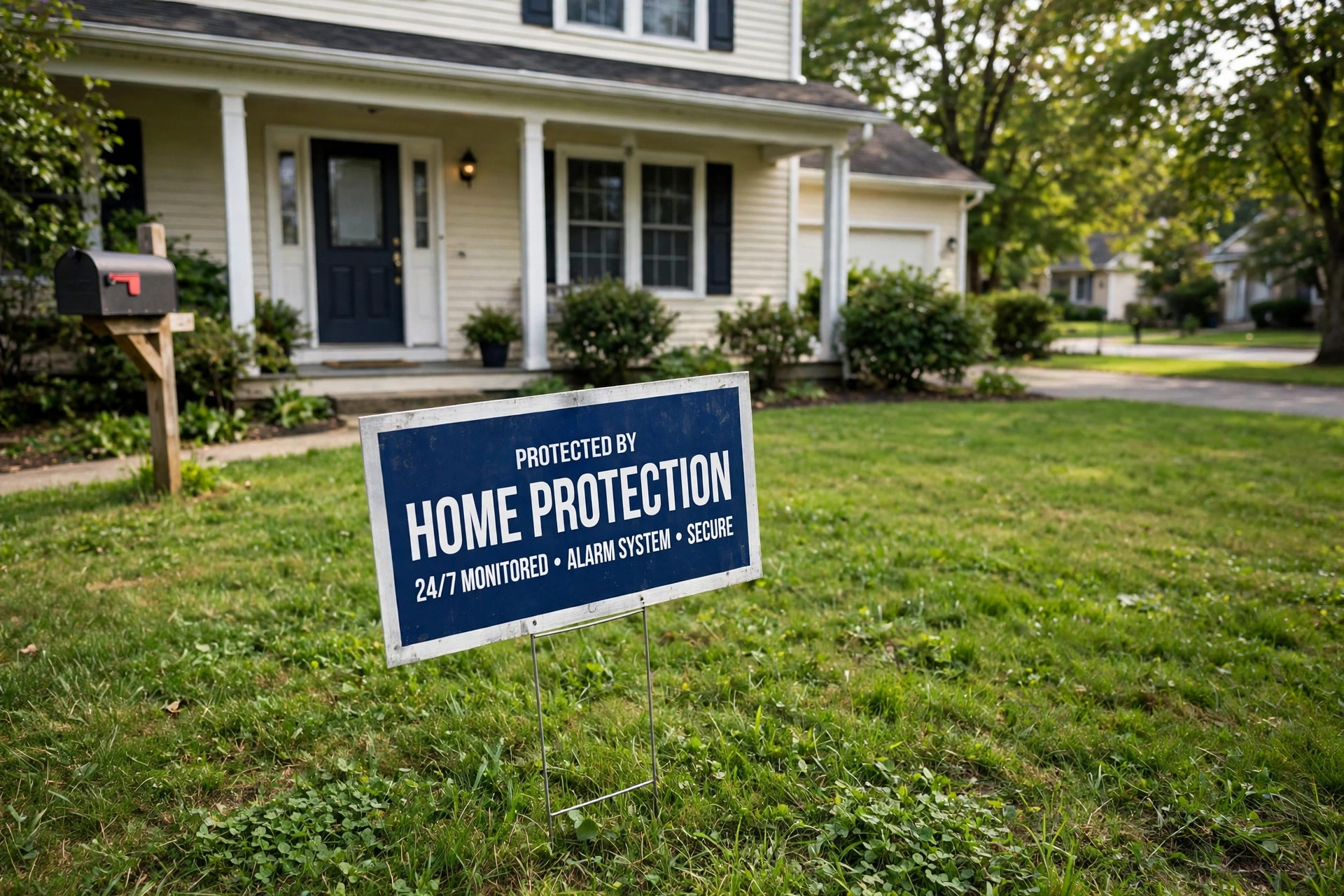

Walk through almost any American neighborhood and you will see them. Small signs sit near the mailbox or by the front walk. They carry a few plain words: “Protected by a Security System,” “Monitored 24 Hours,” “Beware of Dog.” The question behind them is simple. Security yard signs do they work? Do they keep burglars away, or are they only plastic stuck in the grass?
The short answer is that signs help, but they do not protect a home by themselves. They work best as one part of a larger plan. This guide explains what the research shows, what police officers say, what kinds of signs exist, what they cost, and how to use one well. It is written for the ordinary homeowner in the United States who wants plain facts before spending money.
Why a Sign Matters at All
A burglary is usually not a crime of courage. It is a crime of choice. Most thieves look for the easiest house on the block, not the hardest. They walk or drive past homes, study what they see, and pick a target in a short time. A security sign adds one more fact to that quick study. It tells the stranger at the curb that this house may not be easy.
Criminologists have asked burglars about this directly. In interviews done over several decades, many convicted burglars said they avoided houses with signs of an active alarm system. They looked for houses without such signs. A sign, in their words, raised the risk and lowered the profit. It did not make a house impossible to enter. It made it less worth the trouble.
Police departments in many American cities give the same advice. They tell residents to layer their defenses. A sign is one layer. Good locks are another. Smart lights, such as a smart light switch that needs no neutral wire, are another. Trimmed bushes are another. No single layer does the whole job, and the sign is honest about that. It is a warning, not a wall.
How a Sign Works on a Stranger
Think of it from the viewpoint of a man casing a street. He does not know what is behind your door. He must guess. A sign changes the guess. It suggests cameras may be rolling, alarms may be loud, and police may come fast. Most thieves do not want to test that guess. They move to a house with no sign, where the guess is safer.
This effect is strongest when the sign looks real and current. A faded sign from a company that went out of business ten years ago tells a different story. It says the owner is not paying attention. The sign works best when it matches a real system, or at least looks as if it does.
What Signs Can and Cannot Do: Security Yard Signs Do They Work Usa
A sign can make your house less attractive to a casual thief. That is the main value. The largest group of burglars are not professionals. They are opportunists. They want an open door or window, a dark corner, a quiet street. A sign speaks to exactly this group, and it often speaks well enough.
A sign cannot stop a determined thief. A person who wants your specific house, who knows your schedule, who plans the break-in in advance, will not turn away because of a small sign. No sign has ever locked a door. For that reason, experts say to treat a sign as a deterrent, not as protection.
There is also a small risk in some cases. A sign that names an expensive system might tell a thief that the house has things worth stealing. Some security advisers note this trade-off. The general view is that the trade-off is worth it. The chance of turning away the common thief is larger than the chance of attracting the rare planner. Still, it is worth knowing both sides.
Types of Security Yard Signs
Most signs sold in the United States fall into a few clear groups.
Alarm Company Signs
These are the classic signs. They carry the name of a company, such as one of the well-known monitored alarm providers, and a short warning. Many come free with a paid alarm contract. The homeowner stakes them in the yard and puts stickers on the windows. These signs carry weight because thieves recognize the brand names.
Generic “Protected” Signs
These signs name no company. They say things like “This Property Is Monitored” or “Video Surveillance in Use.” They cost little and are sold at home stores and online. Their strength is that they suggest a system without claiming one. Their weakness is that a smart thief may doubt them, since anyone can buy one for a few dollars.
Video Surveillance Signs
These signs warn of cameras. They say “Smile, You Are on Camera” or “24-Hour Video Recording.” They pair well with a real doorbell camera or a set of outdoor security cameras. Even when the cameras are real, the sign helps because it tells the stranger that the cameras are on before he tests them.
Dog Warning Signs
“Beware of Dog” signs work on a different fear. A dog makes noise, and noise is the enemy of a quiet break-in. These signs do not require an alarm system at all. They require only a dog, or at least the idea of one. Some cities have rules about the exact wording, so check local law before posting one.
Smart Home Signs
Newer signs mention smart home monitoring. They may reference smart home camera systems or video doorbells. These suit homes where the owner has built security piece by piece rather than through one alarm company. A do-it-yourself monitoring sign fits this group too.
What Studies and Police Say
Over the years, researchers and police have tested the simple question: security yard signs do they work? The findings line up in a consistent way.
Studies that interview convicted burglars find that most of them noticed signs and avoided houses that had them. In one well-known survey, a large share of burglars said the presence of an alarm system changed their choice of target. Police crime data backs this up in a general way: neighborhoods where many homes show alarm signs tend to have lower break-in rates than similar neighborhoods where few homes show signs.
But researchers are careful. They note that signs often come with real alarms, cameras, and lights, so it is hard to separate the sign from the system behind it. A sign alone, with nothing backing it, has a smaller effect. Reviews of security products by groups such as independent product testers make the same point: a sign is one part of a system, and the system is what matters.
Police advice stays practical. Officers tell homeowners to use a sign, keep it clean and visible, and pair it with real measures: deadbolt locks, lit entry points, trimmed shrubs near windows, and a plan for when the family is away. Technology reviewers at outlets like tech review sites and consumer technology news add that modern cameras and doorbells have made the sign more useful, because the sign now often tells the truth.
The Honest Limit
It is important to be plain about the limit. No study shows that a sign by itself stops all crime. A sign works on the thinking thief who wants easy work. It does less against the thief who is careless, desperate, or set on your house. That is why every expert pairs the sign with other steps.
How to Choose a Sign
Buying a sign is simple, but a few points help you spend wisely.
First, decide whether it will back a real system. If you have an alarm or cameras, use the sign from that maker or a generic sign that fits. If you have no system, a generic sign still has some value, but plan to add real measures soon. A sign should be the start of a plan, not the whole plan.
Second, pick materials that last. Aluminum and heavy plastic hold up to sun and rain far better than thin cardboard. A sign that fades or tips over in a month sends the wrong message. Look for metal stakes and weatherproof print.
Third, size and placement matter more than art. The sign should be large enough to read from the street, usually at least eight to twelve inches wide. Put it where a person walking up to the door will see it: near the front walk, by the driveway, or beside the mailbox. A locking mailbox nearby adds one more small layer against mail theft. Window stickers add a second layer at eye level.
Fourth, obey local rules. Some towns and homeowner groups limit sign size, number, or placement. A quick check with the city office or the association saves trouble later.
Cost and Price in the USA
Security yard signs are among the cheapest security items a homeowner can buy.
– Alarm company signs: Often free with a monitoring contract, which usually costs twenty to sixty dollars a month in the United States. – Generic signs: Two to fifteen dollars each at home stores or online. – Video surveillance signs: Five to twenty dollars, sometimes sold in packs with window stickers. – Dog warning signs: Three to ten dollars.
The related hardware costs more. A video doorbell runs from thirty to two hundred fifty dollars. A set of outdoor cameras runs from one hundred to several hundred dollars. A full professionally installed alarm system with monitoring can run from a few hundred dollars installed plus a monthly fee; see a breakdown of home security system installation cost before you commit. If cost is a concern, review home security product guides and compare options before you buy.
For most families, the smart order is this: buy the sign for a few dollars, add a video doorbell, then add locks and lights. Spend the big money only where the small steps leave a gap.
Care and Upkeep
A sign needs little care, but it needs some. Wash it once or twice a year so it stays easy to read. Replace it when the print fades or the stake bends. A faded, leaning sign tells a stranger that nobody tends the yard, and that undoes the good the sign does.
Check the sign after storms. Wind and snow knock signs down. A sign lying face-down in the mulch helps no one. Set a habit: check the sign when you mow the lawn or take out the trash.
If you change security companies, change the sign. An old sign from a cancelled service is a weak link. The new company’s sign, or a fresh generic sign, keeps the message honest.
Safety and Legal Notes
A sign does not change your legal rights, but a few rules touch on signs.
A “Beware of Dog” sign does not give you free leave to keep a dangerous dog. In some states, the sign can even be used as evidence that you knew the dog might bite. Know your state’s dog laws before you post one. The federal consumer safety agency also publishes guidance on products used around the home, which is worth a look when you buy signs, cameras, or alarms.
Do not put a sign on public land or a neighbor’s property. Keep signs inside your own lot lines. If you rent, ask the landlord before staking anything in the yard. Removable window stickers are usually safe for renters.
Finally, do not claim a service you do not have in a way that could mislead a contract or an insurance claim. A generic “Protected” sign is fine. Forging an official-looking sign to get a discount on insurance is not.
FAQ
Do security yard signs actually work in the USA? They help. Interviews with burglars and police experience show that signs steer many casual thieves to other houses. They work best when paired with a real alarm, cameras, good locks, and lights. They do not stop every thief by themselves.
Is a generic sign as good as a brand-name sign? A brand-name sign from a known alarm company carries more weight with thieves who recognize the name. A generic sign still helps, because most thieves will not test the difference. The best choice is the sign that matches what you actually have.
Should the sign say “alarm” or “video surveillance”? Say what is true. If you have cameras, a camera sign fits. If you have an alarm, an alarm sign fits. If you have both, you can use one of each. Honest signs look real, and real-looking signs work better.
Where should I put the sign? Near the front walk, by the driveway, or beside the mailbox, where a person approaching the house will see it. Add stickers on front and back windows for a second layer. Keep the sign upright, clean, and easy to read from the street.
Can a sign increase my risk? In rare cases, a sign that names a costly system could suggest the house has valuables. Most experts judge the trade-off in favor of the sign, since it turns away far more common thieves than it attracts rare planners.
Do I need a sign if I already have cameras? Yes. Cameras record what happens. A sign warns that it will happen, which stops some events before they start. The two together are stronger than either alone.
A Short Final Word
So, security yard signs do they work in the USA? The plain truth is that they work as a warning, not as a wall. They turn the quiet question in a stranger’s mind toward your neighbor’s dark, unsigned house instead of yours. That is a real and useful effect, bought for a few dollars.
Treat the sign as the first step, not the last. Back it with a doorbell camera, solid deadbolts, lit entries, and trimmed bushes near windows. Keep the sign clean, upright, and honest. A sign that matches a real system is a small piece of wood or metal that speaks all day and all night: this house is not the easy one. Most days, that is enough.
References
ADT. (n.d.). Home security and automation. https://www.adt.com CNET. (n.d.). Technology news and reviews. https://www.cnet.com Consumer Reports. (n.d.). Product reviews and ratings. https://www.consumerreports.org Google Store. (n.d.). Smart home devices. https://store.google.com PCMag. (n.d.). Technology product reviews. https://www.pcmag.com Ring. (n.d.). Smart home security devices. https://www.ring.com SimpliSafe. (n.d.). Home security systems. https://www.simplisafe.com The Verge. (n.d.). Technology news and reviews. https://www.theverge.com U.S. Consumer Product Safety Commission. (n.d.). Product safety information. https://www.cpsc.gov
Was this guide helpful?

About David Wilson
The My Garden US editorial team writes practical, in-depth home and garden guides for American homeowners — tested advice, no fluff.
You May Also Like
Home Assistant vs SmartThings Comparison USA: Which Smart Home Platform Wins
April 30, 2026 0 views
Lutron vs IKEA Smart Blinds Comparison USA: Which Brand Fits Your Home
April 4, 2026 0 views
Fireproof Safe for Home Reviews 2026 USA: What Buyers Should Know
September 16, 2026 0 views