
A running toilet can waste hundreds of gallons of water a day. The sound is steady and dull, like water trickling long after the flush. This running toilet fix step by step usa guide walks you through the problem from start to finish. You need no plumbing skill. You need a few simple tools, a new part or two, and about thirty minutes.
Most running toilets are caused by one of three small parts inside the tank. The flapper wears out. The fill valve sticks. The chain gets tangled. All three are easy to replace with parts sold at any home store in the United States.
Why a Running Toilet Matters
A toilet that runs nonstop fills the tank again and again. That means clean water flows straight into the overflow tube and down the drain. The United States Environmental Protection Agency notes that household leaks can waste nearly 10,000 gallons of water each year. A running toilet is often the worst of those leaks.
The money adds up too. Water bills in the USA are priced by the gallon. One bad toilet can raise a bill by twenty dollars or more a month. Fixing it pays for itself in the first month.
There is another reason to act. Constant running wears out the fill valve. The toilet may start to fill and stop in short bursts. That sound keeps people awake at night. A quick fix brings quiet back to the house.
What You Will Need: Running Toilet Fix Step By Step Usa Guide
Gather these items before you start:
– A new toilet flapper, two inches or three inches to match your toilet – A new fill valve if the old one sticks – A bucket and an old towel – A sponge or small cup – Rubber gloves – A pair of pliers – A pair of scissors
Most flappers cost five to fifteen dollars. A fill valve costs about ten to twenty dollars. These parts are sold in the plumbing aisle of any large home center. Store guides at The Home Depot or Lowe’s can help you find the right aisle.
How a Toilet Tank Works
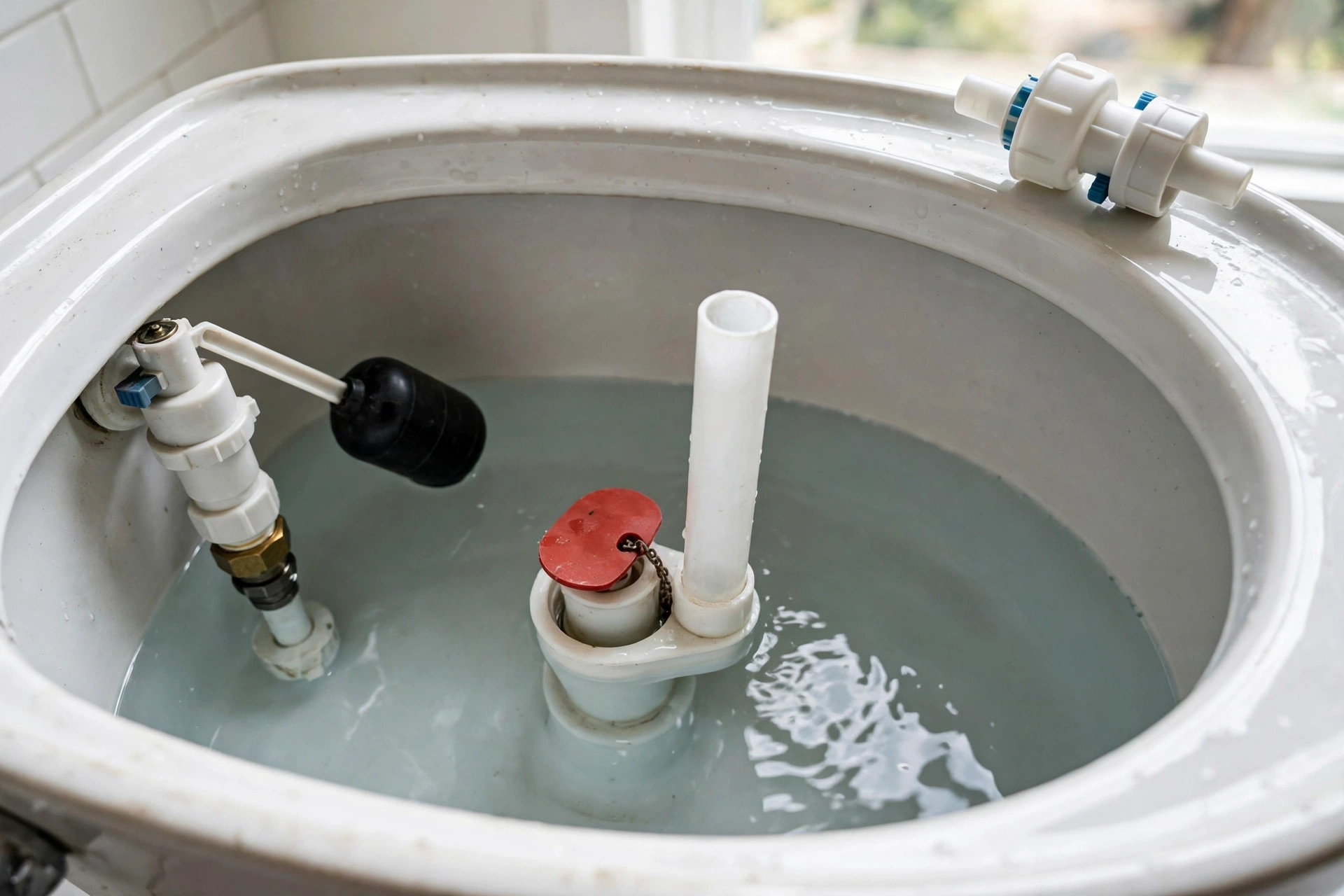
Before you fix it, it helps to know the parts. Lift the lid off the tank and look inside.
The fill valve sits on the left side. It lets water into the tank and shuts off when the tank is full. The float rides on the water. When water reaches the right level, the float tells the valve to close.
The flush valve sits in the middle. The flapper covers its opening. When you press the handle, the flapper lifts and water rushes into the bowl. Then the flapper drops back down and the tank refills.
The overflow tube is a tall pipe in the center. It keeps the tank from spilling over. If water keeps flowing into the overflow tube, you have a running toilet.
Step 1: Find the Cause
Take the lid off the tank. Set it on the floor on a towel. Flush the toilet and watch.
– If water flows down the overflow tube nonstop, the fill valve or float is the problem. – If the water level is fine but water still trickles into the bowl, the flapper is leaking. – If the chain from the handle is tangled or caught under the flapper, that alone can be the cause.
Drop a little food coloring into the tank water. Wait ten minutes without flushing. If the bowl water turns color, the flapper is leaking. This simple test is used by many home experts, including the guides published at Family Handyman.
Step 2: Fix a Tangled Chain
This is the easiest fix. Look at the chain between the flush handle and the flapper.
– Unhook the chain and straighten it out. – Rehook it so it has about half an inch of slack. Too tight and the flapper cannot close. Too loose and it will not lift fully. – Flush once and watch the flapper seat itself.
If the chain is rusted or kinked, replace it. Chains are sold with new flappers.
Step 3: Replace the Flapper
The flapper is the rubber seal at the bottom of the tank. It hardens and warps with age. In hard water areas, it can fail in three to five years.
1. Turn off the water valve behind the toilet. Turn it clockwise until it stops. 2. Flush the toilet to empty the tank. Sponge out the water that remains. 3. Unhook the flapper from the two posts on the overflow tube. 4. Unhook the chain from the flush handle arm. 5. Take the old flapper to the store to match the size. Two-inch flappers are the most common in the USA. 6. Hook the new flapper onto the posts. Attach the chain with a half inch of slack. 7. Turn the water back on and let the tank fill.
Flush twice. The flapper should drop and seal with a soft thud. If water still leaks, check that nothing is blocking the seat. A bit of mineral scale on the seat can be wiped away with a cloth.
Detailed fitting advice for toilet parts is offered by fixture makers such as Kohler and Moen, whose product pages list flapper sizes by model.
Step 4: Adjust or Replace the Fill Valve
If water runs into the overflow tube, the fill valve is not shutting off.
First try adjusting it. Most modern fill valves have a screw or a clip on the float.
1. Find the water line mark on the inside of the tank or on the overflow tube. 2. Adjust the float down so water stops about one inch below the top of the overflow tube. 3. Flush and watch. The water should stop at the new level.
If the valve still does not shut off, replace it.
1. Turn off the water and empty the tank as before. 2. Disconnect the water supply line under the tank with pliers. Have a towel ready for drips. 3. Unscrew the lock nut under the tank and lift the old valve out. 4. Set the new valve to the right height. Most have a twist lock for height. 5. Drop it in, tighten the nut by hand, then a quarter turn with pliers. Do not over tighten. 6. Reconnect the supply line and the refill tube to the overflow tube. 7. Turn the water on and check for leaks at the base.
Newer valve designs are covered in step-by-step repair guides at This Old House and on the product support pages of Delta Faucet.
Step 5: Test Everything
Turn the water on and let the tank fill. Watch for five minutes.
– The water should stop about an inch below the overflow tube. – Nothing should flow into the bowl. – The handle should flush with one press. – The tank should refill and stop again.
Flush three times in a row. Each time the tank should fill and stop on its own. If it does, the fix is done.
What If It Still Runs?
Sometimes the flush valve seat itself is cracked or pitted. In that case the whole flush valve must be replaced. This is a bigger job. You must remove the tank from the bowl, which means undoing the tank bolts. Many homeowners call a plumber at this point.
Another rare cause is a hairline crack in the overflow tube. Water leaks into it at a low level. Replacing the flush valve fixes this too.
If you rent your home, check your lease. Some landlords want to approve plumbing work, even small repairs.
Cost and Price Breakdown
Here is what a running toilet fix usually costs in the USA:
– Flapper: five to fifteen dollars – Fill valve: ten to twenty dollars – Chain: three to six dollars – Both flapper and valve together: fifteen to thirty dollars
A plumber would charge seventy-five to two hundred dollars for the same job, plus parts. That is why this is one of the best do-it-yourself repairs for a new homeowner. The parts fit most toilets sold in the USA from the last forty years.
If you plan more plumbing work, like a rough-in for a basement bathroom or choosing pex fittings for diyers, the same basic tank knowledge helps.
Care and Upkeep
A little upkeep keeps the toilet quiet for years.
– Do not use drop-in tank tablets with bleach. They eat rubber flappers fast. – Clean the flapper seat once a year with a soft cloth. – Check the chain slack each year. Chains stretch with age. – In hard water areas, wipe mineral scale off the fill valve yearly.
Whole-home water quality can also matter. A home water filtration system can reduce the mineral buildup that wears out tank parts. The EPA publishes water safety and conservation guidance for American households.
Safety Notes
Toilet repair is low risk, but a few cautions apply.
– The tank lid is heavy and breaks easily. Set it down gently on a towel. – Porcelain can chip. Do not drop tools into the tank. – Turn the water off before removing any part under pressure. – Do not over tighten plastic nuts. They crack under force. – Wash your hands after working in the tank, even with gloves on.
FAQ
How long does a running toilet fix take?
Most fixes take twenty to forty minutes. Replacing a flapper takes about fifteen minutes. Replacing a fill valve takes about thirty minutes. Both are simple for a first-time repair.
Why does my toilet run every few minutes for a few seconds?
This is called ghost flushing. It means the flapper is leaking slowly. The tank level drops, the valve tops it up, and the cycle repeats. Replace the flapper.
Can I fix a running toilet without turning off the water?
You can adjust the chain or float with the water on. But any part replacement should be done with the supply valve closed. It is safer and the tank is easier to work in when empty.
What size flapper does my toilet need?
Most American toilets use a two-inch flapper. Some newer high-efficiency models use three inches. Measure the drain opening or take the old flapper to the store to match it.
Is it safe to use a running toilet until I fix it?
It is safe to use, but it wastes a lot of water. A bad flapper can waste up to two hundred gallons a day. Fix it soon to keep your water bill down.
Should I call a plumber?
Call a plumber if the tank-to-bowl bolts are rusted through, if the flush valve seat is damaged, or if you find a cracked tank. Those jobs need tools and skill beyond a simple part swap.
A Final Word
A running toilet looks like a big problem and turns out to be a small one. The parts are cheap. The steps are plain. Anyone in the USA can buy what they need at the local home center and finish the job in one afternoon.
For other fixture projects around the house, such as commercial style kitchen faucet reviews, the same approach works: learn the parts, shut off the water, and swap what is worn. Start with the chain and the flapper. Nine times out of ten, that is all it takes.
References
Aquasana. (n.d.). Water filtration systems. https://www.aquasana.com Delta Faucet. (n.d.). Kitchen and bathroom faucets. https://www.deltafaucet.com Family Handyman. (n.d.). DIY home repair and maintenance. https://www.familyhandyman.com Kohler. (n.d.). Bathroom and kitchen fixtures. https://www.kohler.com Lowe’s. (n.d.). Home improvement products. https://www.lowes.com Moen. (n.d.). Faucets and plumbing fixtures. https://www.moen.com The Home Depot. (n.d.). Home improvement products. https://www.homedepot.com This Old House. (n.d.). Home renovation guidance. https://www.thisoldhouse.com U.S. Environmental Protection Agency. (n.d.). Protecting human health and the environment. https://www.epa.gov
Was this guide helpful?

About James Carter
The My Garden US editorial team writes practical, in-depth home and garden guides for American homeowners — tested advice, no fluff.
You May Also Like
Tub Drain Hair Catcher Reviews 2026 USA: A Plain Buyer’s Guide
January 9, 2026 0 views
WaterSense Toilet Rebates Near Me 2026
October 2, 2026 0 views
What Does Exterior Basement Waterproofing Cost in the USA?
August 3, 2026 0 views