A motion flood light turns on when something moves in front of it. A person walks up the driveway, and the yard fills with light. A stray cat crosses the patio, and the light wakes for a minute, then sleeps again. This motion flood lights american homes guide covers the basics that a homeowner needs before buying one: what these lights do, how to pick the right one, what they cost, how to set them up, and how to keep them working for years.
Most American homes have at least one dark corner. It may be the side gate, the back door, or the stretch of driveway past the garage. A steady porch light burns power all night. A motion flood light burns it only when it is needed.
Why It Matters
A sense of safety
Light is the cheapest form of security a house can have. A well lit yard makes it harder for a stranger to approach unseen. A motion flood light adds surprise to the picture. It stays dark, then snaps on the moment someone steps into its field. That sudden change draws the eye of the homeowner and of the neighbors.
A motion flood light does not replace a lock or an alarm. It supports them. It gives the homeowner a clear view of the driveway before stepping outside. It shows the steps, the hose, and the tools that could trip a person in the dark.
Saving power and money
An old porch bulb left on from dusk to dawn may burn for twelve hours each night. A motion flood light in a quiet yard may burn for only ten minutes a night. The rest of the time it waits, drawing almost nothing. The U.S. Department of Energy notes that outdoor lighting is a steady share of home power use, and that controls such as motion sensors cut that use by a wide margin. When the bulb is an LED, the savings grow larger still, because an LED gives more light per watt than older lamps.
Homeowners who watch their bills often start with outdoor lights. The change is simple to make, the payback is quick, and the comfort is real.
Day to day comfort
A motion flood light is not only about crime. It helps with the small chores of home life. It lights the trash cans at night and the walkway when the dog needs to go out.
How to Choose: Motion Flood Lights American Homes Guide
Brightness measured in lumens
Old flood lights were rated in watts. A 150 watt bulb was bright. New LED flood lights are rated in lumens, which measure actual light output. For most homes, a light between 700 and 2,000 lumens covers a driveway or a patio well. A wide back yard or a long rural drive may call for 2,000 to 5,000 lumens. More is not always better. A light that is too strong will blind the neighbors and wash out the yard in harsh white.
Color temperature matters too. Warm white light (about 2700 to 3000 kelvin) feels like an old bulb and suits porches and patios. Cool white or daylight light (about 4000 to 5000 kelvin) feels sharper and suits driveways and work areas where clear detail matters. Many brands, such as the ones sold through The Home Depot and Lowe’s, list both numbers plainly on the box. The ENERGY STAR outdoor lighting pages explain what these ratings mean, and the Department of Energy covers efficient lamps at energy.gov.
Sensor range and angle
The motion sensor is the heart of the fixture. Two numbers describe it. The range tells how far out it can sense movement, often 30 to 70 feet. The angle tells how wide it sees, often 180 to 270 degrees. A light over a garage door needs a wide angle and a long range. A light by a side door needs a narrower view so passing cars do not set it off.
Most sensors use passive infrared, which reads body heat against the cooler background. Heavy clothing, hot wind, and strong sun can fool a cheap sensor. Better models let the owner set the sensitivity, so a small animal does not trip the light while a person does.
Timer and dusk to dawn settings
Three small dials or a phone app control the behavior of most units. The timer sets how long the light stays on after motion stops, often from one to twenty minutes. The sensitivity dial sets how easily the sensor trips. The dusk setting decides whether the unit arms at nightfall or also works in the day. Many owners set the timer to about five minutes and the unit to night only. That is the sweet spot for most yards.
Power source
Hard wired units tie into the house wiring and run without batteries. They are the most common choice for permanent spots like garages and porches. Solar units carry a small panel and a battery, which suits fences and sheds far from an outlet. Battery units are the least common, since the lamp must shine for hours on cold nights. Solar models have improved in recent years, but a shaded panel still means a dim light. For a full motion flood lights buying guide usa shoppers can compare hard wired and solar models side by side at major retailers.
Types and Options
Single head flood lights
A single head unit holds one lamp in one swivel head. It suits small jobs: a back door, a shed, a short walk. These are the least costly units and the simplest to install.
Dual and triple head flood lights
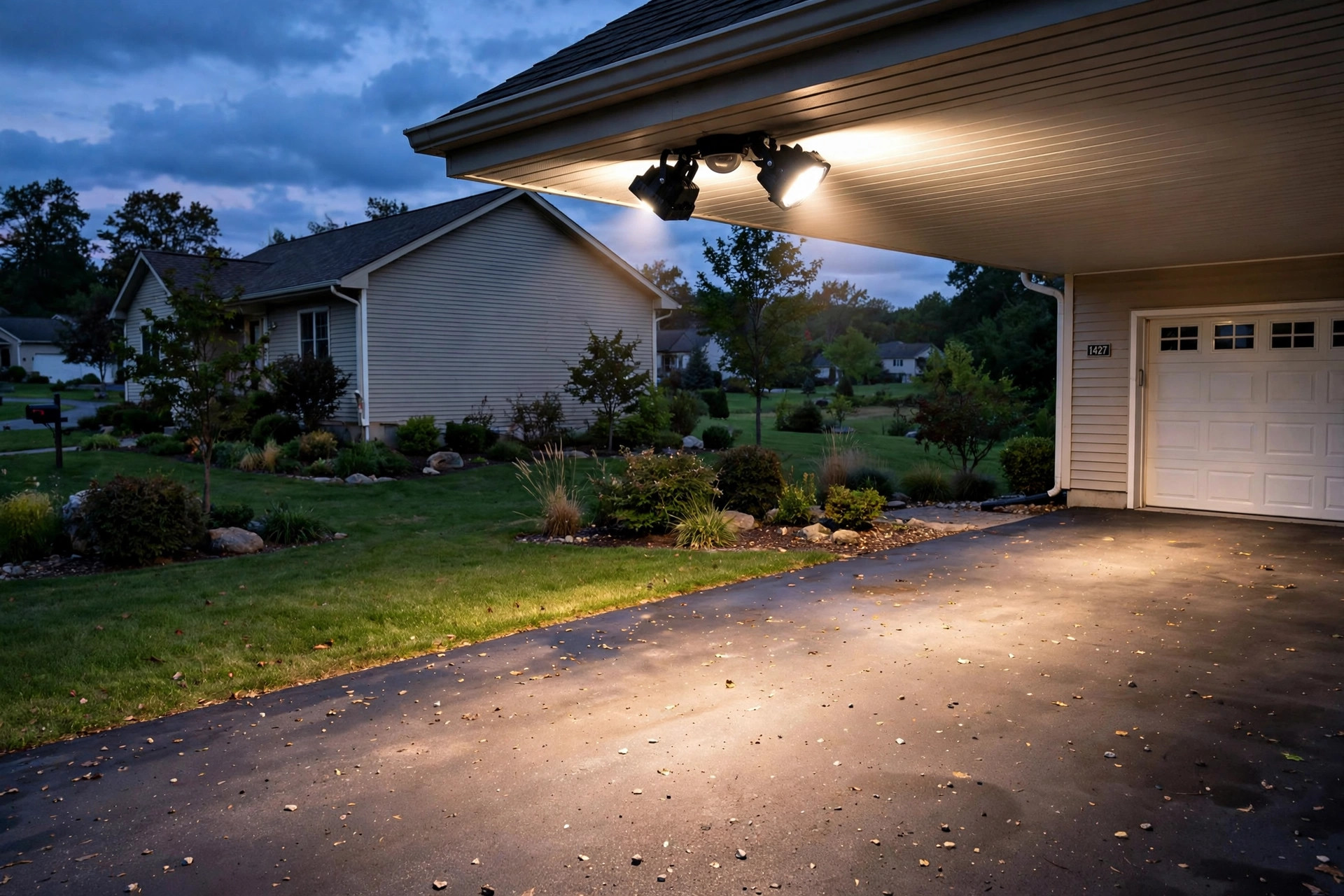
Two or three heads spread light across a wider area. A dual head unit can wash a two car driveway from a single mount point. Triple head units cover corners and L shaped yards. Each head aims on its own, so the owner can point one at the gate and another at the patio.
Smart flood lights
Smart units link to a home network. The owner can aim a camera, speak through a speaker, and change settings from a phone. Some brands tie the light to a video doorbell or a home security system. These units cost more and need a steady Wi-Fi signal at the mounting spot. For shoppers comparing the broader world of home lighting, guides at The Spruce and product experts at Lamps Plus and Lumens cover both basic and smart choices.
Decorative motion lights
Not every flood light must look like a tool. Coach style lanterns, carriage lights, and low profile fixtures now carry hidden sensors. These suit front porches where the look of the house matters. They give less raw light than a true flood unit, but they fit the style of the home. Philips maintains a broad lighting catalog that shows how motion sensing has moved into decorative lines.
Cost and Price
What the fixture costs
Prices run wide. A basic single head LED unit sells for 20 to 40 dollars. A good dual head hard wired unit sells for 40 to 90 dollars. A smart camera flood light sells for 150 to 300 dollars. Solar units sit in the middle at 30 to 80 dollars. These are store prices before any sale or coupon. Consumer testing groups publish lighting reviews and ratings that compare long term value across brands.
What installation costs
A homeowner who can wire a light can install a hard wired unit in an hour. The old fixture comes off, the new one goes on the same box, and the wires match by color. An electrician will charge 100 to 250 dollars for the same job in most American towns. The price rises if a new wire must be run through an attic or a wall. Solar units need no wiring at all, only a sunny spot and a few screws.
Running cost per year
An LED flood light of 1,500 lumens draws about 15 to 20 watts when lit. If it burns for ten minutes a night, the yearly power cost is under two dollars in most states. Even a busy unit on a main street, burning two hours a night, costs only a few dollars a year. The sensor, not the lamp, is what saves the money. This is why energy guides urge homeowners to add controls before adding fixtures.
Related interior lighting follows the same logic of matching the fixture to the room. For example, kitchens benefit from focused task light, as in this guide to kitchen island pendants california homes usa, and baths pair well with layered light, as covered for vanity light bars california homes usa and for general motion flood choice in motion flood lights buying guide usa.
Care and Upkeep
Cleaning the sensor and lens
Dust, pollen, and spider webs cloud the sensor eye and the lens. Twice a year, wipe both with a soft damp cloth. A clean sensor trips less often by mistake, and a clean lens throws more light for the same power.
Checking the aim
Heads drift over time. Wind, a ladder bump, or a ball strike can shift the aim. Once a year, walk the yard at night and watch where the beams fall. Aim one head at the walking path and one at the driveway, not at the street or the neighbor’s window. Keep the sensor pointed slightly downward so it reads people, not passing headlights.
Bulb and LED life
LED flood lights do not take a screw in bulb in most cases. The diodes are built into the head and rated for 25,000 to 50,000 hours. If a unit fails early, it is usually the sensor or the driver, not the lamp. Keep the receipt and the box for the warranty term, which is often three to five years.
Winter care
Cold is kind to LEDs but hard on batteries. Solar units may shine dimmer in January because the panel sees less sun and the battery holds less charge. Brush snow off the panel after a storm.
Safety
Electrical safety
A hard wired flood light connects to 120 volt house wiring. Turn off the breaker before touching the wires. Test with a non contact tester to be sure the line is dead. If the old box is cracked or the wires are brittle, call an electrician rather than forcing the job. The Consumer Product Safety Commission posts home safety guidance that covers outdoor electrical work.
Mounting height and glare
Mount the unit eight to twelve feet high. Lower than that, and a tall guest can bump it. Aim the heads down at about 45 degrees. Light that spills into the street can blind drivers and anger neighbors. Many towns have lighting codes that limit glare, and a shielded fixture keeps the light where it belongs.
Ladder work
Most installs need a ladder. Set it on firm level ground, keep three points of contact, and do not lean past the rails. A second person to hold the ladder is worth the trouble. Do this work in daylight, not at dusk when you plan to test the light.
Water and weather
Outdoor fixtures must be rated for wet locations. Look for the wet location mark on the box. The seal between the head and the mount must face up or sideways, never down where water can pool. After a hard storm, glance at the unit for cracks or a loose cover.
Frequently Asked Questions
How far can a motion flood light detect movement?
Most home units sense motion from 30 to 70 feet out, in an arc of 180 to 270 degrees. Trees, fences, and walls block the sensor, so the real range in a cluttered yard is shorter. For a long driveway, mount the light high and aim the sensor down the path it must watch.
Will a motion flood light turn on during the day?
Only if you let it. Most units have a daylight sensor that arms the motion sensor at dusk. If the unit has a test or override mode, the light may stay on in daylight until the mode is cleared. Check the manual for the switch sequence that returns the unit to auto mode.
Do motion flood lights scare away animals?
They startle animals more than they scare them. Deer, raccoons, and stray cats soon learn that the light means nothing and walk through it. The light is more useful for showing the homeowner what is out there than for keeping animals away for good.
Can I add a motion sensor to my old flood light?
Yes. Screw in sensor adapters fit between the socket and the bulb on older fixtures, and standalone sensor switches can be wired into the circuit. The result is not as neat as a built in unit, but it works and costs little.
How long should the light stay on after motion?
Five minutes suits most homes. It is long enough to cross the yard and unlock the door, and short enough that a false trip wastes little power. Near a busy sidewalk, set it to one or two minutes to cut down on nuisance light for the neighbors.
Are solar motion flood lights worth it?
They are worth it where no wire can reach: fences, sheds, and far garden corners. Buy a model with a separate panel that can sit in the sun while the light sits in the shade. Expect less brightness than a hard wired unit, and plan to wipe the panel clean each season.
A Final Word
A motion flood light is a small purchase that pays back in comfort every night. Pick a brightness that fits the yard, set the sensor to watch people rather than traffic, and aim the heads down and away from the street. Keep the lens clean and the timer short. Done well, the yard stays dark and quiet until the moment it is needed, and then it is bright enough to walk with ease. That is the whole promise of this motion flood lights american homes guide: the right light, in the right place, on only when it should be.
References
Consumer Reports. (n.d.). Product reviews and ratings. https://www.consumerreports.org ENERGY STAR. (n.d.). Energy efficient products. https://www.energystar.gov Lamps Plus. (n.d.). Lighting and home decor. https://www.lampsplus.com Lowe’s. (n.d.). Home improvement products. https://www.lowes.com Lumens. (n.d.). Lighting and ceiling fans. https://www.lumens.com Philips. (n.d.). Lighting products. https://www.philips.com The Home Depot. (n.d.). Home improvement products. https://www.homedepot.com The Spruce. (n.d.). Home and garden advice. https://www.thespruce.com U.S. Consumer Product Safety Commission. (n.d.). Product safety information. https://www.cpsc.gov U.S. Department of Energy. (n.d.). Energy efficiency and renewable energy. https://www.energy.gov
Was this guide helpful?

About James Carter
The My Garden US editorial team writes practical, in-depth home and garden guides for American homeowners — tested advice, no fluff.