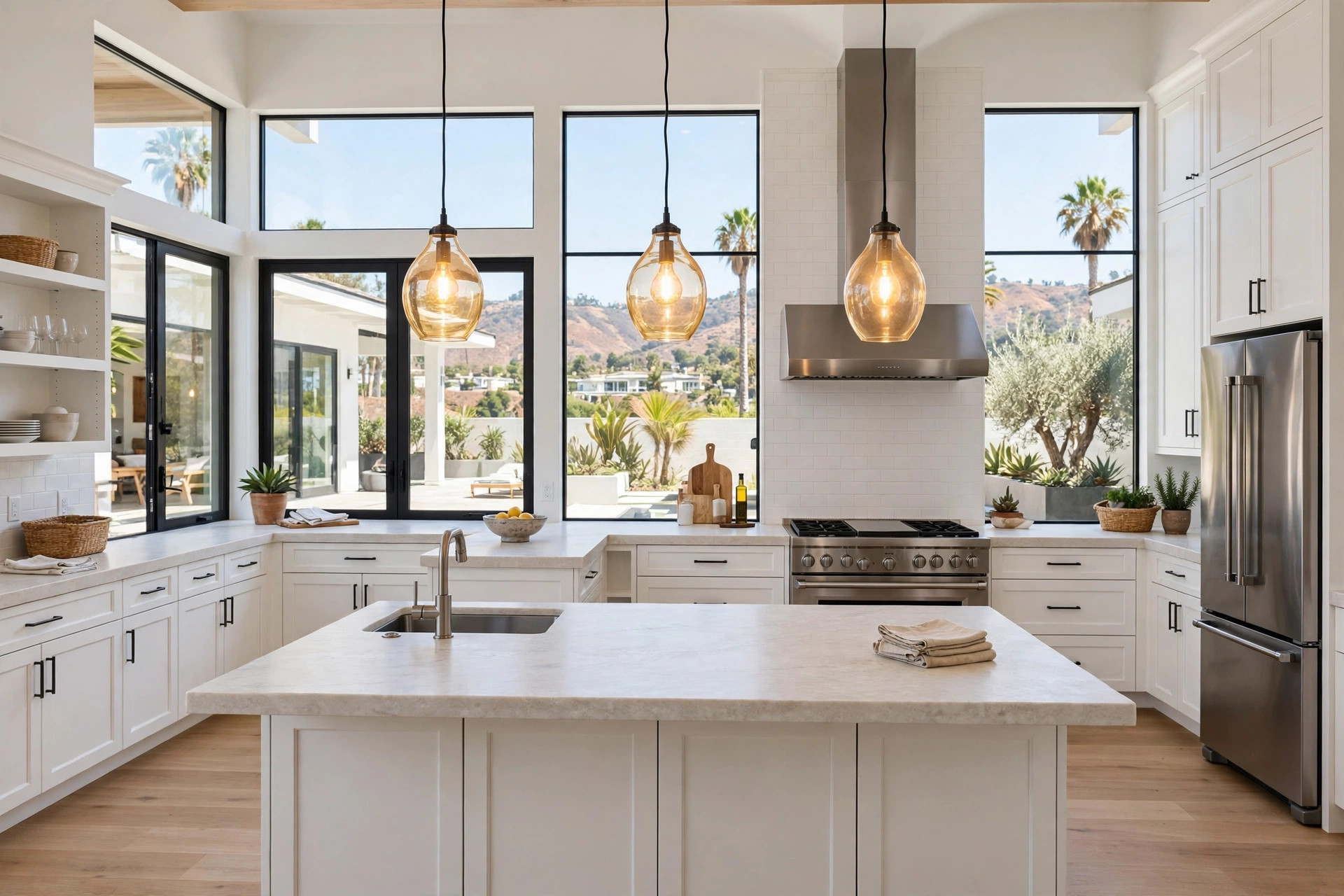
Many home buyers search for kitchen island pendants california homes usa before they start a remodel. The lights that hang over a kitchen island do more than fill a room with light. They set the mood of the whole kitchen. They mark the island as the center of the home. In California, where open floor plans are common, the right pendants can make the space feel warm and complete. The wrong ones can leave the island dark or out of balance.
A pendant is a single light that hangs from the ceiling on a cord, a chain, or a rod. Over a kitchen island, most homes use two, three, or four pendants in a row. This guide covers size, height, style, cost, and safety in plain words.
Why It Matters
The kitchen island is the workhorse of the modern home. Families chop vegetables there. Children do homework there. Guests gather there. Good light over the island serves each of these uses. Task light helps you see what you cut and cook. Ambient light makes the room feel open. One set of pendants can do both jobs at once.
California homes add their own needs. Many were built or remodeled with high or vaulted ceilings. A flush-mount ceiling light cannot reach an island from a twelve-foot ceiling. Pendants hang down and put light where hands work. Earthquakes are also part of life in California. Fixtures must hang level and hold firm during shaking. A sturdy mount matters more here than in most states.
Energy use matters too. California building rules push homes toward efficient light. Shoppers who learn the rules before they buy save money and avoid failed inspections. The Department of Energy notes that LED lighting uses far less power than old bulbs, and that fact shapes every lighting choice today.
What to Look For: Kitchen Island Pendants California Homes Usa
When you shop for kitchen island pendants, start with the island itself. Measure its length and width, and the ceiling height. These numbers drive every choice that follows. A tape measure and a pencil save more time than any catalog.
Size and Scale
Rule of thumb: add the length and width of the room in feet, and that sum in inches is a fair width for the total pendant run. A simpler rule works for the island. Allow about 24 to 30 inches of space between each pendant. A six-foot island takes three small pendants or two wide ones. A nine-foot island takes three or four.
Small shades under ten inches wide fit best in rows of three. Large shades over sixteen inches wide often look best in pairs. Do not crowd the island. Air between fixtures lets each one show its shape. LED recessed lights around the island can fill dark corners and take pressure off the pendants.
Hang Height
The bottom of each shade should sit 30 to 36 inches above the island counter. That range keeps glare out of seated eyes and keeps heads clear when people stand. Over a raised bar top, which is taller than a counter, use the lower end of the range.
For ceilings above nine feet, add about three inches of drop for each extra foot of ceiling. A ten-foot ceiling calls for roughly 33 to 39 inches of clearance. Keep all pendants at the same height. Even small differences show up fast.
Light Color and Brightness
Kitchen work needs clear, warm-white light. Most experts point to 2700K to 3000K for kitchens. That range looks warm but still shows true food color. Bulbs marked “soft white” sit near 2700K. Bulbs marked “bright white” sit near 3000K. Skip bulbs above 4000K over an island. They cast a cold, blue tone that makes food look gray.
Brightness is measured in lumens. Plan for about 400 to 800 lumens per pendant over an island, with the total depending on shade size and glass type. Clear glass passes more light. Frosted glass spreads light more gently. ENERGY STAR lists certified LED bulbs that meet strict tests for brightness and color.
Shade Material
Glass shades are the most popular choice over islands. Clear glass shows the bulb and gives bright task light. Seeded or ribbed glass adds texture. Metal shades throw light straight down and suit modern kitchens. Drum shades in fabric soften light. Woven shades in rattan or bamboo fit the relaxed style of many California coastal homes. Each material changes how the same bulb looks and feels.
Types and Styles
Kitchen island pendants come in a few clear families. Knowing them helps you talk to a store clerk or a contractor.
Single mini pendants are the classic choice. Each shade is eight to twelve inches wide. They hang in rows of two, three, or four. They suit both small and large islands. Retailers such as Lowe’s carry long rows of mini pendants in glass, metal, and mixed materials.
Linear pendants hang one long bar over the island. The bar may hold three or four small lights under one shade. Linear fixtures suit long, narrow islands. They give even light with fewer ceiling mounts.
Globe pendants use round shades of clear or frosted glass. One or two globes can light a small island. Three globes suit a wide one. Globes give soft, even light in all directions. They fit kitchens that lean classic or mid-century.
Lantern pendants have a frame, often in black metal or brass, with glass panels. They suit farmhouse and transitional kitchens, which are common in California suburbs.
Industrial pendants use big metal domes or cages. They throw strong downward light. They fit lofts and modern farmhouses. If the kitchen has brick or raw wood, industrial shades tie the room together.
Style should match the home, but the room should also match the style. A reading floor lamps buying guide can help you pick side lighting that echoes the pendant finishes. California ranch homes wear wood, stone, and warm metals well. Coastal homes suit glass, rope, and light wood. Modern tract homes suit clean metal and simple glass. Look at the cabinet pulls, the faucet, and the door hardware. The pendants should echo those finishes, not fight them.
How to Choose, Step by Step
First, set a budget. Pendants range from under fifty dollars to over five hundred dollars each. Decide the total before you fall in love with one fixture. Three mid-range pendants often cost less than one designer piece, and the row looks better.
Second, check the electrical box. Each pendant needs a ceiling box rated for the fixture weight. Heavy glass and metal shades need fan-rated boxes. If the old fixture was a small flush mount, the box may need an upgrade.
Third, think about dimmers. Bright light for cooking. Low light for dinner. Make sure the dimmer matches the bulb type. LED bulbs need LED-rated dimmers. Philips explains LED dimmer compatibility on its lighting pages, and most bulb boxes name the dimmer types they accept.
Fourth, pick the bulb before the shade. Decide on LED. Decide on 2700K or 3000K. Check the lumen number. Then choose a shade that fits that bulb shape. Some have built-in LED boards that never need a bulb change. Built-in LED lasts long but cannot be swapped if the color is wrong, so choose with care.
Fifth, look at the whole room. Stand at the doorway and picture the row of lights. Do they line up with the island edge? Do they match the dining room fixture nearby? A quick photo of the kitchen helps the eye judge.
Cost and Price
Kitchen island pendants in the USA span a wide price range. Budget mini pendants cost 40 to 90 dollars each at big home centers like The Home Depot. Mid-range fixtures in glass or metal cost 120 to 300 dollars each. Designer and hand-blown glass pieces run 350 to 800 dollars each or more. Lamps Plus and Lumens carry many mid-range and designer lines, and their sites list exact specs for each fixture.
A full set of three mid-range pendants often lands between 400 and 900 dollars for the fixtures alone. Add bulbs at 5 to 15 dollars each for quality LEDs. An electrician charges 150 to 400 dollars to hang and wire a row of pendants, more if new wiring or new boxes are needed. A dimmer switch adds 25 to 60 dollars plus labor.
California buyers should check local utility rebates. Several utilities in the state have offered rebates for ENERGY STAR certified fixtures. The savings are small per fixture but add up across a whole-house project. An LED bulb that costs ten dollars can outlast five or six old bulbs and cut power use by three quarters.
When you are ready to shop, a clear list of where to buy kitchen island pendants helps you compare store prices, online prices, and return policies before you spend.
Care and Upkeep
Pendants over a kitchen island collect grease. Cooking oil rises with heat and settles on glass and metal. Wipe glass shades once a month with a soft cloth and a mild glass cleaner. Metal shades need only a damp cloth. Fabric drum shades should be dusted with a soft brush. Never spray cleaner straight onto a hot bulb.
Dust the cords and rods twice a year. Check that each shade hangs level. Tighten the set screws that hold shades to their sockets. Loose shades rattle and can slip. Replace any cracked glass right away.
LED bulbs last 15,000 to 25,000 hours in normal use. In a kitchen where lights burn four hours a day, that is ten to seventeen years. Even so, keep one spare bulb in a drawer. Light color shifts slightly as LEDs age, so when one bulb fails after years of use, consider replacing the whole row so the color stays even.
Clean the inside of the shade, not just the outside. Grease films the inside glass and dulls light more than most owners expect.
Safety
Hang fixtures with care. Turn off power at the breaker before any work on wiring. Test with a non-contact voltage tester before touching a wire. If the wiring looks old or the wire colors confuse you, call an electrician. Kitchen circuits carry enough current to hurt.
Check the fixture rating. Shades near a gas cooktop must handle heat. The National Electrical Code sets rules for lights near cooking surfaces. As a rule, keep pendants at least the recommended height above the island and never lower a shade close to an open flame or a hot pot.
Weight matters. A heavy glass shade can weigh eight to fifteen pounds. The ceiling box must be rated for that load. In California, seismic rules add a reason to mount with care. Use the safety cable or the extra support screw that comes with heavy fixtures. Tighten all canopy screws so the mount cannot sway loose over time.
Bulb wattage limits are printed on the socket. Never exceed them, even with LED bulbs that run cooler. The limit protects the socket and the wiring, not just the bulb. If a fixture feels hot to the touch after an hour, switch to a lower-wattage bulb.
Keep cords and chains out of reach of curious hands. In homes with small children, raise the hang height to the top of the recommended range. Fabric shades near a cooktop should sit high and well clear of steam and splatter.
Frequently Asked Questions
How many pendants go over a kitchen island?
Count the island length. Under six feet, use two pendants. Six to eight feet, use three. Over eight feet, use three or four. Space them 24 to 30 inches apart, center to center. Keep the end pendants at least six inches from the island edge.
What height should kitchen island pendants hang?
Hang the bottom of each shade 30 to 36 inches above the counter top. For ceilings over nine feet, add about three inches for each extra foot of ceiling height. Measure from the counter surface, not the floor, because counter heights vary.
Can I put pendants over a kitchen island with a cooktop?
Yes, with care. Keep shades high enough that heat and steam clear them. Use shades rated for damp or hot spots near cooking. Metal shades handle heat well. Fabric shades should stay farther from the cooktop. Check local code and the fixture manual before you hang.
Are LED pendants worth the higher price?
Most buyers say yes. LED bulbs cost more up front but last many years and use far less power. In a kitchen where lights burn daily, the power savings pay back the price in a year or two.
What color light is best over a kitchen island?
Warm white, 2700K to 3000K, suits most kitchens. It flatters skin tones and food. It matches the warm look of wood cabinets. Cool white above 4000K looks harsh. If the kitchen gets strong daylight, 3000K blends well with the sun. The Spruce shares more kitchen lighting tips in its home guides.
Do I need an electrician to install pendants?
If a wired ceiling box already sits in the right spot, a handy owner can often swap fixtures. If new boxes, new wiring, or new switch legs are needed, hire a licensed electrician. California cities require permits for new kitchen circuits in many cases.
A Short Final Word
Kitchen island pendants california homes usa is a search term, but behind it sits a simple wish. People want a kitchen that works well and looks right. Measure the island. Choose shades that fit the room. Hang them at the right height. Use warm LED light. Keep them clean and safe. Do these small things with care, and the island becomes the warm center of the home it was meant to be.
References
ENERGY STAR. (n.d.). Energy efficient products. https://www.energystar.gov Lamps Plus. (n.d.). Lighting and home decor. https://www.lampsplus.com Lowe’s. (n.d.). Home improvement products. https://www.lowes.com Lumens. (n.d.). Lighting and ceiling fans. https://www.lumens.com Philips. (n.d.). Lighting products. https://www.philips.com The Home Depot. (n.d.). Home improvement products. https://www.homedepot.com The Spruce. (n.d.). Home and garden advice. https://www.thespruce.com U.S. Department of Energy. (n.d.). Energy efficiency and renewable energy. https://www.energy.gov
Was this guide helpful?

About Michael Thompson
The My Garden US editorial team writes practical, in-depth home and garden guides for American homeowners — tested advice, no fluff.