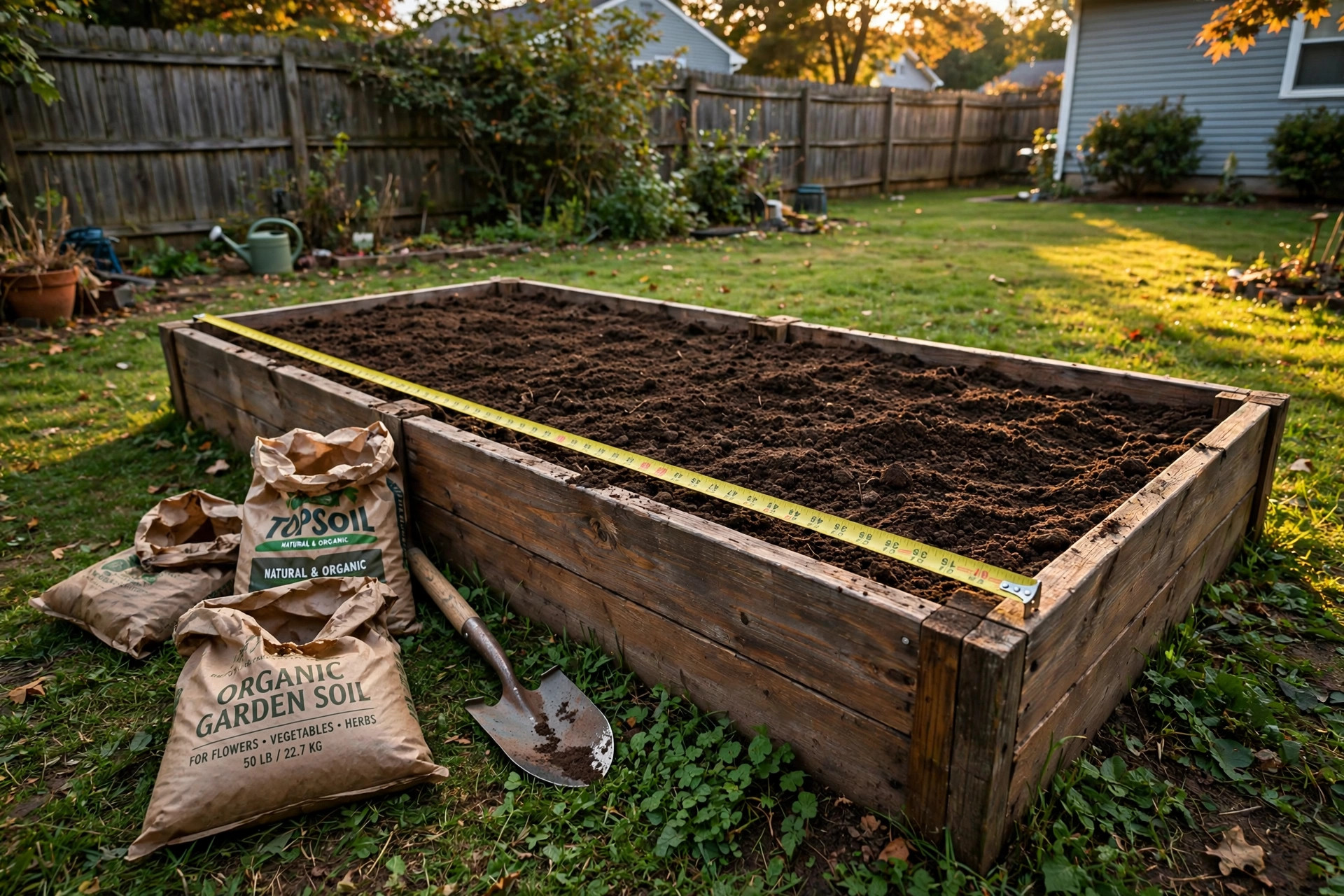
A raised bed soil calculator how much question is one of the most common questions new gardeners ask. You build a raised bed, stand in the garden center aisle, and wonder: how many bags of soil should I buy? Guides from garden experts all agree on one point — measure first, shop second. Too little soil leaves your plants weak. Too much soil wastes money and leaves you with heavy bags to store. This guide shows you how to figure the exact amount of soil your raised bed needs, in cubic feet and in bags, with plain math you can do on paper.
Why It Matters to Measure Soil First
Soil is often the most costly part of a raised bed garden. A standard 4-by-8-foot bed that is one foot deep needs about 32 cubic feet of soil. Bought in two-cubic-foot bags, that is sixteen bags. Bagged garden soil at five to eight dollars a bag means the soil alone can cost over one hundred dollars. If you guess too high and buy twenty-four bags, you spend forty or fifty extra dollars and must find a place to keep eight bags of soil. If you guess too low and buy ten bags, your bed sits half full, your plants root too shallow, and you must make a second trip to the store.
A raised bed soil calculator how much question also matters because plants need depth. Tomatoes, peppers, and carrots need at least eight to twelve inches of loose soil under them. When a bed is filled too shallow, roots hit the hard ground below and the plants stay small. When you know the right volume before you shop, every bed you build will be filled to the right depth from the start.
Gardeners also use these numbers when they mix their own soil. A popular raised garden bed soil mix recipe calls for set parts of compost, topsoil, and aeration material. You cannot mix the right parts unless you know the total volume first. The calculator step comes before the mix step, every time.
The Simple Math Behind Every Soil Calculator: Raised Bed Soil Calculator How Much
Every raised bed soil calculator, whether it is a web tool or a paper chart, does the same simple math. It finds the volume of your bed in cubic feet. The formula is:
Length (feet) × Width (feet) × Depth (feet) = Cubic feet
That is all. Take a bed that is 4 feet long, 4 feet wide, and 1 foot deep. Multiply 4 × 4 × 1. The answer is 16 cubic feet. A bed that is 4 feet long, 8 feet wide, and 10 inches deep needs one small step first. Ten inches is 10 ÷ 12, or 0.83 feet. Then 4 × 8 × 0.83 = 26.6 cubic feet.
For round beds, the formula is slightly different but still simple: 3.14 × radius × radius × depth. A round bed with a 2-foot radius (4 feet across) and 1 foot deep holds 3.14 × 2 × 2 × 1 = 12.6 cubic feet.
Write your bed sizes down and keep the paper. You will reuse these numbers every spring when you top off beds that have settled.
From Cubic Feet to Bags
Soil is sold two ways in American stores: by the bag (cubic feet per bag) and in bulk (cubic yards). Most bagged garden soil, raised bed mix, and compost come in 1-cubic-foot, 1.5-cubic-foot, or 2-cubic-foot bags. The bag size is printed on the front of the bag, usually near the bottom.
To find how many bags you need, divide:
Total cubic feet ÷ cubic feet per bag = number of bags
For a 4-by-8 bed one foot deep, you need 32 cubic feet. With 2-cubic-foot bags, that is 32 ÷ 2 = 16 bags. With 1.5-cubic-foot bags, it is 32 ÷ 1.5 = 21.3, so buy 22 bags. Always round up, never down. A bag that is half empty still helps fill corners and low spots.
Bulk soil is sold by the cubic yard. One cubic yard equals 27 cubic feet. To convert, divide your cubic feet by 27. Our 32-cubic-foot bed needs 32 ÷ 27 = 1.19 cubic yards, so you would order 1.25 or 1.5 cubic yards. Bulk soil is often much cheaper per cubic foot than bagged soil, so it is worth a call to a local yard if you are filling three or more beds.
Common Bed Sizes at a Glance
If you do not want to do the math, use these ready figures. They cover the most common raised bed sizes sold in the United States.
– 4 × 4 ft, 6 inches deep: 8 cubic feet. About 4 bags (2 cu ft each) or 5-6 bags (1.5 cu ft each). – 4 × 4 ft, 12 inches deep: 16 cubic feet. About 8 bags (2 cu ft each) or 11 bags (1.5 cu ft each). – 4 × 8 ft, 6 inches deep: 16 cubic feet. About 8 bags (2 cu ft each). – 4 × 8 ft, 12 inches deep: 32 cubic feet. About 16 bags (2 cu ft each). – 3 × 6 ft, 10 inches deep: 15 cubic feet. About 8 bags (2 cu ft each). – 2 × 8 ft, 12 inches deep: 16 cubic feet. About 8 bags (2 cu ft each).
These are exact volumes. In practice, buy 5 to 10 percent more than the table shows. Soil settles after the first few waterings, and a little extra lets you top off the bed to full depth.
How to Measure an Odd-Shaped or Tiered Bed
Not every bed is a plain box. L-shaped beds, corner beds, and tiered beds need one extra step. Break the bed into simple boxes, find the cubic feet of each box, and add them together.
For an L-shaped bed, picture it as two boxes side by side. If one arm is 4 × 4 × 1 ft (16 cubic feet) and the other is 4 × 6 × 1 ft (24 cubic feet), the whole bed needs 40 cubic feet.
For a tiered bed, measure each level on its own. A two-level bed with a bottom tier of 4 × 8 × 1 ft (32 cubic feet) and a top tier of 2 × 4 × 1 ft (8 cubic feet) needs 40 cubic feet in total.
For beds with sloped sides or tapered planters, use the average of the top and bottom sizes. Measure the width at the top rim and at the base, add the two numbers, and divide by two. Use that average width in the regular formula. The result is close enough for garden work.
Cost and Price: What Filling a Bed Really Costs
Soil prices vary by region, season, and brand, but these ranges are common across the United States in recent years.
– Bagged raised bed mix: about $5 to $9 per 2-cubic-foot bag. A 4 × 8 bed at 12 inches deep costs roughly $80 to $145 in soil alone. – Bagged topsoil: about $3 to $6 per 2-cubic-foot bag. Cheaper, but it often needs compost mixed in for good growth. – Bagged compost: about $4 to $8 per 1.5-cubic-foot bag. Good for mixing into topsoil. – Bulk garden soil: about $30 to $60 per cubic yard, plus a delivery fee of $40 to $80. A 4 × 8 bed at 12 inches deep needs about 1.2 cubic yards.
A useful rule: when you are filling more than three or four full-size beds, bulk soil is nearly always cheaper. When you are filling one or two beds, bagged soil saves you the delivery fee and the pile of extra dirt in the driveway.
Money can also be saved by filling the bottom of deep beds with cheap bulk material. For beds deeper than 12 inches, many gardeners fill the bottom third with logs, branches, and leaves — an old method that cuts the soil bill by a third while feeding the soil as the wood breaks down. Just keep this filler below the top 8 to 12 inches where plant roots do their main work.
Care and Upkeep: Soil Settles Every Year
A new bed filled to the rim in April will sit two or three inches lower by June. This is normal. Soil particles pack together, organic matter breaks down, and watering firms the mix. Plan to add 1 to 3 inches of fresh compost or garden soil to each bed every spring. For a 4 × 8 bed, a 2-inch top-up is 4 × 8 × 0.17 = 5.4 cubic feet, or about three 2-cubic-foot bags.
Keep your old volume numbers from the calculator step. Subtract the soil you already have from the total, and you only buy the top-up amount. Many gardeners keep a small notebook by their seed packets with each bed’s size and its yearly top-up number.
Old tools matter for upkeep too. A sharp spade cuts cleanly through packed soil, and dull tools make top-dressing harder than it needs to be. Read our notes on how to sharpen garden tools properly before spring work begins.
Compost is the best top-up material. It feeds the soil, holds water, and costs little or nothing if you make it yourself. A simple compost bin for kitchen scraps can supply most of a small garden’s yearly top-up for free.
Safety Notes for Soil Work
Bagged soil is heavy. A 2-cubic-foot bag of moist garden soil can weigh 40 to 60 pounds. Lift with your knees bent and your back straight, and ask for help when moving more than a few bags. Store bags flat and dry so they do not split and spill.
Wear gloves when you handle soil and compost. Garden soil can carry bacteria, and sharp bits of wood or stone hide in bulk loads. A dust mask is wise on windy days when you pour dry bagged soil, and it is a must when you work with perlite or vermiculite — fine soil additives whose dust should not be breathed in.
Check bags for damage before you buy. Torn bags let water in and dry the mix out, and they are harder to carry. If you buy in bulk, ask the yard whether the soil was screened for glass and large stones, and keep children and pets away from the pile until it is spread.
Frequently Asked Questions
How much soil does a 4 × 4 raised bed need?
A 4 × 4 bed that is 6 inches deep needs 8 cubic feet of soil, or about four 2-cubic-foot bags. The same bed at 12 inches deep needs 16 cubic feet, or about eight 2-cubic-foot bags. Add one extra bag for settling.
Can I use a raised bed soil calculator for bags and bulk soil?
Yes. The calculator gives you cubic feet first. Divide by the bag size to get bags, or divide by 27 to get cubic yards for bulk orders. One number feeds both answers, so you can compare prices before you buy.
Should I fill a deep raised bed all the way with garden soil?
For beds deeper than 12 inches, you do not need costly garden soil all the way down. Fill the bottom with logs, branches, straw, or leaves, and put your good soil mix in the top 8 to 12 inches where roots grow. This cuts cost and still gives plants what they need.
How much does it cost to fill a raised bed with soil?
A 4 × 8 bed at 12 inches deep needs 32 cubic feet. In bags at $5 to $9 per 2-cubic-foot bag, that is roughly $80 to $145. In bulk at $30 to $60 per cubic yard, the same bed costs roughly $40 to $75 plus delivery. Prices vary by town and season.
Why did my soil level drop after the first month?
Settling is normal. Watering packs the soil down, and organic matter in the mix breaks down and shrinks. Expect a new bed to drop 2 to 3 inches in its first season. Top it off each spring with an inch or two of compost to bring it back to full depth.
How often should I recalculate my soil needs?
Recalculate when you build a new bed, change a bed’s depth, or switch from bags to bulk soil. For yearly spring top-ups, keep your old bed volumes on file and buy only the few extra cubic feet the bed has settled.
A Final Word
The raised bed soil calculator how much question has a plain answer: measure length times width times depth, and you have your cubic feet. From there, bags and bulk yards follow with one more division. Ten minutes with a tape measure and a pencil can save you fifty dollars and a second trip to the store. Keep your bed sizes written down, round up when you buy, and top off with compost each spring. Your plants will get the depth they need, and your wallet will thank you.
References
Bob Vila. (n.d.). Home improvement advice. https://www.bobvila.com Burpee. (n.d.). Seeds, plants, and gardening supplies. https://www.burpee.com Consumer Reports. (n.d.). Product reviews and ratings. https://www.consumerreports.org Corona Tools. (n.d.). Garden and landscape tools. https://www.corona-tools.com Family Handyman. (n.d.). DIY home repair and maintenance. https://www.familyhandyman.com Fiskars. (n.d.). Garden and cutting tools. https://www.fiskars.com Gardener’s Supply Company. (n.d.). Gardening tools and supplies. https://www.gardeners.com Lowe’s. (n.d.). Home improvement products. https://www.lowes.com The Home Depot. (n.d.). Home improvement products. https://www.homedepot.com The Spruce. (n.d.). Home and garden advice. https://www.thespruce.com
Was this guide helpful?

About James Carter
The My Garden US editorial team writes practical, in-depth home and garden guides for American homeowners — tested advice, no fluff.