
Many gardeners sow seeds indoors each spring, and a clear seed starting under lights schedule is what turns small sprouts into strong plants. A seed starting under lights schedule is simply a plan for how many hours each day the lamps stay on, how close they hang above the trays, and when the whole setup begins and ends. Without such a plan, seedlings stretch toward a weak window and grow thin and pale. With one, they grow short, sturdy, and deep green.
This guide lays out a full seed starting under lights schedule in plain terms. It covers hours of light, lamp height, and the calendar from sowing day to transplant day. The same ideas work for tomatoes, peppers, lettuce, herbs, and flowers. Read this along with a general guide to starting seeds indoors for the full picture of trays, soil, and watering.
Why a Light Schedule Matters
Plants read light the way people read clocks. The length of each day tells a seedling how to grow. A window alone rarely gives enough light in late winter and early spring. The sun sits low, days are short, and glass cuts the light still further. Seedlings under a window often lean, stretch, and turn leggy within days.
An indoor seed starting under lights schedule fixes this by giving each tray a full, steady day of bright light. Sixteen hours under lamps each day stands in for the long days of late spring. The plant never has to reach for light, because the light hangs close and even over every cell of the tray. The result is a stocky stem and tight leaves, the marks of a seedling that will take transplant without shock.
Consistency matters more than perfection. A timer that turns the lamps on and off at the same hour each day beats a fussy plan that changes by hand. Plants respond to rhythm. Gardeners who keep a written seed starting under lights schedule on the wall near the rack also spot problems sooner, because a change in growth can be matched to the calendar.
Many home gardeners begin their season with nothing more than a shop light on chains and a kitchen timer. Garden supply houses and home centers both sell simple fixtures that hang well over seed trays, and gardening guides describe racks built from plain wire shelving.
How Many Hours of Light Seedlings Need: Seed Starting under Lights Schedule
Seeds Before Germination
Most seeds do not need light to sprout. They need warmth and moisture. Tomatoes, peppers, eggplant, basil, and most flowers sprout fine in the dark under a humidity dome. During this stage, the lamps can stay off. The important step is to check the trays once or twice a day and remove the dome at the first sign of green.
A few seeds are different. Lettuce, celery, dill, and many tiny flower seeds sprout best in light. For these, run the seed starting under lights schedule from sowing day, with the lamps on for about twelve hours a day. Check the seed packet, which usually states whether light aids germination. When in doubt, give the tray a half day of light. It does no harm.
Seedlings After Sprouting
Once green shoots appear, the seed starting under lights schedule becomes the most important tool in the room. Most vegetable and flower seedlings thrive on fourteen to sixteen hours of light each day. Sixteen hours suits tomatoes, peppers, and eggplant. Fourteen hours suits lettuce, spinach, onions, and cool-season herbs. Flowers such as petunias and marigolds do well at fourteen to sixteen hours.
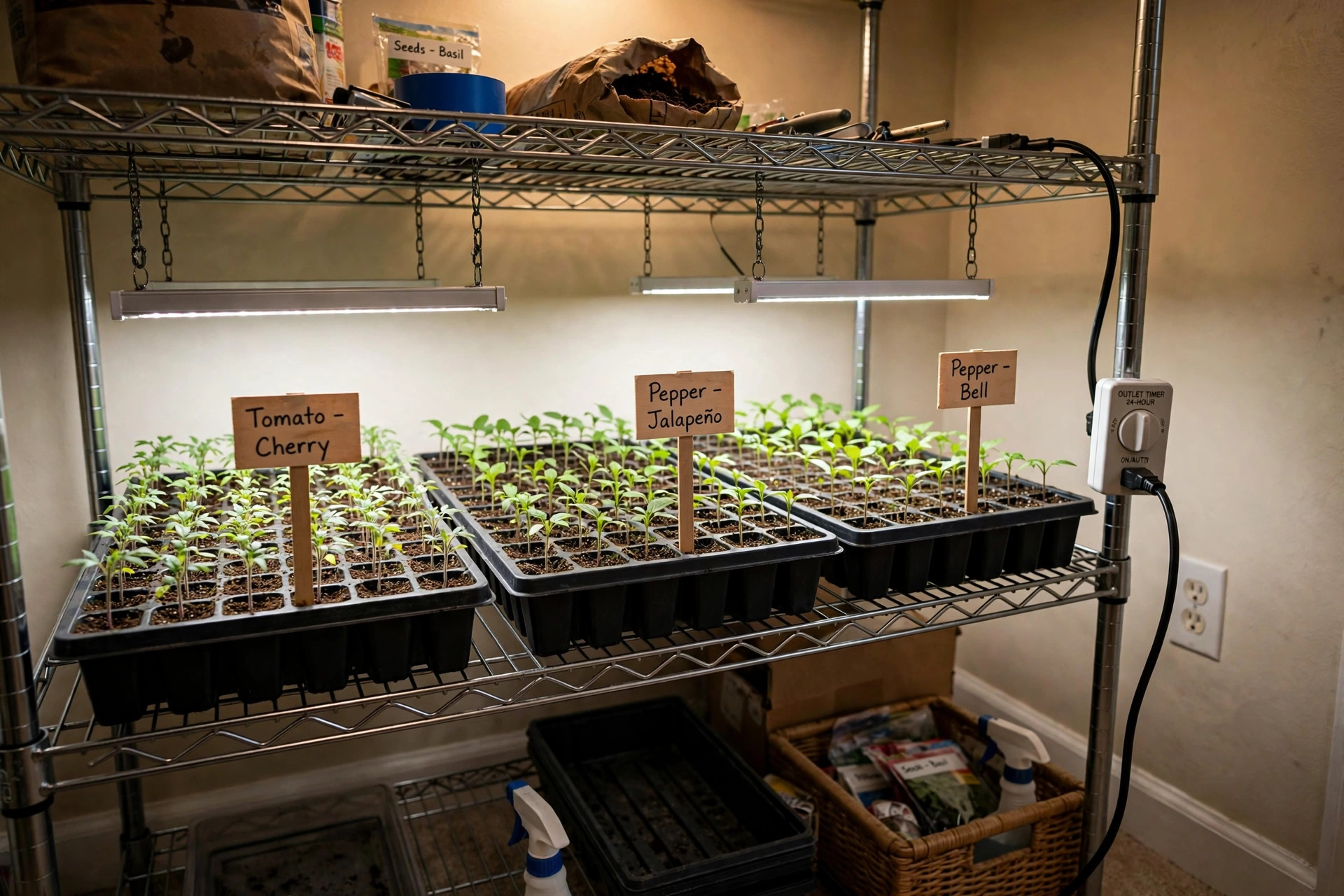
Set the timer once and leave it alone. A common pattern is on at six in the morning and off at ten at night. The dark hours matter too. Plants do part of their growing work at night, and a full eight hours of dark keeps them healthy. Never run the lamps around the clock. Seedlings grown under twenty-four-hour light often turn yellow and weak, because they never rest.
Keep this schedule from sprouting day until the hardening-off stage. Some gardeners drop the hours to twelve or thirteen in the last week indoors, to match the natural day length outside. This small step eases the move to the garden. Home improvement writers note that a plain outlet timer is one of the cheapest tools a gardener can buy, and product testers publish lamp ratings that help when choosing fixtures.
How Close the Lights Should Be
Lamp height is the second half of any seed starting under lights schedule, and it matters as much as hours. Fluorescent shop lights and LED grow bars give useful light only at short range. Hang them two to four inches above the tops of the seedlings. Closer is better, up to the point where leaves touch the tubes or the fixture feels warm on the back of a hand.
Adjust the height every few days as the plants grow. Chains and S-hooks make this easy. The classic setup hangs a two-tube fluorescent fixture from the shelf above on short chains, so the whole fixture rises as the seedlings rise. Some gardeners rest the fixture on blocks beside the tray and move the blocks down over time. Either method works.
Compact fluorescent bulbs and single LED bulbs in clamp fixtures follow the same rule, but hang them six to twelve inches above the tray, because they run hotter in one spot. Watch the leaves for burn. White or brown edges mean the lamp is too close. Tall, thin stems mean it is too far. The plants themselves are the best gauge, and a glance each morning becomes part of the daily routine.
What Kind of Lights to Use
The seed starting under lights schedule works with several lamp types, and none of them need to be costly.
Standard fluorescent shop lights with one cool white and one warm white tube remain a favorite. They are cheap, run cool, and give a balanced mix of color. Two forty-watt tubes in a four-foot fixture light two standard trays side by side. This was the standard setup in the nineteen eighties and it still works.
T5 fluorescent fixtures run brighter and slimmer, and they fit more shelves into a rack. They cost more up front but give strong light over a wide area. Many garden tool makers and tool brands sell under the same roofs where these fixtures are stocked, and hardware retailers carry both the lights and the shelving.
LED grow lights are the newest choice. They draw less power and last for years. Full-spectrum LED bars made for seedlings spread even light over a tray. Choose white full-spectrum panels rather than the purple-red grow lights, which make it hard to see the true color of the leaves. A simple white LED shop light of four thousand to five thousand Kelvin works well for seedlings, even though it is not sold as a grow light.
Whatever the type, buy a fixture a little wider than the tray. Light falls off at the edges, so seedlings on the border of a narrow fixture will lean inward. Two fixtures side by side beat one narrow one for a wide shelf.
Cost and Price of a Basic Setup
A seed starting under lights schedule does not require a large budget. The basic parts are a fixture, a timer, and a shelf or table.
A four-foot fluorescent shop light costs about the same as a bag of potting mix. A mechanical outlet timer costs less than a paperback book. A simple wire shelf unit from a home center gives four shelves, enough for eight to twelve trays.
LED bars cost more at the start but use about half the power of fluorescents. Over several seasons, the lower electric bill narrows the gap. For a gardener who starts seeds every year, LED bars are a sound buy. For a first trial with a few trays of tomatoes, a shop light and a timer are plenty.
Electricity for a sixteen-hour seed starting under lights schedule runs a few dollars per month for one fixture. The lamps are the cheapest part of the whole garden once the fixture is bought. Seeds, seed starting mix, and trays cost more over a season than the power does.
Care and Upkeep for the Light Rack
The fixture needs little care, but a few habits keep the seed starting under lights schedule working at full strength.
Wipe the tubes or LED bars with a dry cloth once a month. Dust cuts light more than most gardeners guess. A clean tube gives noticeably more light than a dusty one, and the seedlings show it within days.
Replace fluorescent tubes every two or three seasons. Old tubes still glow but lose strength long before they burn out. A tube that looks fine to the eye may give half the light it gave new. Mark the year on the end of each tube with a marker so the age is never a guess.
Check the timer twice a season. Power cuts and curious children can throw it off. A timer that runs two hours short each day slowly starves the plants, and the cause is invisible unless the schedule is checked.
Keep the cords tidy and off the floor. Water and electricity share the seed room, so run cords along the shelf frame and plug everything into one power strip with a switch. The strip makes it easy to kill the whole rack in an emergency, and it keeps the timer in one place.
At season end, unplug everything, wash the trays, and store the fixtures upright in a dry spot. Lights stored damp can rust, and rust on a fixture is a sign it should be replaced. Home how-to publications carry seasonal checklists that pair well with a written light schedule.
Safety Around Grow Lights and Water
A seed room mixes water, soil, and electricity, so a few safety rules belong in every seed starting under lights schedule.
Never mist or water with the lamps plugged in and hanging low over wet trays. Move the fixture aside or switch it off before heavy watering. Small splashes are normal, but standing water near a plugged fixture is not.
Use a ground-fault outlet or a ground-fault power strip for the whole rack. These outlets cut power in a fraction of a second if water reaches the wiring. They cost little and are standard in kitchens and baths for the same reason.
Let hot bulbs cool before touching them. Fluorescent tubes stay near room temperature, but some LED and compact fluorescent fixtures run warm. Check heat with the back of a hand before adjusting chains or moving a clamp lamp.
Keep the rack out of reach of small children and pets. Trays of soil invite digging, and dangling cords invite pulling. A simple door or a baby gate on the seed room solves most of the risk. A backyard greenhouse can serve as a later home for trays, but young seedlings still need the indoor lamps until nights warm.
Frequently Asked Questions
Can I use a sunny window instead of lights on a schedule?
A bright south-facing window helps, but it rarely replaces a lamp schedule. Windows give strong light for only a few hours and only on sunny days. Seedlings still stretch on cloudy days. Many gardeners use both: trays sit in the window by day and under lamps on a timer to fill the hours the window cannot give.
What happens if the lights stay on too long?
Seedlings grown under light for twenty hours or more each day often turn pale and stop growing well. They need a dark period to complete their daily cycle. If the plants look washed out, cut the seed starting under lights schedule back to fourteen hours and watch for a week.
Should the schedule change as seedlings get older?
The daily hours can stay the same from sprouting to transplant. What changes is lamp height, which must rise as the plants grow. In the final week indoors, some gardeners trim the day to twelve hours to match outdoor light, which eases the move outside.
Do different plants need different light schedules?
Most common vegetables and flowers share the same range of fourteen to sixteen hours. Lettuce and herbs lean toward fourteen; tomatoes and peppers lean toward sixteen. The seed packet sometimes gives a hint, and seed suppliers print growing guides that list light needs by variety.
Can I start seeds under regular LED shop lights?
Yes. A white LED shop light of four thousand to five thousand Kelvin, hung two to four inches above the tray, grows fine seedlings. It need not be labeled as a grow light. Keep the seed starting under lights schedule at fourteen to sixteen hours and watch the plants. If stems stay short and leaves stay green, the light is enough.
When does the light schedule end?
It ends when the seedlings move outside for good. During the hardening-off week, carry the trays outdoors for a few hours each day and lengthen the time until they stay out all day. Then transplant on a cloudy day or in the evening, water well, and let the sun take over the schedule.
A Final Word
A seed starting under lights schedule is one of the simplest plans in gardening, and one of the most rewarding. Sixteen hours of light, lamps hung low, a timer that never forgets. That is nearly the whole of it. The rest is patience and a daily look at the trays. Gardeners who keep the schedule through spring set out plants that stand up straight in the wind and take hold in the soil within days. The lamps go dark, the trays go to the shed, and the garden takes over until next winter, when the schedule begins again.
References
Bob Vila. (n.d.). Home improvement advice. https://www.bobvila.com Burpee. (n.d.). Seeds, plants, and gardening supplies. https://www.burpee.com Consumer Reports. (n.d.). Product reviews and ratings. https://www.consumerreports.org Corona Tools. (n.d.). Garden and landscape tools. https://www.corona-tools.com Family Handyman. (n.d.). DIY home repair and maintenance. https://www.familyhandyman.com Fiskars. (n.d.). Garden and cutting tools. https://www.fiskars.com Gardener’s Supply Company. (n.d.). Gardening tools and supplies. https://www.gardeners.com Lowe’s. (n.d.). Home improvement products. https://www.lowes.com The Home Depot. (n.d.). Home improvement products. https://www.homedepot.com The Spruce. (n.d.). Home and garden advice. https://www.thespruce.com
Was this guide helpful?

About Robert Taylor
The My Garden US editorial team writes practical, in-depth home and garden guides for American homeowners — tested advice, no fluff.
You May Also Like
Best Garden Gloves for Men Large: How to Find a Pair That Fits
July 26, 2026 0 views
Best Potting Soil for Container Gardens: What to Know Before You Buy
February 1, 2026 0 views
Garden Tool Set for Beginners Reviews
January 13, 2026 0 views