
Lead in drinking water is one of the oldest worries in the American home. It has no taste. It has no color. It has no smell. Yet even small amounts can do harm, and children face the greatest risk. That is why lead in drinking water filter reviews usa get so much attention from buyers. A good review tells you which filters really remove lead, and which ones only claim to do so.
This guide walks through the whole subject. It explains how lead gets into tap water, what to look for in a filter, the main types of lead-removal systems, what they cost, how to keep them working, and what to ask before you buy. It does not name winners and losers, because test results change and every home is different. Instead, it teaches you how to read reviews the way a careful buyer should.
Why Lead in Drinking Water Still Matters
Lead is a metal that can harm the brain and the nervous system. In adults, long exposure can raise blood pressure and harm the kidneys. In young children, it can slow learning and growth. There is no level of lead in a child’s blood that doctors call safe.
The trouble comes from pipes and parts. Many American cities still have lead service lines that carry water from the street main to the house. Inside older homes, lead solder joined copper pipes until the mid-1980s, and brass faucets and fittings once held lead too. When water sits in these lines overnight, lead can leach into the water that comes out of the tap in the morning.
The federal government has pushed for lead pipe replacement for years, and the Environmental Protection Agency sets the rules that water systems must follow. But full replacement takes decades. In the meantime, a filter that is certified to remove lead is the most direct step a homeowner can take at the kitchen tap.
That is what makes reading lead in drinking water filter reviews usa so useful. Honest reviews show real test data, not just advertising claims. They tell you whether a filter was tested by an independent lab and whether it meets the written standard for lead reduction.
What to Look for When You Read Reviews: Lead in Drinking Water Filter Reviews Usa
Before you trust any review, learn the three marks of a real lead-removal filter.
Independent certification. The gold standard is certification to NSF/ANSI Standard 53, which covers the reduction of lead in drinking water. Some filters are also certified to NSF/ANSI 58 for reverse osmosis systems. A claim such as “reduces lead” on the box means little unless a third-party lab certified it. Look for the words NSF or WQA on the product, and check the certification listing by model number when you can.
Test conditions. Standard 53 testing requires the filter to cut lead from 150 parts per billion down to 10 parts per billion or less for the full life of the cartridge. That is a tough test. Reviews that quote this standard are worth more than reviews that only repeat the maker’s marketing copy.
Filter life and cost per gallon. A cartridge that lasts 100 gallons sounds fine until you do the math. A family of four that uses two gallons a day for drinking and cooking will use about 60 gallons a month. The cheapest filter on the shelf can become the most costly one over a year. Good reviews state the rated capacity and the replacement price, and some do the yearly math for you.
How Lead Gets Into Your Tap Water
Most lead in tap water does not come from the water plant. It comes from the pipes between the plant and your glass. Lead service lines are the largest source. Inside the home, lead solder, older faucets, and some older water fountains add more.
Hot water dissolves lead faster than cold water, so cooking and drinking should always start with cold tap water. Water that has sat in the pipes for six hours or more carries the most lead. Many plumbing guides, including the how-to pages at Family Handyman, suggest letting the cold tap run for 30 to 60 seconds in the morning before you fill a glass or a pot.
The only way to know your level is to test. A lab test costs money but gives exact numbers. Home test kits are cheaper but rough. Read our guide on home water quality test cost near me to see what testing runs in your area.
Types of Filters That Remove Lead
Four main types of home filters are certified to reduce lead. Each suits a different home and budget.
Pitcher and Dispenser Filters
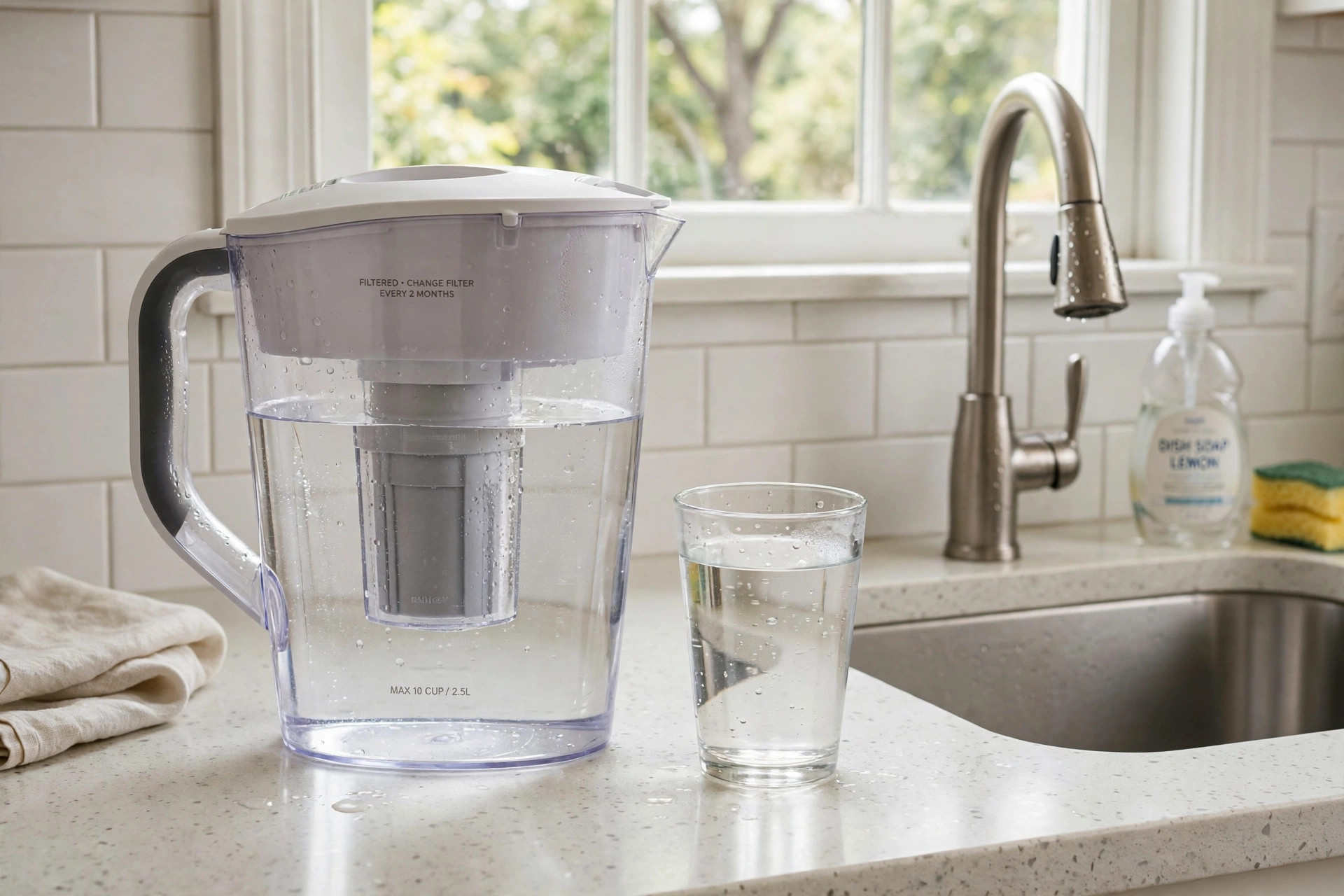
Pitcher filters are the simplest choice. You fill the top reservoir, water drips through the cartridge, and clean water collects below. Larger dispenser models sit on the counter and hold a gallon or more.
They are cheap to buy and need no plumbing. The trade-off is speed and capacity. A pitcher may take ten minutes to filter a gallon, and cartridges often last only 40 to 100 gallons. For a single person or a couple, that can be enough. For a large family that cooks at home, the constant refilling grows old. Many reviews of water filter pitcher for lead reviews usa stress this point: check the cartridge life before you judge the price.
Faucet-Mount Filters
These small units screw onto the kitchen faucet and filter water on demand. A lever switches between filtered and unfiltered flow. They cost a little more than pitchers but filter faster, and the cartridges often last 100 to 200 gallons.
The weak point is fit. Not every faucet accepts a mount, and pull-down sprayer faucets almost never do. If you plan to buy one, check your faucet type first. Faucet makers such as Moen and Delta publish faucet dimensions and specs that help you tell what will fit.
Under-Sink Filters
Under-sink systems mount inside the cabinet and feed a small separate tap on the sink deck. They hold more filter media, so cartridges last longer, often six to twelve months. Multi-stage models can cut lead along with chlorine taste, sediment, and other contaminants.
Installation needs basic plumbing skill: a cold-water line tap, a drain connection for some types, and a hole for the dispenser faucet. Many homeowners do it in an afternoon with the kit’s instructions. Guides at This Old House walk through under-sink installs step by step.
Reverse Osmosis Systems
Reverse osmosis, or RO, pushes water through a fine membrane that blocks lead and most other dissolved solids. RO systems certified to NSF/ANSI 58 handle lead well. They mount under the sink and include a storage tank, so filtered water is ready when you turn the tap.
RO costs more up front and wastes some water in the process, though newer models waste far less than old ones. They also remove minerals, which gives the water a flat taste that some people love and others do not. For homes with very high lead levels or many contaminants at once, RO is the heavy tool of the set.
Reading Reviews the Smart Way
Lead in drinking water filter reviews usa come from three kinds of writers: labs, magazines, and everyday buyers. Each has value if you know its limits.
Lab and certification data is the most solid. When a review cites NSF/ANSI 53 certification with a model number, you can trust the claim. Some filter makers publish their own lab reports; these are useful but not the same as third-party certification.
Magazine and expert reviews compare many models side by side. Retailers such as Home Depot and Lowe’s host thousands of buyer reviews, and filter specialists like Aquasana publish detailed spec sheets for their own lines. Expert roundups save time, but check the date. A 2022 review may cover models that have since changed.
Buyer reviews tell you about real life: how often the cartridge clogs, whether the pitcher drips, how the company handles warranty claims. Take single angry or glowing reviews with a grain of salt. Look for patterns across dozens of reviews instead.
Be wary of reviews that never mention certification, that test only with cheap strip kits, or that praise “alkaline” or “mineral” features as if they removed lead. They do not.
Cost and Price: What Lead Filters Really Run
Prices vary widely by type. The numbers below are typical American retail ranges, not quotes for any one brand.
– Pitcher filters: $25 to $60 for the pitcher; $15 to $30 per replacement cartridge. Yearly cost for a family: roughly $90 to $200. – Faucet-mount filters: $30 to $80 for the unit; $20 to $40 per cartridge. Yearly cost: roughly $80 to $180. – Under-sink single or multi-stage: $80 to $300 for the system; $40 to $120 a year in cartridges. Some need a plumber, which adds $150 to $300 once. – Reverse osmosis systems: $200 to $600 for the unit; $60 to $150 a year in filters and membranes. Professional install adds $200 to $400.
These are steady costs, not one-time buys. The filter only works while the cartridge is fresh. A cheap system with costly cartridges can pass a dearer system within two years. When you compare best filter for lead removal reviews usa, do the three-year math, not just the shelf price.
Care and Upkeep
A lead filter is only as good as its last cartridge change. When the media is spent, lead passes straight through, and the filter can even release trapped lead back into the water.
Change cartridges on time. Use the maker’s gallon rating or month rating, whichever comes first. Many units have a timer or a meter; trust it.
Flush a new cartridge. Run the maker’s stated gallons through a new cartridge before drinking the water. This clears carbon dust and air.
Keep it clean. Wash pitchers and reservoirs weekly with warm soapy water. Wipe the dispenser tap on under-sink systems. Biofilm grows in any damp filter housing.
Test yearly. If your water once showed lead, test again each year, or any time plumbing work is done on your street. A filter handles the tap; it does not fix the pipes.
Fixture maker Kohler and others note that older faucets can add lead at the very last inch of the run, so some homes pair a filter with a newer lead-free faucet for full peace of mind.
Safety Notes
A few safety points deserve plain words.
First, filters certified for lead handle the cold-water tap only, unless the maker says otherwise. Never run hot water through a filter cartridge; heat can damage the media and release contaminants.
Second, a filter is a bridge, not a cure. If your home has a lead service line, ask your water utility about replacement programs. Many cities now replace them free or at low cost.
Third, pregnant women and families with small children should take lead most seriously. If a test shows high lead, use filtered or bottled water for drinking, cooking, and mixing baby formula until the problem is fixed.
Fourth, keep spare cartridges on hand but store them sealed and dry. An opened cartridge left on a shelf can grow mold.
Frequently Asked Questions
Do all water filters remove lead? No. Most basic carbon filters improve taste but are not certified for lead. Only filters certified to NSF/ANSI 53, or reverse osmosis systems certified to NSF/ANSI 58, are proven to reduce lead. Check the certification before you buy.
How do I know if my water has lead? You cannot tell by look, taste, or smell. Ask your water utility for its lead testing results, or have your own tap tested by a certified lab. Homes built before 1986 face the highest risk because of lead solder and older pipes.
Is a pitcher filter enough for lead? It can be, if the pitcher is certified to NSF/ANSI 53 for lead reduction and you change the cartridge on time. Pitchers suit small households. Larger families often prefer an under-sink or RO system for speed and capacity.
How often must I change the cartridge? Follow the maker’s rating in gallons or months, whichever ends first. A family that cooks and drinks at home can wear out a pitcher cartridge in two months. Write the change date on the cartridge with a marker so you do not forget.
Does boiling water remove lead? No. Boiling kills germs but does not remove lead. In fact, boiling can raise the lead concentration as water steams away. Never boil water to fix a lead problem.
Should I test my water after installing a filter? It is a good idea. A lab test of the filtered water, taken a month or two after install, tells you the system is working in your home. Test again each year.
A Final Word
Lead in drinking water is a serious matter, but it is a solvable one. Start with a test so you know what you face. Then read lead in drinking water filter reviews usa with a sharp eye: demand independent certification, compare the true yearly cost, and pick the type that fits your household. Change the cartridge on schedule, and the water from your tap can be safe to drink again.
References
Aquasana. (n.d.). Water filtration systems. https://www.aquasana.com Delta Faucet. (n.d.). Kitchen and bathroom faucets. https://www.deltafaucet.com Family Handyman. (n.d.). DIY home repair and maintenance. https://www.familyhandyman.com Kohler. (n.d.). Bathroom and kitchen fixtures. https://www.kohler.com Lowe’s. (n.d.). Home improvement products. https://www.lowes.com Moen. (n.d.). Faucets and plumbing fixtures. https://www.moen.com The Home Depot. (n.d.). Home improvement products. https://www.homedepot.com This Old House. (n.d.). Home renovation guidance. https://www.thisoldhouse.com U.S. Environmental Protection Agency. (n.d.). Protecting human health and the environment. https://www.epa.gov
Was this guide helpful?

About Michael Thompson
The My Garden US editorial team writes practical, in-depth home and garden guides for American homeowners — tested advice, no fluff.
You May Also Like
Well Pump Replacement Cost Near Me: What Homeowners Should Know
May 9, 2026 0 views
Pipe Bursting vs Pipe Lining Cost Comparison for Homeowners
May 2, 2026 0 views
Best Water Leak Detector for Water Heater USA: A Complete Buying Guide
January 2, 2026 0 views