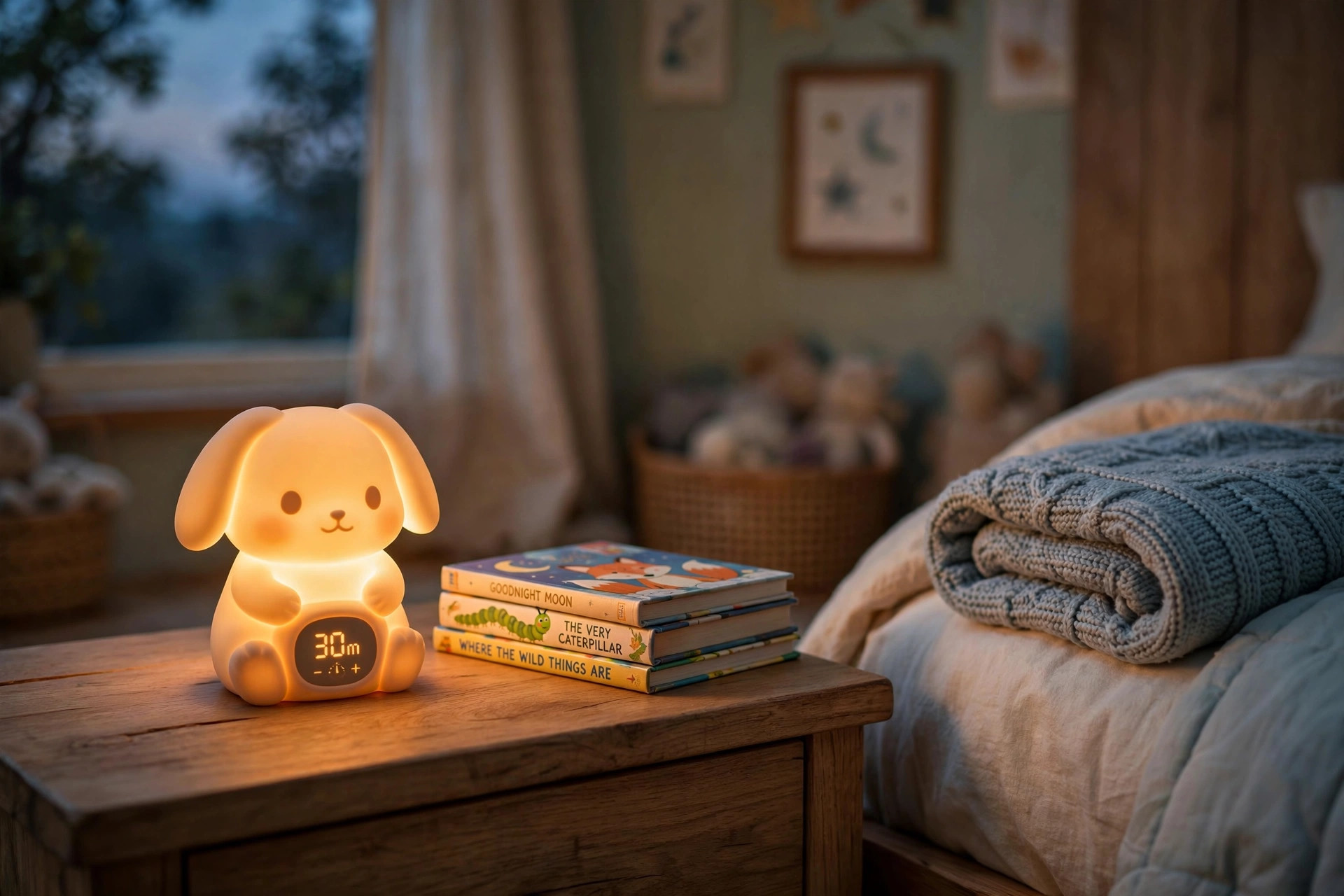

Many families find the end of the day hard. Children are tired, and parents are tired too. A kids night light with timer for bedtime routine can make those final minutes of the day calmer and more orderly. The light gives a child comfort as the room grows dark, and the timer takes away one more decision. There is no need to come back later to switch the lamp off. The light does its work, then rests until morning. This guide explains what these lights do, how to choose one, and how to fold it into a steady bedtime routine.
Why a Timer Night Light Helps the Bedtime Routine
A bedtime routine works best when it is the same each night. Children learn from patterns. Bath, brush teeth, story, lights low, then sleep. A kids night light with timer for bedtime routine fits into that pattern as a clear signal. When the soft light comes on, the child knows the day is ending. When it fades off by itself, the child learns that the room is now for sleeping. Parents gain too. They no longer lie awake wondering if they left a lamp on, or get up to turn one off once the child has drifted away.
Comfort Without Full Darkness
Some children fear the dark. A small warm glow keeps the room from feeling empty. It is bright enough for a child to see the shape of the bed and the door, yet dim enough to let sleep come. A timer adds a natural end. The light stays for the falling-asleep part of the night, then goes off. Research groups that study child sleep often note that a steady, dim light in the first part of the night does not block rest the way a bright lamp does. The American Academy of Pediatrics notes that a calm, dark, quiet sleep space helps children of all ages.
Teaching Time and Limits
A timer is also a quiet teacher. Some models change color when the time is up, turning from amber to green to mark morning. Others simply dim down to nothing. Either way, the child learns that light has a season. This is useful for early risers as well. Many parents use the same light to show when it is fine to get up. The lamp comes back on in the morning, and the child knows the day has begun.
What to Look for When You Choose One: Kids Night Light with Timer for Bedtime Routine
Shops carry many kinds of kids night lights with timers. The choices can confuse. Focus on a few basic points and the choice grows easier.
Light Color and Brightness
Warm light suits sleep. Cool white and blue-toned light can keep the brain alert, which is the opposite of what a bedroom needs at night. Look for a lamp that offers warm amber or soft red tones. Many models let you set the brightness. Start low. You can always turn it up a little if the child asks. For more on nursery lighting choices, see this guide to a nursery lamp with soft warm light for night.
Timer Settings
Check how the timer works. Some lights offer set times such as 15, 30, or 60 minutes. Others let you set any length you like. A few can stay on all night at very low power, which suits babies who wake to feed. Think about your routine. If your child usually falls asleep within twenty minutes, a 30-minute setting is enough. Retailers like IKEA and Wayfair list timer settings in the product details, so compare before you buy.
Power Source
Battery, rechargeable, and plug-in models each have trade-offs. Plug-in lights cost nothing to run but need an outlet near the bed. Battery models can sit anywhere, though you must change the cells. Rechargeable lamps charge by USB and run for many nights on one charge. Pick the kind that fits your room. If the outlet is far from the bed, a rechargeable lamp saves trouble.
Shape, Size, and Material
Children touch their night lights. Choose one that feels safe. Soft silicone models survive drops and do not break into sharp pieces. Glass lamps look fine but belong out of reach. Keep the size small enough for a bedside table. Some lamps come shaped as animals, moons, or stars. Let the child pick the shape if you can. A lamp they chose will comfort them more. You can browse many child-safe designs at Pottery Barn Kids.
Extra Features
Some kids night lights play soft sounds or lullabies. Others project stars on the ceiling. A few link to a phone app. These extras can be nice, but they are not required. A simple warm light with a timer does the core job well. If you like projection features, compare with the options in this roundup of the best kids night light projector for bedroom.
Types of Kids Night Lights with Timers
Plug-In Wall Lights
These small lamps plug straight into the wall outlet. Many have a dusk-to-dawn sensor plus a timer. They are cheap, sturdy, and simple. The light they give is mild. They suit hallways, bathrooms, and the corner of a childs room. Their weak point is placement. They must sit near an outlet, which is not always where you want light.
Portable Rechargeable Lamps
These are the most common nursery choice. They charge by USB, then run cord-free for hours. Most offer several timer settings and tap controls. A child can tap the lamp to make it brighter or dimmer. Because they have no cord, they are safe for cribs and toddler beds. Check the battery life. A good lamp runs ten or more hours on a single charge at low brightness.
Sound Machines with Light
Some sound machines include a small night light with a timer. The two work together. The light fades as the white noise plays, and both switch off together. These suit families who already use sound for sleep. They save space on the nightstand because two jobs live in one device.
Projector Lights with Timers
Projector lamps throw stars, clouds, or ocean waves across the ceiling. Many include a timer that stops the show after half an hour. Children who find plain light boring often love these. The moving shapes give the eyes something soft to watch until sleep takes over. They work best in rooms with plain, light-colored ceilings.
Toddler Clock Lights
Toddler clock lights combine a timer with a color cue. The lamp glows warm amber at bedtime, stays dark through the night, and turns green at the wake-up time you set. These are less about falling asleep and more about the whole night. Parents of early risers prize them. They teach the child to wait for the green light before calling out.
Cost and Price Ranges
Prices vary widely. A basic plug-in timer night light costs only a few dollars. Mid-range rechargeable lamps usually run between fifteen and forty dollars. These offer better materials, more timer choices, and dimming. High-end models with apps, projectors, or toddler clock functions can cost fifty to ninety dollars.
You do not need the most costly model. A twenty-dollar rechargeable lamp with a warm tone and a 30-minute timer serves most families well. Check the return policy before you buy. Children are honest critics. If the child dislikes the lamp, you will want an easy exchange. Store sites such as Target publish clear return terms online.
Building the Light into a Bedtime Routine
Buying the lamp is only half the work. The other half is habit. Here is a simple routine that uses the kids night light with timer for bedtime routine as its anchor.
1. Start wind-down time thirty minutes before bed. Turn off the main room light and switch on the night light. The room grows calm. 2. Follow the usual steps: bath, pajamas, brush teeth. Keep voices low and the pace slow. 3. Read one story by the warm glow. Avoid screens during this time. 4. Set the timer together. Let the child press the button or tap the lamp. This small act gives the child a sense of control. 5. Say good night. Leave the room while the light is still on. The timer will end the light on its own.
Keep the routine the same each night, even on weekends. Children trust what repeats. If you travel, take the lamp along. Familiar light in a strange room helps a child settle. Sleep guidance from What to Expect stresses that steady routines matter more than any single product.
Care and Upkeep
A night light needs little care, but a few habits keep it working well.
– Wipe the lamp with a dry cloth now and then. Dust dims the glow. – Charge rechargeable models before they run flat. A dead lamp at bedtime causes upset. – Check cords and plugs each month. Replace frayed cords at once. – Keep spare batteries if your model uses them. – Test the timer once a month. If it drifts, reset it.
Store the manual or bookmark the makers page so you can find the reset steps. Most brands print them on their websites.
Safety Tips
Safety comes first in a childs room. The Consumer Product Safety Commission sets rules for nursery products, and night lights are no exception. Follow these points.
– Buy lamps marked for child use. Look for safety marks from known testing labs. – Keep cords out of the crib and away from small hands. Cordless models remove this risk. – Do not let the lamp touch bedding or curtains. Even low-heat lamps need air around them. – Check that the lamp stays cool after an hour of use. If it grows hot, stop using it. – Keep small parts out of reach of babies who mouth objects. – Never leave a damaged lamp in use. Cracked plastic or a loose plug means it is time to replace it.
If you also use a night light for night feedings, a dimmable model gives more control. Read this comparison of a nursery night light with dimmer for feeding to find one that suits newborns.
Common Mistakes to Avoid
Parents sometimes buy a light that is too bright. A bright lamp fights sleep. Start with the dimmest setting and raise it only if the child is truly scared.
Another mistake is moving the lamp around. The lamp works best in one fixed spot. The child links that spot and that glow with sleep. If you must move it, give the child a few nights to adjust.
Some families set the timer too short. If the light dies before the child falls asleep, the child may cry out for it again. Watch for a few nights. Set the timer a little longer than the time your child needs to drift off.
Do not use the night light as a toy. Some children tap it on and off for fun. That is fine in the daytime. At night, calm use keeps the routine intact. For general advice on healthy sleep habits for kids, the Sleep Foundation offers clear, research-based guides.
Frequently Asked Questions
Is a night light with a timer safe for a newborn?
Yes, if you choose a cool, dim, cordless model and keep it away from the crib. Use the lowest brightness. Newborns do not need much light. Parents often find a dim lamp helpful for night feeds without fully waking the baby.
What timer length is best?
Thirty to sixty minutes suits most children. Younger children who fall asleep fast may need only fifteen or twenty minutes. Watch your child for a week and set the timer a bit longer than the falling-asleep time. You can shorten it later.
Will the light hurt my childs sleep?
A dim warm light used only at the start of the night is unlikely to harm sleep. Problems come from bright, cool, or all-night light, and from screens. Keep the lamp dim and warm, and let the timer end it. The Spruce covers this balance in its nursery lighting guides.
Can one lamp serve two children?
It can, if they share a room and keep similar hours. Place the lamp where both can see it. If their sleep times differ by much, two small lamps with separate timers work better.
What if my child is still afraid of the dark?
A night light is one tool, not a cure. Keep the routine steady. Talk about the fear in the daytime, not at night. Let the child keep a comfort object. If fear stays strong for many weeks, speak with your pediatrician. The American Academy of Pediatrics has guidance on nighttime fears.
Do I need a smart or app-linked model?
No. A basic lamp with a timer does the job. App features add cost and another device to manage. They suit some families, but they are never required for a good routine.
A Short Final Word
A kids night light with timer for bedtime routine is a small thing with a large job. It marks the end of the day, comforts a child in the dark, and frees parents from one more night-time errand. Choose a warm, dim, safe lamp. Set the timer with your child. Keep the routine steady. Night after night, that small glow will do its quiet work, and mornings will come a little easier for the whole house.
References
American Academy of Pediatrics. (n.d.). HealthyChildren.org. https://www.healthychildren.org IKEA. (n.d.). Home furnishings. https://www.ikea.com Pottery Barn Kids. (n.d.). Kids furniture and decor. https://www.potterybarnkids.com Sleep Foundation. (n.d.). Sleep information and guidance. https://www.sleepfoundation.org Target. (n.d.). Retail store. https://www.target.com The Spruce. (n.d.). Home and garden advice. https://www.thespruce.com U.S. Consumer Product Safety Commission. (n.d.). Product safety information. https://www.cpsc.gov Wayfair. (n.d.). Furniture and home goods. https://www.wayfair.com What to Expect. (n.d.). Pregnancy and parenting guidance. https://www.whattoexpect.com
Was this guide helpful?

About David Wilson
The My Garden US editorial team writes practical, in-depth home and garden guides for American homeowners — tested advice, no fluff.
You May Also Like
The Toddler Floor Bed Montessori Style Low: A Parent’s Complete Guide
April 22, 2026 0 views
Kids Dresser Knobs Replacement for Fun Decor: A Complete Guide
August 13, 2026 0 views
Nursery Glider with Nursing Pillow Set: Comfort for New Parents
June 20, 2026 0 views