Introduction
A hot tub is one of the great comforts of home life. Warm water, quiet jets, and a place to rest at the end of the day. But before any of that, there is the matter of power. The hot tub electrical requirements for installation are strict, and for good reason. A hot tub mixes water and high current in the same small space. A proper electrical setup keeps the heater strong, the jets steady, and everyone who steps into the water safe.
Many buyers pick out the tub first and think about the wiring later. That is a mistake. The electrical work often costs as much as a good share of the tub itself. It can also take weeks to schedule with an electrician and the local permit office. This guide walks through the whole subject in plain language: voltage, amperage, dedicated circuits, GFCI protection, disconnect boxes, permits, cost, and upkeep. Read it before you buy, and you will avoid the most common and most expensive errors.
Why Electrical Planning Comes First: Hot Tub Electrical Requirements for Installation
A hot tub is not like a lamp or a television. A standard home outlet gives you about 15 or 20 amps at 110 volts. Most full-size hot tubs need 40 to 60 amps at 220 volts. That is a different world. It means new wiring from your breaker panel, a larger breaker, and often a larger main panel if yours is already full.
The electrical work is also where safety lives. Water conducts current. A fault in a hot tub circuit can send current through the water and into the bodies of the people in it. The rules in the National Electrical Code exist to stop exactly that. A licensed electrician knows them. A do-it-yourself job that skips them can end in injury, a failed home inspection, or a fire.
There is a second reason to plan early. Your tub cannot run until the power is ready. Delivery trucks do not wait for electricians. If you schedule the electrical work first, the tub can be placed, filled, and wired in one smooth week instead of sitting empty on the patio for a month.
Voltage and Amperage: 110-Volt vs 220-Volt Models
Plug-and-Play 110-Volt Tubs
Some small tubs run on a normal 110 or 120-volt outlet. Makers call these plug-and-play models. They are usually small, light, and built for two or three people. They heat water slowly and often cannot run the heater and the jets at full power at the same time. For a good look at what smaller tubs offer, see our guide to hot tubs for small backyards.
220-Volt Tubs
Most full-size hot tubs run on 220 or 240 volts. This is the standard for four-person and larger tubs. A 220-volt supply heats water far faster and can run the heater and all the pumps at once. In cold regions, where a tub works hard all winter, 220 volts is almost a must. Our article on hot tubs for cold climates explains why insulation and power go hand in hand.
A 220-volt tub will list its need as something like 50 amps at 230 volts. That tells the electrician the size of the circuit to build. Common sizes are 40, 50, and 60 amps. The wire gauge must match the amperage and the distance from the panel. Long runs need thicker wire. This is not a place to guess. The tub’s manual gives the exact numbers. The electrician follows them. Maker sites such as Hot Spring and Bullfrog Spas list the electrical specs for their models.
The Dedicated Circuit Rule
Every hot tub needs a dedicated circuit. That means a circuit that serves only the tub and nothing else. No sharing with the garage, the shed, or the outdoor kitchen.
The reason is simple. A hot tub draws a large, steady load. If another device shares the circuit, the breaker will trip. Worse, an undersized or shared circuit can overheat the wiring in your walls. A dedicated circuit sized to the tub’s nameplate rating is one of the firmest hot tub electrical code requirements in the book.
The circuit runs from your main breaker panel to the tub. If your panel is full, the electrician may add a subpanel. In older homes, the whole main panel may need an upgrade from 100 to 200 amps. That is a bigger job, but it is common, and it adds value to the house.
Breakers, Disconnects, and GFCI Protection
GFCI Breakers
GFCI stands for ground-fault circuit interrupter. It is a device that watches the current going out and coming back on a circuit. If even a small amount of current leaks away, which is what happens when current passes through water or a person, the GFCI cuts the power in a fraction of a second.
Hot tub GFCI breaker requirements are clear. Every hot tub circuit must have GFCI protection. For hard-wired tubs, the GFCI is usually a special breaker in the panel or in a subpanel near the tub. For plug-in tubs, it can be a GFCI outlet or a GFCI cord. Do not skip this. Do not replace a GFCI breaker with a standard breaker to stop nuisance trips. If the breaker trips, there is a reason, and you should find it.
The Disconnect Box
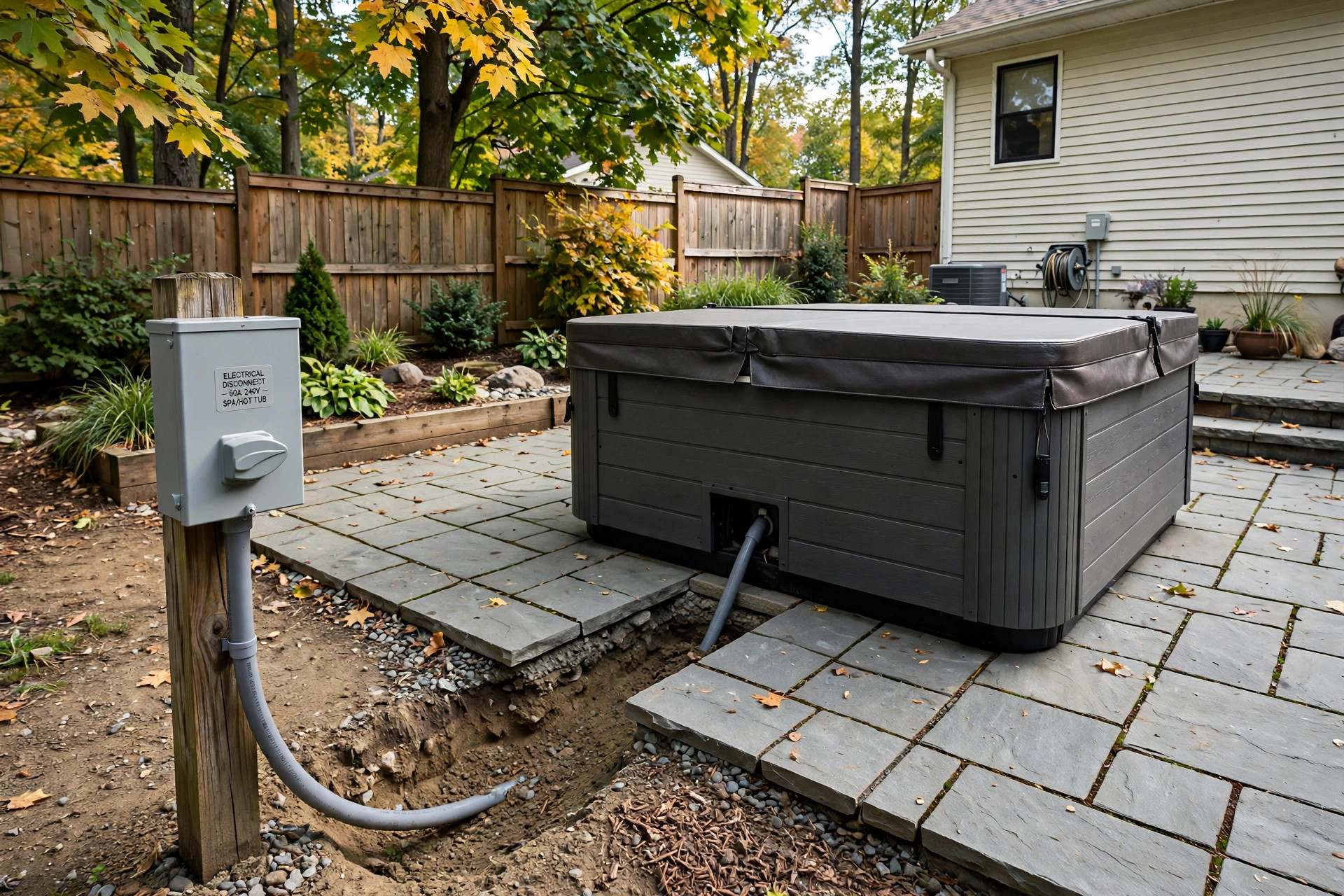
Code also calls for a disconnect box, a weatherproof switch box that can shut off power to the tub in an emergency. It must be within sight of the tub but at least five feet away from the water’s edge. That distance matters. A person in the water should not be able to reach the switch, but someone standing by the tub should be able to kill the power fast.
The disconnect box is where a subpanel often lives. The wire from the house panel lands there, passes through the GFCI breaker, and then runs underground or along the house to the tub. A licensed electrician will mount it on a post or the house wall at the right height and distance.
Wiring and Grounding
The wire that feeds a hot tub is thicker than the wire in your walls. A 50-amp circuit at 220 volts typically uses copper wire of a gauge the manual specifies, often number 6, though the exact size depends on length and local code. The wire runs through conduit, which is a plastic or metal tube that protects it. Buried conduit must sit at a set depth, often 18 inches or more, depending on the local code.
Grounding is just as important. The tub’s metal parts must bond to the same ground as the house. This keeps stray voltage from building up on handrails, ladders, and equipment, and it helps the GFCI do its job. After the work is done, the inspector will check the ground as part of the permit inspection.
For owners who like to learn the upkeep side of tub care, Swim University publishes plain how-to guides on hot tub maintenance, and a solid starter set of water care products helps once the tub is running. See our notes on hot tub chemical starter kits for that side of ownership.
How Much Does the Electrical Work Cost?
The cost to install a hot tub electrical hookup varies a great deal. The price depends on the distance from your panel to the tub, the amperage the tub needs, the state of your panel, and local labor rates. As a rough guide, homeowners in the United States often pay between $1,000 and $3,000 for a standard 220-volt hot tub circuit with GFCI and disconnect. Some cost less. Some go well above. Guides on The Spruce and project pages at The Home Depot give a good picture of typical outdoor wiring project costs.
The distance is the biggest factor. If the panel sits in the garage and the tub goes on the patio just outside, the run is short and cheap. If the panel is 100 feet away, the cost climbs fast because of the extra wire and conduit.
Panel upgrades are the other big cost driver. A simple breaker addition might cost a few hundred dollars in labor and parts. A full panel upgrade to 200 amps can add $1,500 to $3,000 or more. Some homes also need a trench dug across the yard for buried conduit, which adds labor.
Get three written quotes from licensed electricians. Make sure each quote covers the permit, the GFCI breaker, the disconnect box, the wire and conduit, and the final inspection. A quote that leaves out the permit is a red flag.
Permits and Inspections
Most towns and counties require an electrical permit for a hot tub circuit. The permit is a small fee, usually well under $200, but it matters. It puts your job on the record. It triggers an inspection. And it keeps your home insurance valid if something ever goes wrong.
The electrician often pulls the permit for you. The town then sends an inspector to look at the work before the trench is filled or the walls are closed. The inspector checks wire size, breaker size, GFCI protection, disconnect placement, conduit depth, and grounding. This is routine work for a licensed electrician. If you hire someone who says you do not need a permit, find a different electrician.
Some areas also require a separate building permit for the concrete pad or deck that holds the tub. Ask your permit office about both at the same time so you are not caught short later.
Care and Upkeep After Installation
Once the tub is wired and running, the electrical system needs only light care. Keep the area around the disconnect box clear of weeds, mulch, and stored items. Do not hang towels or pool toys on the box. Check once a season that the box lid closes tight and no wasps or mice have moved in.
Test the GFCI breaker once a month. Every GFCI breaker has a test button. Press it. The breaker should trip and cut power to the tub. Then switch it back on. If the test button does not trip the breaker, call an electrician.
Watch for signs of trouble. A breaker that trips again and again, a buzzing sound from the panel, a hot smell near the disconnect box, or flickering tub controls all call for a professional visit. Water and electricity do not forgive delay.
Safety Rules Every Owner Should Know
Electrical safety does not end when the electrician leaves. Keep these rules:
– Never touch the disconnect box or the tub’s electrical equipment with wet hands if you can avoid it. Dry your hands first. – Keep all radios, phones, and plugged-in devices at least five feet from the water. Better still, keep them far away. – Never run an extension cord to a hot tub. If the cord does not reach, the tub is in the wrong place. – Teach children that the disconnect box and panel are not toys. Lock the panel if young children play nearby. – After a storm or flood, do not switch the tub back on until an electrician has checked it.
The Consumer Product Safety Commission publishes safety guidance on pools and spas that every hot tub owner should read at least once. Their hot tub and spa safety materials cover drain covers, barriers, and electrical safety in plain terms. Spa retailers like Leslie’s and Pool Warehouse also carry GFCI equipment and disconnect boxes built for outdoor spa use.
Frequently Asked Questions
Can I wire a hot tub myself?
You should not. Hot tub wiring must meet the National Electrical Code and local rules, and it must pass inspection. Most towns require a licensed electrician for this work. A bad job can void the tub’s warranty, fail the inspection, or cause injury. Save your skills for the deck furniture and hire the wiring out.
What size breaker does a hot tub need?
It depends on the model. Small plug-in tubs may need only a 20-amp 110-volt circuit. Full-size tubs most often need 40, 50, or 60 amps at 220 volts. The exact number is printed on the tub’s nameplate and in the manual. Always size the circuit to the manual, never to a guess.
How far must the disconnect be from the hot tub?
At least five feet from the water’s edge, and within sight of the tub. This is a code rule. The five-foot gap keeps someone in the water from reaching the switch, while the line-of-sight rule lets a helper cut the power in an emergency.
How long does the electrical installation take?
The work itself often takes one day for a simple job: mount the disconnect, run the conduit, pull the wire, and connect the breaker. The slow part is the schedule. Good electricians may book two to four weeks out, and the permit and inspection add days on each end. Plan for a month from the first phone call to the final switch-on.
Will a hot tub raise my electric bill?
Yes, but how much depends on the tub, the climate, and your rates. A well-insulated 220-volt tub in a mild climate might add $20 to $40 a month. A tub in a cold region, used daily, can add $50 to $100 or more. A good cover, lower standby temperatures, and off-peak use all help. Ask your utility about time-of-use rates before you buy.
A Short Final Word
The hot tub electrical requirements for installation are not decoration. They are the frame that holds the whole pleasure of the tub together. Plan the power first. Hire a licensed electrician. Pull the permit. Size the circuit to the manual. Test the GFCI every month. Do these plain things, and your tub will give you years of warm, easy evenings with none of the trouble that comes from a rushed job.
References
Bullfrog Spas. (n.d.). Hot tubs and spas. https://www.bullfrogspas.com Hot Spring Spas. (n.d.). Hot tubs and spas. https://www.hotspring.com Leslie’s Pool Supplies. (n.d.). Pool supplies and equipment. https://www.lesliespool.com Pool Warehouse. (n.d.). Pool equipment and supplies. https://www.poolwarehouse.com Swim University. (n.d.). Pool and hot tub care guides. https://www.swimuniversity.com The Home Depot. (n.d.). Home improvement products. https://www.homedepot.com The Spruce. (n.d.). Home and garden advice. https://www.thespruce.com U.S. Consumer Product Safety Commission. (n.d.). Product safety information. https://www.cpsc.gov
Was this guide helpful?

About Jennifer Lee
The My Garden US editorial team writes practical, in-depth home and garden guides for American homeowners — tested advice, no fluff.