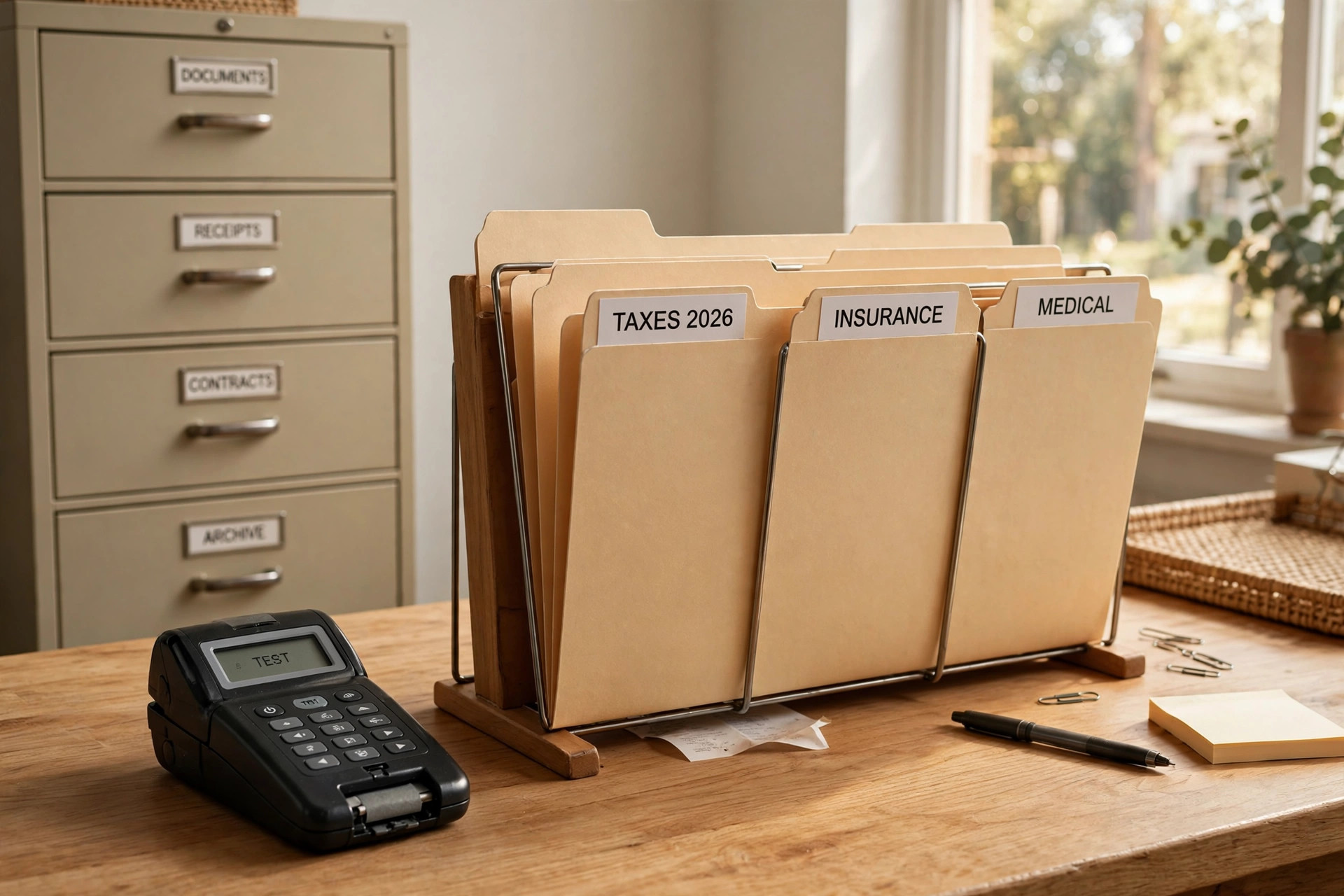

A home office label maker for filing organization is one of the smallest tools you can buy and one of the most useful. It prints clean labels for folders, boxes, drawers, and shelves. Paper piles shrink. You find papers in seconds instead of minutes. This guide explains why a label maker matters, how to choose one, what types exist, what they cost, and how to set up a filing system that stays neat all year.
Why Labels Matter in a Home Office
Paper is the quiet mess in most home offices. Bills, tax papers, medical forms, and school letters all land on the same desk. Without clear marks, one folder looks like the next. A home office label maker for filing organization solves this with plain printed words. You label each folder the day the paper arrives. Nothing hides.
Labels also keep your mind clear. When the shelf says “Taxes 2026” and “Car Insurance,” you stop worrying that a bill is lost. You know where it sits. Studies of office work long ago showed that clear filing cuts search time by half or more. That finding still holds in a spare bedroom office.
A label maker also helps anyone else in the house. A spouse can find the insurance papers without asking. A child can file school papers in the right box. The system works because the words on the folders do the teaching.
Labels Cut Stress, Not Just Clutter
Lost papers cause real stress. Many workers report that a messy desk makes them feel behind before the day starts. A row of labeled folders gives the eye a place to rest. You sit down, you see order, and you start work faster. The cost of that calm is tiny compared to a new desk or a bigger office.
Labels also guard against mix-ups at tax time. Every April, millions of people hunt for receipts and forms. A labeled system means the receipts were filed when they arrived. The tax folder is full and ready. Your accountant will thank you. If you run a small business from home, this habit also protects you in an audit, since every paper has a clear home.
How to Choose a Label Maker: Home Office Label Maker for Filing Organization
Start with the jobs you need it to do. A home office label maker for filing organization should print labels wide enough to read across a room. Most folder tabs take labels of one half inch to one inch. Check that the maker handles these widths.
Print Quality and Readability
Look for crisp, dark print. Some cheap makers print faint text that fades in a year. Better models use thermal transfer tape. The ink sinks into the tape and resists light and water. Test print quality in the store if you can. If the letters look sharp at arm’s length, the maker will serve you well.
Tape Cost and Availability
The maker is only part of the price. Tape cartridges are the rest. Check the price of refills before you buy. Some brands sell tape at fair prices in many stores. Others lock you into pricey refills. The Home Depot and IKEA often carry common brands and refills. Reviews at Wirecutter and PCMag compare long term tape cost across models.
Keyboard Versus Phone App
Old style makers have a small keyboard on the machine. Newer ones link to a phone app over Bluetooth. The keyboard style is quick for single labels. The phone app style is better for batches, since you can type fast and save label designs. If you label dozens of folders at once, the app model saves real time.
Power and Portability
Some makers run on batteries. Others plug into the wall. A battery model can sit in a drawer until needed. A plug-in model never dies mid-job. For filing work, either is fine. Pick the one that fits where you will use it.
Print Speed and Batch Work
If you plan to label fifty folders in one afternoon, print speed matters. Cheap makers print one label every ten seconds. Better ones print in three or four. Over a big batch, that gap adds up. Models with auto cut save even more time, since each label drops ready to stick.
Types of Label Makers
Handheld Embossing Makers
These press raised letters into plastic tape. They need no power and no ink. The labels last for years. The downside is slow work and only one font. They suit a small filing box but not a whole room.
Thermal Print Makers
These are the standard choice for a home office label maker for filing organization. They print on sticky tape in seconds. Many fonts and sizes are built in. The labels look neat and professional. Guides at The Spruce and CNET list top thermal models each year.
Desktop and PC Connected Makers
These plug into a computer. You design labels on a large screen. They print address labels, file labels, and even barcodes. They cost more. They make sense if you also ship parcels or run a home business.
Heavy Duty Industrial Models
These print on tough tape for wires, tools, and pipes. They are more than most home offices need. Skip them unless your office shares space with a workshop.
Tape Materials Compared
Not all tape is the same. Paper tape is cheap but tears and fades. Plastic tape resists water and lasts longer. Fabric tape suits drawers you open daily. For a home office label maker for filing organization, laminated plastic tape is the best pick. It costs a bit more, yet one cartridge will label a whole room.
Font Size and Layout Options
Most makers offer several font sizes. Use large type for boxes you read across the room. Use small type for folder tabs. Keep to one or two sizes per system. Too many sizes look messy and defeat the purpose of clean labels.
Cost and Price
A basic handheld maker costs about fifteen to thirty dollars. A good thermal model costs thirty to eighty dollars. A desktop model with a computer link costs eighty to two hundred dollars. These prices have been stable for years.
Tape cartridges run five to twenty dollars each. One cartridge prints dozens of labels. Buy tape in multi packs to save money. The total first year cost for most buyers stays under one hundred dollars. That is cheap compared to the time lost hunting for lost papers.
Watch for sales at office supply stores and big box retailers. The Wayfair home office section often lists label makers during back to school and new year sales. Good Housekeeping rounds up tested picks that balance price and print quality.
Setting Up a Filing System
A label maker is only as good as the system behind it. Follow these steps to build a filing setup that lasts.
Step One: Gather All Papers
Pull papers from every drawer, bag, and shelf. Spread them on a table. This feels messy for an hour, but it ends the mess for good.
Step Two: Sort Into Piles
Make broad piles first: taxes, insurance, medical, home, car, school, and personal. Do not overthink it. Ten to twelve piles cover most homes.
Step Three: Name Each Pile
Give each pile a plain name. Short names work best on labels. “Auto Insurance” beats “Motor Vehicle Coverage Papers.” Write the names on scrap paper first and live with them for a day.
Step Four: Choose Your Storage
Match your storage to your space. A lockable filing cabinet for home business documents holds sensitive papers and keeps them safe from kids and guests. A home office storage cabinet with locking doors works for larger rooms. For small corners, a best desk organizer set for small office desk handles daily papers near your keyboard. Advice on matching furniture to space appears at Herman Miller and Steelcase, and ergonomic desk ideas at Uplift Desk.
Step Five: Print and Stick Labels
Print one label per folder or box. Center it on the tab. Smooth it flat with a finger. If a label peels, the tape is cheap or the surface is dusty. Wipe the folder with a dry cloth and try again.
Step Six: Keep a Master List
Write down every folder name on one sheet. Keep this sheet at the front of the cabinet. When you need a paper, the list tells you the folder. This master list is the map of your whole system.
Step Seven: Handle Daily Incoming Paper
Give new mail a landing spot. Use a small tray marked “To File.” Once a week, file the tray and print any new labels you need. This weekly habit takes ten minutes and stops paper piles from growing back.
Care and Upkeep
A label maker needs little care. Keep it in a drawer away from dust. Wipe the print head with a dry cotton swab once or twice a year. Change batteries when print grows faint.
Store spare tape away from heat and sun. Heat ruins adhesive. A cool closet shelf is ideal. Labels on folders last for years in normal room conditions. Replace any label that curls at the edges.
Revisit your filing system once a year. Shred old papers you no longer need. Tax papers usually stay for seven years. Old utility bills can go after one year. After the purge, print fresh labels for any new folders. Guides at Family Handyman offer yearly home paper cleanup checklists.
Safety
Label makers are safe tools, but a few rules apply. Keep small tape cartridges away from toddlers. They are choking hazards. Do not let children play with the cutting blade. Unplug desktop models during storms.
If you use a label maker in a shared office, wash your hands before touching shared food. Ink dust from old thermal printers is mild but worth avoiding. Keep the maker on a stable desk so it cannot fall on a foot.
Frequently Asked Questions
What is the best label maker for office filing?
The best label maker for office filing is a thermal model with one half inch and one inch tape. It prints fast, reads clearly, and refills are easy to find. Keyboard models are fine for small jobs. Phone app models are better for big batches.
How long do printed labels last on folders?
Thermal transfer labels last five to ten years indoors. Direct thermal labels fade faster, often in one to two years near sun. For a filing cabinet that you open daily, thermal transfer tape is worth the small extra cost.
Can a label maker print on hanging file folders?
Yes. Most makers print labels that fit the plastic tabs of hanging folders. Measure your tab width first. Buy tape a touch narrower than the tab so the label sits flat and does not hang over the edge.
How do I organize labels by color?
Many makers print black on white, black on yellow, or white on black tape. Use color with meaning. White for finance, yellow for urgent, green for medical. Write the color code on your master list so the meaning stays clear years later.
Is a label maker worth it for a small home office?
Yes. Even a ten folder system benefits. Clear labels stop the daily hunt for papers. The time saved in one month usually pays for the maker. Small offices gain the most because space is tight and every folder counts.
What width of tape should I buy?
Buy two widths: one half inch for folder tabs and three quarter inch or one inch for boxes and shelves. This covers almost every filing job in a home office. Avoid very wide tape unless you label large storage bins.
A Short Final Word
A home office label maker for filing organization is a small buy with a large payoff. It turns a pile of mystery folders into a system anyone can use. Choose a thermal model with fair tape prices. Sort your papers. Print clear labels. Keep a master list. Do this once, and your home office will stay calm for years.
References
CNET. (n.d.). Technology news and reviews. https://www.cnet.com Family Handyman. (n.d.). DIY home repair and maintenance. https://www.familyhandyman.com Good Housekeeping. (n.d.). Product reviews and home advice. https://www.goodhousekeeping.com Herman Miller. (n.d.). Office furniture and ergonomic seating. https://www.hermanmiller.com IKEA. (n.d.). Home furnishings. https://www.ikea.com PCMag. (n.d.). Technology product reviews. https://www.pcmag.com Steelcase. (n.d.). Office furniture and workplace research. https://www.steelcase.com The Home Depot. (n.d.). Home improvement products. https://www.homedepot.com The Spruce. (n.d.). Home and garden advice. https://www.thespruce.com UPLIFT Desk. (n.d.). Standing desks and ergonomic office furniture. https://www.uplift-desk.com Wayfair. (n.d.). Furniture and home goods. https://www.wayfair.com Wirecutter. (n.d.). Product reviews from The New York Times. https://www.nytimes.com/wirecutter
Was this guide helpful?

About Michael Thompson
The My Garden US editorial team writes practical, in-depth home and garden guides for American homeowners — tested advice, no fluff.
You May Also Like

USB C Docking Station for Home Office Setup: A Plain Guide
May 8, 2026 0 views
Best Standing Desk Mat for Concrete Floors: A Practical Guide
January 2, 2026 0 views
Best Pen Holder Organizer for Office Desk: A Practical Buying Guide
July 30, 2026 0 views