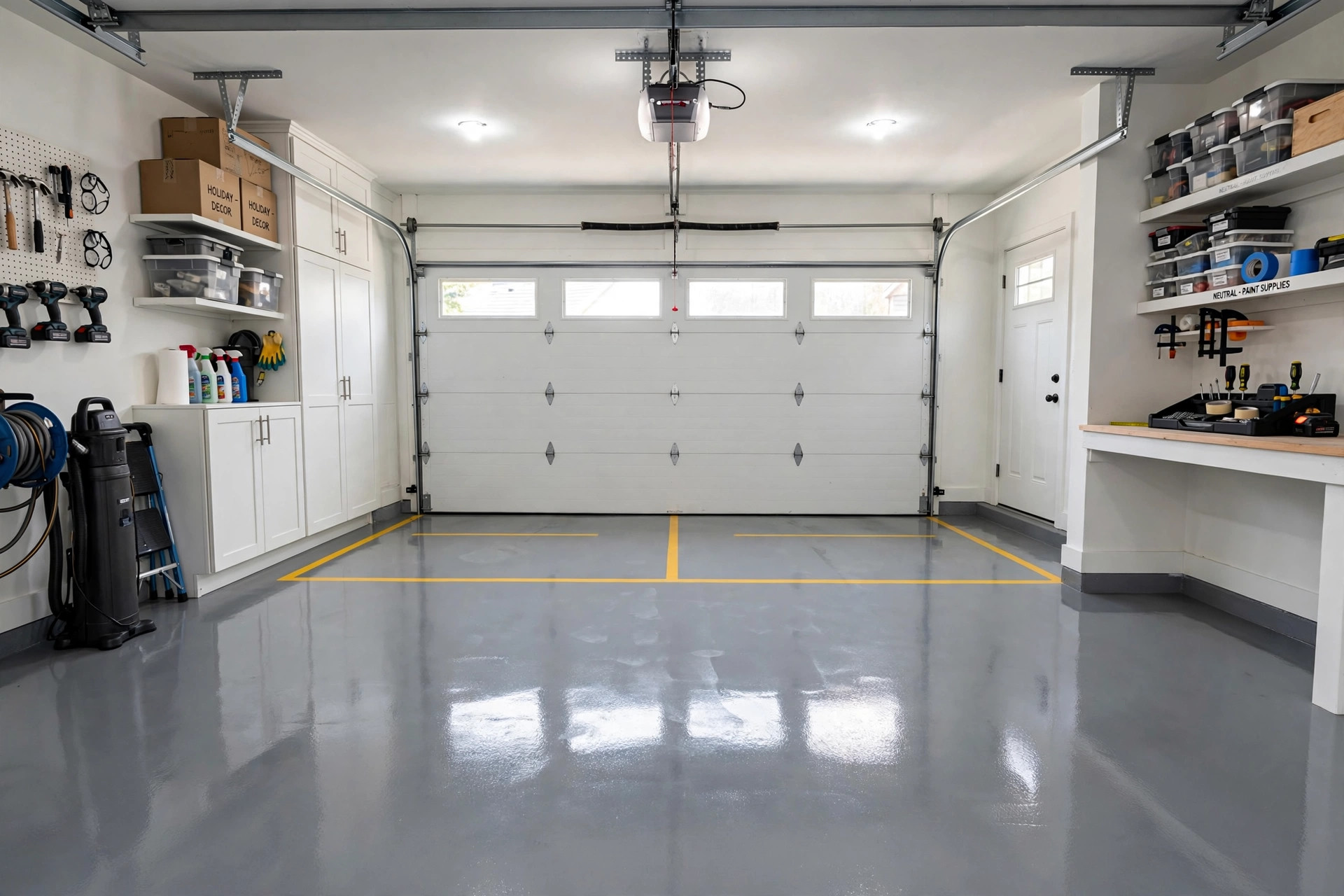

Most homeowners ask about epoxy garage floor cost per square foot before they call a contractor or buy a kit. The garage is no longer a place to park and forget. Many families use it as a workshop, a gym, or a clean storage room. A coated floor changes the feel of the whole space. But the price ranges printed on boxes and websites can be wide and confusing. This guide explains the cost in plain terms. It covers what drives the price up and down, what the choices are, and how to keep the floor in good shape for years.
Why Homeowners Ask About Epoxy Floor Cost
A plain concrete garage floor is dusty and hard to clean. Oil stains sink in. Salt from winter roads eats at the surface. An epoxy coating seals the concrete. It gives a smooth, glossy finish that resists oil, chemicals, and hot tires. It also brightens the garage. The light floor reflects the overhead lamps, and the whole room feels larger and cleaner.
The question of epoxy garage floor cost per square foot comes up because size is the main cost driver. A one-car garage may be only 200 square feet. A three-car garage may run past 700 square feet. Small jobs cost more per square foot than large jobs. The surface condition matters too. A new slab in good shape is cheap to coat. An old floor with cracks, oil stains, and peeling paint takes much more labor. Homeowners who plan a budget need to know these facts before they sign a contract or open a kit.
An epoxy floor is also a long-term choice. A cheap do-it-yourself job may last only two or three years. A professional job with proper preparation may last ten to twenty years. When you compare prices, you are really comparing years of service. That is why the cost per square foot matters. It lets you compare a $300 kit against a $4,000 professional job on fair terms.
What to Look for When Choosing an Epoxy System: Epoxy Garage Floor Cost Per Square Foot
Not all epoxy coatings are the same. The label may say “epoxy” on boxes that hold very different products. Three things matter most.
Solids Content
Epoxy is sold by its solids content. A water-based kit from a store may be only 50 percent solids. The rest is water that dries off. The film left behind is thin, sometimes less than three thousandths of an inch. A professional-grade epoxy is often 90 to 100 percent solids. It goes on thick and hard. When you read a cost estimate, ask what solids the product has. A low price per square foot may hide a thin product that will wear fast.
Surface Preparation
Preparation is the most important step. The concrete must be clean, dry, and rough enough for the coating to grip. Contractors usually grind the floor with a diamond grinder. Some use acid etching instead. Grinding is better on old, hard concrete. A floor that was never cleaned will peel within a year, no matter how good the epoxy is. When you get quotes, ask exactly how the surface will be prepared. The answer tells you much about the quality of the job.
Type of System
Some systems are pure epoxy. Others add a polyurethane or polyaspartic topcoat. A topcoat adds cost but brings better resistance to sun, scratches, and yellow spots. Many contractors now sell hybrid systems with an epoxy base and a faster topcoat on top. If your garage gets full sun at the door, ask about a topcoat with ultraviolet protection. Plain epoxy can turn yellow where the sun hits it.
For homeowners weighing other painting projects too, resources like Bob Vila and This Old House publish plain guides to coatings across the house, from reading interior door paint reviews to planning outdoor work.
Types of Epoxy Garage Floor Coatings
Epoxy garage floors come in several forms. Each form has a different price and a different look.
Water-based epoxy is the least costly. It is sold in kits at big stores such as Home Depot and Lowe’s. It is easy to apply and has a mild odor. But the film is thin, and it wears faster under car traffic. It suits a garage that is used mostly for storage.
Solvent-based epoxy is stronger than water-based epoxy. It has more solids and a harder finish. The odor is strong, and the garage needs good air flow during the work. Many old kits use this formula. It is harder to find now because of rules about chemical fumes.
One hundred percent solids epoxy is the professional standard. It has no water or solvent to dry off. What you spread is what stays. It forms a thick, hard layer that resists hot tires and chemicals. It is hard to apply for a beginner because it sets fast in the mixing pot. Most professionals use this type.
Polyaspartic and polyurethane topcoats are often added over the epoxy. They cure fast, sometimes in one day. They resist sunlight and scratch marks. A full system with a topcoat costs more per square foot, but it lasts longer and looks better.
Decorative flakes are color chips thrown over the wet epoxy. They hide dirt and give the floor a speckled look. Most homeowners choose flakes. A metallic epoxy is another style. It uses special pigments to make a swirl pattern that looks like marble. Metallic floors cost more because the labor is slow.
Product brands such as BEHR, Sherwin-Williams, and Benjamin Moore all sell floor coatings through retail channels, and HGTV and The Spruce carry photo galleries that show how each style looks in a real garage.
Cost and Price: Epoxy Garage Floor Cost Per Square Foot
Now the main question. What is the epoxy garage floor cost per square foot in the United States in 2026?
For a do-it-yourself job with a store kit, the material cost runs about $2 to $5 per square foot. A one-car garage of 250 square feet may need two or three kits. Total material cost lands near $500 to $1,200.
For a professional job, the epoxy garage floor cost per square foot installed runs about $3 to $12 per square foot. The wide range comes from the choices. A simple one-color epoxy at $3 to $5 per square foot is the low end. A two-car garage of 450 square feet then costs $1,350 to $2,250. A full system with grinding, crack repair, flakes, and a polyaspartic topcoat runs $7 to $12 per square foot. The same garage then costs $3,150 to $5,400.
Several things push the price up. Heavy surface repair is one. If the slab has deep cracks or old paint, the contractor must grind harder and fill more. Moisture is another. A slab that lets water vapor through needs a special primer, or the epoxy will bubble. That primer adds about $1 to $2 per square foot. Metallic and custom designs are the highest cost. They run $12 to $20 per square foot because the artistry takes time.
Small garages cost more per square foot. A contractor has fixed costs for travel and setup. A 200-square-foot garage may cost $8 per square foot while a 600-square-foot shop costs $5. Geography matters too. Labor in large cities runs higher than in small towns. Always get at least three written quotes. Ask each contractor to list the solids content, the prep method, the number of coats, and the warranty in writing.
To put the numbers in a common table, here is a rough view for a 450-square-foot two-car garage in 2026.
– DIY water-based kit: $900 to $1,800 total, or $2 to $4 per square foot. – DIY high-solids kit: $1,350 to $2,700 total, or $3 to $6 per square foot. – Professional simple epoxy: $1,800 to $3,150 total, or $4 to $7 per square foot. – Professional flake system with topcoat: $3,150 to $5,400 total, or $7 to $12 per square foot. – Professional metallic art floor: $5,400 to $9,000 total, or $12 to $20 per square foot.
These are ranges, not promises. Your local market may sit higher or lower. But the order is right. DIY is cheapest, a plain professional coat sits in the middle, and a full flake or metallic system is the premium choice.
Care and Upkeep
An epoxy floor is easy to care for, but it is not indestructible. Sweep or dust-mop often. Sand and grit act like sandpaper under shoes and tires. Wash the floor a few times a year with a mild soap and warm water. Do not use harsh acid cleaners or strong bleach. They can dull the finish.
Wipe up oil, gasoline, and brake fluid soon after a spill. Epoxy resists chemicals, but no coating likes to sit in a puddle for a week. Place a mat under a car that drips. In winter, hose off the road salt. Salt left on the floor can leave white marks over time.
Watch for hot tires. Tires warmed by a long drive can mark a fresh epoxy floor. Most coatings cure fully in about seven days. Park the car outside for that week if you can. After full cure, normal driving is fine.
Outdoor paint jobs need the same care thinking, and readers who also plan deck or pool projects often compare notes from pool deck paint reviews for hot climates before buying.
Safety
Safety starts during the work. Epoxy fumes are strong. Wear a proper respirator, not just a dust mask. Open the garage door and use a fan for fresh air. Keep children and pets out until the floor is fully cured. The label cure time is often 24 to 72 hours for foot traffic and seven days for cars. Read the label for your product.
Once cured, epoxy is safe for normal home use. The floor can be slick when wet. Decorative flakes help grip, but they are not a rough surface. If your garage gets wet often, ask about an anti-slip additive. It is a fine grit mixed into the topcoat. It adds a small cost but keeps feet steady.
Moisture testing is a smart step before you buy. Tape a square of plastic sheeting to the bare concrete for 24 hours. If water drops form under the plastic, your slab has vapor trouble. A moisture-block primer solves it in most cases. Skipping this test is a common cause of peeling floors. If you hire a pro, ask them to test.
Disposal matters too. Do not pour leftover epoxy or solvents down the drain. Let small leftover amounts harden in the can, then throw them with the household trash per your town’s rules. Take large amounts to a hazardous waste drop-off.
FAQ
How long does an epoxy garage floor last?
A DIY kit floor often lasts two to five years under car traffic. A professional floor with good preparation often lasts ten to twenty years. The topcoat and the prep matter more than the brand name. A thick floor that was ground and cleaned well will outlast a thin floor that was painted over dust.
Can I apply epoxy over an old painted garage floor?
Only if the old paint is sound. Loose or peeling paint must come off. The contractor should grind it away and start from bare concrete. Coating over weak paint means the epoxy will peel with the paint. A test patch is wise. Coat a small area, let it cure, and try to scrape it off. If it lifts easily, more prep is needed.
What is the cheapest way to lower epoxy garage floor cost per square foot?
Do the preparation yourself and hire the coating only. Or choose a one-color system with no flakes and no topcoat. Large jobs also cost less per square foot than small ones. Some families coat a neighbor’s garage in the same week and split the trip charge with the contractor.
Does epoxy work on a garage floor with cracks?
Yes, if the cracks are repaired first. Hairline cracks are filled with epoxy filler. Wide cracks need a flexible crack repair product. A floor that moves or sinks badly is a different problem. No coating can fix a broken slab. Ask a contractor to look at serious damage before you spend money.
How soon can I drive on a new epoxy floor?
Most products allow foot traffic in 24 hours and car traffic in three to seven days. Polyaspartic topcoats cure faster, sometimes in one day. Cold weather slows the cure. Follow the label times for the temperature in your garage. Driving too soon can leave tire marks that never come out.
Is epoxy better than paint for a garage floor?
Epoxy is thicker and harder than ordinary floor paint. It resists hot tires and chemicals far better. Floor paint costs less but wears faster. If you want a floor that looks good for years, epoxy wins. If you need a quick cheap refresh before selling a house, paint may be enough. Homeowners finishing other rooms sometimes start with paint guides such as best paint for basement ceiling exposed to learn the basics of prep before they tackle the garage.
A Short Final Word
The epoxy garage floor cost per square foot is only one part of the choice. A low price on a thin kit can cost more in the end if it fails in two years. A fair price on a well-prepared professional floor pays back in clean, bright, easy years of service. Measure your garage. Test the slab for moisture. Get three written quotes. Ask about solids, prep, coats, and warranty. Then choose the system that fits your budget and your plans for the space. A coated floor is one of the most satisfying upgrades a homeowner can make. It turns a gray box into a room you are proud to open.
References
Behr. (n.d.). Paints, primers, and stains. https://www.behr.com Benjamin Moore. (n.d.). Paints and stains. https://www.benjaminmoore.com Bob Vila. (n.d.). Home improvement advice. https://www.bobvila.com HGTV. (n.d.). Home and garden ideas. https://www.hgtv.com Lowe’s. (n.d.). Home improvement products. https://www.lowes.com Sherwin-Williams. (n.d.). Paints and coatings. https://www.sherwin-williams.com The Home Depot. (n.d.). Home improvement products. https://www.homedepot.com The Spruce. (n.d.). Home and garden advice. https://www.thespruce.com This Old House. (n.d.). Home renovation guidance. https://www.thisoldhouse.com
Was this guide helpful?

About Lisa Anderson
The My Garden US editorial team writes practical, in-depth home and garden guides for American homeowners — tested advice, no fluff.
You May Also Like
Painting Over Wallpaper Pros and Cons USA: Should You Paint or Strip?
May 21, 2026 0 views
Winter Interior Painting Tips for USA Homes
February 25, 2026 0 views
Waterproof Paint for Basement Walls Interior: A Complete Homeowner’s Guide
September 14, 2026 0 views