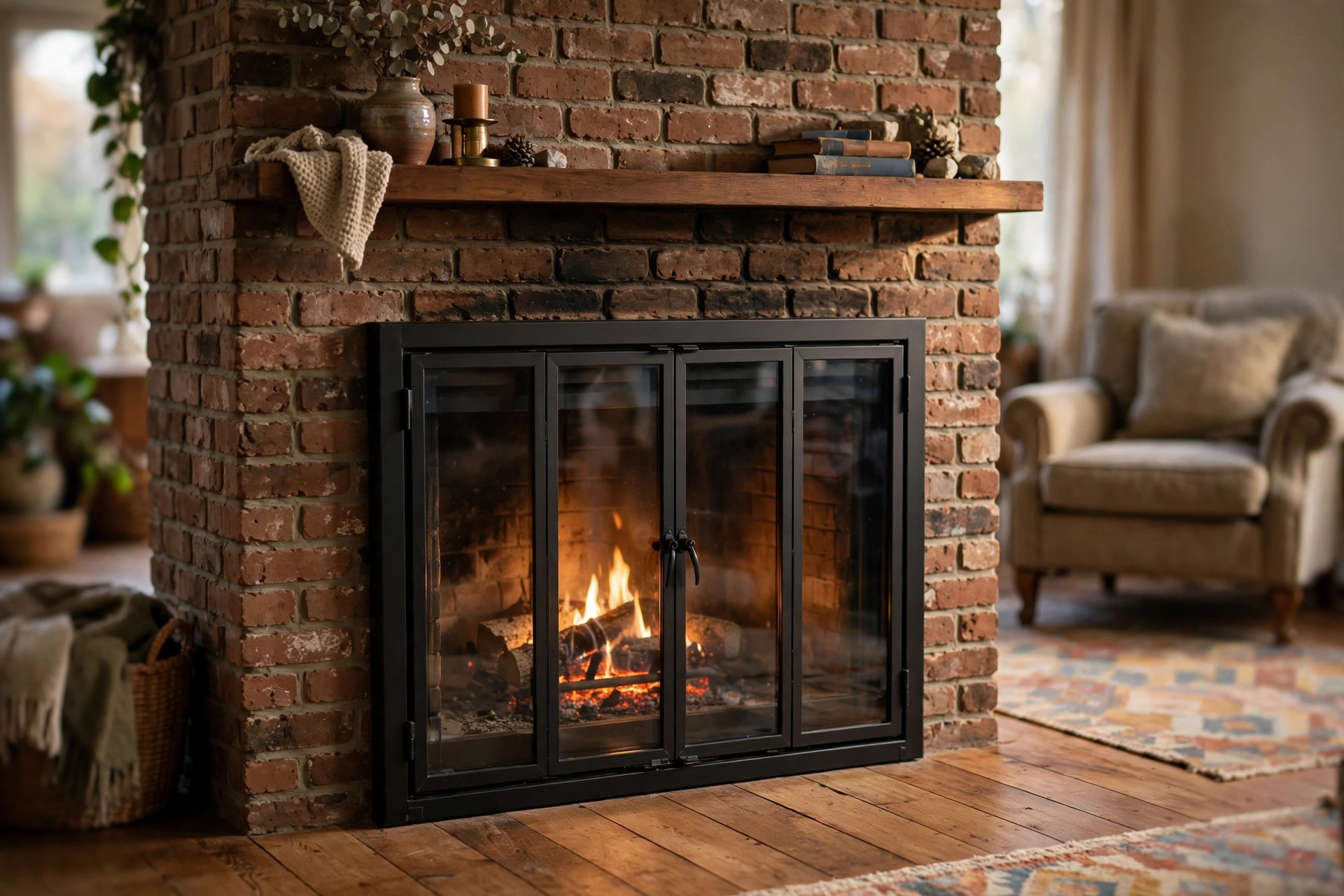

A fireplace is one of the great comforts of an American home. The light of the flames on a winter evening is hard to match. But an open fireplace is also one of the great wasters of heat. When the fire dies down, warm room air rushes up the flue all night. Many families solve this problem with a simple fix: energy efficient fireplace glass doors. When you shop for energy efficient fireplace glass doors with free shipping, you get the best of both worlds. You keep the look of a real fire. You keep far more of the heat in the room where it belongs. And with free shipping, you save money before the doors even arrive at your home.
This guide explains what these doors do, how to choose the right set, what they cost, and how to find real free shipping offers online. It is written for the homeowner who wants honest, plain advice and no sales talk.
Why Glass Doors Matter for Efficiency
An open masonry fireplace can lose a great deal of heat. The flue must stay open while a fire burns, and that is correct. The trouble starts after the fire is out. Hot air rises. If the fireplace is open, the warm air of your living room rises up the chimney for hours. This is called heat loss through the flue.
Glass doors change this picture. When the fire is done, you close the doors. The seal between the doors and the frame slows the draft. Warm air stays in the room. Cold air from outside stays out. The result is lower heating bills and a room that stays warm through the night.
During the burn, doors help too. With the doors closed and the air vents open a little, the fire draws less room air. Many doors have adjustable vents. You can control the draft much as you would on a wood stove. This gives a steadier, more even heat.
There is also safety to think of. Glass doors keep sparks and embers inside the firebox. This protects your rug, your floor, and small children who may come too close. For many families, this safety is the first reason to buy. The energy savings are the second.
Some homeowners also look at other ways to heat with a fireplace. Example can add steady heat with less fuss than wood. But for wood burners, glass doors remain the simplest upgrade.
How to Choose the Right Doors: Energy Efficient Fireplace Glass Doors with Free Shipping
Measure First
Good measuring is the key to a good fit. Most doors are made to fit inside the fireplace opening or to overlap it. You must measure the opening with care.
Take three width measures: top, middle, and bottom of the opening. Take three height measures: left, center, and right. Write them all down. Use the smallest width and the smallest height. This is your safe size.
Many makers sell doors that fit inside the opening. Others sell doors that sit on the face of the fireplace and cover it. Inside-fit doors look neat and close. Overlap doors hide rough edges and fit odd shapes. Both can be energy efficient if the frame seals well.
Types of Glass Doors
Glass doors come in several styles. Flat panel doors have one or two flat panes. They fit most fireplaces and cost less. Bi-fold doors fold back like an accordion. They give a wide view of the fire when open. Cabinet style doors swing open on hinges, like doors on a cabinet. They give the clearest view of all.
The glass itself comes in choices. Clear glass shows the fire best. Tinted glass looks fine and hides soot a little. Ceramic glass handles very high heat and stays clear for years. Tempered glass is strong and safe for normal use. Ask the maker which glass fits your type of fireplace.
Frames come in steel, aluminum, and brass finishes. Black steel is the most common and often the least costly. Brass looks classic but may cost more. The finish does not change the energy savings much. Pick the one that suits your room.
What “Energy Efficient” Really Means
The words “energy efficient” on a box do not have one legal meaning for fireplace doors. There is no federal rating system like the one for furnaces. So you must look at the features yourself.
Look for these signs of a tight door:
– A solid frame with no gaps where it meets the masonry. – Doors that close fully and stay closed. – A damper or vent control that lets you manage the draft. – Heavy glass that fits tight in its frame. – Good weather stripping or gasket material around the edges.
A well-made door keeps air from moving when it is closed. That is the whole secret. Fancy words mean little. A tight seal means much.
If you burn wood often, you may want to look at the whole chimney system too. Example and a good cap help keep the draft right and cut heat loss from the top.
Cost and Price: What to Expect
Prices for fireplace glass doors cover a wide range. Simple flat panel doors can cost from one hundred dollars to three hundred dollars. Better made sets with thicker glass and solid frames run from three hundred to eight hundred dollars. Custom doors for odd sizes or wide fireplaces can cost one thousand dollars or more.
The cost often pays for itself over time. A home that burns wood all winter can save real money on the heating bill. Even a home that burns a few fires a week will feel the difference in the room.
The True Cost of Shipping
Glass doors are heavy and breakable. Shipping can cost fifty to one hundred fifty dollars or more. That is why the words “with free shipping” matter so much. Free shipping can cut ten to twenty percent off the total price.
But read the offer with care. Some sellers say “free shipping” but only on certain sizes. Some send the doors by freight with long wait times. Some count free shipping only to the lower forty-eight states.
The honest sellers state the terms plainly. Look for these details:
– Is free shipping for all sizes or only standard sizes? – How many days does delivery take? – Does the price include delivery to your door or only to the curb? – Is the glass covered against damage in transit?
When you compare two prices, always compare the delivered price. A door that costs two hundred dollars with free shipping beats a door that costs one hundred seventy dollars with fifty dollars of shipping. Do the math before you buy.
Home improvement stores often run free shipping sales on hearth products. The Www.homedepot.com site lists many fireplace door sets and marks which ones ship free. Www.lowes.com does the same, and both let you check stock at local stores too.
Where to Buy: Stores and Online Sellers
You can buy fireplace doors at local hearth shops, at big home improvement stores, and from online sellers. Each path has its points.
A local hearth shop gives you expert help. The staff can measure your fireplace and order the right size. They may install the doors for you. You pay more, but you get peace of mind.
Big box stores give you choice and fair prices. You can see some models on the shelf. Online orders from these stores often ship free over a set dollar amount. Return is easy if the size is wrong.
Online specialty sellers often have the widest range. They sell only hearth products and know them well. Many offer free shipping on every door. Read reviews of the seller before you order. A seller with hundreds of good reviews is a safer bet than one with few.
Maker sites are worth a look too. Www.napoleon.com and Www.heatilator.com make fireplaces and hearth parts. Their sites show how doors fit their own fireplaces. Even if you buy elsewhere, the maker guides teach you what to look for.
For a general look at current hearth trends and buying advice, Www.thespruce.com and Www.thisoldhouse.com both run useful home guides. Www.familyhandyman.com has step-by-step install pieces that show the job in plain terms.
Installation: What a Homeowner Can Do
Many glass door sets are made for do-it-yourself installation. The job takes one to two hours with basic tools. Here is how it usually goes.
1. Clean the fireplace opening. Remove soot, dust, and old sealant from the surfaces where the frame will sit. 2. Dry fit the frame. Set it in the opening without fasteners. Check that it sits level and square. 3. Mark the fastener spots. Most frames use clamps or screws that press against the masonry. 4. Fasten the frame. Tighten with care. Do not over-tighten and crack the frame. 5. Hang the doors. Set each door on its track or hinges. Test that they open and close with ease. 6. Seal the edges. Use the gasket or sealant that came with the set to close small gaps. 7. Test the vents. Open and close the air controls to be sure they move free.
If your fireplace is very old, very large, or has cracks in the masonry, call a professional. A hearth shop or chimney sweep can do the job right. The cost of labor is often one hundred to three hundred dollars.
One word of caution: never drill deep into the firebox walls without knowing what lies behind them. Some fireplaces have hidden gas lines or thin linings. When in doubt, ask a pro.
Care and Upkeep
Glass doors need little care, but a little care goes far. Clean the glass when it cools. Use a damp cloth and a cleaner made for fireplace glass. Do not use oven cleaner or harsh grit. It can scratch the glass.
Check the gaskets once a year. The seal around the frame can wear with heat. If you feel a draft when the doors are closed, the gasket may need to be replaced. Most makers sell replacement gasket kits for a few dollars.
Oil the hinges and tracks once a year with a drop of high-heat oil. Keep the vents free of ash. Brush ash from the tracks so the doors slide smooth.
If the glass cracks, replace it at once. Do not burn with cracked glass. Order the right glass from the maker. Glass made for fireplaces must stand high heat. Normal window glass will not do.
Safety Notes
Glass doors get hot. Teach children not to touch them. A screen or gate adds one more layer of safety for toddlers.
Never close the doors on a roaring fire with the vents shut. Fire needs air. If you starve it of air, you get smoke and creosote in the flue. Burn with the vents open as the maker advises. Close the doors fully only when the fire is low or out.
Keep a working smoke detector and carbon monoxide detector near the fireplace. This is good practice for every home with a fuel-burning heater. The Www.epa.gov offers guidance on safe wood burning and clean air in the home.
Have the chimney cleaned and checked once a year. A chimney sweep can spot cracks, blockages, and worn parts. For advice on energy use in the home, the U.S. Department of Energy publishes plain guides. Consumer Reports tests hearth products and rates them for quality.
FAQ
Do glass doors really save energy?
Yes. An open fireplace lets warm room air escape up the flue for hours after the fire dies. Closed glass doors block most of that draft. The savings show up most in homes that burn wood often through the winter.
Can I burn a fire with the doors closed?
Most makers say yes, with the air vents open. The vents feed air to the fire in a controlled way. Follow the maker guide for your set. When the fire is out or down to coals, close the vents too.
Will the glass get black with soot?
Some soot is normal, most of all with slow burns. Burning dry, seasoned wood cuts soot a great deal. Good air flow helps the glass stay clear. Clean the glass with a proper cleaner when it cools.
How do I know my size?
Measure the opening in three spots for width and three for height. Use the smallest numbers. Most sellers give a size chart. If your opening falls between sizes, call the seller. Many sell custom sizes for a fair price.
Is free shipping really free?
It should mean no shipping charge on your bill. Read the terms. Check that it covers your state and your door size. Compare the delivered price with other sellers. Sometimes a lower price with paid shipping still wins.
Can I install the doors myself?
In most cases, yes. The job needs basic tools and one to two hours. If the fireplace is damaged, oddly shaped, or very old, hire a professional. A chimney sweep or hearth shop can install them for a few hundred dollars.
A Short Final Word
Energy efficient fireplace glass doors are one of the simplest upgrades a homeowner can make. They cut heat loss. They keep sparks in. They make the room warmer and the fire safer. When you find energy efficient fireplace glass doors with free shipping, the deal is even sweeter. Measure with care, compare the delivered price, and buy from a seller with a good name. Your fireplace will thank you all winter long.
If you are dressing up the whole hearth area, Example can give your room a finished look without a full remodel.
Related guides on this site include high efficiency gas log sets for sale, freestanding electric stoves reviews and buying guide, and buy tile fireplace surrounds online in texas.
References
Example. (n.d.). Home and garden information. https://www.example.com/high-efficiency-gas-log-sets-for-sale/ Example. (n.d.). Home and garden information. https://www.example.com/buy-chimney-liners-online-in-california/ Family Handyman. (n.d.). DIY home repair and maintenance. https://www.familyhandyman.com Heatilator. (n.d.). Fireplaces and fireplace products. https://www.heatilator.com Lowe’s. (n.d.). Home improvement products. https://www.lowes.com Napoleon. (n.d.). Fireplaces, grills, and heating products. https://www.napoleon.com The Home Depot. (n.d.). Home improvement products. https://www.homedepot.com The Spruce. (n.d.). Home and garden advice. https://www.thespruce.com This Old House. (n.d.). Home renovation guidance. https://www.thisoldhouse.com U.S. Department of Energy. (n.d.). Energy efficiency and renewable energy. https://www.energy.gov U.S. Environmental Protection Agency. (n.d.). Protecting human health and the environment. https://www.epa.gov Www. (n.d.). Home and garden information. https://www
Was this guide helpful?

About Robert Taylor
The My Garden US editorial team writes practical, in-depth home and garden guides for American homeowners — tested advice, no fluff.
You May Also Like
Affordable Freestanding Electric Stoves With Free Shipping: A Plain Guide
June 22, 2026 0 views
Affordable Firewood Storage Racks With Free Shipping
May 21, 2026 0 views
Smart Gas Fireplace Inserts for Sale: A Plain Guide for American Homes
July 7, 2026 0 views