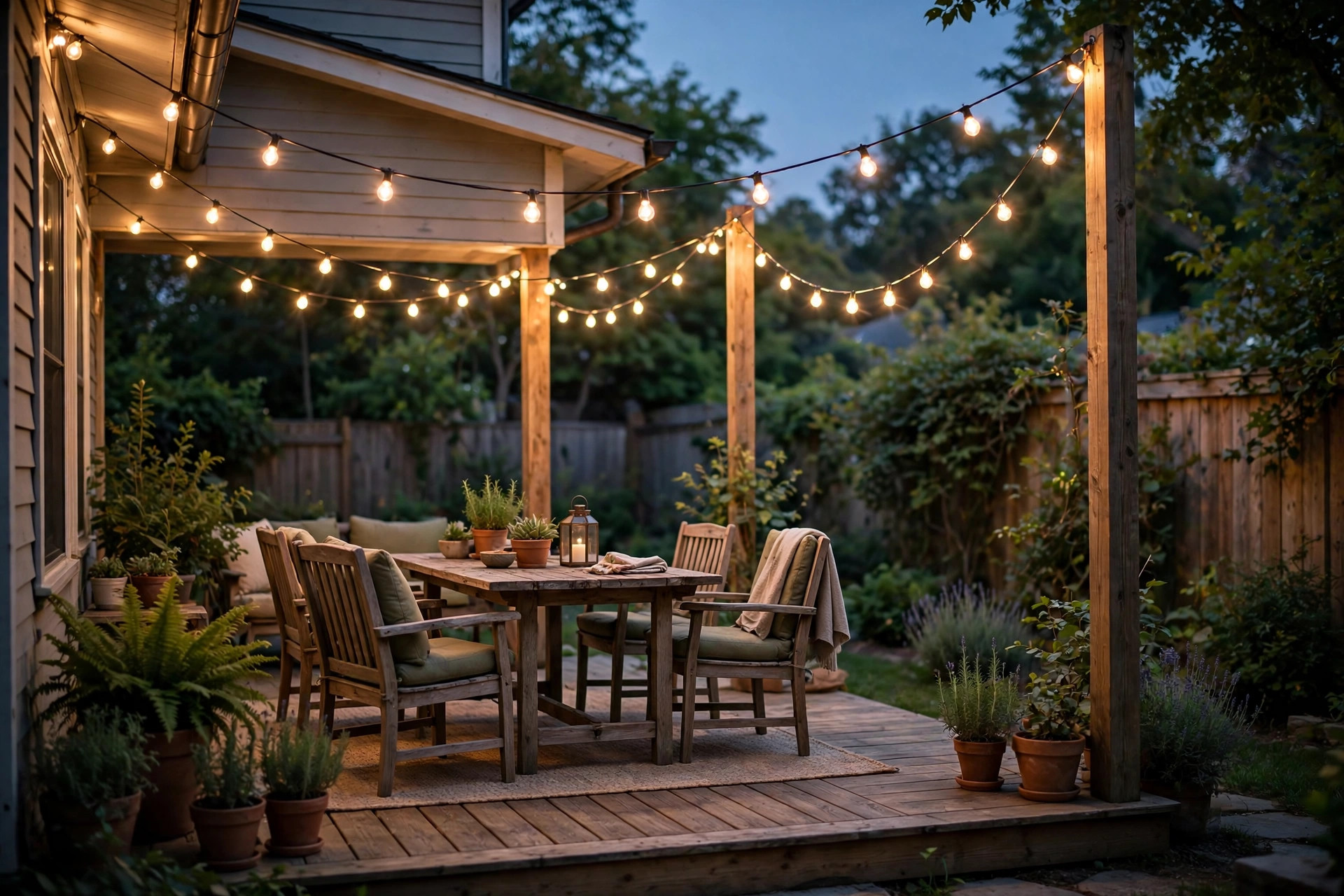

Learning how to hang string lights on patio can change the way you use your outdoor space. A few strands of light turn a plain patio into a place where people want to stay. Supper tastes better under a warm glow. A quiet book reads better. The work is not hard, but it pays to plan first.
Many people buy lights on a whim and hang them in a rush. The result sags in the middle. Bulbs burn out. The string blows down in the first wind. This guide walks through each step in plain terms. You will learn how to hang string lights on patio the right way, from picking the lights to keeping them up through the season.
Why String Lights Work So Well on a Patio
String lights give a kind of light that lamps cannot copy. The bulbs are small and spread out. The light falls soft and even. Harsh corners fade away. The whole patio feels warm and close.
They are also cheap. A good set of outdoor string lights costs less than one strong lamp. They use little power, so the electric bill barely moves.
A patio with string lights gets used more. Families sit out longer. Friends stay for one more cup of coffee. That is the real reason to learn this small skill.
Plan Before You Hang: How to Hang String Lights on Patio
Good work starts with a plan. Stand on your patio and look at it as if you were a guest. Notice where the light should fall. Most people want light over the table or the seats. A dark walkway may also need a strand for safety.
Measure the space. Stretch a tape measure across the patio where you want the lights to run. Write down each length. Add at least ten percent extra for sag and for the drops at the ends. It is better to have a little slack than to pull the string tight.
Count the outlets. Note where they are. You need a grounded outdoor outlet within reach of the strand. If the nearest outlet is far, plan for an outdoor-rated extension cord. Never run an indoor cord outside. Rain and indoor cords do not mix.
Look at your mounting points. Posts, railings, trees, and house walls all work. You need something solid at each end of a run and every ten feet or so in between.
Sketch it on paper. Draw the patio as a box. Mark the outlets and the mounting points. Draw the lines where the strands will run. This small drawing saves trips back to the store.
Choosing the Right Lights
Not all string lights belong outside. This is the most common mistake. Indoor lights look the same in the store, but they cannot take rain or sun. Check the box for the words “outdoor rated” before you buy.
Bulb Type
LED bulbs are the best choice for most patios. They stay cool, use little power, and last for many seasons. Old glass bulbs give a warm look, but they burn hot and break easy. If you love the warm glow of old bulbs, pick LED bulbs marked “warm white.” They copy the color well.
Strand Length
Strands come in set lengths, often 25, 48, or 100 feet. Check the box for the maximum number of strands you can link. Stay under the limit the maker gives.
Bulb Spacing
Bulb spacing changes the look. Bulbs every two feet give a soft, dotted line of light. For a patio, bulbs every two or three feet are usually enough.
Color Temperature
Color is marked in Kelvin. Warm white, near 2700K, feels like candlelight. It suits patios best. Cool white looks like office light. It makes a patio feel cold.
Weather Rating
Look for a rating of IP44 or higher. This mark tells you the lights can take rain and spray. A rating of IP65 means the lights can take strong rain. Anything lower than IP44 is not fit for a patio that sees weather.
For product advice on brands and ratings, Consumer Reports tests outdoor lighting and can help you compare models. Retailers like IKEA and Wayfair stock a wide range of outdoor string lights at fair prices.
What You Will Need
Gather the tools before you start. You will need a sturdy ladder, a tape measure, and a pencil. You will also need screw-in hooks, cup hooks, or eye hooks, depending on your surface. For wood posts, use screw-in eye hooks. For walls, use masonry anchors and eye hooks.
You will need guide wire for long runs. A thin steel cable holds the strand so it does not sag. Cable clamps or zip ties fasten the string to the cable. For trees, use tree straps that wrap the trunk without harming the bark.
You will also need an outdoor extension cord rated for the job and a timer or smart plug if you want the lights to switch on at dusk. A helper makes the work much faster and much safer.
Step-by-Step: How to Hang String Lights on a Patio
Step 1: Install the Mounting Points
Start with the ends. Screw an eye hook into each mounting point. For a wood post, drill a small pilot hole first so the wood does not split. For brick or concrete, drill a hole and set a masonry anchor before the hook.
The hook should point down or to the side. This keeps the strand from slipping off in wind. Place hooks seven to nine feet above the ground.
Step 2: String the Guide Wire
For runs longer than ten feet, run a steel guide wire between the hooks first. Pull it tight. The wire will carry the weight so the strand does not stretch.
Step 3: Attach the Strand
Start at the outlet end. Plug in the first strand and check that every bulb works before you hang it. Fixing a dead bulb on the ground is easy. Fixing it ten feet in the air is not.
Drape the strand along the guide wire. Fasten it with zip ties every two to three feet. Do not pull it tight. A gentle sag, about four to six inches between supports, looks best. It also leaves room for wind to move without snapping the wire.
Step 4: Link Extra Strands
If you need more length, link the next strand to the end of the first. Make the link over a support point. Stay within the maker’s limit for linked strands.
Step 5: Hide the Cord
Run the plug end down a post or wall to the outlet. Use small cable clips to hold it. Keep the plug off the ground so it stays dry.
Step 6: Test at Dusk
Wait for dusk and switch the lights on. Stand back and look. Check the sag. Check that the light falls where you want it. Make small changes now. Move a strand a little. Add a tie where it hangs too low.
Hanging Without Trees or Walls
Some patios have no walls or trees nearby. You can still hang string lights on patio spaces like this. The answer is poles.
Patio string light poles stand in heavy bases or planters. Set two or four around the patio. Fill the planters with concrete or soil for weight. Run the strands from the house to the poles, or from pole to pole.
Freestanding poles need strong bases. A light wind can tip a weak base. Use planters at least two feet wide, or buy bases made for this job.
On a small patio, pair the lights with the right seats. Our guide to the best outdoor sectional sofa for small patios can help you pick furniture that fits under your lights.
Patterns That Look Good
The zigzag is the classic. Run strands back and forth across the patio in a zigzag. It covers the whole space with light and needs the fewest mounting points.
The tent pattern suits square patios. Run all strands from a center point out to the corners. This looks grand over a dining table.
The border pattern runs strands around the edge of the patio. It marks the space and leaves the middle open. This works well when the middle holds a fire pit.
Mix patterns if the patio is large. Use a zigzag over the seats and a border along the walk.
Cost and Price
A basic set of 48-foot outdoor LED string lights costs between 25 and 60 dollars. Guide wire, hooks, and clamps add another 20 to 40 dollars. An outdoor extension cord and a timer add 20 to 30 dollars.
Most patios need two to three strands. A full job for a medium patio runs about 100 to 200 dollars in parts. Poles and planters, if you need them, add 40 to 100 dollars.
Most home owners can do the job in one afternoon. The skill is simple, and the tools are few.
Care and Upkeep
Check the strands each spring before you hang them. Look for cracked wire, loose sockets, and dead bulbs. Replace bulbs with the type the maker names. The wrong bulb can draw too much power.
Clean the bulbs once a year. Dust and grime dim the light. Wipe each bulb with a damp cloth while the power is off. Let them dry before you switch them on.
Take the lights down in hard winters if your area gets ice. Ice adds weight and can snap strands. Coil each strand in a loose loop. Store the coils in a dry box.
Cover or store patio furniture cushions for the off season too. If you are not sure what covers fit your set, read our guide on weatherproof patio furniture covers heavy duty to find the right size and material.
Safety Rules
Safety comes first with outdoor electric work. Follow these rules every time.
Use only outdoor-rated lights, cords, and timers. Indoor parts fail outside and can cause shock or fire.
Keep all plugs and links off the ground. Water pools on patios. A plug in a puddle is a hazard. Mount links over supports, not in mid-air where wind can tear them.
Do not overload outlets. Add up the watts of all linked strands. Stay well under the outlet limit. LED strands draw little power, but old glass-bulb strands draw much more.
Keep strands away from grills, fire pits, and heaters. Heat melts wire coating. Hang lights at least ten feet from open flame.
Turn the lights off when you are away for days. A timer can do this for you. Unplug the strands in storms with strong wind or lightning.
Weatherproofing Your Setup
Rain is normal for patio lights. Outdoor-rated sets handle it. Still, a few steps make the setup last longer.
Point the sockets down. This keeps rain out of the sockets. If your strands hang sideways, adjust the ties so each bulb tilts down.
Seal the links. Where strands join, wrap the link with electrical tape rated for outdoor use. This keeps water out of the connector. Do the same for the link between the strand and the extension cord.
Check the outlet cover. An in-use weatherproof cover closes over the plugged cord. It keeps rain off the plug while the lights run. They cost little and add real safety.
FAQ
How high should string lights be on a patio?
Seven to nine feet above the patio floor is the sweet spot. Lower than seven feet, and tall guests will bump the bulbs. Higher than nine feet, and the light feels weak.
Can I hang string lights on patio without drilling?
Yes. Use heavy planter poles, adhesive hooks rated for outdoor use, or gutter clips along the roof edge. Tree straps wrap trunks without screws. These options leave no holes. They are best for renters. Adhesive hooks hold less weight, so keep runs short and light.
How many strands can I link together?
This depends on the maker. Most LED sets allow three to five strands. The box or the leaflet gives the exact limit. Never pass it.
Do string lights use a lot of electricity?
No. A 48-foot LED strand often uses less than ten watts. Three strands running five hours a night for a month cost less than a dollar in most areas.
Can string lights stay up in winter?
It depends on your climate. In mild areas, outdoor-rated lights can stay up all year. In areas with ice and heavy snow, take them down. Ice is heavy. It can snap guide wires and tear hooks out of posts. If you take them down, coil them loose and store them dry.
What if my patio has no outlet nearby?
Run an outdoor-rated extension cord from the nearest grounded outlet. Keep the cord off walkways to avoid trips. For a neat look, run it along walls or under the patio edge. Battery and solar strands exist, but they give weak light and need daily sun to charge. A wired set is brighter and more sure.
Do I need a timer for patio string lights?
A timer is not needed, but it is a fine idea. It switches the lights on at dusk and off at bedtime. Smart plugs do the same job and let you control the lights from a phone.
Finishing Touches
Once the lights are up, finish the space. Add soft seats under the light. A small table holds drinks. Plants in pots break up the lines of the patio. If you like a gentle sway in the evening, a porch swing for two pairs well with string lights and needs only a strong beam or frame.
Step back at dusk. Look at the whole patio. Small moves make a big change. Then sit down and enjoy it. That is the reward of knowing how to hang string lights on patio.
Final Word
Hanging string lights on a patio is a small job with a big payoff. Plan the lines. Buy outdoor-rated lights. Hang them on solid supports with a gentle sag. Keep the electric parts dry and within their limits. Do these things, and your patio will glow warm all summer long.
References
Consumer Reports. (n.d.). Product reviews and ratings. https://www.consumerreports.org IKEA. (n.d.). Home furnishings. https://www.ikea.com Wayfair. (n.d.). Home goods and outdoor furniture. https://www.wayfair.com
Was this guide helpful?

About Robert Taylor
The My Garden US editorial team writes practical, in-depth home and garden guides for American homeowners — tested advice, no fluff.
You May Also Like
Weatherproof Patio Furniture Covers: Heavy-Duty Protection for Every Season
September 8, 2026 0 views
Best Eucalyptus Outdoor Furniture Reviews: A Plain Guide for Buyers
May 27, 2026 0 views
Outdoor Kitchen Cart with Wheels Reviews: What to Know Before You Buy
May 19, 2026 0 views