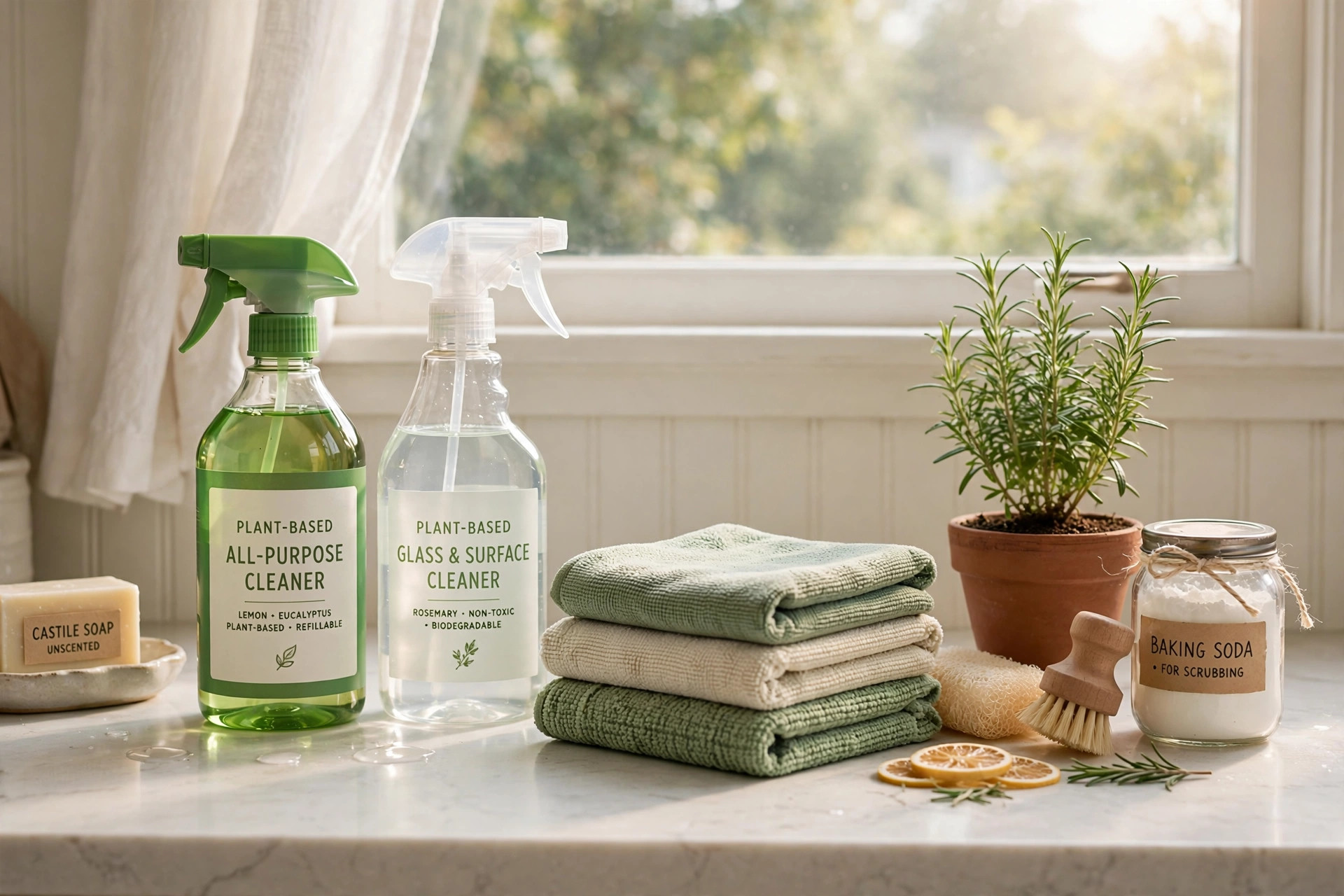

Many families today want a clean home without harsh chemicals. The shelves are full of green bottles and bold claims. This eco friendly cleaning supplies reviews and buying guide will help you sort the truth from the sales talk. It will show you how to read a label, what to look for, what each kind of product does, and what a fair price looks like. It is written in plain words. By the end, you will know how to buy with care.
Why It Matters
The air inside a home can hold more dust and fumes than the air outside. Strong cleaners can add to that load. They can leave a sharp smell in the air long after the work is done. People with asthma or skin trouble often feel it first. Children and pets play close to the floor, where wet cleaners sit. A safer product lowers these risks. It does not mean the home is less clean. It means the home is clean in a kinder way.
The old way of cleaning used harsh acids and strong scents to cover dirt. The new way asks a simple question. Does this product do the job without harm? Many do. Plant-based soaps, oxygen cleaners, and plain steam can match old-style cleaners in most homes. The U.S. Environmental Protection Agency notes that many household products release fumes that add to indoor air trouble. Choosing a cleaner with a clear label is a small step with real gain.
Waste matters too. Most green brands now use bottles made from recycled plastic. Some sell refills that cut waste to almost nothing. A small change in what you buy can mean a large change in what you throw away over a year.
How to Choose: What to Look For on the Label: Eco Friendly Cleaning Supplies Reviews and Buying Guide
Start with the full list of parts. A good label names its parts in plain words. Be wary of a label that says little. Words like “natural” and “green” are not ruled by law in this trade. Any maker can print them. Look for facts, not flags.
Third-party marks carry weight. The EPA runs a Safer Choice mark for products that pass a set of safety tests. You can read about it at Safer Choice. Other honest marks come from the Leaping Bunny list for goods not tested on animals. A mark from a known group is worth more than a leaf printed by the maker.
Read the use notes. A good product tells you how much to use. It tells you which surfaces are safe. It tells you how long to let it sit. Short, clear notes show that the maker has tested the product in real homes.
Smell is a guide. A strong pine or lemon scent often comes from added oils or fake scents. A light, clean smell is fine. A product that burns your nose is not fine. Vent the room in any case. Open a window and let fresh air in while you work.
Price is a guide too. Most plant-based all-purpose cleaners cost a few dollars more than the cheapest brands. A big price jump does not always mean a better product. It may mean a bigger ad budget. Compare the price per ounce, not the price per bottle.
Types of Eco Friendly Cleaning Supplies
All-Purpose Cleaners
These are the workhorses of the home. A good one cuts grease on counters, sinks, and tile. Plant-based all-purpose cleaners use coconut or corn soaps. They work well for daily messes. They are not the best choice for baked-on oven grease. For that, you may need a stronger paste or a steam tool.
Look for a spray that lists its parts. Try it on a small spot first. Some stone counters do not like acid cleaners, even mild ones. A neutral-pH spray is the safest pick for mixed surfaces.
Bathroom Cleaners
Bathrooms grow mold and soap scum. Green bathroom cleaners use citric acid or hydrogen peroxide to fight them. They work more slowly than bleach. Give them time. Spray, wait five minutes, then scrub. The extra wait is the price of a gentler product.
Toilet bowl cleaners made with plant acids do a fair job on stains. They will not bleach the bowl white in one pass. With weekly use, they keep it clean.
Floor and Carpet Cleaners
Hard floors do well with simple plant-based mops and soaps. A common question is how steam mops for tile floors stack up. Steam mops use only heat and water. They kill many germs without any soap at all. They are a true green choice. They are not right for wood or waxed floors, where steam can cause harm.
For carpets, look for cleaners that skip strong scents. Test any new cleaner in a hidden corner. Some plant soaps can leave a film if you use too much. Less is more.
Laundry and Dish Products
Green laundry soap now comes in sheets, strips, and refills. They cut plastic waste. They work well in warm water. Cold water washes may need an extra rinse for heavy soil.
Dish soaps made from plant oils cut grease well. Dishwasher pods with oxygen cleaners handle most loads. Skip the rinse-aid pods with strong dyes if you want a simple product.
Cost and Price: What a Fair Deal Looks Like
Green cleaners cost more than the cheapest brands. They cost less than many fear. A plant-based all-purpose spray often runs three to seven dollars for a large bottle. That is close to what Consumer Reports finds in its regular tests of cleaners: the price gap between basic and green lines is small in most stores.
Concentrates save money. A bottle of concentrate can make four to six bottles of spray. The math is simple. A ten-dollar concentrate that makes five bottles costs two dollars per bottle. That beats most ready-made sprays.
Refill stations are new in many towns. You bring your own bottle. You pay by the ounce. The price is often lower than a new bottle. The waste is almost zero.
Watch the store brands. Many large stores now sell their own green lines. These often cost less than the big green brands. The labels are plain, but the parts are often the same. Read the parts list and compare.
Bulk clubs can be a good buy if you clean a lot. A large jug of plant-based floor soap can last a year in a small home. Do not buy more than you will use in a year. Old soap can lose strength.
Care and Upkeep of Your Supplies
Green cleaners need the same care as any cleaner. Keep them cool and dry. Keep them out of the sun. Heat can break down plant soaps faster than it breaks down old-style soaps.
Do not mix products. Vinegar and peroxide cleaners each work well alone. Mixed together, they lose strength and can make fumes. Follow the label. One product at a time is the rule.
Replace old bottles. Most cleaners work best within a year of opening. Write the date on the bottle when you open it. This is a small habit that saves waste.
Tools need care too. A set of microfiber cleaning cloth sets can replace many rolls of paper towels. Wash them in hot water without fabric softener. Softener coats the fibers and ruins their grip. Hang them to dry. A good set can last for years.
Keep spray tops clean. A clogged sprayer wastes product and tests your patience. Rinse the top with warm water now and then. Store bottles upright so the seals stay tight.
Safety Notes
Green does not mean harmless. Any cleaner can harm eyes or skin in the wrong hands. Keep all cleaners away from children and pets. Lock the cabinet under the sink.
Read the first-aid notes on the back of the bottle. Know what to do if a product splashes in the eyes. Keep the number for poison help near the phone. In the United States, you can also find plain safety facts at ENERGY STAR, which covers green buying for the home.
Wear gloves when you scrub for a long time. Even mild soaps can dry the skin. Vent the room. Open a window or run a fan. This is the oldest safety rule in cleaning, and it still works.
Store products in their first bottles. Do not pour cleaners into food jars or cups. A plain spray bottle is fine if you mark it with the name of the product and the date you filled it.
Watch for fake claims. A bottle that says “non-toxic” but lists no parts is not giving you facts. A bottle with a full parts list and a third-party mark is. Trust the label that says the most.
For deep advice on keeping a home in good shape, the Family Handyman and This Old House sites both carry plain guides on safe cleaning and home care.
Reviews: How to Read Them Like a Pro
Online reviews can help or harm. Read a mix of good and bad notes. Look for reviews that name the surface and the stain. “It cleaned my sink” is thin. “It cut the grease on my gas stove in two passes” is useful.
Watch the date. Old reviews may speak of an old mix. Makers change parts now and then. New reviews speak of what is on the shelf today.
Look at how many reviews there are. A product with five glowing notes may be new. A product with two thousand notes shows a real track record. The Good Housekeeping test labs and Bob Vila both run hands-on tests you can trust more than single-buyer notes.
Check what the bad reviews say. If ten people say the sprayer broke, the sprayer is weak. If ten people say it did not cut oven grease, that is a limit of the product, not a flaw. Know what you need it to do.
Be wary of paid reviews. A review that reads like an ad often is one. Real reviews have real flaws. They name what did not work as well as what did.
FAQ
Do eco friendly cleaners really work as well as strong ones?
For most daily jobs, yes. Plant-based all-purpose cleaners, citric acid sprays, and steam tools handle counters, sinks, floors, and glass. They work more slowly on baked-on grease and heavy mold. Give them more time to sit. For the worst jobs, a paste of baking soda and water can help.
What does the Safer Choice label mean?
It means the EPA has checked the parts and the mix against a set of safety tests. The product passed. It does not mean the product is free of all risk. It means it is safer than most like it. You can read the rules at the EPA Safer Choice site linked above.
Are homemade cleaners like vinegar and baking soda enough?
They do a lot. Vinegar cuts light scale. Baking soda scrubs without scratching. But they are not strong germ killers. They also do not work on all surfaces. Vinegar can harm stone counters. For a home with small children or sick family members, a tested product may be the better pick.
How can I save money on green cleaners?
Buy concentrates. Use refill stations. Wash and reuse microfiber cloths instead of paper towels. Many homes cut their cleaner bill in half with these three steps. Also look at store-brand green lines. They often match big brands at a lower price.
Are green cleaners safe for pets?
Most are safer than old-style cleaners. Pets still should not drink them. Rinse food bowls after cleaning. Let floors dry before pets walk on them. For odor trouble, many pet owners pair green cleaners with budget friendly pet odor eliminator sprays made without harsh scents. When in doubt, ask your vet.
Do I need different cleaners for each room?
Not many. One good all-purpose spray, one bathroom cleaner, and one floor soap cover most homes. A eco friendly HEPA vacuum cleaner with a sealed filter can cut dust more than any spray. Simple beats a crowded cabinet.
A Short Final Word
Buying green cleaners is not hard. Read the parts list. Trust third-party marks more than bold claims. Try one product at a time. Give it a fair test. Keep what works and drop what does not. For more home ideas in plain words, The Spruce and Wirecutter both keep tested buying guides you can read at your own pace.
A clean home should feel good to live in. The right cleaners help you get there without harsh fumes or high waste. Start small, buy with care, and let your own tests guide you.
References
Bob Vila. (n.d.). Home improvement advice. https://www.bobvila.com Consumer Reports. (n.d.). Product reviews and ratings. https://www.consumerreports.org ENERGY STAR. (n.d.). Energy efficient products. https://www.energystar.gov Family Handyman. (n.d.). DIY home repair and maintenance. https://www.familyhandyman.com Good Housekeeping. (n.d.). Product reviews and home advice. https://www.goodhousekeeping.com The Spruce. (n.d.). Home and garden advice. https://www.thespruce.com This Old House. (n.d.). Home renovation guidance. https://www.thisoldhouse.com U.S. Environmental Protection Agency. (n.d.). Protecting human health and the environment. https://www.epa.gov U.S. Environmental Protection Agency. (n.d.). Safer Choice product criteria. https://www.saferchoice.epa.gov Wirecutter. (n.d.). Product reviews from The New York Times. https://www.nytimes.com/wirecutter
Was this guide helpful?

About James Carter
The My Garden US editorial team writes practical, in-depth home and garden guides for American homeowners — tested advice, no fluff.
You May Also Like

Chimney Cleaning Brushes Price Comparison USA: A Buyer’s Guide
May 17, 2026 0 views
Robot Vacuum Cleaners Price Comparison USA: A Practical Buyer’s Guide
August 5, 2026 0 views
Best Antibacterial Disinfectant Sprays for Humid Climates
August 20, 2026 0 views