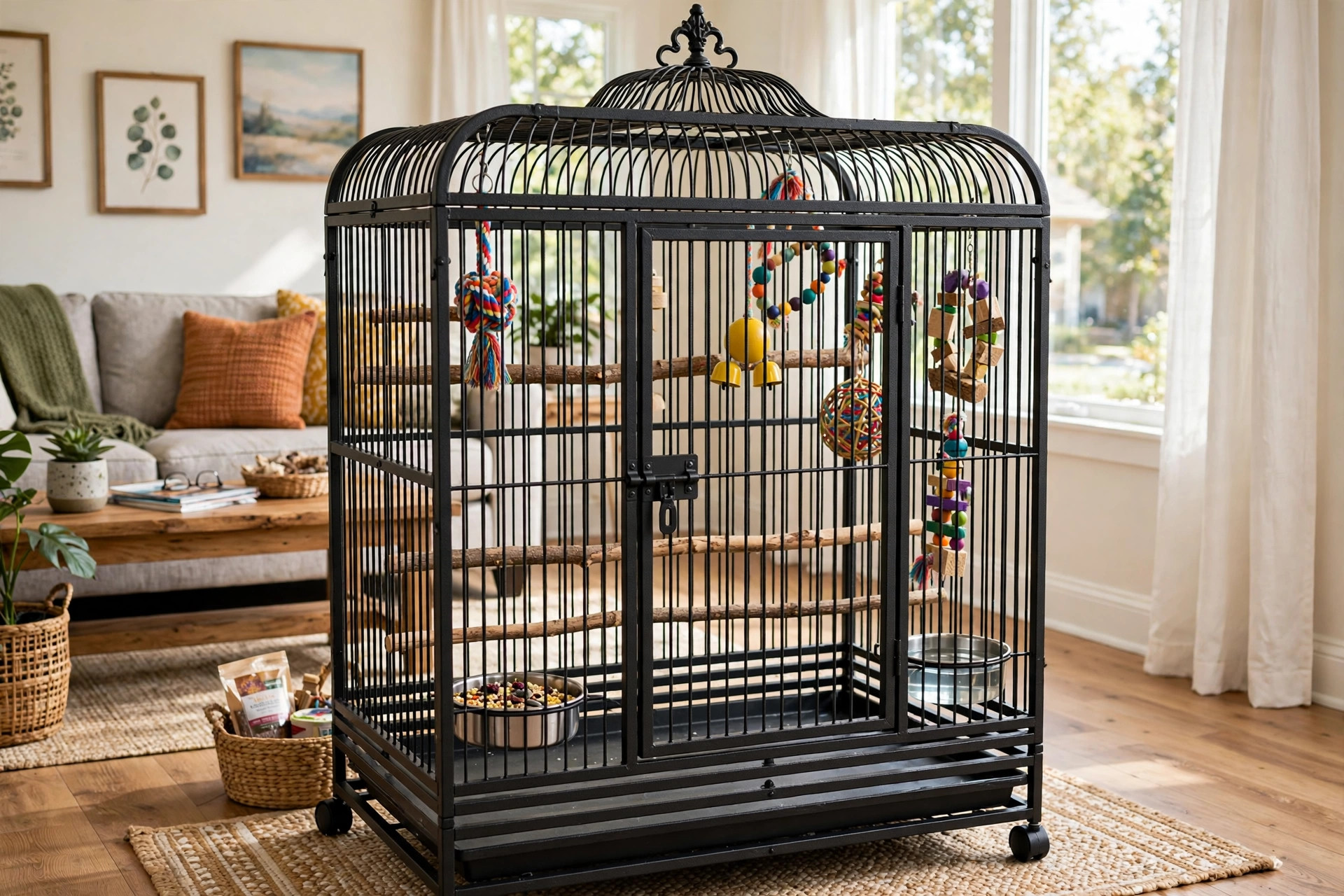

A bird cage large for parrots and conures is one of the most important purchases a bird owner will ever make. The cage is the bird’s home. It is where the bird eats, sleeps, plays, and spends much of its life. A cage that is too small can cause stress, feather plucking, and bad health. A cage that is the right size helps the bird stay active, calm, and happy. This guide explains in plain words how to choose the best cage for medium parrots and conures.
Why a Large Cage Matters
Parrots and conures are active birds. In the wild, they fly long distances each day. They climb, chew, and explore. A cage cannot match the wild, but a large cage comes much closer to their natural needs than a small one.
Size is the first rule of bird care. A large cage lets the bird stretch its wings fully. It gives room for several perches at different heights. It leaves space for toys, food dishes, and water bowls without crowding. When the bird has space, it moves more. Movement builds strong muscles and keeps weight under control.
Small cages cause real harm. Birds in cramped cages often develop bad habits. They may pluck their own feathers. They may scream more. They may sit still for too long, which weakens their body. Many of these problems improve once the bird moves into a larger cage. That is why a bird cage large for parrots and conures is worth the money.
New owners often ask if a large cage will make taming harder. The answer is no. A bird that feels safe in a roomy home is easier to work with than a stressed bird in a tight box. Large cages also make daily life simpler for the owner. Food dishes, toys, and cleaning tools fit with room to spare.
What to Look For in a Large Bird Cage: Bird Cage Large for Parrots and Conures
Bar Spacing
Bar spacing is the distance between the metal bars. This is a safety matter. If the bars are too far apart, the bird can stick its head through and get stuck. If they are too close, the bird cannot climb well and the cage feels closed in.
For conures and similar small parrots, the bar spacing should be about half an inch to five eighths of an inch. For larger parrots such as African greys and Amazons, five eighths to three quarters of an inch works well. Always measure before you buy. Numbers on the box can be wrong.
Bar Thickness
Parrots have strong beaks. Conures chew for fun. The bars must be thick enough to stand up to daily chewing. Thin wire will bend, break, or lose its coating. Look for welded steel bars. Good cages use wire of at least 3 to 4 millimeters in thickness for medium parrots.
Safe Materials and Coating
The best cages use powder-coated steel. The powder coating is baked on. It does not chip easily. It also hides sharp edges. Avoid cages with paint that smells strong. Some cheap paints contain lead or zinc, which are poison to birds. Stainless steel cages are the safest choice, but they cost much more.
Doors and Latches
A good cage has at least one large front door. The owner needs to reach in for cleaning and to handle the bird. Some cages add a second smaller door for nest boxes or extra perches. The latches must be bird-proof. Parrots are clever. They learn to open simple locks. Look for twist locks or bolt locks that a beak cannot open.
Size Guide
As a rule, the cage should be at least one and a half times the bird’s wingspan in width. For a conure with a wingspan near 18 inches, look for a cage at least 24 to 32 inches wide. For a medium parrot, 32 to 40 inches wide is better. Height should be at least 36 inches. Depth of 24 inches or more gives room for perches and toys. Bigger is always better if your home has the space.
Types of Large Bird Cages
Dome Top Cages
Dome top cages have a curved roof. The curve adds headroom. It also gives the bird a high point to perch on. Many dome top models open at the top, which creates a play area. This type is popular for conures.
Play Top Cages
Play top cages have a flat area on top with built-in perches and cup holders. The bird can sit on top of the cage for out-of-cage time. This is a nice extra for owners who keep the cage open during the day. Make sure the play top is sturdy and easy to clean.
Double Cages and Flight Cages
Flight cages are long rather than tall. They give the bird room to fly from perch to perch inside the cage. A flight cage is the closest thing to free flight at home. Some large cages come as double units with a divider in the middle. The divider can split the cage for two birds or come out to make one huge space.
Corner Cages
Corner cages fit into a corner of the room. They save floor space while still giving the bird plenty of room. Check the inside shape. Some corner cages waste space in the corners. Round out the choice by measuring the actual floor space the bird gets.
Cost and Price
A bird cage large for parrots and conures costs more than a small cage, but it lasts for years. A basic large cage for conures starts near one hundred dollars. A well-built model with safe coating and strong latches often runs between two hundred and four hundred dollars. Premium cages and stainless steel models can reach one thousand dollars or more.
Do not buy on price alone. A cheap cage that rusts or breaks within a year costs more in the long run. Read the details on bar thickness and coating. Check what other owners say about the locks and the doors. A solid mid-range cage is often the best value. For ideas on safe cage setups and bird care basics, see the pet guides at PetMD and the care sheets at Chewy.
Care and Upkeep
A large cage needs regular cleaning. Change the paper or liner at the bottom of the cage each day. Wash food and water dishes daily with warm water. Wipe down perches and bars once a week to remove droppings and dust. Once a month, take the cage apart for a deep clean if the design allows it.
Use bird-safe cleaners. Plain white vinegar mixed with water works well for most jobs. Rinse well and let the cage dry fully before the bird goes back in. Never use strong cleaners with bleach or ammonia near the bird. Fumes from many household cleaners can harm a bird’s lungs. The ASPCA offers helpful guidance on safe home products for pets.
Place the cage in a bright part of the room but out of direct drafts. Birds need ten to twelve hours of sleep each night. A cage cover at night helps them rest. During the day, let the bird out of the cage for supervised time when you can. Even the largest cage is not a full day home. Related housing guides, such as the best dog playpen and the outdoor rabbit hutch pages, cover similar shelter basics for other pets.
Safety Tips
Safety starts with the cage itself. Check the bars often for rust, chips, or bent spots. Rust can poison a bird. Broken welds can trap a toe or a beak. Replace perches that are worn smooth. Smooth perches can cause foot sores.
Keep the cage away from the kitchen. Cooking fumes are a danger to birds. Self-cleaning ovens and non-stick pans release fumes that can kill a bird in minutes. Scented candles, air fresheners, and strong perfumes are also risky. Keep the bird’s room free of smoke of any kind.
Secure the cage on a stable stand. A large cage can tip if a child or a large pet knocks into it. Lock the cage doors when you leave the room. Make sure all family members know the rules: doors stay shut unless an adult is present. For general bird care advice, the bird articles at The Spruce Pets and the pet care library at Petco are worth a read.
Frequently Asked Questions
How large should a cage be for a conure?
A single conure does well in a cage at least 24 inches wide, 24 inches deep, and 30 inches tall. Larger is always better. If you keep two conures, go bigger still. A bird cage large for parrots and conures of this size gives the bird room to climb and play without feeling trapped.
Can two birds share one large cage?
Two birds of the same species can share a large cage if they get along. Introduce them slowly. Watch for signs of fighting over food or perches. Some pairs need separate sleeping areas. A double cage with a removable divider is a flexible choice for two birds.
Is a stainless steel cage worth the cost?
Stainless steel is the safest and longest-lasting cage material. It will not rust. It has no coating to chip or poison the bird. It is also easy to clean. The cost is high, but the cage can last the whole life of the bird. For owners who plan to keep parrots for decades, it is a sound buy.
How many toys should go in the cage?
Four to six toys are enough for most parrots. Use different types: chewing toys, foraging toys, and puzzle toys. Rotate the toys every few weeks to keep the bird interested. Do not crowd the cage. The bird still needs open space to move and stretch.
Should the cage be covered at night?
Yes. Covering the cage at night signals sleep time. It blocks light and cuts noise. Use a cover made for bird cages or a plain breathable cloth. Leave a small gap for air flow. Keep the room dark and quiet for ten to twelve hours each night.
Where is the best place for the cage in the house?
Put the cage against a wall in a room where the family spends time. Birds are social. They like to watch daily life. Keep the cage away from windows that get hot sun, away from doors that swing open in winter, and away from the kitchen. For more home setup ideas, browse the pet supplies at Home Depot and the small pet section at Walmart.
A Final Word
Choosing a bird cage large for parrots and conures comes down to three things: space, safety, and build quality. Give the bird room to move. Make sure the bars, spacing, and coating are safe. Buy a cage that will last. Set it up in a bright, social part of the home, keep it clean, and fill it with toys that keep a clever mind busy. A good cage is a gift to the bird. It shows in the bird’s feathers, its voice, and its calm. For ongoing tips on water, food, and daily care, see the pet health pages at PetSmart and the bird care resources at the American Kennel Club. You may also enjoy our related guides on the best pet water fountain for multi-pet homes.
References
American Kennel Club. (n.d.). Dog care and training resources. https://www.akc.org ASPCA. (n.d.). Pet care and animal welfare resources. https://www.aspca.org Chewy. (n.d.). Pet supplies. https://www.chewy.com Petco. (n.d.). Pet supplies and services. https://www.petco.com PetMD. (n.d.). Pet health information. https://www.petmd.com PetSmart. (n.d.). Pet supplies and services. https://www.petsmart.com The Home Depot. (n.d.). Home improvement products. https://www.homedepot.com The Spruce Pets. (n.d.). Pet care guides and product reviews. https://www.thesprucepets.com Walmart. (n.d.). Everyday low prices. https://www.walmart.com
Was this guide helpful?

About Emily Rodriguez
The My Garden US editorial team writes practical, in-depth home and garden guides for American homeowners — tested advice, no fluff.
You May Also Like
Best Slow Feeder Bowl for Cats Whisker Friendly: A Complete Guide
January 13, 2026 0 views
Pet Gate with Walk Through Door for Kitchen: A Complete Guide
May 1, 2026 0 views
Best Orthopedic Cat Bed for Senior Cats: A Guide to Comfort for Older Felines
January 7, 2026 0 views