
Most home buyers never ask about the bathroom fan. They ask about tile and light and the price of the vanity. Then they move in, run a hot shower, and learn the truth. The old fan roars like a small truck. This is why best quiet bathroom exhaust fan reviews USA searches have grown so common. Homeowners want the moisture gone and the noise gone too. Makers now build fans so silent that many owners check the grille to see if the fan is even on. This guide reads the fine print for you. It explains sone ratings, the numbers that matter, the types on the market, what fair prices look like, and how to keep a quiet fan quiet for years.
Why a Quiet Bath Fan Matters
A bath fan has one job. It must pull damp air out of the room before that damp air can hurt the house. Every hot shower can put a quart of water vapor into the air of a small bath. If the fan is too weak or too loud to use, that vapor settles on walls, on the ceiling, and inside the wall cavity. Over months it feeds mold. It loosens paint. It can rot trim and warp door frames. A good fan stops all of that. A quiet fan does it while people actually keep it switched on.
Noise is the enemy of use. Loud fans get turned off fast. A fan that runs at 4.0 sones sounds harsh in a small room. A fan at 0.5 sones hums like a whisper. The quieter the unit, the longer the shower steam gets cleared. Longer clear time means drier walls and cleaner air.
There is a health side too. Mold spores can bother people with asthma and allergies. Quiet fans that run long enough cut down on the damp corners where mold starts. Energy experts also note that modern quiet fans often use far less power than the old builder-grade units they replace.
What to Look For When You Choose: Best Quiet Bathroom Exhaust Fan Reviews Usa
Fan boxes print big letters. The letters often lie by omission. The numbers do not lie. Learn four numbers and you can read any fan like a reviewer does.
The Sone Rating
Sones measure loudness as the ear hears it. A rating of 0.3 to 0.5 is near silent. A rating of 1.0 is soft but you can hear it. A rating of 1.5 is plain background noise. Anything above 2.0 is loud for a bath. Anything above 4.0 belongs in a factory, not a bathroom. When you read the best quiet bathroom exhaust fan reviews USA shoppers write, nearly every happy review starts with a sone number under 1.0. The test room matters too. Makers test in a lab. Real bathrooms have hard tile that bounces sound. So treat the printed sone as a best case. Pick a fan rated at 0.8 or less and it will still be calm in a real tile bath.
CFM, the Airflow Number
CFM stands for cubic feet per minute. It says how much air the fan moves. The old rule is simple. For a bath under one hundred square feet, you need one CFM for each square foot. A fifty square foot bath needs a fifty CFM fan. Big baths, tall ceilings, jetted tubs, and separate shower rooms need more. When in doubt, size up a little. An oversized quiet fan on a humidistat is better than an undersized loud one that never clears the steam.
Energy Star and Power Draw
An Energy Star label tells you the fan meets tested limits for both noise and power use. It is a quick trust mark when the box claims are bold. Check the wattage too. Older shaded-pole motors can draw thirty or forty watts. Newer quiet models with DC motors draw as little as five to eight watts at low speed. The savings are small per hour, but the fan runs thousands of hours a year in a busy home.
Humidity Sensor and Controls
A humidity sensor fan turns itself on when the air gets damp and off when the room dries. This is the single best feature for a quiet fan. You never forget to run it. You never let it run all night by mistake. Some fans pair the sensor with a timer or a motion switch. Timer switches are the cheap backup. A twenty or thirty minute delay switch costs little and does much of the same job.
Duct Size and Fit
Most quiet bath fans use four-inch or six-inch round ducts. A bigger duct lets air leave with less strain, which keeps noise down. Long ducts with many bends force the motor to work harder. That adds noise and cuts airflow. If your bath has a long duct run to the roof, a fan rated for high static pressure is worth the money. Also check the housing size. Many makers design new quiet fans to fit the same ceiling hole as old loud units. That makes replacement a one afternoon job.
Types of Quiet Bathroom Exhaust Fans
Standard Ceiling Fans
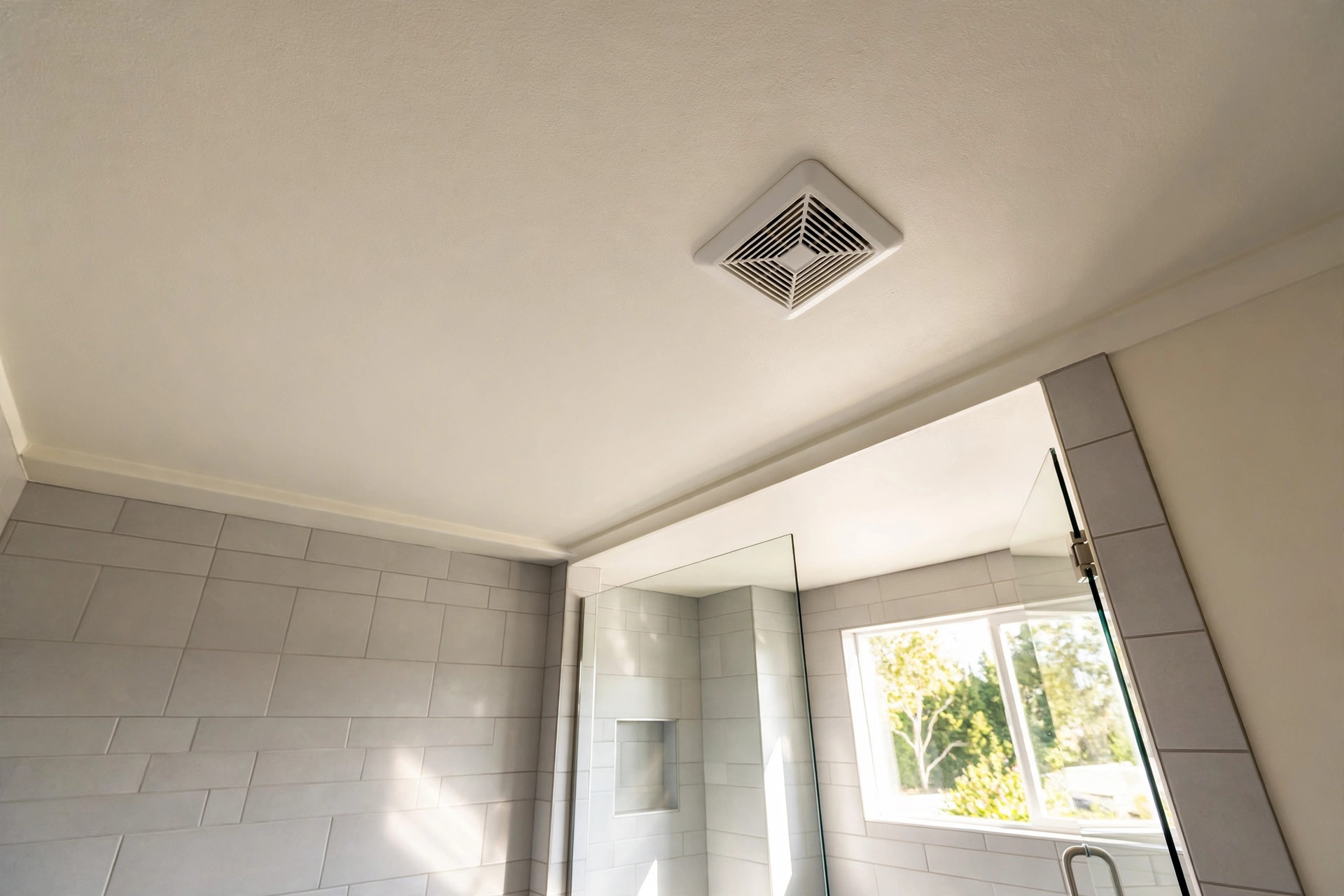
These are the square grilles most baths have. The quiet class starts near fifty CFM and one sone and gets better from there. Top models move eighty to one hundred and ten CFM at under half a sone. They cost more than builder units but far less than custom work. For most homes this type is the answer. If you are comparing a bathroom exhaust fan installation cost usa plan, the standard ceiling type is the cheapest to mount because it uses the opening that is already there.
Fan and Light Combos
These put the exhaust fan and an overhead light in one housing. They save ceiling space in small baths. The good ones are just as quiet as plain fans. Newer ones use LED lamps that run cool and last years.
Fan and Heater Combos
These add a small electric heater to the fan housing. On cold mornings they take the chill out of the air while the fan clears the steam. They need their own circuit or a heavy wire because heaters draw real current. They are loved in cold states and in basement baths. They cost more to buy and more to run, but a quiet model can still keep noise under one sone when only the fan runs.
Inline and Remote Fans
An inline fan sits far down the duct, often in the attic. Only a grille shows in the bath. Because the motor lives away from the room, the noise in the room drops to almost nothing. These cost more and need more duct work, but for master baths and noise-sensitive owners they are the quietest choice of all. Readers who also like the best inline duct fan reviews 2026 usa will find this type discussed there in more detail.
Humidity Sensor Models
Sensor fans watch the air and act on their own. They are popular in rental homes and family baths where nobody remembers the switch. The quietest sensor models hold sone ratings under one. Note that steam from a hot shower can fool a sensor into short cycles. Better models let you set the humidity trigger point so the fan runs long enough to do the job. A bathroom fan with humidity sensor reviews usa roundup can help you compare trigger ranges and delay times.
What Quiet Models Cost
Prices run wide. A basic quiet ceiling fan at fifty to eighty CFM often sells between sixty and one hundred and twenty dollars. A mid-range model with a humidity sensor or an LED light runs from one hundred and twenty to two hundred and twenty dollars. High-end quiet fans, heater combos, and inline kits can reach two hundred and fifty to four hundred and fifty dollars. Labor is the other half of the bill. A straight swap into an existing wired hole and duct may cost one hundred and fifty to three hundred dollars from an electrician. A new install with fresh wiring, a roof vent, and attic work can cost five hundred to nine hundred dollars or more.
Do not judge a fan by price alone. A ninety-dollar fan at 0.3 sones can beat a two-hundred-dollar fan at 2.5 sones on the only test that matters. Read the sone number first. Then read the CFM. Then read the warranty. Longer warranties on the motor often mark better-built units. Five-year motor warranties are common on good quiet fans.
Running cost is small. A modern quiet fan that draws eight watts costs only a few dollars a year to run an hour a day. The U.S. Department of Energy notes that ventilation is part of a healthy home plan, and the Energy Star program lists certified fans that meet strict noise and efficiency limits.
Care and Upkeep
A quiet fan stays quiet when it stays clean. Dust is the slow killer. It coats the blades, the motor, and the grille. Coated blades move less air and hum louder. Twice a year, turn off the breaker, pop off the grille, and wash it in warm soapy water. Vacuum the blade wheel with a soft brush tool. Wipe the motor housing with a dry cloth. Never spray water into the motor.
Check the duct once a year from the attic side if you can reach it. Look for crushed flex duct, loose joints, and disconnected runs. A disconnected duct blows damp air into the attic. That is how roof sheathing rots. Tape joints with metal foil tape, not cloth duct tape. Make sure the outside vent cap opens freely and that its screen is not packed with lint.
Safety
Electricity and damp air are a poor mix. Always cut power at the breaker before you touch a fan. Use a non-contact voltage tester to be sure the line is dead. Bath fans must be wired to code. Many local codes now require the fan to run on its own switch or on a timer. Some codes require a fan in any bath without an openable window.
Duct the fan to the outside. This is not optional advice. It is code in most places. A fan that dumps into the attic or the wall space will grow mold where you cannot see it. Use rigid metal duct where you can. It moves air with less drag than ribbed flex duct. Insulate the duct in cold attics so warm moist air does not condense inside the pipe and drip back down. Keep the outside cap at least a few feet from any intake vent so the damp air is not pulled right back in.
Heater combo units need more care. They pull heavy current. They must sit on a circuit sized for the load. If you are unsure about wire size or breaker size, hire a licensed electrician. The Consumer Product Safety Commission publishes free guidance on safe home ventilation and electrical practice, and Carrier and Trane both maintain homeowner libraries on indoor air quality. Makers such as Lennox, Rheem, and Goodman also publish ventilation guidance for whole-home comfort.
Frequently Asked Questions
How many sones is truly quiet? Anything at or below 1.0 sones is quiet in a bath. The sweet spot is 0.3 to 0.8. At that level the fan fades into the background. Above 2.0 you will hear it clearly. Above 4.0 it will drive people to switch it off early.
What size fan do I need for my bathroom? Use one CFM per square foot for baths under one hundred square feet. For larger baths add one CFM per fixture beyond the basics, meaning the toilet, the tub or shower, and the sink each add demand. Tall ceilings and jetted tubs call for more. When between sizes, pick the larger quiet fan.
Should the fan vent into the attic? No. Never. The fan must duct all the way to the outside through a roof cap or a wall cap. Attic venting puts moisture where it rots wood and feeds mold. Wall and roof caps are cheap. Use them.
How long should the fan run after a shower? Twenty to thirty minutes is the common rule. That is long enough to clear the damp air from a normal bath. A humidity sensor fan does this on its own. A timer switch does it on a fixed schedule. Running the fan all day wastes power and wears the motor for no gain.
Can I replace my loud fan myself? If the wiring and duct already exist and the new fan fits the old hole, many handy owners do it in an afternoon. Turn off the breaker first. Match the wire colors. Seal the duct joint with foil tape. If new wiring, a new roof hole, or a heater combo is needed, call an electrician. This Old House shows how pros handle vent and duct work in older homes.
Do quiet fans cost more to run? Usually they cost less. Old loud fans often use old motors that draw thirty watts or more. New quiet fans often use DC motors that draw under ten watts. The quiet fan can run longer for less money, which means drier air and fewer mold repairs.
A Final Word
The best quiet bathroom exhaust fan reviews USA buyers leave share one theme. The winners are not the fanciest boxes. They are the fans with honest sone numbers, honest CFM, and a sensor or timer that keeps them running long enough to matter. Size the fan to the room. Duct it to the outside. Clean it twice a year. Do those three things and a modest quiet fan will guard your walls, your paint, and your air for a decade or more. Silence is not a luxury in a bathroom. It is what makes the fan get used. And a fan that gets used is the only kind worth buying.
References
Carrier. (n.d.). Heating and cooling systems. https://www.carrier.com ENERGY STAR. (n.d.). Energy efficient products. https://www.energystar.gov Goodman. (n.d.). Heating and cooling equipment. https://www.goodmanmfg.com Lennox. (n.d.). Heating and cooling systems. https://www.lennox.com Rheem. (n.d.). Heating, cooling, and water heating. https://www.rheem.com This Old House. (n.d.). Home renovation guidance. https://www.thisoldhouse.com Trane. (n.d.). Heating and air conditioning. https://www.trane.com U.S. Consumer Product Safety Commission. (n.d.). Product safety information. https://www.cpsc.gov U.S. Department of Energy. (n.d.). Energy efficiency and renewable energy. https://www.energy.gov
Was this guide helpful?

About James Carter
The My Garden US editorial team writes practical, in-depth home and garden guides for American homeowners — tested advice, no fluff.
You May Also Like

Electric Fireplace Insert Reviews 2026 USA: A Plain Buyer’s Guide
January 24, 2026 0 views
Cellular Shades for Energy Efficiency Reviews
July 20, 2026 0 views
Best Air Filter for Allergies Reviews USA: A Plain Guide to Cleaner Air
June 22, 2026 0 views