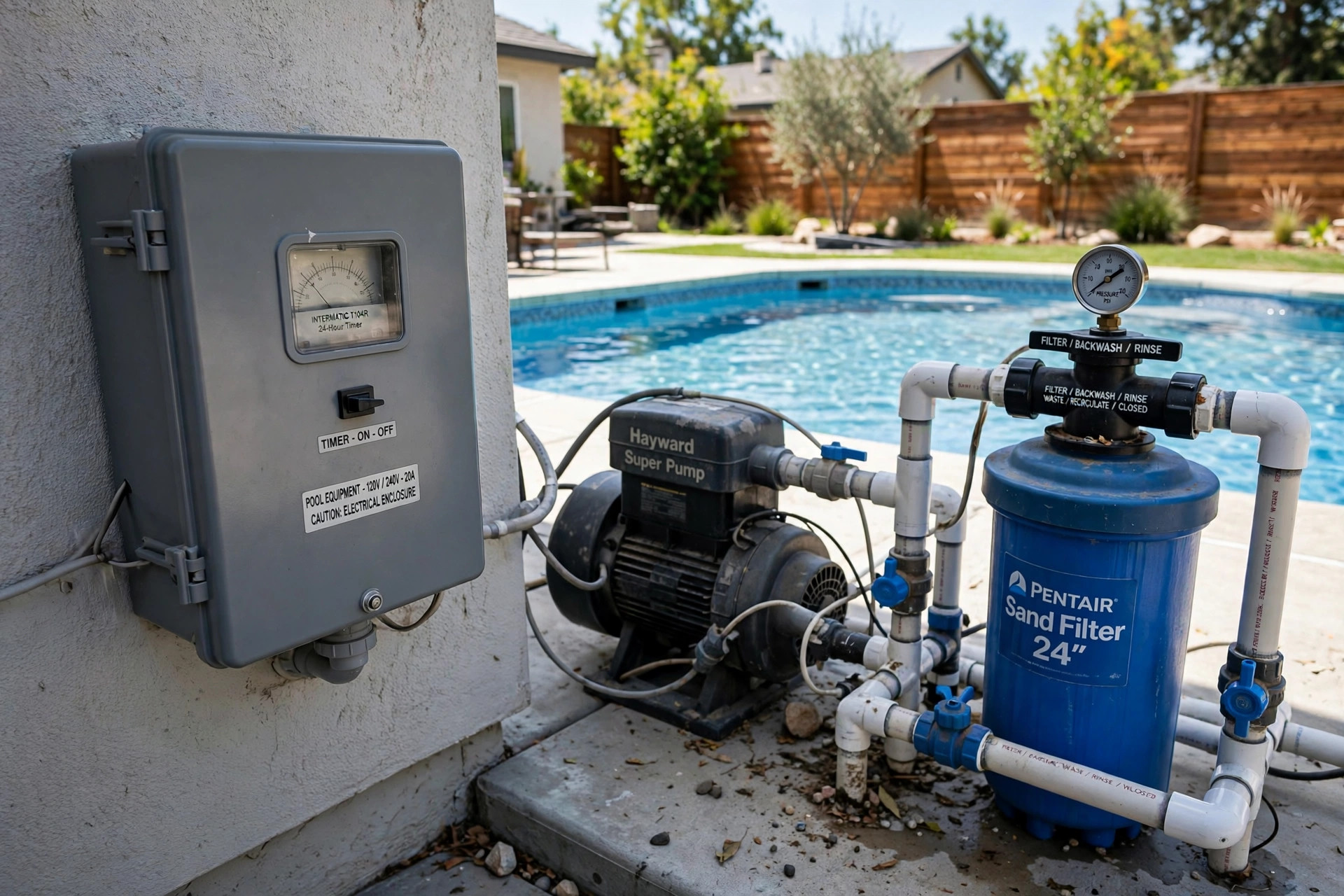

The best pool timer for pump automation is one that turns your pool pump on and off at set times each day. A timer takes over a simple but important job. It runs the pump long enough to keep the water clean. It stops the pump when running is not needed. This saves power and money. It also protects the pump from overuse. Many pool owners switch to an automatic pool pump controller because manual operation is easy to forget. You leave the pump on too long. Or you forget to turn it on at all. Both mistakes cost money and hurt water quality.
A pool timer is a small box that sits between your power supply and your pump. You set the schedule once. The timer does the rest. This guide explains the types of timers, what to look for, what they cost, and how to stay safe.
Why Pump Automation Matters
A pool pump is the heart of your pool system. It moves water through the filter. It spreads chemicals evenly. Most pools need the pump to run six to ten hours a day in summer. That is a long time to manage by hand.
An automated timer gives you steady control. It runs the pump at the same hours each day. Your water stays clear. Your chemical levels stay stable. You do not need to remember to flip a switch. This is the main reason pool owners choose the best pool timer for pump automation over manual control.
Timers also help with energy savings. Pool pumps draw a lot of power. Running one for twelve hours when six would do wastes real money. A timer lets you run the pump during off-peak hours if your power company charges less at night. Over a full season, the savings add up. Many guides on pool equipment supplies at Leslie’s Pool Supplies point out that shorter, well-timed pump runs keep pools just as clean as all-day operation.
Healthier Water With Less Effort
When a pump runs on a fixed schedule, filtration becomes steady. Steady filtration removes dirt and algae spores before they grow. Chemical feeders and salt systems also work best when the pump runs at set times. The result is clearer water with less chlorine use. That means fewer surprise water problems and fewer trips to the pool store.
Types of Pool Timers: Best Pool Timer for Pump Automation
Not all timers work the same way. There are three main kinds. Each has strengths and limits. The right choice depends on your pump, your budget, and how much control you want.
Mechanical Timers
Mechanical timers are the oldest kind. They use a clock motor and small trippers that you set on a dial. You push trippers in for on times and out for off times. They are simple and tough. They work well outdoors. They cost the least.
The main limit is detail. A mechanical timer usually allows only one on and one off time per day. If you want the pump to run twice a day, for example morning and evening, most mechanical models cannot do it. They also drift a little over time. You may need to reset the clock now and then. Still, for basic pump control, they are a solid choice. Many pool owners who want simple pool pump timer installation start here.
Digital Timers
Digital timers use a screen and buttons. They let you set several on and off times per day. You can set different schedules for weekdays and weekends. Many keep their settings during a power outage because they have a small backup battery.
Digital models are a good middle ground. They cost more than mechanical timers but less than smart models. The display can be hard to read in bright sun, so mount the box where you can see it. A digital pool timer vs mechanical timer comparison usually favors digital when you want more than one cycle per day.
Smart Timers
Smart timers connect to your phone through Wi-Fi or a home network. You control them with an app. You can change the schedule from anywhere. Some send alerts if the pump does not start. Some track power use.
Smart models are the most flexible. They cost the most and need a good Wi-Fi signal near the pool pad. They are a good fit if you travel or want full control from your phone. When searching for the best pool timer for pump automation, many buyers today compare smart features first.
What to Look for When You Buy
A timer must match your pump and your electrical setup. These points matter most.
Voltage and Amps
Pool pumps in the United States usually run on 120 volts or 240 volts. Your timer must match the voltage of your pump. Check the amp rating too. A timer must handle the full load amps listed on the pump motor plate. A timer rated too low can overheat. If you are not sure, read the motor label or ask an electrician. Guides on pump equipment at Pool Warehouse remind owners that matching voltage and amps is the first safety step.
Number of Circuits
A simple timer controls one circuit, which means one device. That is fine for a pump alone. If you also want the timer to control a booster pump, a pool light, or a salt system, you need a timer with two or more circuits. Multi-circuit models let you set separate schedules for each device.
Freeze Protection
Some timers include freeze protection. A sensor watches the air temperature. When it nears freezing, the timer turns the pump on by itself. Moving water is less likely to freeze and crack pipes. If you live where winter nights drop below freezing, this feature is worth the extra cost. It is also handy if you forget to winterize early. Our guide on how to winterize inground pool properly explains full cold-weather care.
Weatherproof Case
The timer box will sit outside near the pump. It must be rated for outdoor use. Look for a case marked NEMA 3R or weatherproof. This keeps rain and sun off the wiring. Mount it where it gets some shade if you can. Sun bakes electronics over time.
Battery Backup
Digital and smart timers should hold their settings when power fails. A small battery keeps the clock running. Without it, every outage means reprogramming. Check that the model you buy has this feature.
How Pool Timers Save Energy and Money
A pool pump is often the biggest power user in a home with a pool. It can use as much power as several large appliances. Running it only when needed cuts your bill.
Most residential pools need the full water volume turned over once or twice a day. For a typical pump, six to eight hours of run time is enough in summer. Less is needed in cooler months. A timer makes this easy. You set summer hours and winter hours and change them twice a year.
Off-peak timing saves even more. Many power companies charge less at night. Set the timer to run from late evening to early morning. The pool still gets full filtration. You pay a lower rate. Advice on energy use at Energy.gov explains that shifting heavy loads to off-peak hours lowers household power costs.
Variable-speed pumps pair well with timers. A variable-speed pump runs slower and uses far less power than a single-speed pump. Timers made for these pumps let you set low-speed cycles for most of the day. This is one of the cheapest ways to cut pool power costs. If you are shopping for a new pump too, see our guide on best pool pump for inground pools.
Cost and Price Range
Timer prices vary by type and features. These are typical ranges in the United States:
– Mechanical timers: 50 to 120 dollars. Simple, reliable, and easy to install. – Digital timers: 100 to 250 dollars. Multiple cycles, battery backup, sometimes freeze protection. – Smart timers: 150 to 400 dollars. App control, alerts, power tracking. – Multi-circuit control panels: 300 to 800 dollars or more. These run the pump, lights, heater, and more from one panel.
Installation cost is separate if you hire an electrician. A simple swap of an old timer may cost 150 to 300 dollars for labor. A new circuit or a complex panel can cost more. Many owners buy the timer at a home improvement retailer like The Home Depot and hire a licensed electrician for the wiring. Retail prices there let you compare models side by side.
Basic Installation and Wiring Notes
Installing a pool timer involves real electrical work. Pool equipment sits near water. Mistakes can be dangerous. These notes explain what is involved, but they are not a full how-to. When in doubt, hire a licensed electrician.
The timer mounts on a wall or post near the pump. Power from the breaker panel goes into the timer. Wires from the timer go out to the pump. The timer acts as a switch on that path. Most pool pump timers use a 240-volt double-pole setup. This means both hot wires pass through the timer.
Grounding is critical. The timer case, the pump, and all metal parts must connect to the ground wire. Outdoor pool equipment also needs proper bonding. Local codes set the rules. Your electrician will know them.
A few practical tips:
– Turn off the breaker before you open any box. Test with a voltage tester to be sure the power is off. – Use wire rated for outdoor and wet locations. Indoor wire will fail over time. – Keep the timer at least five feet from the pool water edge. This is a common code rule. – Label the breaker after you finish. Future service work goes faster. – After wiring, run a full on-off cycle to test. Watch the pump start and stop on schedule.
Project guides at This Old House cover outdoor electrical work in detail and stress the same point: match the work to code and get a permit if your town requires one.
Care and Upkeep
A good timer needs little care. A few simple habits keep it working for years.
Check the clock setting each spring. Power outages and time changes throw clocks off. A mechanical timer drifts slowly, so look at it when you open the pool. Confirm that the on time on the dial matches the real time.
Keep the box clean and dry. Clear leaves and spider webs from around it. Do not spray it with a hose. If the case seal looks worn, replace the gasket or the whole case. Water inside an electrical box is a hazard.
Listen for odd sounds. A loud buzz from a mechanical timer can mean the clock motor is wearing out. Replacement motors are sold for common models. Digital timers usually fail by losing their display or their memory. In that case, replace the whole unit.
Test freeze protection before winter. If your timer has a freeze sensor, check that it turns the pump on when air gets cold. A sensor covered in a cobweb may not read true. This small check protects your pipes.
Safety Tips
Pool timers deal with electricity near water. Respect that mix.
– Always hire a licensed electrician for wiring. This is not the place to learn electrical work. – Make sure the timer circuit has ground fault protection. A GFCI breaker or device shuts power off fast if a fault occurs. – Keep the timer box closed and latched. Children should not open electrical boxes. – Never touch wiring with wet hands. Stand on dry ground when you adjust the timer. – Do not run extension cords to the timer or pump. Permanent wiring is the safe way. – Store the timer manual near the box. You will want it when the schedule needs a change. – Safety guidance from the U.S. Consumer Product Safety Commission at CPSC.gov covers pool electrical safety and drain safety. Read it if you own a pool.
A Note on Storm Season
Heavy storms knock out power. After an outage, check that the timer restarted on the right schedule. Digital timers with battery backup usually recover on their own. Mechanical timers stop during an outage and must be reset. After any big storm, walk the pool pad. Look for water in the timer box or damaged conduit. Fix problems before the pump runs again.
FAQ
How many hours a day should a pool pump run?
Most pools need six to eight hours a day in warm weather. Smaller pools and lighter use may need less. In winter, two to four hours is often enough. Start with six hours and adjust. If the water stays clear, the schedule is working. If it clouds up, add an hour or two.
Can one timer control both the pump and the pool light?
Yes, if the timer has two circuits. A two-circuit model lets you set one schedule for the pump and another for the light. If your timer has only one circuit, it can control only one device. Some owners add a second small timer for the light.
Do I need a smart timer, or is a mechanical one enough?
A mechanical timer is enough if you want simple on and off times and you are home most days. A smart timer is better if you travel, want phone control, or want power-use alerts. Both automate the pump. The choice is about convenience, not basic function.
Will a timer work with a variable-speed pump?
Many timers do, but check the model. Variable-speed pumps need timers built for their control type. Some connect through the pump’s own controller instead of switching raw power. Read both the pump manual and the timer manual before you buy. Pool care guides at Swim University explain how pump types pair with timers.
What happens if the timer fails?
If the timer fails open, the pump will not run. Water can cloud within days in warm weather. If it fails closed, the pump runs nonstop and your power bill climbs. Check the timer once a week during swim season. A quick look at the dial or the app catches most failures early.
Should I run the pump at night or during the day?
Night running is usually best. Power rates are often lower. The pump noise bothers no one. Filtration works just as well at night. The only downside is that you cannot watch for problems, so check the pool each morning. Daylight skimming tips, like keeping up with leaves, are covered in our review of best pool vacuum for leaves reviews.
A Final Word
The best pool timer for pump automation is the one that fits your pump, your wiring, and your habits. Mechanical timers are simple and cheap. Digital timers add flexible schedules. Smart timers add phone control. All of them do the same core job. They run the pump on time and stop it on time. That steady rhythm keeps water clean and power bills low.
Buy a timer rated for your voltage and amps. Mount it in a weatherproof box. Set the schedule and check it now and then. If wiring feels beyond your skill, call an electrician. It is a small cost for safe, automatic pump control all season long. Extra pool care advice at The Spruce can help you tune the schedule as the seasons change, and spa owners can look to brands like Hot Spring and Bullfrog Spas for automation ideas that work beyond the pool pad.
See Hot Spring Spas for more detail.
References
Bullfrog Spas. (n.d.). Hot tubs and spas. https://www.bullfrogspas.com Hot Spring Spas. (n.d.). Hot tubs and spas. https://www.hotspring.com Leslie’s Pool Supplies. (n.d.). Pool supplies and equipment. https://www.lesliespool.com Pool Warehouse. (n.d.). Pool equipment and supplies. https://www.poolwarehouse.com Swim University. (n.d.). Pool and hot tub care guides. https://www.swimuniversity.com The Home Depot. (n.d.). Home improvement products. https://www.homedepot.com The Spruce. (n.d.). Home and garden advice. https://www.thespruce.com U.S. Consumer Product Safety Commission. (n.d.). Product safety information. https://www.cpsc.gov
Was this guide helpful?

About Michael Thompson
The My Garden US editorial team writes practical, in-depth home and garden guides for American homeowners — tested advice, no fluff.
You May Also Like

How to Clean Pool Filter Cartridge: A Simple Step-by-Step Guide
May 14, 2026 0 views
The Best Pool Pump for Energy Savings: A Homeowner’s Guide
August 13, 2026 0 views
Best Pool Vacuum Head for Vinyl: A Complete Buyer’s Guide
January 8, 2026 0 views