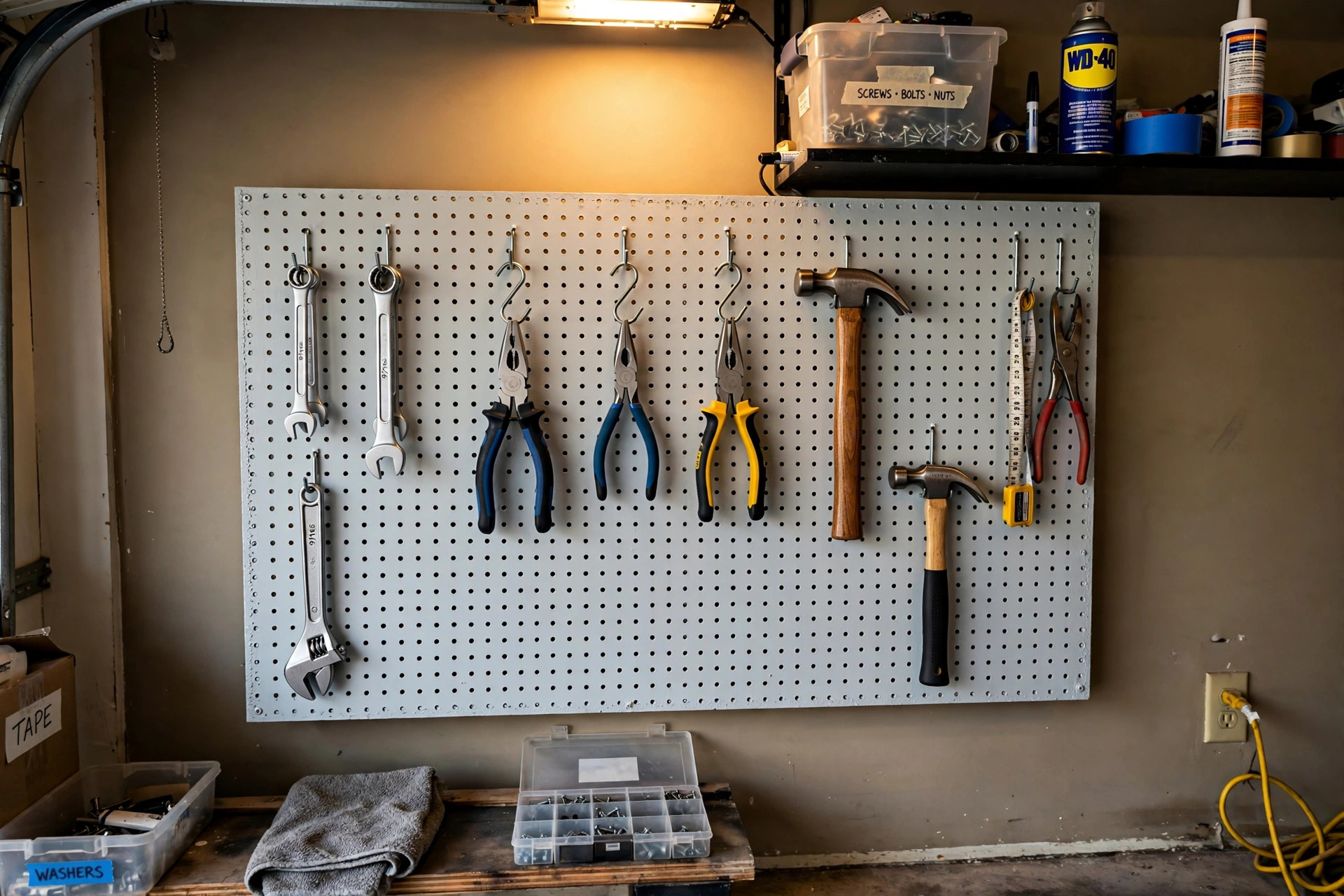

A pegboard is one of the most useful boards a garage can hold. It keeps tools off the floor and in plain sight, and it turns a blank wall into a work station. But a bare board of hardboard does not look good, and it does not last long in a damp garage. That is why so many home owners search for the best paint for pegboard in garage usa projects. The right paint makes the board harder, cleaner, and easier to live with for years.
Paint also changes the way the pegboard feels. A coat of paint seals the pressed fibers, keeps hooks from snagging, and stops grease from soaking into the brown surface. A light color helps a dim garage feel brighter. A dark color hides the marks of daily work. Before you buy a can, it helps to know what paint does well on this kind of board, and what to avoid.
Why the Right Paint Matters for a Garage Pegboard
A pegboard is not like a smooth wall. It is full of small holes, made from compressed wood fiber, and the edges soak up water fast. In a garage, the air is often damp. Cars bring in rain, and washers and water heaters add steam. Over time, an unpainted board can swell, warp, and break down at the edges. Paint seals the fibers and keeps moisture out.
The holes matter too. Each hole is a small rim of raw fiber. Hooks press on those rims when they carry heavy tools. A good hard paint coats the rims and keeps them from crumbling. Cheap paint, or paint put on too thick, can clog the holes, and then the hooks will not fit. The right paint strikes a balance. It seals the surface and the holes, yet leaves them open for hooks.
Looks count as well. Many people spend long hours in the garage, and a clean painted pegboard lifts the whole room. Light gray, white, or soft blue reflect the work light and make small tools easier to see. Some home owners match the board to the garage walls. Others pick a bold color and use the board as the center of the work zone. Either way, paint turns a plain brown panel into a finished part of the room.
What to Look for When You Choose Paint for Pegboard: Best Paint for Pegboard in Garage Usa
Not every paint works on hardboard. Some are too thick. Some stay soft for weeks. Some crack when the board flexes. When you read labels in the store, look for a few key traits.
First, look for paint that grips smooth surfaces. Hardboard is pressed flat, and cheap flat wall paint can peel off it in sheets. A paint made for trim, doors, or cabinets has stronger grip and holds far better.
Second, look for a hard finish. Tools bump against the board all day. Semi-gloss and satin finishes are tougher than flat, and they wipe clean with a damp rag. In a garage, that is a real benefit.
Third, think about how you will put the paint on. Pegboard has hundreds of holes. A brush leaves drips in the holes, and a roller skips the rims. Spray paint gets into every hole and lays down an even coat. Many guides on the best paint sprayer for home use reviews point out that spraying gives the smoothest result on boards with holes.
Fourth, check dry time and fumes. Fast-drying paint lets you add a second coat the same day. If you can, take the board outside to paint it. Open air helps the paint dry and keeps fumes away from the house.
Test a Small Area First
Before you paint the whole board, test one corner. Put on primer and two coats, then push a hook into a hole and hang a wrench from it. If the paint chips or the hole closes up, change your plan.
Types of Paint That Work on Pegboard
There are four main kinds of paint that home owners use on pegboard. Each has strong points and weak points. Most people in the United States pick one of these, and the same hard-wearing formulas often top guides to the best paint for front door usa reviews, since both jobs need paint that stands up to bumps and weather.
Acrylic Latex Paint
Acrylic latex is the most common choice. It is easy to find in every paint aisle in the country, cleans up with water, and dries fast. A satin or semi-gloss acrylic latex gives a hard shell that resists bumps from tools. Brands sold at The Home Depot and Lowe’s carry trim and cabinet formulas that grip well on hardboard. The colors at Sherwin-Williams and Benjamin Moore are known for rich color and smooth flow.
The weak point of latex is that it can take weeks to reach full hardness. For the first few days, hooks can dent it. Let the board cure for a few days before you load it with heavy tools, and use a primer first.
Enamel Paint
Enamel gives the hardest finish of the group. Once it cures, tools slide against it without leaving marks, and it wipes clean with ease. Water-based enamel is now more common than oil-based because it dries faster and smells less. The water-based enamel lines at Behr are popular for doors and trim and work just as well on a garage pegboard.
The trade off is dry time. Enamel takes longer to dry between coats, and oil-based enamel has strong fumes, so you need good air flow. But if you want the toughest board possible, enamel is the top pick. Many readers who study Bob Vila guides on hard-wearing finishes choose enamel for this reason.
Chalk Paint
Chalk paint has a soft, matte look and grips almost any surface without much prep. It works well if the pegboard is part of a styled garage or craft room. But it is soft, so it shows marks fast in a hard-use garage. It also needs a wax or clear coat on top, which adds time and cost. Chalk paint suits a light-use board, not a shop board that holds heavy tools.
Spray Paint
Spray paint, in cans or through a sprayer, is often the best way to paint pegboard. The mist reaches into every hole and coats the rims, and it lays down a thin even film so holes stay open. It dries fast. Most spray paints are enamel-based, so the finish is hard and durable. A standard 4 by 8 foot board needs only two or three cans. This Old House and The Spruce both praise spray application for boards with many holes, and their advice holds true here.
Primer: The Step You Should Not Skip
Primer is the base that makes paint hold. Hardboard is thirsty. Without primer, the first coat sinks into the fibers and looks blotchy. With primer, the top coats sit on a sealed surface and look even. Use a bonding primer made for slick surfaces. The primer guides at HGTV stress the same rule: paint fails most often because the surface was not sealed first.
Put primer on both faces and all four edges, since the edges soak up the most moisture. Spray it lightly into the holes so the rims get sealed too. One coat is enough for a new board. Two thin coats beat one thick coat that clogs holes. Let the primer dry as the can directs. For more on primers, see the guide to the best primer for drywall patches usa.
How to Paint a Pegboard Step by Step
A good result comes from steady work, not from speed. Set aside a morning. Work outside or in the open garage door. Here is a plain method that works well.
1. Take the board off the wall and lay it flat on sawhorses or a drop cloth. Painting it flat keeps drips out of the holes. 2. Wipe the board clean with a damp cloth and let it dry. Sand rough spots lightly and wipe off the dust. 3. Seal the edges. The cut edges of hardboard soak up the most water. 4. Apply primer in thin coats, sprayed or rolled on. Do not flood the holes. Let it dry fully. 5. Apply the first coat of paint in light passes. Two thin coats beat one thick coat that clogs holes. 6. Check a few holes with a spare hook. If paint has bridged over a hole, push through gently before it hardens. 7. Apply the second coat. Give the board a full day to cure before you hang it and load it with tools.
If you paint the board while it hangs on the wall, you save the work of taking it down. But paint will get on the wall behind it. Most people find it easier to paint flat. Either way, keep coats thin.
Cost and Price: What You Will Pay
Painting a pegboard is a low-cost project. The board itself often costs less than a single can of good paint. Here is what to expect in the United States.
A quart of quality acrylic latex in satin or semi-gloss costs about eight to fifteen dollars, and it covers a standard 4 by 8 foot board with two coats. A gallon costs about twenty-five to forty-five dollars and covers several boards. Spray primer costs about five to eight dollars a can. Spray paint costs about five to ten dollars a can, and you need two or three cans per large board. A quart of bonding primer costs about ten to fifteen dollars.
All told, most people spend between fifteen and forty dollars on paint and primer for one large pegboard. Compared to buying a new metal pegboard, which can cost two or three times more, painting a hardboard panel is a clear win.
Color Ideas for a Garage Pegboard
Color is a matter of taste, but a few choices work well in most garages. White and light gray are the most popular. They reflect light and make tools stand out. Light gray hides dust better than white. Some home owners match the board to the wall color for a calm, built-in look. Others paint the board a strong accent color, like deep blue or red, and use it as the center of the work zone. Think about the light in your garage. A dark garage needs a light board. A bright garage can carry a dark board without trouble. If you change your mind later, pegboard is cheap to repaint.
Care and Upkeep
A painted pegboard needs little care. Dust it now and then with a dry cloth or a soft brush. Wipe grease spots with a damp rag and mild soap. Do not scrub hard. Even tough paint will wear if you scour it.
Check the hooks once a year. Pull each hook out and look at the hole. If paint has chipped, dab a little touch-up paint on the spot with a small brush. That stops bare fiber from showing.
Keep heavy tools on the lower holes when you can, since weight pulls on the board over time. Mount the board on furring strips so a small gap sits between the board and the wall. That gap lets the back face dry and keeps mold away. If the finish gets badly scratched after years of use, sand lightly and repaint. The old paint makes a fine base for the new coat.
Safety Tips
Paint work is safe if you take simple steps. Wear a dust mask when you sand, and wear gloves to keep paint off your skin. Work with fresh air. If you use spray paint or oil-based enamel, open the garage door wide or work outside. Keep paint away from water heaters and furnaces with open flames, since spray mist travels far. Store leftover paint with the lid on tight, away from children and pets. Read the label on every can for dry time and safety gear.
FAQ
Can I paint pegboard without primer?
No. Bare hardboard soaks up paint and looks blotchy, and the paint peels sooner. One thin coat of bonding primer doubles the life of the job.
Will paint clog the holes in the pegboard?
Only if you put it on too thick. Use thin coats. Spray paint or light roller passes keep the holes open. Push a spare hook through a few holes after each coat to clear any wet bridges.
What is the toughest paint for a garage pegboard?
Enamel gives the hardest finish. Water-based enamel balances toughness, dry time, and low odor. Acrylic latex in semi-gloss is close behind and easier to work with. For a board that holds heavy tools, pick enamel or cabinet-grade latex.
Can I paint a pegboard that is already hanging on the wall?
Yes. Slide cardboard behind the board to shield the wall, mask the edges, and apply thin coats. Painting in place suits a small board. For a large board, take it down and paint it flat.
How long should I wait before hanging tools on a fresh board?
Wait at least one full day. Latex feels dry in hours but stays soft for days, and enamel needs even longer to reach full hardness. Heavy tools pressed into soft paint will leave dents.
Does painted pegboard hold up in a damp garage?
Yes, if you seal all sides. Paint the front, the back, and all four edges, then mount the board on strips so air moves behind it. A sealed board in a damp garage lasts for many years.
A Short Final Word
The search for the best paint for pegboard in garage usa projects has a simple answer. Pick a hard-wearing paint, seal the board with primer, and put it on in thin coats. Satin or semi-gloss acrylic latex suits most home owners. Enamel suits those who want the toughest finish. Spray application gives the cleanest result. The project costs little and takes a morning.
References
Behr. (n.d.). Paints, primers, and stains. https://www.behr.com Benjamin Moore. (n.d.). Paints and stains. https://www.benjaminmoore.com Bob Vila. (n.d.). Home improvement advice. https://www.bobvila.com HGTV. (n.d.). Home and garden ideas. https://www.hgtv.com Lowe’s. (n.d.). Home improvement products. https://www.lowes.com Sherwin-Williams. (n.d.). Paints and coatings. https://www.sherwin-williams.com The Home Depot. (n.d.). Home improvement products. https://www.homedepot.com The Spruce. (n.d.). Home and garden advice. https://www.thespruce.com This Old House. (n.d.). Home renovation guidance. https://www.thisoldhouse.com
Was this guide helpful?

About Sarah Mitchell
The My Garden US editorial team writes practical, in-depth home and garden guides for American homeowners — tested advice, no fluff.
You May Also Like
Beadboard Wallpaper vs Real Beadboard: Which One Belongs in Your Home?
March 6, 2026 0 views
How to Remove Old Wallpaper Glue in the USA: A Complete Guide
April 26, 2026 0 views
Best Paint for Laminate Cabinets USA Reviews
September 5, 2026 0 views