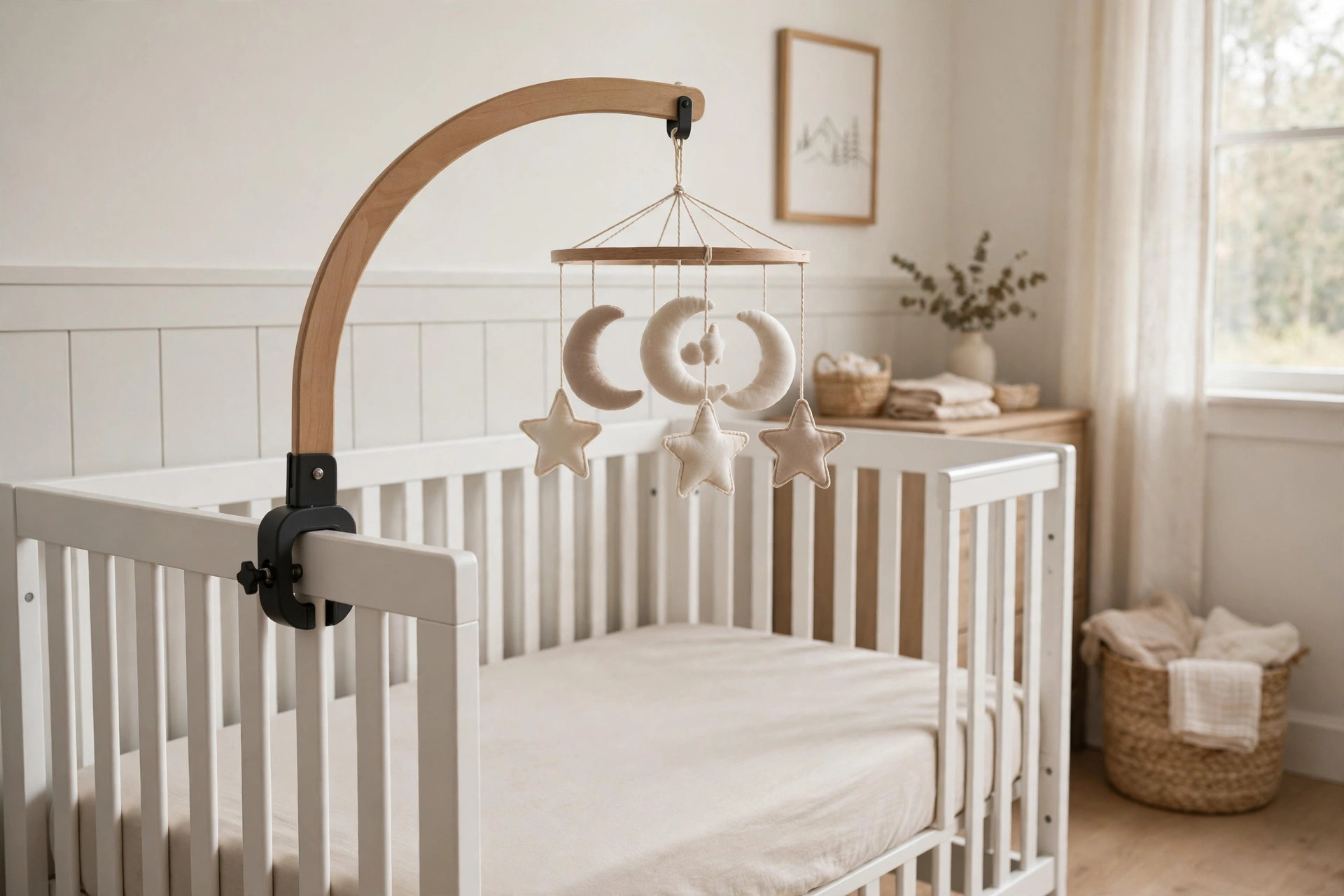

A crib mobile arm for attaching to crib rails is a small but useful part of the nursery. It is a curved or straight arm that clamps onto the side of the crib and holds a hanging mobile above the mattress. Many parents buy a mobile first and then find that they have no good way to hang it over the crib. That is where this simple arm helps. It gives the mobile a safe, steady home without the need for screws in the wall or hooks in the ceiling.
This guide explains what a crib mobile arm is, how to choose one, and how to attach it with care. It covers the main types, the prices you can expect, and the safety rules that matter most. If you are setting up a nursery for the first time, the notes below will help you make a calm and sound choice.
Why a Crib Mobile Arm for Attaching to Crib Rails Is Useful
A mobile gives a young baby something gentle to watch while lying in the crib. Soft shapes turn slowly overhead, and many mobiles play a quiet tune. The American Academy of Pediatrics offers guidance on safe sleep and healthy play for infants, and it is a sound habit to read such guidance before you add anything to the crib.
An arm made for this purpose has three clear benefits. First, it keeps the mobile centered over the mattress instead of hanging off to one side. Second, it needs no drilling or permanent change to the crib or the room, which matters a great deal for families who rent. Third, it can be moved from one crib to another in a few minutes. Many parents who travel to see grandparents carry the arm along with the nursery crib mobile musical for baby sleep, so the baby keeps the same familiar view.
There is one point to keep firmly in mind. A mobile and its arm are meant for looking, not for touching. Once a baby can push up on hands and knees, most experts say the mobile should come down. We return to this point in the safety section below.
What to Look For When You Choose One: Crib Mobile Arm for Attaching to Crib
Not all arms fit all cribs. A careful check of a few points before you buy will save you time and trouble.
Clamp Fit and Rail Shape
The clamp is the most important part of a crib mobile arm for attaching to crib sides. It must grip the top rail or side rail of your crib firmly. Cribs come with rails of many shapes: round dowels, wide flat boards, and curved rails. Measure the thickness of your crib rail with a ruler or a tape measure before you shop. Compare that number with the clamp range given by the maker.
A clamp that is too wide will wobble. A clamp that is too narrow will not close. Either fault can let the arm shift during use. Look for a clamp with a rubber or felt pad inside the jaws. The pad protects the finish of the crib from scratches and helps the grip hold. Shoppers who browse IKEA or Wayfair will find product pages that list rail thickness in plain numbers; make use of them.
Reach and Height
The arm must reach far enough over the mattress to hang the mobile near the center. Most arms extend twelve to twenty-four inches from the clamp. An arm that is too short leaves the mobile hanging over the edge of the crib, where the baby can reach it too soon. An arm that is too tall puts the mobile out of the baby’s line of sight.
Check the height of the hanging point as well. The mobile should hang well above the mattress, out of reach of a small hand.
Material and Build
Most arms are made of wood or metal. Wooden arms look warm and suit classic nursery styles; many parents buy them from shops such as Pottery Barn Kids. Metal arms are often lighter and can be adjusted with a simple screw or knob. Both types work well if they are made with care.
Adjustability
The best arms let you change the angle and height after the clamp is fixed. A ball joint at the bend allows you to tilt the mobile toward the center of the crib. A telescoping tube lets you raise or lower the hanging point. These small features matter more than they seem, because cribs vary in size and the mobile you own may hang low or high.
Types of Crib Mobile Arms
You will find several main designs on the market. Each has its own strengths.
Clamp-on arms. These are the most common type. A screw clamp grips the crib rail, and a bent arm rises from it. They suit most standard cribs and are easy to remove. If you plan to use the arm with a best convertible crib for small nursery room, check that the clamp fits the slats as well as the rails, since convertible models sometimes have thicker sides.
Screw-in arms. A few older designs attach with screws driven into the crib rail. They hold very firmly, but they leave holes in the wood.
Holder and stand arms. Some products pair an arm with a weighted base that sits on the floor beside the crib. These need no clamp at all. They are useful when the crib rails have an odd shape that no clamp can grip. The drawback is that the base takes up floor space and must sit where no one will trip on it.
Universal mobile holders. These are simple plastic or metal brackets that fit a wide range of rails. They cost little and do the job, but they often lack the fine adjustment of a purpose-built arm.
DIY wooden arms. Some craft-minded parents make their own arm from a wooden dowel and a clamp. This can work if the builder is skilled and careful, but a homemade arm should be checked often for loose joints and rough spots.
How to Attach the Arm Step by Step
Putting up a crib mobile arm for attaching to crib rails takes only a few minutes. Work slowly and check each step.
1. Clear the crib. Take all bedding, toys, and the baby out of the crib before you start. 2. Choose the spot. Pick a point on the side rail near the middle of the crib’s long side. Do not clamp to the head or foot boards if they curve, since a curved board gives a poor grip. 3. Open the clamp. Turn the screw until the jaws open wider than the rail. 4. Seat the clamp. Slide the clamp over the rail so it sits flat and level. Check that any rubber pad faces the wood. 5. Tighten by hand. Turn the screw until the clamp grips firmly. It should not slide when you push it. Do not use pliers or tools to force it tighter; you may crack the rail or strip the screw. 6. Set the arm angle. Bend or rotate the arm so it reaches over the center of the mattress. 7. Hang the mobile. Attach the mobile to the hook or loop at the end of the arm, following the mobile maker’s own instructions. 8. Test it. Push the arm gently from several directions. It should not move. Hang a small weight equal to the mobile for a minute to test the hold. 9. Check the reach. Lie a small doll or a rolled towel on the mattress and make sure no part of the mobile or its strings could be grabbed by a baby who pushes up.
Repeat the test every week. Clamps can loosen over time, and wood rails can shrink slightly in dry air.
Cost and Price
A crib mobile arm for attaching to crib rails is not an expensive purchase. Prices in the United States generally fall into three bands.
Basic universal holders cost about ten to twenty dollars. They are simple and light, and they suit parents who need a quick solution. Mid-range wooden and metal arms cost about twenty to forty dollars. These often include padded clamps and adjustable joints, and they tend to last through more than one child. Premium sets, which pair the arm with a matching mobile, can cost fifty dollars or more. Shops like Target and Babylist list products across all three bands, so you can compare with ease.
Keep in mind that the arm is only part of the cost. If you do not yet own a mobile, you will need one. Set your budget with both parts in mind.
Care and Upkeep
A crib mobile arm needs little care, but a small routine keeps it safe.
Wipe the arm with a damp cloth when you clean the nursery. Dust gathers on the joints and the clamp screw, and a quick wipe keeps the moving parts smooth. Check the tightening screw once a month. Turn it by hand to confirm it still grips; if it has loosened, tighten it again.
Look at the finish from time to time. If paint chips or wood splinters appear, sand the spot smooth or replace the arm. A rough edge near a baby’s sleeping area is never worth the risk. If the arm came with rubber pads on the clamp, check that they are still in place and have not hardened or fallen off.
When the baby outgrows the mobile, store the arm in a dry place. Wrap the clamp in a soft cloth so the screw does not scratch other items in storage. Sites such as What to Expect and BabyCenter carry parent forums where families trade notes on which nursery items held up best over time.
Safety
Safety comes first with anything that hangs over a crib. Follow these rules without exception.
– Mount the mobile high and out of reach. Strings and cords near a baby are a strangulation risk. Keep all parts of the mobile and its arm where the baby cannot grab them. – Remove the mobile when the baby can push up. The usual guidance is to take the mobile down once the baby reaches five months of age or can push up on hands and knees, whichever comes first. The American Academy of Pediatrics and the U.S. Consumer Product Safety Commission both stress safe sleep practices; a mobile left too long becomes a hazard. – Never hang the mobile over the baby’s head within arm’s reach. Even a well-made arm can be pulled by a determined toddler. – Check for recalls. Before you buy, and again each year, search the CPSC recall list for the brand and model. A recalled arm should be returned or destroyed, never passed on. – Use only the parts the maker supplied. Do not add extra hooks, strings, or extension cords to make the arm longer. Added parts change how the arm balances and may fail. – Keep the nursery calm at night. A mobile is a daytime play item. Many parents also use a nursery night light with dimmer for feeding for night visits, and keep the mobile still after dark so the crib stays a place for sleep.
If you ever feel unsure about a product, stop using it and ask your pediatrician. A short question at a check-up can settle most doubts.
Frequently Asked Questions
Will a crib mobile arm for attaching to crib rails fit any crib?
Most clamp-on arms fit standard cribs with rails up to about two inches thick. Cribs with very thick or rounded rails may need a different design, such as a stand arm with a floor base. Always measure your rail and compare it with the product’s stated range.
Can I use the arm on a mini crib or a bassinet?
Some arms fit mini cribs, but bassinets are usually too light to hold an arm safely. A clamp needs a firm rail to grip. Check the maker’s list of approved uses before you try.
Does the arm damage the crib?
A well-designed clamp with rubber or felt pads leaves no marks. Clamps without padding can scratch the finish. Choose a padded clamp and do not over-tighten.
How high should the mobile hang?
Hang it high enough that the baby cannot touch it even when stretching, but low enough that the baby can see the shapes clearly. For most cribs this means the bottom of the mobile sits about sixteen inches above the mattress. Adjust the arm until the view looks right from the baby’s position.
Can I move the arm to another crib later?
Yes. That is one of the main advantages of a clamp-on arm. Loosen the screw, lift the clamp off, and refit it to the new crib. Check the fit again, since the second crib may have rails of a different thickness.
What should I do when the baby starts pulling up?
Take the mobile and the arm down at once. Do not wait for the next milestone. A baby who can pull up can also reach parts that were once out of range. Store both items out of the nursery until they are needed again.
A Final Word
A crib mobile arm for attaching to crib rails is a small purchase that solves a real problem. It places the mobile where it belongs, over the center of the crib, without holes in the wall or damage to the furniture. Choose an arm with a well-padded clamp that fits your rails, check the price band that suits your budget, and follow the safety rules each week. With those simple steps, the mobile becomes what it should be: a quiet, gentle sight for a young baby at play. Guides like those at The Spruce offer further ideas for setting up a calm and safe nursery around it.
References
American Academy of Pediatrics. (n.d.). HealthyChildren.org. https://www.healthychildren.org BabyCenter. (n.d.). Toddler play and learning guides. https://www.babycenter.com Babylist. (n.d.). Baby registry and gear guides. https://www.babylist.com IKEA. (n.d.). Home furnishings. https://www.ikea.com Pottery Barn Kids. (n.d.). Kids furniture and decor. https://www.potterybarnkids.com Target. (n.d.). Retail store. https://www.target.com The Spruce. (n.d.). Home and garden advice. https://www.thespruce.com U.S. Consumer Product Safety Commission. (n.d.). Product safety information. https://www.cpsc.gov Wayfair. (n.d.). Furniture and home goods. https://www.wayfair.com What to Expect. (n.d.). Pregnancy and parenting guidance. https://www.whattoexpect.com
Was this guide helpful?

About Michael Thompson
The My Garden US editorial team writes practical, in-depth home and garden guides for American homeowners — tested advice, no fluff.
You May Also Like

Kids Vanity Set with Mirror for Girls Room: A Parent’s Buying Guide
April 19, 2026 0 views
Nursery Wall Art Set for Baby Boy Room: A Simple Buying Guide
August 26, 2026 0 views
Crib Sheet Set Organic Cotton for Sensitive Skin: What Parents Should Know
May 28, 2026 0 views