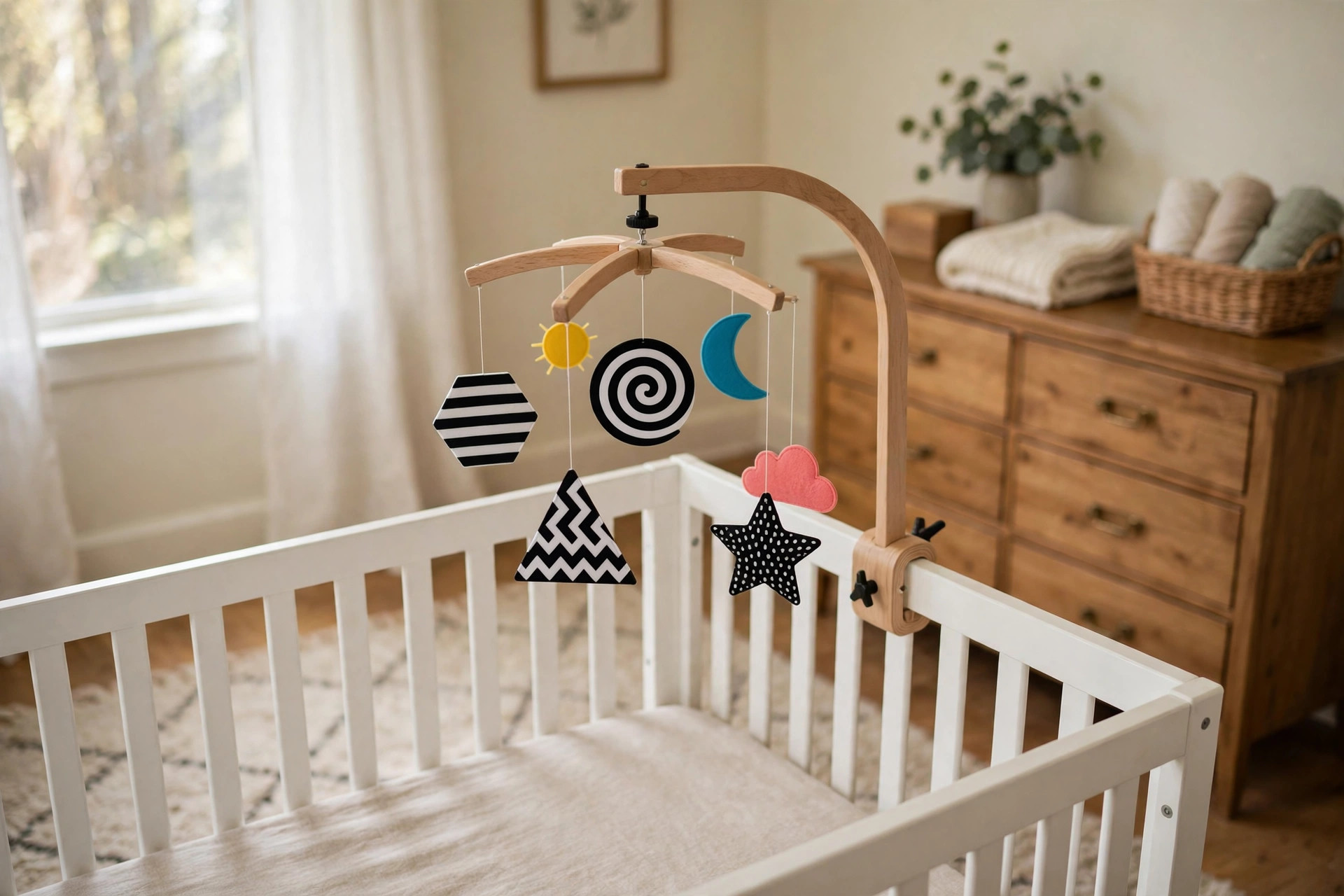

A baby lying in a crib sees only a small slice of the world. The ceiling, the crib rail, and whatever hangs above are the whole view. Parents who look for the best nursery crib mobile for visual stimulation want more than a decoration. They want a gentle teacher for young eyes. A good mobile gives the baby clear shapes to follow, strong color changes to notice, and slow motion that trains focus.
Newborn eyesight is poor at first. Babies see best at a short distance. They notice bold contrast before they notice fine detail. Over the first months, their eyes grow stronger each week. They learn to track a moving object.
The mobile is not the most important thing in the nursery. A safe crib, a firm mattress, and loving care matter far more. But a good mobile adds real value during awake time. It gives the baby a reason to look up and study. This article explains what makes a mobile good for visual stimulation, how to choose one, what types exist, what they cost, how to keep them clean, and how to use them safely.
Why Visual Stimulation Matters in the Nursery
In the first months, the baby’s brain builds itself through the senses. Sight is one of the first tools. When a baby looks at a clear shape and follows it, the brain learns to link what the eyes see with how the body moves. This is the start of hand eye coordination. It is the start of attention. It is the start of learning.
Contrast is the key idea. A newborn sees black against white far better than soft pink against soft cream. Bold edges tell the eye where one shape ends and another begins. As the months pass, color vision grows. By about four months, most babies see the full range of color much like an adult. A mobile that starts with black and white shapes and adds color in later months matches this natural path.
Motion matters too. A slowly turning mobile asks the baby to track movement. Slow, smooth motion is best.
Many pediatric sources note that simple visual play in the first months supports healthy development. Guidance at HealthyChildren.org, the parenting site of the American Academy of Pediatrics, explains how babies learn through everyday sights and sounds. A mobile is one small piece of this rich daily diet of sights, voices, and touch.
What to Look for in a Crib Mobile: Best Nursery Crib Mobile for Visual Stimulation
The best mobile for visual stimulation has a few clear traits. None of them require a high price. They require thought.
Contrast and Color
Look for bold contrast first. Black and white patterns, or very dark shapes on light backgrounds, are the easiest for young eyes. Circles, spirals, and checker patterns work well. Some mobiles show high contrast designs on one side of each hanging piece. These sides face the baby during the first weeks.
For older babies, color becomes the star. Bright reds, yellows, greens, and blues catch the eye. A mobile with both contrast sides and color sides can grow with the child. You can turn the pieces to show the plainer side early on and the colorful side later. If you want related reading on sleep friendly nursery light, a nursery night light with dimmer for feeding pairs well with any mobile, since soft light helps the baby see shapes without glare.
Motion
Choose slow, smooth rotation. The mobile arm should turn at a gentle pace, about one full turn every ten to twenty seconds. Battery powered mobiles often have a motor with a timer. Wind up mobiles need rewinding, which some parents find soothing and others find a chore. Either way, test the motion before you buy. If it wobbles or spins too fast, skip it.
Some mobiles let you adjust the speed. This is a fine extra feature, but not a must. What matters is that the motion is steady and quiet.
Music and Sound
Many mobiles play a lullaby or soft nature sounds. Music is pleasant, but it is not required for visual stimulation. Some parents prefer a musical crib mobile for baby sleep because it pairs sight and sound into one routine. Others prefer silence so the baby can focus on the shapes alone. Both choices are fine.
If you choose music, pick simple tunes at low volume. The sound box should sit far from the baby’s ears, up at the mobile arm or above. Loud sound near a newborn ear is never a good idea. A timer that stops the music after ten or fifteen minutes is a helpful feature.
Size and Height
The hanging pieces should be large enough to see from the mattress. Pieces about three to five inches across work well. Very small pieces blur into dots from below. Very large pieces can block the baby’s view of the room, which is also part of the learning world.
The mobile should hang high. Safety rules call for the lowest part of the mobile to be at least sixteen inches above the mattress, and the mobile must be removed entirely once the baby can push up on hands and knees. Height is not only a safety rule. It is also a vision rule. Shapes held too close are hard for a newborn to focus on.
Types of Crib Mobiles
Shops sell many styles. Each has strengths for visual stimulation.
High contrast mobiles show black and white or black and red patterns. These are the top pick for the first two months. They are often the least costly type. Many are made of felt, paper, or printed fabric.
Animal and nature mobiles hang soft plush shapes such as clouds, stars, moons, and animals. They suit babies from about two months on. They offer color and friendly shapes. Parents who want more color in the room may also like a kids night light projector, which casts soft stars or shapes on the ceiling as a second source of visual interest.
Wooden mobiles use plain wooden balls, beads, and rings. They follow a simple, calm style. Their value for vision comes from movement and from strong light and shadow on the wood. They suit parents who want a quiet, natural look.
Projector mobiles shine shapes or soft lights on the ceiling while turning. These give two things to watch at once: the hanging pieces and the projected image. Check the light level. The projection should be soft, never bright enough to hurt young eyes.
DIY and handmade mobiles are popular with craft loving families. Felt, yarn, and paper shapes on a wooden hoop make a personal mobile. Handmade pieces can be excellent because you can design the contrast yourself. Be strict about safety if you build your own: strong knots, short strings, and nontoxic materials.
Parenting sites such as What to Expect carry buyer guides that compare popular models, and home decor sites such as The Spruce show how different styles fit real nursery rooms.
Cost and Price
Most crib mobiles cost between fifteen and sixty dollars. Simple felt or paper mobiles sit at the low end, often fifteen to twenty five dollars. Mid range plush or wooden mobiles run thirty to fifty dollars. Large stores such as Wayfair list options across this whole range, which makes price comparison easy. Projector mobiles and large designer models can reach sixty dollars or more.
Price does not predict visual value. A fifteen dollar black and white mobile can serve a newborn better than a sixty dollar plush mobile with pale pastel animals. What you pay for at the high end is brand, material, music features, and looks. None of these are bad. They are simply extras.
Think of the mobile as a short term item. You will remove it once the baby can sit up or push up, usually around five to seven months. A mobile that costs twenty dollars and is used daily for five months is good value. There is no need to spend a lot unless the design brings you joy as well.
Watch for extra costs. Some mobiles need batteries. Some need a separate crib arm or clamp. Check the box to see what is included. Retailers such as IKEA and Pottery Barn Kids sell mobiles with the arm included, which saves a surprise extra charge.
Care and Upkeep
A mobile hangs above the crib, so dust gathers on it. Dust can dull the shapes and bother the baby. Wipe or brush the pieces once a week with a dry cloth. Fabric pieces that allow it can be hand washed and air dried. Check the care tag before washing anything.
Test the moving parts now and then. If the arm turns unevenly, check for tangled strings. If a battery motor slows, change the batteries. A mobile that jerks or stops and starts can frustrate a baby who is trying to follow the motion.
Inspect the strings and knots every week. Pull each hanging piece gently to be sure the knot holds. Strings should be short, no more than seven inches, following standard safety guidance. If any string stretches longer or any knot loosens, fix it at once or remove the mobile. A small tear in a fabric piece can grow, so repair or replace worn pieces promptly.
When the mobile’s time is over, store it clean and dry for a future child or pass it to another family.
Safety
Safety comes before stimulation, always. The U.S. Consumer Product Safety Commission sets rules for crib mobiles, and every parent should know the main ones.
First, hang the mobile high. No part of the mobile should be within the baby’s reach. The common rule is at least sixteen inches between the mattress top and the lowest hanging piece. The baby must not be able to grab a string or a piece.
Second, use short strings. Strings longer than seven inches pose a strangulation risk. If the mobile you bought has longer strings, shorten them or choose another model.
Third, remove the mobile on time. Once the baby can push up on hands and knees, usually around five months, the mobile must come down. A mobile left up too long becomes a climbing aid or a pulling hazard. Mark the date on your calendar if it helps.
Fourth, secure the clamp or arm. The mobile arm must grip the crib rail firmly and not slide. Test it by pulling gently before each use. A falling mobile arm can strike the baby.
Fifth, keep the sleep space bare. Safe sleep guidance from the NICHD and the American Academy of Pediatrics is clear: the crib should hold only a firm mattress and a fitted sheet. The mobile hangs above the crib, never inside it. It is for awake time only. Remove or swing it away at sleep time if your model allows.
Finally, buy from trusted sellers and check for recalls. The U.S. Consumer Product Safety Commission keeps a public list of recalled nursery products. A quick check before you buy takes only a minute and can prevent a real danger.
Frequently Asked Questions
When should I start using a crib mobile? You can hang the mobile from the first week home. Newborns will not track it at once. In the first weeks they may only notice light and dark. By six to eight weeks, many babies start to follow slow movement. The mobile earns its keep in months two through five, when tracking skills grow fast.
What colors are best for a newborn? Black and white first. Strong contrast is the easiest thing for a newborn to see. Add bold red around the second month if you like. Full bright colors become most useful from about three to four months, when color vision matures. A mobile with contrast on one side and color on the other covers the whole span.
How long should the baby watch the mobile each day? Short sessions are best. Five to ten minutes of calm watching, a few times a day, is plenty. Watch the baby’s cues. Turning the head away, fussing, or closing the eyes are signs of enough. The mobile is a tool for awake play, not a babysitter.
Should the mobile play music? It can, but it does not need to. Music adds a soothing layer, and many families like a musical crib mobile for baby sleep as part of a calm routine. If you prefer silence, the visual motion alone is enough for stimulation. Keep any music soft and let it stop on its own with a timer.
Can a mobile help the baby sleep? A mobile is for awake time, not for sleep. Sleep experts advise a bare crib with no hanging toys during sleep. A slow mobile with soft music may help a baby wind down before sleep, but move it away or turn it off once the baby is drowsy. Never leave it running over a sleeping baby.
When must the mobile come down? Remove it as soon as the baby can push up on hands and knees. This is usually around five months, and it can happen earlier for strong babies. After that point the baby could reach the strings or pull the arm down. Do not wait for the first scare. Take it down at the first sign of pushing up.
Final Word
The best nursery crib mobile for visual stimulation is a simple one used well. Pick bold contrast for the early weeks and color for the later months. Choose slow, quiet motion. Hang it high, keep the strings short, and take it down when the baby starts to push up. Use it for short, calm sessions during awake time, and keep the crib bare at sleep time.
You do not need to spend much. A plain black and white mobile can do more for young eyes than a costly plush one. What counts is that the baby gets clear shapes to study, gentle motion to follow, and a parent nearby to talk, smile, and share the looking. That shared attention is the real lesson the mobile teaches.
References
American Academy of Pediatrics. (n.d.). HealthyChildren.org. https://www.healthychildren.org American Academy of Pediatrics. (n.d.). Child health resources. https://www.aap.org Eunice Kennedy Shriver National Institute of Child Health and Human Development. (n.d.). Safe to Sleep campaign. https://www.nichd.nih.gov IKEA. (n.d.). Home furnishings. https://www.ikea.com Pottery Barn Kids. (n.d.). Kids furniture and decor. https://www.potterybarnkids.com The Spruce. (n.d.). Home and garden advice. https://www.thespruce.com U.S. Consumer Product Safety Commission. (n.d.). Product safety information. https://www.cpsc.gov Wayfair. (n.d.). Furniture and home goods. https://www.wayfair.com What to Expect. (n.d.). Pregnancy and parenting guidance. https://www.whattoexpect.com
Was this guide helpful?

About David Wilson
The My Garden US editorial team writes practical, in-depth home and garden guides for American homeowners — tested advice, no fluff.
You May Also Like

A Nursery Wall Shelf for Books and Decor: A Complete Buying Guide
May 10, 2026 0 views
Toddler Step Up Stool for Sink Reaching: A Parent’s Guide
May 29, 2026 0 views
Toddler Bed Frame with Headboard for Style: A Buyer’s Guide
August 21, 2026 0 views