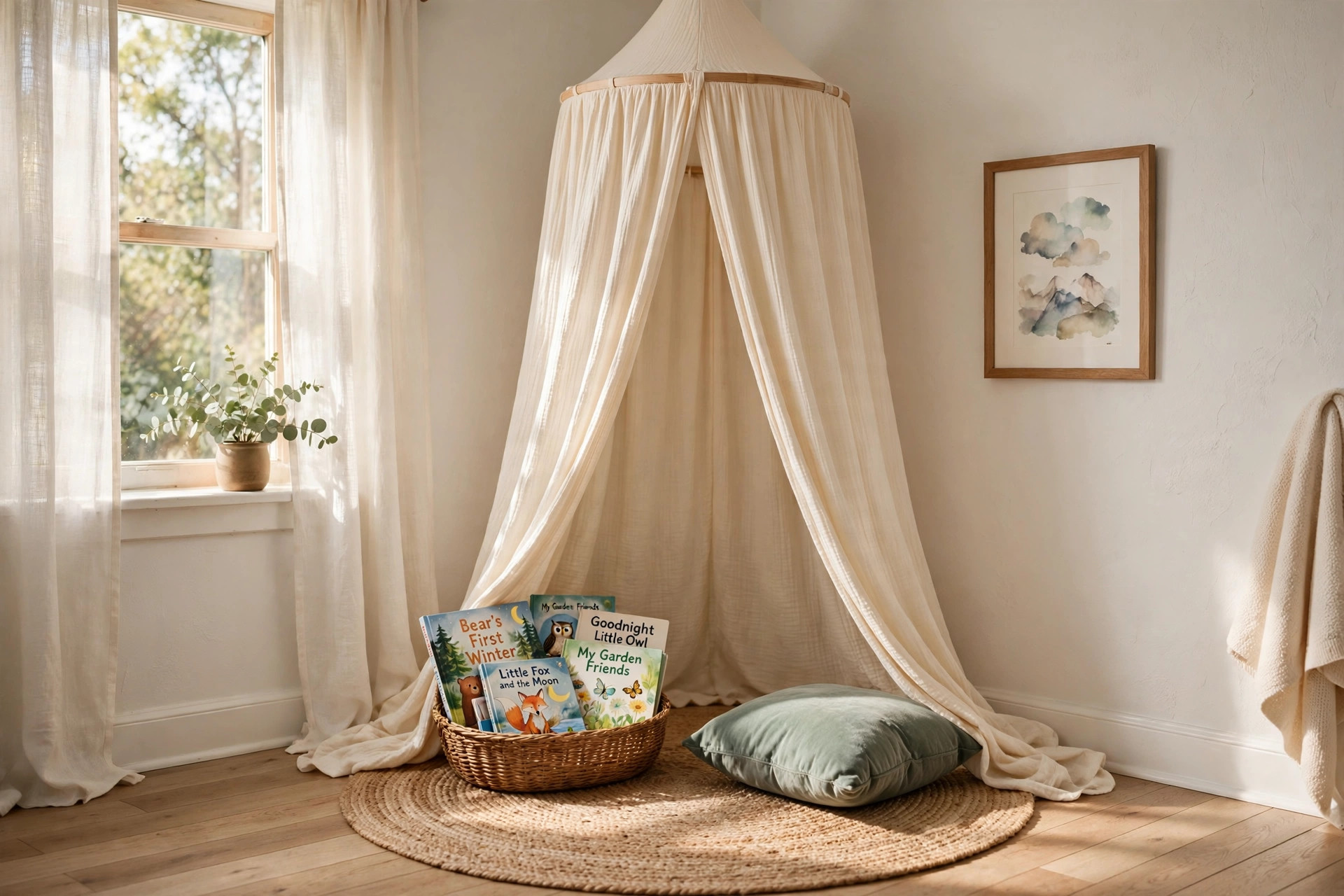

A toddler reading nook canopy tent for bedroom is one of the simplest ways to give a small child a place of his own. It is a light fabric canopy, hung over a corner or a small mat, that marks off a space just for books. Many parents set one up in the bedroom, where the child already feels safe. The tent does not need much room. It needs only a corner, a few books, and a soft place to sit.
Children at this age learn by habit. When the same small tent waits in the same corner each day, the child comes to know that tent means story time. That habit matters more than the price of the tent. A plain canopy with a floor cushion can do the job as well as a costly one, so long as the child finds it warm and easy to reach.
Why a Reading Nook Matters to a Toddler
A toddler’s world is full of noise. The house hums. Older brothers and sisters run past. The television talks in the next room. A reading nook gives the child a quiet place where one small voice can be heard, the voice of a parent reading a book.
The child crawls inside, and the world grows soft and small. The book becomes the main event.
The tent also teaches the child to be still. Toddlers are not known for sitting still. But a space made for sitting, with walls of soft fabric around it, invites calm. Many parents find that their child, who would not sit for a page on the living room floor, will sit for a whole book inside the tent.
There is a third reason. A reading nook belongs to the child. It is small. It fits a small person. In a house built for grown-ups, with tall tables and high shelves, the tent is made for a small body. He will bring his favorite books there. He may even bring his stuffed bear. The nook becomes his place, and that place builds his love of books.
How to Choose the Right Tent: Toddler Reading Nook Canopy Tent for Bedroom
Size and Shape
Measure the corner where the tent will stand before you buy anything. Most toddler canopy tents need a floor space of about three to four feet across.
Shape matters less than most people think. Round canopies hang from a single point on the ceiling and fall open like a cone. Teepee styles stand on poles and hold their shape well. Rectangular canopies with a hoop at the top give the most headroom and the clearest view inside, which some parents prefer so they can watch the child from across the room.
Fabric and Build
Light fabric is best. Cotton, muslin, and light canvas let air pass through and keep the inside from growing hot. Hold the fabric up to a light when you can. If light comes through, air will too. Avoid heavy canvas or lined fabrics that trap heat.
Check the seams. Turn the tent inside out in the store if you can, or read the return policy well when you buy online. Seams should lie flat and show no loose thread.
The hanging hardware deserves care. A tent that hangs from the ceiling needs a hook rated well above the weight of the tent, set into a beam or a stud. A tent that stands on poles needs poles of wood or strong plastic, never thin wire. If the tent uses long cords or strings, look for breakaway fasteners or keep the cords short and out of reach.
Color and Pattern
Toddlers respond to warm, simple colors. Solid pastels and soft prints, such as stars or small dots, work well inside a bedroom. Loud patterns with many colors can make the inside of a small tent feel busy, which works against the calm you want.
Some tents come with built-in pockets for books or small toys. These are useful and cut down on clutter.
Types of Canopy Tents You Will See
The shops offer many styles, and most fall into four groups.
The ceiling-hung canopy is the simplest. It is a ring or hoop with fabric hanging down, fixed to the ceiling by a short cord or chain. It opens at the front and drapes to the floor. These cost little, weigh almost nothing, and can be moved from room to room with ease. Their weakness is sway. An active toddler can set the whole tent swinging by pulling on the fabric.
The standing teepee needs no ceiling hardware. Four or five poles meet at the top, and fabric wraps around them. It stands firm and gives the child a sense of a real little house. It needs more floor space than a hung canopy, so look for poles with rounded or capped ends.
The pop-up tent folds flat and springs open. These are the cheapest of all and the easiest to store. Their frames are usually thin fiberglass or spring steel, which do not last long under daily use by a toddler. They serve well as a short-term answer or as a travel tent.
The reading arch or half-canopy hangs on the wall instead of the ceiling. It frames a corner like a small stage curtain. These leave the most floor space open, but they offer the least sense of being inside something, which is part of the charm for many children.
Most parents choose between the ceiling-hung canopy and the standing teepee. Either one, paired with a soft seat such as a kids bean bag chair for reading corner, makes a nook that a toddler will use every day. A standing teepee also pairs well with a kids teepee tent for indoor playroom decor if you want a matching look in the playroom.
What It Costs
A toddler reading nook canopy tent for bedroom costs less than most nursery furniture. Prices in the United States run in three bands.
The low band, about fifteen to thirty dollars, buys a simple muslin or polyester canopy or a basic pop-up tent. These work well and need no tools beyond a ceiling hook.
The middle band, about thirty to sixty dollars, buys thicker cotton fabric, finished seams, pole sets for teepees, and small extras such as tie-backs or book pockets. This is the band where most families find the best value. A forty-dollar teepee of good cotton will often last through two children.
The high band, about sixty to one hundred twenty dollars, buys designer prints and organic cotton. These are pretty and well made, but a toddler will not read better inside them. Buy at this level for the look of the room, not for the reading.
Watch for the hidden cost, which is the seat. The tent is only half the nook. Plan another fifteen to forty dollars for a floor cushion, a small bean bag, or a folded quilt, plus a small lamp or night light to complete the corner.
Setting It Up
Choose the corner first. The best spot is near the child’s bed but not blocking the door or the path to the bathroom. The child should be able to reach the nook on his own, without climbing over furniture. A corner near a window gives fine daylight, but keep the tent a foot or more from the glass and from any blind cords.
Hang or stand the tent next. For a ceiling-hung canopy, find a stud with a stud finder and drive the hook into it. Drywall alone will not hold. For a standing teepee, open the poles fully and check that each joint locks. Push on the frame from all sides. It should not fold or tip.
Lay down something soft, such as a round rug or a quilt folded double, and add the seat. Place a small basket with five to ten books inside. Fewer books, changed often, beat a tall stack that never moves.
Keep the front open. Toddlers should never be zipped or tied inside a tent. The open door lets air move and lets the child leave whenever he wants, which is what makes the nook feel safe instead of shut in. A best kids night light projector for bedroom can make the inside feel magical after dusk, though plain warm light is fine for reading.
Sit with the child the first few times. Read one short book inside the tent. Let the child arrange his cushions and choose which books live in the basket. After two or three such visits, most toddlers will start going to the nook on their own.
Care and Upkeep
Canopy tents are easy to keep clean if you follow a few plain rules.
Shake the tent out once a week. Crumbs and dust settle in the folds of fabric, and a good shake outside the door clears most of it. Wash the fabric as the maker directs, usually in cold water on a gentle cycle, and hang it to dry. A dryer can shrink cotton and melt thin polyester, so air drying is the safer course.
Check the hardware each month. Tighten the ceiling hook if it has worked loose. Look at pole joints for cracks. Feel along the hanging cord for fraying. Toddlers pull, swing, and lean on these tents every day, and a small fault caught early never becomes a big one.
Keep food and drink out of the nook. This one rule will save you most of the washing. A sippy cup of milk spilled inside a tent means a full wash and a day of drying. Rotate the books every week or two. Library books are ideal for this, since they cost nothing and come home in a steady stream.
Safety Comes First
A reading nook should be the safest corner of the room, and a little care makes it so.
Anchor everything that can tip. A standing teepee should be wide enough at the base that a toddler leaning on one side cannot topple it; if it can tip, brace it against the wall. A ceiling-hung canopy should hang from a hook set in a stud, and the cord should be short. Long cords and strings are a strangulation hazard for small children, so keep them high, short, or fitted with breakaway clips. The Consumer Product Safety Commission offers plain guidance on cord safety around children, and it is worth a read before you hang anything in a toddler’s room.
Mind the air and the small parts. The tent must breathe, so choose light fabric, keep the front open, and never cover the tent with extra blankets. A toddler should never sleep overnight inside a closed play tent. Pull on every finial, bead, and button when the tent is new; if one moves, remove it.
Keep the tent away from heat. Do not place it near a radiator, a space heater, or a hot lamp. A cool LED night light is the safe choice for evening reading.
Finally, stay within earshot. A reading nook is not a babysitter. The child may play alone in the tent, but a grown-up should be close enough to hear and to check in.
Parents who want more background on safe sleep and play spaces for small children can find steady, plain advice from the American Academy of Pediatrics through its HealthyChildren site, which covers room setup for toddlers in clear terms.
Frequently Asked Questions
At what age can a toddler use a reading nook tent?
Most children are ready between eighteen months and two years, when they can walk in and out on their own. The real test is whether the child can enter and leave the tent freely. If he can, he is old enough.
Will the tent fit in a small bedroom?
Yes, in most cases. A corner tent needs about three feet of floor space across, which is less than a small dresser. Measure your corner before you shop, and you will know at once what fits.
Should I hang the canopy from the ceiling or buy a standing tent?
Either works. A hung canopy costs less and needs less floor space, but it sways when pulled. A standing teepee holds its shape and feels more like a little house, but it needs more room. Renters often prefer standing tents because they need no holes in the ceiling.
How do I keep the toddler from pulling the tent down?
Set the tent up firmly, with the hook in a stud or the poles fully locked. Then show the child how the tent works. Children pull less on things they understand. If the child is in a climbing phase, a low standing teepee braced in a corner is the sturdiest choice.
Can the nook double as a sleep space?
No. A reading nook is for reading and quiet play, not for sleep. Toddlers should sleep in a crib or bed with a firm, flat surface. Keep naps and nights in the bed, and keep the tent for stories.
How many books should I keep in the nook?
Five to ten is plenty. A small basket that the child can carry is better than a shelf he cannot reach. Change the books every week or two to keep his interest fresh.
A Final Word
A toddler reading nook canopy tent for bedroom asks little and gives much. It asks for a corner, a hook or a set of poles, and a few books. It gives the child a place of his own, a daily habit of stories, and a quiet corner in a loud house. Set it up with care, keep it safe, and sit inside it with your child. The tent will wear out in time, as all things do. The habit of reading that grows inside it will last far longer.
For more background, see The Spruce, What to Expect, and IKEA. Buying guides are also published by Wayfair and Pottery Barn Kids. See also Target for further detail.
References
American Academy of Pediatrics. (n.d.). HealthyChildren.org. https://www.healthychildren.org IKEA. (n.d.). Home furnishings. https://www.ikea.com Pottery Barn Kids. (n.d.). Kids furniture and decor. https://www.potterybarnkids.com Target. (n.d.). Retail store. https://www.target.com The Spruce. (n.d.). Home and garden advice. https://www.thespruce.com U.S. Consumer Product Safety Commission. (n.d.). Product safety information. https://www.cpsc.gov Wayfair. (n.d.). Furniture and home goods. https://www.wayfair.com What to Expect. (n.d.). Pregnancy and parenting guidance. https://www.whattoexpect.com
Was this guide helpful?

About Robert Taylor
The My Garden US editorial team writes practical, in-depth home and garden guides for American homeowners — tested advice, no fluff.
You May Also Like
The Best Nursery Dresser for a Small Baby Room
June 25, 2026 0 views
Crib Mattress Protector Waterproof Breathable: The Complete Parent Guide
September 28, 2026 0 views
Crib Sheet Saver for Quick Diaper Changes: A Parent Guide
June 29, 2026 0 views