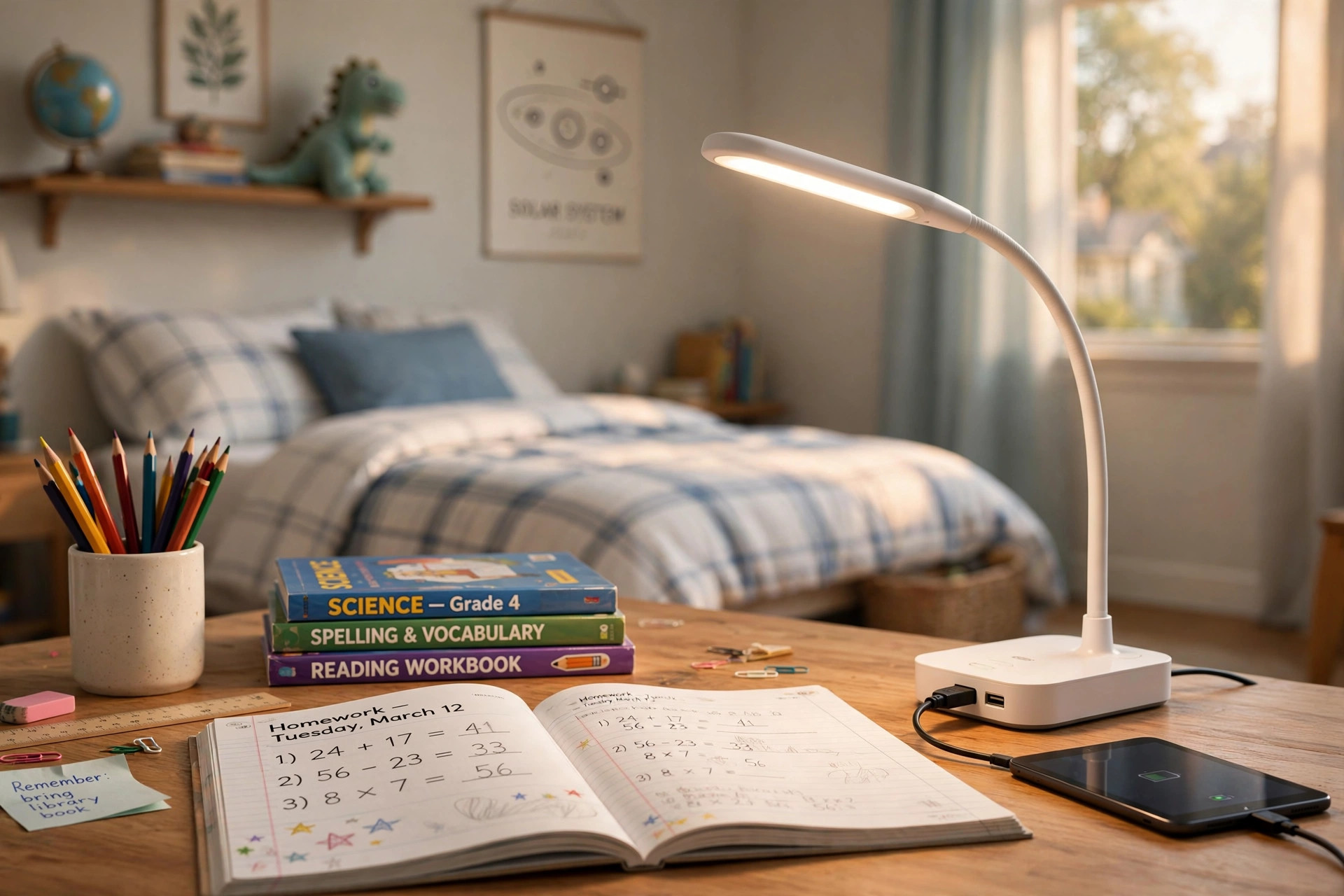

A kids desk lamp with usb port for homework can change the way a child studies at home. Good light makes reading easier. It cuts down on eye strain. It helps a child sit up straight and focus on the work in front of them. A lamp with a built-in USB port adds one more useful feature. It gives the child a place to charge a small tablet, a phone, or a reading device while homework gets done. No more tangled cords running across the room to a wall outlet.
Many parents shop for a kids study lamp after school work is done. Some lamps are tall and bend in the middle. Some are small and clamp to the edge of a desk. Some glow warm and soft, while others shine bright white. This guide walks through what matters, what to skip, and how to pick a children’s homework lamp that will last through several school years.
Why Good Desk Light Matters for Homework
Children spend many hours each week reading, writing, and drawing at their desks. When the light is poor, the body pays a price. Eyes work harder. The neck bends closer to the page. Headaches can follow. A steady pool of light on the desk removes these small strains before they start.
A lamp made for kids should light the work area, not the whole room. Overhead room lights often leave shadows right where the child reads. A desk lamp sits close and fills that gap. The best lamps let the child aim the light where it is needed without glare in the eyes.
There is another quiet benefit. A small lamp marks the study space. When the lamp goes on, the mind knows it is time to work. Many teachers and parents at HealthyChildren.org note that a steady homework routine helps children settle into their tasks. A lamp that belongs to the child, on the child’s desk, is part of that routine.
What to Look for When You Choose: Kids Desk Lamp with Usb Port for Homework
Light Quality and Brightness
Brightness is measured in lumens. For homework, about 400 to 800 lumens is usually enough for one desk. The light should be even, with no dark spots on the page. Many LED desk lamp models for kids use a ring or bar of small lights that spread the glow wide.
Color temperature matters too. It is measured in kelvins, marked with a K. Warm light near 2700K is easy on the eyes in the evening. Neutral light near 4000K looks like daylight and suits reading and writing. Cool light near 5000K or above can feel harsh for a young child. A lamp with three or four settings lets the child pick what feels best. Reviews at Consumer Reports note that adjustable color is one of the most used features on modern lamps.
Flicker is worth checking. Cheap lamps may flicker in a way the eye cannot quite see, but the brain still notices. The result is tired eyes after an hour of homework. Quality LED lamps are built to run steady. If a lamp hums or the light shimmers, pass it by.
The USB Port
The USB port is the feature that sets this lamp apart from a plain desk lamp. Most models place the port on the base or on the back. The child plugs in a cable, and the small device charges while homework continues.
A few points matter here. Look at the power rating. A standard 5-volt port at 1 to 2.1 amps will charge a phone or small tablet at a normal pace. Also confirm that the lamp still shines at full strength while something charges. On well-made lamps it does.
Size, Shape, and Flexibility
A child’s desk is often small. The lamp should fit without crowding out books, a pencil box, and a water bottle. Clamp-style lamps save the most space. They grip the back edge of the desk and swing out over the work. Base-style lamps need a corner of the desk but are easier to move from room to room.
The neck should bend and hold its place. A gooseneck arm is the classic choice. It curves wherever the child points it and stays put. Some lamps use two hinged arms like a drafting lamp. These give fine control but add joints that can wear out. For younger children, fewer moving parts is better.
Height matters for a simple reason. Light that sits too low throws long shadows from the child’s hand. Light that sits too high spills into the child’s eyes.
Kid-Friendly Design
A lamp for a child should be hard to tip over. A wide, weighted base is the first line of defense. Touch controls are a nice touch. Many lamps change brightness with a tap on the base. No small switches to break, no knobs to lose.
Rounded edges are safer than sharp corners. Cool-to-touch lamp heads are safer than hot bulbs. LED lamps run far cooler than the old halogen desk lamps of the past. The ENERGY STAR program notes that LED lighting uses far less power than older bulbs and stays cool in normal use, which suits a child’s room.
Style counts with children too. A lamp in a fun color or shape gets used. A dull lamp gets pushed aside. Let the child pick between two or three safe choices.
Common Types of Kids Desk Lamps with USB Ports
Gooseneck base lamps. The most common type. A solid base, a bendable neck, a lamp head with LEDs. Simple, sturdy, and priced for most budgets. These suit ages five and up.
Clip-on lamps. These clamp to a shelf, a bed rail, or the desk edge. They are light and easy to move. They suit small desks and bunk beds. The clip must be strong enough to hold through daily bumps.
Two-arm drafting lamps. These give precise aim with spring or friction joints. They cost more and suit older children, roughly ten and up, who can adjust the joints with care.
Ring and bar lamps. These spread light in a wide, even sheet. They are popular for art homework and crafts because the whole page glows at once. Many include a USB port on the base as a standard feature.
Novelty lamps. Shaped like animals, rockets, or flowers, these appeal to younger children. Check the basics first: steady light, safe materials, a real USB port with listed power ratings. A cute shape is no excuse for poor light. Large retailers such as Pottery Barn Kids and Wayfair show full specs on their listings, so parents can compare brightness and USB ratings side by side.
Cost and Price
Prices for a kids desk lamp with usb port for homework vary more than many parents expect. A basic LED model with a single brightness level and a simple USB charging port often sells between 15 and 30 dollars. These do the job for a young child’s desk.
A mid-range lamp, between 30 and 60 dollars, usually adds three or four brightness levels, two or three color temperatures, touch controls, and a sturdier neck. This is the sweet spot for most families. The lamp will serve from early grades through middle school.
Premium models run 60 to 120 dollars or more. They may add an auto-off timer, a motion sensor, or wireless charging pads built into the base. These extras are pleasant but not required.
One cost that hides in plain sight is the bulb. LED lamps with built-in light panels never need a new bulb. Lamps that take replaceable bulbs will need new ones every few years. Over the life of the lamp, the sealed LED design usually costs less. Bargain lamps under 12 dollars often cut corners on the light panel or the USB port. Reviews on The Spruce and Lamps Plus can help spot which low-cost models still hold up.
Care and Upkeep
An LED desk lamp asks for little care, but a few habits keep it working well for years.
Dust the light panel once a month with a dry, soft cloth. Dust dims the output more than most people guess. A quick wipe brings the brightness back. Never use water or spray cleaners on the panel or the touch controls.
Check the cord twice a year. Look for kinks, cracks, or places where the cord meets the plug. A damaged cord is the main reason to retire a lamp. Unplug the lamp before you move it across the room. Pull the plug, not the cord.
Keep the USB port clean. Dust and crumbs find their way into open ports. A gentle puff of air clears them out. If a cable fits loosely, try a new cable first, since cheap cables wear faster than the port itself.
Teach the child to turn the lamp off when homework is done. The habit saves power and teaches care of one’s things. A lamp with an auto-off timer handles this on its own if the family prefers.
Safety
A child’s desk lamp should be safe first and stylish second. The rules are simple and worth following.
Buy lamps that carry a safety mark from a known testing lab, such as UL or ETL. The mark is usually on the plug or on a sticker under the base. It shows the lamp passed basic electrical safety tests.
Keep cords out of walkways and away from little siblings. Run the lamp cord behind the desk and secure it with a clip. The U.S. Consumer Product Safety Commission at cpsc.gov warns that loose cords are a strangulation and trip hazard for small children, so this step is not optional in a shared kids’ room.
Do not let the lamp hang over a bed pillow or a pile of papers. Even cool-running LEDs should have air around them. Keep liquids away. A water bottle that tips over onto a plugged-in lamp is a common accident.
Check the heat with your own hand after the lamp has run for an hour. The head should feel warm, not hot. If it is too hot to touch, stop using it and contact the maker. Age-by-age safety checklists at What to Expect also cover the home study area.
Setting Up the Homework Station
The lamp works best as part of a tidy setup. Place the desk near a wall so the lamp can sit in the back corner. If the child is right-handed, put the lamp on the left side. If left-handed, put it on the right. This keeps the writing hand from casting a shadow over the words.
Pair the lamp with the rest of the room. A kids toy organizer with labeled bins keeps clutter off the desk, which lets the light reach the work. A kids bookshelf with toy bins combo unit gives books a home nearby so the desk stays clear. Even kids wall art canvas prints for girls room can mark the study corner as the child’s own space, which encourages regular use.
Set a routine. Lamp on, device on the charger plugged into the lamp’s USB port, books open. When the routine repeats each day, homework starts with less argument.
Frequently Asked Questions
Is a USB port on a kids lamp safe? Yes, when the lamp carries a UL or ETL safety mark and is used as directed. The port delivers low-voltage power, the same kind a wall phone charger gives. Keep the port dry, and unplug the lamp during storms.
What brightness is best for homework? For most children, 400 to 800 lumens at a neutral or warm color is right. The child should be able to read small print without squinting and without the page looking washed out. Adjustable brightness lets each child find their own comfort level.
Can the lamp charge a tablet and light the desk at the same time? On a well-made lamp, yes. The light circuit and the USB circuit run separately. If the light dims when you plug something in, consider a different model.
What age is right for a desk lamp with a USB port? Children around five or six can use one with a parent’s help setting it up. By age eight or nine, most children handle the lamp on their own. For toddlers, keep any lamp out of reach.
LED or replaceable bulb: which is better for kids? Sealed LED panels are the better pick for most families. They run cool, they never need a bulb change, and they sip power. Replaceable-bulb lamps give more choice of bulb style but add a part to buy and a hot surface to avoid.
How long should a kids desk lamp last? A quality LED lamp should give five to ten years of daily homework use. The neck joints and the USB port usually wear before the light panel does. Buying from a maker with a real warranty, often two years or more, is good insurance.
A Final Word
A kids desk lamp with usb port for homework is a small purchase with a daily payoff. It gives a child clear, kind light for reading and writing. It keeps a device charging within reach instead of across the room. It marks a corner of the home as the place where learning happens.
Choose steady light over fancy features. Choose a safety mark over a low price. Choose a lamp the child likes enough to use every day. With those three choices made well, the lamp will quietly do its job through spelling lists, book reports, and science projects for years to come.
References
American Academy of Pediatrics. (n.d.). HealthyChildren.org. https://www.healthychildren.org Consumer Reports. (n.d.). Product reviews and ratings. https://www.consumerreports.org ENERGY STAR. (n.d.). Energy efficient products. https://www.energystar.gov Lamps Plus. (n.d.). Lighting and home decor. https://www.lampsplus.com Pottery Barn Kids. (n.d.). Kids furniture and decor. https://www.potterybarnkids.com The Spruce. (n.d.). Home and garden advice. https://www.thespruce.com U.S. Consumer Product Safety Commission. (n.d.). Product safety information. https://www.cpsc.gov Wayfair. (n.d.). Furniture and home goods. https://www.wayfair.com What to Expect. (n.d.). Pregnancy and parenting guidance. https://www.whattoexpect.com
Was this guide helpful?

About Michael Thompson
The My Garden US editorial team writes practical, in-depth home and garden guides for American homeowners — tested advice, no fluff.
You May Also Like
Crib Rail Cover for Teething Protection Padded: A Parent’s Guide
September 14, 2026 0 views
Best Bunk Bed With Stairs for Kids Room: A Parent’s Buying Guide
July 24, 2026 0 views
Nursery Chandelier for Baby Girl Room Decor: A Plain Guide to Choosing the Right Light
May 4, 2026 0 views