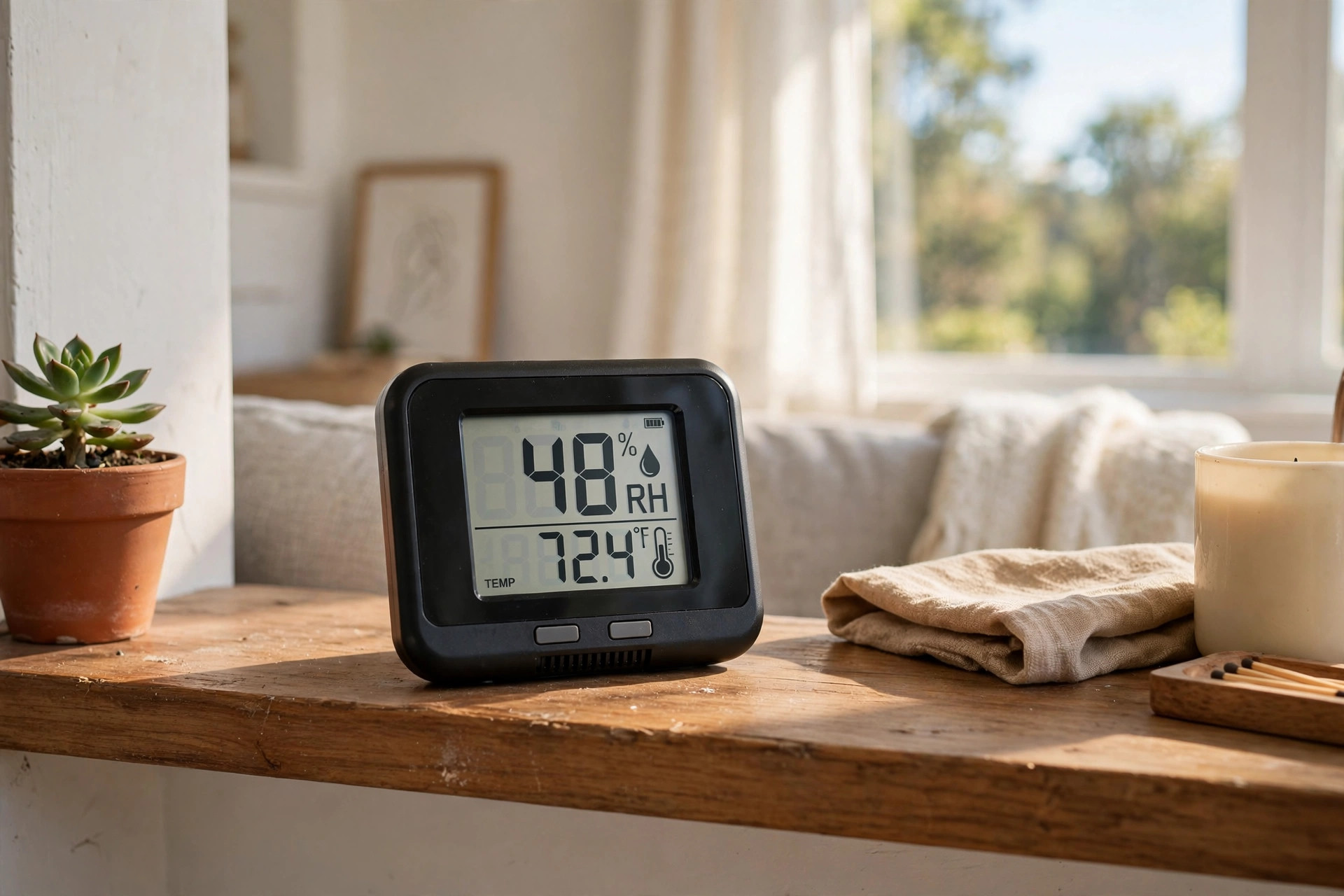

Air holds water. In every room of your house, the air carries a certain amount of moisture. Too much moisture can feed mold. Too little can dry your skin and crack wood floors. A hygrometer is a small tool that measures the moisture in the air. This guide to the best hygrometer for home reviews 2026 USA will help you pick a model that fits your home, your heating system, and your budget.
Why Indoor Humidity Matters
Most homes feel best when indoor humidity sits between 30 and 50 percent. The United States Environmental Protection Agency has long advised homeowners to keep indoor humidity in that range. When levels rise above 60 percent, dust mites thrive and mold can start to grow. When levels fall below 30 percent, wood can shrink, paint can crack, and people can wake with dry throats and itchy skin.
Heating and cooling equipment changes indoor humidity all the time. Furnaces dry winter air. Air conditioners pull moisture out in summer. Heat pumps move air in ways that can leave rooms too dry or too damp. A hygrometer gives you a number you can act on instead of a guess. If the reading is low, you know to run a humidifier. If it is high, you know to check ventilation or run a dehumidifier. Without a reading, you are working blind.
People with asthma and allergies gain the most from steady readings. Doctors often advise patients to watch indoor humidity because mold and dust mites grow worse in damp air. A small meter on a bedroom shelf can tell you more than a guess ever could. Even homeowners with no health concerns use hygrometers to protect hardwood floors, pianos, and wooden furniture from the stress of swings in moisture.
What to Look for in a Home Hygrometer: Best Hygrometer for Home Reviews 2026 Usa
Accuracy comes first. Most home models read within 2 to 5 percent of the true value. A meter that is off by more than that is little use. Look for a stated accuracy of plus or minus 2 or 3 percent in the 20 to 80 percent range, which covers normal home conditions. Some units allow you to adjust the reading after comparing it with a known value. That feature, called calibration, is worth having.
Digital vs. Analog Models
Digital hygrometers are the common choice today. They use electronic sensors and show the reading on a small screen. Most also show the temperature. Many record the highest and lowest readings over the past day. They run on small batteries and cost little. Analog hygrometers use a coil or a strand of hair that moves a needle on a dial. They need no batteries and can look fine on a wall, but they drift over time and are harder to read with care. For most homes, a digital model gives the better value.
Response time matters more than many buyers think. A cheap sensor may take half an hour to settle after you move it to a new room. A good one steadies within ten minutes. If you plan to carry one meter from room to room, a fast sensor saves time and doubt.
Other features are worth a look. A backlit screen helps at night. Memory for high and low readings helps you spot patterns. An alarm that sounds when humidity passes a set point can warn you of a leak or a failing humidifier. Wireless models send readings to your phone, which is handy if you want to watch a basement or a crawl space from upstairs. None of these extras are required, but each has its place.
Main Types of Hygrometers for Home Use
Tabletop digital models are the simplest. You set one on a shelf or a nightstand and read the screen. They cost the least and suit a single room. Wall-mount models hang like a small clock. They fit hallways, laundry rooms, and basements where a shelf is not handy.
Probe models have a sensor on a wire. You set the meter outside a terrarium, a humidor, or a gun safe and drop the thin probe inside. They suit hobbyists and anyone who wants to watch a closed space without opening it. Wireless sensor sets place small senders in several rooms and show all readings on one base station. They cost more, but they beat buying four separate meters.
Smart hygrometers connect to a home network. They log readings over weeks and show charts on a phone. Some link with smart thermostats so the heating system can react to damp air. If you already own a smart thermostat, a smart hygrometer can fit well into the same setup. For a simple bedroom check, though, a plain digital meter is enough. Reviews from This Old House often note that the plain models win on ease of use.
How to Choose the Right Hygrometer
Start with the room you care about most. A bedroom needs a meter with a dark or dim screen so the light does not disturb sleep. A basement needs a model with memory for high readings, since damp often strikes when you are not there. A nursery or a sick room may need an alarm that warns when air grows too dry.
Match the meter to your heating and cooling setup. Homes with forced-air heat often run dry in winter. If you are shopping for the best whole house humidifier reviews 2026 usa to fix dry winter air, a hygrometer tells you whether the humidifier is doing its job. Homes with heat pumps can swing between damp and dry as the weather shifts. Our guide to the best thermostat for heat pump reviews usa covers controls that pair well with humidity readings.
Think about how many rooms you want to watch. One meter moved from room to room works for a first check, but humidity can differ a lot between floors. A wireless set with three or four sensors gives a truer picture of the whole house. Manufacturers such as Trane and Carrier advise homeowners to check conditions in each part of the home, since ductwork and insulation vary by zone.
Read the accuracy statement on the box or the listing. Skip any model that does not state one. Check whether the unit can be calibrated. A meter you can adjust is worth more than one you cannot, because all sensors drift with age. Advice from the U.S. Department of Energy on indoor air quality stresses steady, measured control over guesswork, and a calibrated meter is the start of that control.
Cost and Price
Home hygrometers are among the cheapest tools a homeowner can buy. A basic digital tabletop model often costs between 10 and 20 dollars. It will show humidity and temperature with fair accuracy and suit most rooms. Mid-range models with memory, alarms, and backlit screens run from 20 to 40 dollars. Wireless multi-sensor sets run from 40 to 100 dollars depending on how many sensors come in the box.
Smart models with phone apps and long-term logging sit at the top of the home range, often from 50 to 120 dollars. Prices rise with sensor count and brand name rather than with basic accuracy. A 15-dollar meter from a known maker can read as true as a 60-dollar one. The extra money buys range, logging, and ease, not a truer number.
Batteries add a small running cost. Most meters use one or two AAA batteries and run for a year or more. Some use small coin cells. Factor in a pack of spare batteries when you buy. ENERGY STAR notes that small monitoring tools pay for themselves when they help heating and cooling equipment run at the right setting, and a hygrometer is a good example.
Care and Upkeep
Keep the sensor clean. Dust on the sensor slows the reading and can shift it. Wipe the case with a dry cloth. Never spray cleaner into the vents or the sensor opening. Keep the meter away from direct sun, heating vents, and steamy bathrooms, because heat and steam skew the reading.
Check accuracy once a year. The salt test is the common home method. Put the meter in a sealed bag with a bottle cap of damp salt for eight to twelve hours. Table salt in a sealed space holds the air near 75 percent humidity. If your meter reads far from 75, use its calibration control to adjust, or note the gap and add it in your head. Guides at Family Handyman walk through the same test for home sensors.
Change batteries when the screen dims or the reading freezes. A weak battery can make a digital sensor read wrong long before the screen goes blank. Store spare meters in a dry place. If you keep a meter in an unheated garage over winter, bring it inside a day before you trust its readings, since cold can throw sensors off.
Safety
Hygrometers are safe tools with few risks. They use low-voltage batteries and hold no heat. Still, follow a few plain rules. Keep coin-cell models out of reach of small children, since swallowed button batteries are a serious hazard. The U.S. Consumer Product Safety Commission warns parents about button batteries in many small home devices.
Do not place a meter where it can fall into water. Bathroom counters near sinks are fine, but keep the unit clear of the tub edge. If you use a probe model in a fish tank or a sump pit, keep the meter body dry and check the wire for cracks each year. Makers such as Lennox and Goodman remind homeowners that any device near HVAC equipment should sit clear of moving parts and electrical panels.
Mold safety matters too. A hygrometer may reveal that a basement or crawl space runs damp enough to grow mold. Do not scrub large mold patches yourself. The common advice from health agencies is to call a professional for any patch bigger than about ten square feet. Use the meter to find the problem; use a pro to fix a big one.
Frequently Asked Questions
Where should I place a hygrometer in my home? Put it where you spend time, at about chest height, away from windows, doors, vents, and direct sun. Bedrooms and living rooms are the usual first spots. Basements and attics are good second spots because trouble often starts there.
What is the ideal indoor humidity level? Most guidance points to 30 to 50 percent. Many homeowners aim for 40 to 45 percent as a sweet spot. Below 30 percent, dry air can irritate skin and throats. Above 50 percent, dust mites and mold find better footing.
How often should I check the reading? Glance at it daily in the first week after you set it up. After that, a weekly check is enough unless you are running a humidifier or fighting a damp spell. Models with high and low memory make weekly checks easy, since the extremes are stored for you.
Do I need one hygrometer per room? One meter gives you a start, but rooms can differ by 10 percent or more. Bedrooms, basements, and rooms with lots of plants deserve their own readings. If you pair humidity control with room units, our guide to the best portable humidifier for bedroom usa can help you size a unit for one room at a time.
Can a hygrometer help lower my energy bills? Yes, in an indirect way. Damp air feels warmer than dry air at the same temperature. If your meter shows that winter air is too dry, adding moisture lets you set the thermostat a degree or two lower and feel just as warm. Rheem and other equipment makers note that balanced humidity lets heating and cooling systems work with less strain.
How long do home hygrometers last? A good digital model often lasts five to ten years. Sensors drift with age, so yearly checks with the salt test keep readings honest. When a meter can no longer hold calibration, replace it. At these prices, replacement beats repair.
A Final Word
A hygrometer is a small buy with a large payoff. It turns a feeling about the air into a number you can trust. Pick a digital model with stated accuracy, place it with care, and check it through the seasons. Whether you heat with a furnace, a heat pump, or a mini split, the reading will tell you when to add moisture and when to take it away. Your skin, your floors, and your heating bill will all be better for it.
References
Carrier. (n.d.). Heating and cooling systems. https://www.carrier.com ENERGY STAR. (n.d.). Energy efficient products. https://www.energystar.gov Family Handyman. (n.d.). DIY home repair and maintenance. https://www.familyhandyman.com Goodman. (n.d.). Heating and cooling equipment. https://www.goodmanmfg.com Google Store. (n.d.). Smart home devices. https://store.google.com Lennox. (n.d.). Heating and cooling systems. https://www.lennox.com Rheem. (n.d.). Heating, cooling, and water heating. https://www.rheem.com This Old House. (n.d.). Home renovation guidance. https://www.thisoldhouse.com Trane. (n.d.). Heating and air conditioning. https://www.trane.com U.S. Consumer Product Safety Commission. (n.d.). Product safety information. https://www.cpsc.gov U.S. Department of Energy. (n.d.). Energy efficiency and renewable energy. https://www.energy.gov
Was this guide helpful?

About James Carter
The My Garden US editorial team writes practical, in-depth home and garden guides for American homeowners — tested advice, no fluff.
You May Also Like

Best Pool Heater for Cold Climates USA: How to Keep Your Water Warm All Season
June 13, 2026 0 views
UV Light for HVAC System Pros Cons USA: A Plain Guide
June 3, 2026 0 views
Geothermal Heating Pros and Cons USA Homeowners Should Know
August 23, 2026 0 views