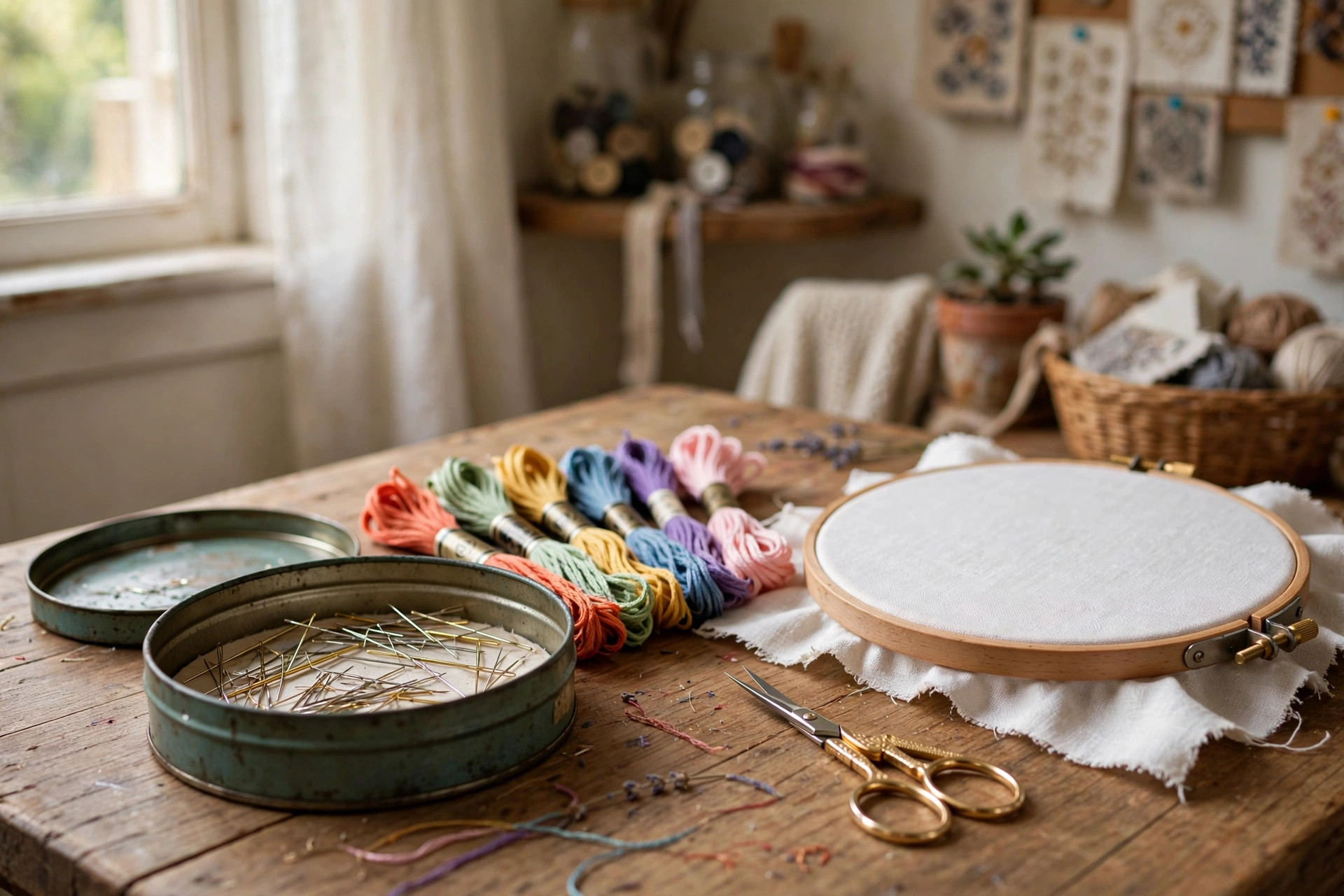

Every hand stitch begins with a single needle. The best embroidery needles set for hand sewing makes each stitch smooth, even, and pleasant. A poor needle, on the other hand, drags through the cloth, frays the thread, and tires the fingers. This guide will help you choose a set that suits your hands, your fabric, and your budget.
Why the Right Needles Matter
Embroidery is slow work. A skilled stitcher may put ten thousand stitches into a single piece. Each stitch passes the needle through cloth, so small flaws in the needle add up over time. A good needle glides. It keeps the thread whole. It leaves the fabric clean.
A poor needle pulls threads out of place. It can snap delicate floss or leave tiny holes in fine linen. For a beginner, a bad needle can make a simple craft feel hard. Many people blame their skill when the real fault lies in a dull or badly shaped needle. A quality set removes this hidden problem.
A set also gives you choice. Different fabrics and threads call for different needles. A set holds many sizes in one place, so you can match the needle to the job. This is far better than owning one needle and forcing it through every cloth you meet.
What to Look for When You Choose: Best Embroidery Needles Set for Hand Sewing
Size and Thickness
Needles carry numbers. In most embroidery systems, a smaller number means a thicker needle, and a larger number means a finer one. A size 1 needle is thick and long. A size 10 needle is fine and short. The thick needle suits heavy floss and coarse cloth. The fine needle suits silk thread and delicate fabric.
A set that runs from size 1 to size 10 covers nearly all hand sewing. Look at the range printed on the packet before you buy. Wide sets serve beginners well, because you can test each size and learn what feels right in your fingers.
The Eye
The eye of the needle is the hole at the top. Thread must pass through it with ease. A long, narrow eye is the mark of a true embroidery needle, sometimes called a crewel needle. The long eye lets thick floss slide in without bunching. A short, round eye is harder to thread and can wear the floss down as you work.
Hold a needle up to the light and look at the eye. A clean, smooth eye without rough edges is what you want. Cheap needles often have eyes with burrs. A burr is a tiny ridge of metal left by poor finishing. It will chew your thread into fuzz after a few dozen stitches. Quality sets avoid this fault.
The Point
Some needles end in a sharp point. Others end in a blunt or ball point. Sharp points pierce woven cloth with ease. Blunt points are made for open-weave fabrics like Aida cloth, where the needle must slip between threads rather than pierce them.
Most hand sewing for embroidery uses sharp needles. A set of sharp needles will serve most projects. If you plan to work on counted cross-stitch fabrics, add a blunt tapestry needle to your kit.
The Shaft
A good needle has a smooth, polished shaft. The polish lets it pass through cloth with little force. High-quality needles are often plated with nickel or gold. The plating resists rust and adds extra smoothness. Gold-plated needles also show up well against dark fabric, which helps tired eyes.
Test the shaft by running it gently across your cheek or the back of your hand. It should feel slick. If it drags or scratches, the finish is poor. Put such needles aside. They will only slow your work.
Types of Embroidery Needles
Not all needles suit embroidery. Here are the types you will meet in most sets.
Crewel needles. These are the workhorses of embroidery. They have a sharp point, a long eye, and a medium-length shaft. They suit cotton floss on linen, muslin, and most woven fabrics. A good set contains many crewel needles.
Tapestry needles. These have a blunt point and a long eye. They are used for cross-stitch, needlepoint, and any work on open-weave cloth. The blunt tip slips between fabric threads without splitting them.
Chenille needles. These are thicker, with a sharp point and a long eye. They suit heavy yarn, wool, and ribbon embroidery. They also work well on thick fabrics like denim and canvas.
Milliners needles. These are long and thin, with a small round eye. They suit knotted stitches, bullion knots, and French knots, because the shaft stays the same width from eye to point. The knot slides down the shaft without catching.
Sharps. These are short, fine sewing needles. Some stitchers prefer them for small detail work. A set may include a few for fine lines and outlines.
The best embroidery needles set for hand sewing usually blends crewel, tapestry, and chenille needles. This mix covers surface embroidery, counted work, and heavy-thread projects in one packet.
How to Match the Needle to Your Thread and Fabric
A simple rule serves well: the needle should be about the same thickness as the thread, and the hole it makes should close neatly behind it. A needle that is too thick leaves open holes. A needle that is too thin forces the thread through too tight a path and frays it.
Use this rough guide. Six strands of cotton floss on linen call for a size 3 or 4 crewel needle. Three strands call for a size 5 or 6. One strand calls for a size 8 or 9. Fine silk thread on batiste needs a size 10. Wool yarn on canvas needs a chenille size 18 or 20.
When you start a new project, stitch a small sample first. Try two or three needle sizes on scrap cloth. The right needle will feel smooth from the first stitch. Trust your fingers. They learn faster than any chart.
Cost and Price of a Set
Embroidery needles are one of the cheapest tools in the craft room. A basic set of twelve needles from a craft chain often costs one to three dollars. These work fine for a beginner testing the craft. A mid-range set from a known needle maker, with nickel or gold plating and fine finishing, costs three to eight dollars.
Handmade or specialty needles cost more. Japanese needle makers sell sets for eight to fifteen dollars. Gold-plated milliners needles and extra-long sizes may cost more still. The price buys smoother finish, sharper points, and eyes without burrs.
A beginner needs only one good set. It will last for months of daily stitching. Replace needles when they bend, rust, or grow dull. At these prices, there is no reason to stitch with a worn needle. For craft supplies of all kinds, the big craft chains such as Michaels and Joann carry full needle ranges, and art suppliers like Blick stock quality brands too. Online marketplaces such as Etsy are a fine source for handmade and vintage needle sets.
Do not buy the largest set you can find just because it is cheap. A hundred mixed needles of poor finish are worth less than twelve well-made ones. Quality matters more than count.
Care and Upkeep
Needles last long when you treat them well. Keep them in a dry place. A needle case or a pin cushion filled with emery powder will keep them clean and sharp. Emery is a fine grit that polishes metal. A few passes through an emery cushion will sharpen a dull point.
Wipe needles before you store them. Oils and salts from your skin can tarnish nickel plating over time. A soft cloth is enough. Never leave needles loose in a sewing box where they can bend against scissors or thimbles.
Rust is the main enemy. If a needle shows rust spots, throw it away. Rust will stain your fabric and weaken the metal. Stainless or well-plated needles resist rust, but damp rooms can harm any needle in time. A small packet of silica gel in your sewing box helps in humid climates.
Store needles sorted by type and size. Many sets come in a flat packet with printed size labels. Keep that packet. When you empty a set into a shared case, mark each size with a small piece of tape so you can tell them apart.
Safety
Needles are small and sharp, so a few habits will keep you and your household safe.
Keep needles counted. Know how many needles you took out and put them all back. A needle lost in a chair or a carpet is a real hazard. If you lose one, stop and search with a magnet before you move on.
Use a needle book or case. Never pin needles to your sleeve or hold them between your lips. A case with felt pages costs little and keeps points covered.
Keep needles away from children and pets. A needle on the floor is a danger to small feet and curious paws. Work at a table where needles cannot roll away, and put them up when you finish.
Mind your fingers. A thimble is cheap protection. Use one when you push needles through heavy cloth. Pull with the fingers, not with the teeth. Teeth crack under such strain, and old stitchers will tell you so.
Dispose of bent or broken needles safely. Wrap them in tape or push them into a small bottle before you throw them away. Loose points in a trash bag can prick through.
Safety rules are the same in every craft room. The hardware store sites such as Home Depot sell magnetic sweepers and organizers that also suit a sewing table, and home guides like This Old House and Family Handyman cover safe craft-room habits well. For repair and upkeep advice, Bob Vila keeps useful household guides too.
Where a Needle Set Fits in Your Craft Life
Embroidery needles pair well with many other crafts. If you enjoy making small gifts, a DIY keychain kit for resin and crafts gifts lets you add stitched tags or sewn fabric accents. A quiet afternoon project like a DIY terrarium kit for succulents and plants makes a fine companion hobby for days when your eyes need rest. And if you sell your finished pieces at a craft fair, a sublimation printer for a home craft business can print labels and packaging for your goods.
Frequently Asked Questions
How many needles should a beginner buy?
One set of twenty to thirty needles is plenty. You will use three or four sizes most of the time. The rest give you room to try new threads and fabrics. Buy one quality set rather than three cheap ones.
What size needle should I use for standard cotton floss?
For six strands of cotton floss on linen or muslin, use a size 3 or 4 crewel needle. For three strands, move to a size 5 or 6. For one strand, a size 8 or 9 feels best. These are starting points. Adjust to suit your hand.
How often should I replace an embroidery needle?
Replace a needle when it bends, loses its point, or starts to drag. For daily stitching, this may mean a new needle every few weeks. Needles are cheap. A fresh needle makes stitching more pleasant, so do not wait too long.
Can I use sewing needles for embroidery?
You can, but they are not ideal. Sewing needles have short, round eyes that are hard to thread with floss. Embroidery needles have long eyes that protect thick thread. For fine detail lines with one strand, a sharp sewing needle works fine.
Why does my thread keep fraying?
Fraying usually means the needle eye is too small or rough. Try a needle with a longer, smoother eye. A gold-plated needle can help, because the plating is extra slick. Also check that your thread is not too old. Old floss weakens and breaks no matter what needle you use.
Are gold-plated needles worth the extra cost?
For many stitchers, yes. Gold plating adds smoothness and resists rust. Gold needles also show up against dark fabric, which helps when the light is poor. They cost a few dollars more than plain nickel sets. If you stitch often, the comfort is worth it.
A Final Word
The best embroidery needles set for hand sewing is the one that fits your hands and your projects. Start with a quality mixed set of crewel, tapestry, and chenille needles. Match the needle to the thread. Keep your needles clean, dry, and counted. Replace them when they wear. These small habits will lift the quality of every piece you make, from your first sampler to your finest work.
References
Blick Art Materials. (n.d.). Art and craft supplies. https://www.dickblick.com Bob Vila. (n.d.). Home improvement advice. https://www.bobvila.com Etsy. (n.d.). Handmade and craft marketplace. https://www.etsy.com Family Handyman. (n.d.). DIY home repair and maintenance. https://www.familyhandyman.com JOANN. (n.d.). Fabric and craft supplies. https://www.joann.com Michaels. (n.d.). Arts and crafts supplies. https://www.michaels.com The Home Depot. (n.d.). Home improvement products. https://www.homedepot.com This Old House. (n.d.). Home renovation guidance. https://www.thisoldhouse.com
Was this guide helpful?

About David Wilson
The My Garden US editorial team writes practical, in-depth home and garden guides for American homeowners — tested advice, no fluff.
You May Also Like
Wood Craft Blanks for Painting and Signs: A Complete Guide
March 14, 2026 0 views
Embroidery Thread Set for Hand Stitching Crafts: A Full Guide
April 8, 2026 0 views
DIY Jewelry Box Kit for Woodworking Beginners: A Simple Guide
June 27, 2026 0 views