
Introduction
More people now work from home than ever before. Many of them work in a spare corner of a bedroom, a narrow alcove, or a small study that barely holds a chair. An ergonomic standing desk for small home office rooms can change how that space feels. It gives the body a choice: sit when you want to rest, stand when you want energy. In a room of eight or ten feet square, every inch of floor matters, and a desk that is too big will crowd out everything else. The right desk does the opposite. It keeps the room open, holds the work tools you need, and lets you move between sitting and standing without a fuss. This guide explains why a compact standing desk matters, what to look for, which types suit small rooms, what they cost, and how to keep them in good shape.
Why It Matters: Ergonomic Standing Desk for Small Home Office
The body was not made to sit all day
Long hours in one chair can stiffen the back, tighten the hips, and tire the eyes. A standing desk lets you change your posture through the day. You can stand for twenty minutes while reading a report, then sit back down for a long writing session. That small change breaks up the long stretch of stillness. For people with short commutes from the bedroom to the desk, the day can pass with almost no movement. A desk that rises and falls is a quiet reminder to move.
Small rooms need smart choices
In a large office, a desk can be wide and deep without harm. In a small home office, a desk that is too large leaves no room to turn, no space for a shelf, and no air in the room. A compact standing desk is made for this problem. Some are only thirty inches wide. Some fold against the wall. The goal is simple: keep the work surface big enough for a laptop, a notebook, and a cup, and keep everything else clear.
Work feels better with a view
Many small home offices sit in a corner with the desk facing the wall. A small standing desk can turn to face a window instead. Natural light lifts the mood and eases the eyes. Because these desks are small, they move easily, and you can try more than one layout before you settle.
How to Choose the Right Desk
Measure first
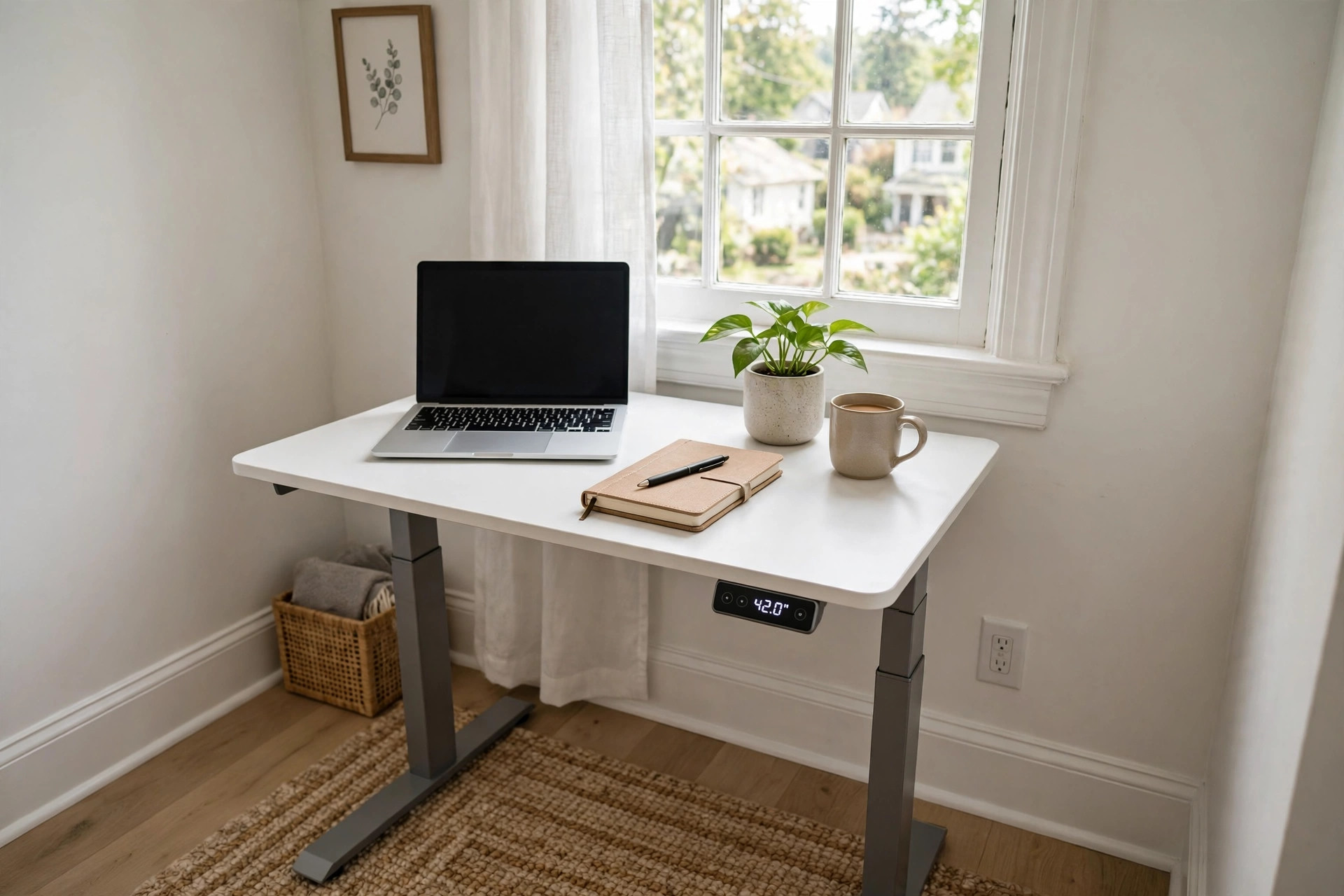
Start with a tape measure. Write down the width and depth of the space where the desk will go. Leave at least twenty inches behind the chair so you can push back. If the desk will sit in a corner, check both walls. A compact sit stand desk of forty by twenty-four inches is a common middle size, but smaller thirty-inch models suit very tight rooms. Bring the numbers with you when you shop.
Check the height range
Ergonomic means the desk fits your body, not the other way round. Look for a height range of about twenty-eight to forty-eight inches. The low end should let you sit with your elbows at ninety degrees. The high end should let you stand with your forearms flat on the desk. If two people will use the desk, a wide range matters more. Electric models often list the range on the spec sheet; read it before you buy.
Pick the lifting system
There are three main lifting systems. A manual crank desk raises by turning a handle. It costs less and needs no power, but the handle takes time. A gas spring or pneumatic desk rises with a squeeze of a lever. It is fast and quiet, and it needs no plug, but heavy monitors may be too much for it. An electric desk moves at the touch of a button and often has memory settings for two heights. It needs an outlet nearby, and it costs more. For a small home office, a pneumatic or small electric model is often the best match, because the compact size keeps the weight down.
Look at the work surface
The top should be strong, flat, and easy to clean. Laminate tops are light and wipe down well. Wood tops look warm but need more care. Check the edge: a rounded or beveled edge is kinder to the wrists than a sharp one. Some small desks add a cable tray under the top, which keeps cords off the floor and out of the way.
Think about stability
A desk that wobbles when you type will annoy you every day. Read reviews for words like steady, solid, and shake. Two-leg desks are common in small sizes and are fine if the feet are wide. Four-leg models stand firmer but take more floor space. If you add a monitor arm or heavy books, test the desk under load if you can.
Do not forget the chair
A standing desk does not mean you stand all day. Most experts suggest a mix: thirty minutes sitting, twenty minutes standing, or a ratio close to that. A good office chair still matters. Look at the ergonomic chair buying guide style of planning: match the desk to the chair so both suit your height. A footrest helps when standing for long stretches.
Types and Options for Tight Rooms
Corner standing desks
An L-shaped or corner desk fills the two walls where they meet. This turns dead corner space into real work space. Some corner models are split into two tops that rise together. Check that the corner section rises level with the rest, or you may get a tilt.
Wall-mounted fold-down desks
For the very smallest rooms, a wall-mounted desk folds up like a Murphy bed when work is done. Some fold-down models have a small standing option with a raised lip. These desks need a strong wall and proper anchors, so mount them into studs, not just drywall.
Compact electric desks
These look like normal desks but smaller, usually thirty to forty inches wide, with a quiet motor. Memory buttons let you save a sit height and a stand height. They are the closest thing to a full-size office desk for a small room. The motor adds weight, so moving the desk later is harder.
Standing desk converters
A converter sits on top of an existing table and raises only the work surface. It is the cheapest way to try standing work. In a small room, a converter on a simple table can work well, but it eats the table space and looks crowded. Converters suit short trial periods better than long-term use.
Desks with built-in storage
A few small standing desks add a drawer or a shelf under the top. Storage helps in small rooms where every drawer counts. A small standing desk with storage keeps pens, pads, and cables close without adding a separate cabinet. Pair it with a home office storage ottoman with lid for files you do not touch every day, and the room stays tidy.
Cost and Price
Prices vary with size, motor, and brand. Manual crank models for small spaces often sell between one hundred and two hundred dollars. Pneumatic models run from about two hundred to four hundred dollars. Compact electric desks usually cost between three hundred and six hundred dollars. Wall-mounted fold-down desks fall near one hundred to three hundred dollars, not counting the cost of mounting hardware.
What drives the price? The lifting system is the main factor. An electric motor and a strong frame cost more than a crank. Brand and warranty add cost too. A long warranty of five years or more is worth paying for, because a lifting column is hard to repair at home.
Set a budget before you shop. Write down the must-have features: size limit, height range, and lift type. If the price is too high, decide what to drop. A simple crank desk in the right size beats an electric desk that does not fit the room.
Watch for extra costs. Some desks need assembly, and the instructions can be long. Delivery fees apply to heavy models. If you plan to add a monitor arm, check the desk weight limit first, since small desks hold less than large ones.
Care and Upkeep
A standing desk is a simple machine, and simple care keeps it working for years. Dust the top weekly with a soft cloth. For laminate, a damp cloth and mild soap is enough. For wood, use a cleaner made for wood and dry it well.
Check the frame every few months. Tighten the bolts with the tool that came in the box. A loose bolt is the most common cause of wobble. If the desk has a motor, listen for new sounds. A smooth hum is normal; a grinding noise is a sign to call the maker.
Keep the lifting columns clean. Dust and pet hair can work into the mechanism. Wipe the columns with a dry cloth once a month. Do not spray cleaner into the motor housing.
Mind the cords. A standing desk moves up and down, and the cords must move with it. Use the cable tray or a cord sleeve so nothing hangs loose. Leave enough slack for the full height range. A cord that pulls tight at the top can damage the outlet or the desk.
Do not overload the desk. Every model has a weight limit, often between one hundred fifty and two hundred fifty pounds for small desks. Heavy printers belong on a separate stand. A best printer stand with storage for home office keeps the printer close without loading the desk. Rug care matters too: a home office rug to protect hardwood floors under the chair stops scratches as you roll and stand.
Safety
A moving desk has moving parts, and care is needed. Keep fingers away from the frame joints when the desk rises or falls. Teach children not to play with the controls. Electric desks often have an anti-collision sensor that stops the motor when it meets an obstacle; check that yours has it and that it works.
Place the desk on a level floor. A desk that leans can tip when raised. If the floor is uneven, use the adjustable feet that come with the desk. Keep the area under the desk clear of bags, boxes, and toys so the desk can lower fully.
Wall-mounted desks need proper anchors in studs. A desk that pulls from the wall can fall and hurt someone. If you are not sure about the wall, ask a professional to mount it. Electric desks should plug into a grounded outlet, and the cord should run where no one trips on it.
Frequently Asked Questions
Is a standing desk good for a small home office?
Yes. A small home office is where a compact standing desk helps most. It gives the same sit-stand choice as a large office desk while fitting a tight corner or a narrow wall. Measure the space first and pick a desk that leaves room to move.
How much room does a standing desk need?
A compact model needs about thirty to forty inches of wall width and twenty-four inches of depth. Leave twenty inches behind the chair. For an adjustable height desk for tiny room layouts, thirty-inch-wide models are the smallest common size.
Should I sit or stand more?
Most experts suggest a mix. A common pattern is twenty to thirty minutes of sitting followed by fifteen to twenty minutes of standing, repeated through the day. Listen to your body. Sore feet or a tired back mean it is time to change position.
Do electric standing desks use much power?
No. The motor runs for only a few seconds at a time and draws little power. Over a year, the cost is a few dollars at most. The main need is an outlet close to the desk.
Can I put a monitor arm on a small standing desk?
Often yes, but check the weight limit and the clamp depth first. A monitor arm saves space on the top and puts the screen at eye level. For very small desks, a single-arm model suits a single monitor best.
How long should a standing desk last?
A good desk lasts seven to ten years with basic care. Electric models may need a new motor or control box after five years of heavy use. A strong warranty is a good sign of a long-lived desk.
A Short Final Word
An ergonomic standing desk for small home office rooms is a small change that pays off every workday. It asks little: a few square feet, a little power if you choose electric, and a few minutes of care now and then. In return it gives movement, comfort, and a room that feels larger than it is. Measure the space, pick a lift type that suits your habits, and set the heights to fit your body. The desk will do the rest.
For more background, see IKEA, Wayfair, and Herman Miller. For more background, see Steelcase, UPLIFT Desk, and The Spruce. Buying guides are also published by Wirecutter and PCMag.
References
Herman Miller. (n.d.). Office furniture and ergonomic seating. https://www.hermanmiller.com IKEA. (n.d.). Home furnishings. https://www.ikea.com PCMag. (n.d.). Technology product reviews. https://www.pcmag.com Steelcase. (n.d.). Office furniture and workplace research. https://www.steelcase.com The Spruce. (n.d.). Home and garden advice. https://www.thespruce.com UPLIFT Desk. (n.d.). Standing desks and ergonomic office furniture. https://www.uplift-desk.com Wayfair. (n.d.). Furniture and home goods. https://www.wayfair.com Wirecutter. (n.d.). Product reviews from The New York Times. https://www.nytimes.com/wirecutter
Was this guide helpful?

About James Carter
The My Garden US editorial team writes practical, in-depth home and garden guides for American homeowners — tested advice, no fluff.
You May Also Like
Ergonomic Keyboard Tray for Corner Desk Setup: A Complete Guide
April 6, 2026 0 views
Rolling Standing Desk With Locking Wheels: A Practical Guide for the Home Office
January 13, 2026 0 views
Best Whiteboard Calendar for Home Office Wall
July 27, 2026 0 views